War · Myanmar · Rakhine & Chin
Myanmar junta airstrikes kill civilians in a pattern that has become the signature of this war: four days of bombing across Paletwa in Chin State and Kyauktaw, Thandwe and Ponnagyun in Rakhine State left at least 14 people dead and 28 injured between November 14 and 17, according to the Arakan Army and local media — beginning with a single night in Paletwa that killed 12 displaced people, among them a woman five months pregnant and a child aged three.
PALETWA, Myanmar, November 18, 2026 — Myanmar junta airstrikes kill civilians in western Myanmar in a four-day wave that the Arakan Army (AA) says left at least 14 people dead and 28 injured across four townships in Chin and Rakhine states between November 14 and 17. The figures come from the AA, the armed group that controls most of the territory struck, as reported by the Democratic Voice of Burma (DVB) and corroborated in outline by the Border News Agency (BNA), Narinjara and the Global Arakan Network. They cannot be independently verified: Rakhine and southern Chin are closed conflict zones, cut off from outside journalists and largely from the internet, and every number in this report is attributed to the source that issued it. Myanmar’s military had not commented on the strikes at the time of publication.
Track it live: Live wars tracker — Myanmar and every active conflict
One night in Paletwa
The wave began, and did most of its killing, on Saturday night in Paletwa Township. According to the AA’s account, reported by DVB and the Global Arakan Network, the bombardment of the area near Thuthey — also rendered Thae Kone — village ran for more than an hour, from 7:57 p.m. to 9:15 p.m. on November 14. Four fighter jets and one Y-12 aircraft took part, the AA said, delivering nearly 50 munitions, including 500-pound, 300-pound and 200-pound bombs and rockets. Twelve civilians were killed: six men, four women, a woman who was five months pregnant, and a child aged three. Twenty-one more people were injured.
The people sheltering near the village were, on the AA’s account, displaced people — families who had already fled fighting elsewhere and gathered in Paletwa precisely because it was supposed to be behind the lines. The AA said there was no active ground fighting in the area at the time of the strike. That claim, like the casualty figures themselves, comes from one side of the war and has not been independently confirmed; the junta, which routinely describes its air operations as strikes on armed-group positions, offered no account of this one at all before publication. What the separate local outlets agree on is the core of it: BNA’s reporting, like DVB’s, puts the Paletwa toll at 12 killed and 21 injured, including the three-year-old and the pregnant woman.
Paletwa is not a random target on a map. The township has been under AA control since January 14, 2024, and it is western Myanmar’s overland trade gateway to India, sitting 462 kilometres (287 miles) south of Hakha, the Chin State capital, on the corridor that links the Kaladan river route to India’s northeast. A town the junta lost nearly two years ago, holding a trade route it cannot reach by road, can now be reached by the junta in only one way: from the air. Saturday night was that logic, executed at scale — five aircraft and nearly 50 munitions against a township the military does not hold and, on the AA’s account, was not contesting on the ground that evening.
Then the wave widened
The bombing did not end in Paletwa. Follow-up strikes on November 16 and 17 hit three Rakhine townships — Kyauktaw, Ponnagyun and Thandwe — killing at least two more civilians and wounding seven, according to the AA via DVB. Taken together with Paletwa, that produces the four-day totals the AA reported on Tuesday: at least 14 killed and 28 injured.
In Kyauktaw Township, a strike on November 16 destroyed a vacant Agricultural Science School, the AA said; three people were injured. The building was empty — a school with no students in it, in a state where schools have largely ceased to function as schools — and the AA released a photograph of the destroyed building, carried by DVB, showing a collapsed structure where classes once met. In Ponnagyun Township, strikes on November 16 fell near Kwan Taung village; the AA’s four-day summary folds Ponnagyun into the wave without a separate casualty figure in the DVB account. And in Thandwe, on November 17, two fighter jets struck in two waves near the Government Technical Institute in Ward No. 1 of the town at around 11:30 a.m., according to the Global Arakan Network’s account of the AA’s reporting — killing two civilians, injuring four, and damaging school buildings and homes.
One more township belongs in the record precisely because nobody died there. Airstrikes also hit Kyaukphyu Township on November 14 and 15, the AA reported, with no casualties. Kyaukphyu is the strategic deep-sea port where AA forces are actively battling regime forces for control — the one place in this four-day list where a ground war is openly under way. The geography is worth holding in mind: strikes where the fighting is, at Kyaukphyu, and strikes where, on the AA’s account, it is not — a displaced people’s shelter in Paletwa, an empty school in Kyauktaw, a technical institute in Thandwe.
Two counts, one pattern
There are two headline counts of this wave in circulation, and they should not be merged. The AA’s account, carried by DVB, counts at least 14 civilians killed and 28 injured across four townships — Paletwa, Kyauktaw, Thandwe and Ponnagyun — between November 14 and 17. The Border News Agency, reporting from Kyauktaw on November 18, counts 15 civilians killed across five townships controlled by the AA: Thandwe, Kyauktaw, Paletwa, Sane and Ponnagyun. The difference is one of scope and reporting windows, not of substance: BNA’s wider map includes Sane, and both counts agree exactly on the wave’s centre of gravity — Paletwa, 12 killed and 21 injured. Narinjara, the Rakhine news agency, has likewise chronicled the strikes through the AA’s statements and local witnesses.
Neither count can be checked by outsiders. That is not a caveat pasted onto this story; it is a condition of the war. Rakhine State is blockaded, its phone and internet networks throttled or cut, and no independent investigators are present in the townships concerned. What can be said is that the two counts were produced by different newsrooms working from the AA’s statements and local reporting, that they converge on Paletwa, and that the junta — the only other party that could confirm or contest them — said nothing at all before publication. Silence is not corroboration. But in a closed war, the record is what the record-keepers on the ground produce, and on November 14 to 17 the record-keepers describe the same wave.
Why this matters
The first reason is structural. Myanmar’s military has lost most of Rakhine State and cannot move through it on the ground; what it retains, undiminished, is an air force. Air power has become the junta’s substitute for territorial control — the means by which a government that no longer administers Paletwa, Kyauktaw or Thandwe can still reach into them, at the cost, local outlets and the AA say, of the civilians who live under that reach. The AA has separately said that airstrikes in Rakhine have killed 17 people and wounded 58 since the start of November — an attributed figure, offered here as the AA’s own running tally of the month, not as a verified total.
The second reason is the calendar. This wave came days after an airstrike on the Byar La displaced persons camp in Ponnagyun Township, where witnesses and a rescue worker reported 12 people killed — covered in our report on the Byar La IDP camp strike. A camp of displaced people one week, a shelter of displaced people in Paletwa the next: whatever the intent in each case — and intent is for investigators, not headlines — the practical effect compounds, because the places civilians gather to escape the war keep appearing in the strike reports. The pattern extends beyond this fortnight, as our coverage of junta airstrikes on a Bible school and a hospital earlier this month records.
The third reason is Paletwa itself. The township is the landward hinge of the Kaladan corridor — India’s long-built route from its own northeast into the Bay of Bengal, through the port of Sittwe and up the Kaladan River to Paletwa. New Delhi has spent years and considerable money on that corridor; the town at its northern end is now governed by the AA and bombed by the junta. Every strike on Paletwa is therefore also a data point for India, whose border trade and flagship connectivity project run through a township its partner government in Naypyidaw no longer controls.
How western Myanmar reached this point
Myanmar’s civil war began with the military coup of February 1, 2021, which overthrew the elected government and detonated nationwide resistance. The war in the west turned decisively in late 2023, when the Arakan Army — an ethnic Rakhine armed group that had built a parallel administration over years — launched the offensive that has since taken most of Rakhine State and, in January 2024, Paletwa in neighbouring Chin. The junta retains the state capital, Sittwe, and a contested hold on Kyaukphyu and its Chinese-backed deep-sea port; the AA holds nearly everything else, governs it, and is bombed in it.
The wider war’s toll frames these four days. The conflict’s overall death toll has passed 100,000 by the estimates monitoring groups work with, and the United Nations has documented what it describes as deliberate attacks on civilians as a feature of the junta’s campaign — the context set out in our report on Myanmar’s civil war death toll and the UN’s findings. In that ledger, 14 dead is a small number. In Paletwa, where 12 of them were killed in a single hour on a Saturday night, it is the whole story.
What each side says
The Arakan Army’s position is stated in its own releases: the strikes of November 14 to 17 were attacks on civilian centres and non-military infrastructure in territory it administers, carried out, it says, because the military cannot take that territory back on the ground. A political analyst based in Arakan State, speaking to DVB, made the same argument in analytical form: regime forces have increasingly directed aerial bombardment against civilian centres as the junta’s latest ground counteroffensive — launched on September 4 — has faltered. That is an interpretation from within the region the AA controls, and it is presented here as such; it is, however, consistent with the observable map, on which the junta’s ground position in Rakhine has not advanced while its air campaign has intensified.
The junta’s position, on this wave, is absence. Myanmar’s military authorities had issued no comment on the Paletwa, Kyauktaw, Thandwe or Ponnagyun strikes at the time of publication, and state media carried no account of them in the reporting available to this newsroom. In past episodes the military has described its air operations as precision strikes on armed-group targets and has disputed civilian casualty reports; no such statement accompanied this wave. Signal Post News reports the AA’s and local media’s figures because they are the only figures that exist, attributes them throughout, and will update this article if the junta issues an account.
What happens next
Three theatres will decide whether this wave was an episode or a tempo. The first is Kyaukphyu: the one live ground battle in this story, for a deep-sea port that matters to China’s energy routes and to the junta’s remaining foothold on the Rakhine coast. If the AA presses its advantage there, the air campaign over the townships behind it is likely to intensify in step — the pattern of this month suggests as much. The second is the India border: Paletwa’s role in the Kaladan corridor gives New Delhi a direct interest in the township’s security that it did not choose and cannot easily escape, and sustained bombing of the corridor’s hinge will test how long India can treat the war as someone else’s.
The third is diplomatic, and it is the bleakest. ASEAN’s five-point consensus on Myanmar has been stalled for years; the bloc’s envoys come and go while the air war proceeds on its own schedule. Nothing in the record of November suggests an external lever — not ASEAN, not the UN’s documentation, not the junta’s growing dependence on imported jet fuel — that is currently priced into the decision to send five aircraft against Paletwa on a Saturday night. Until one is, the most reliable forecast for western Myanmar is the one the last four days supplied: a government ruling from the air over territory it has lost, an armed group governing under that air, and civilians — displaced people above all — counted afterward by whoever is left to count them.
Related coverage: Myanmar airstrike on Byar La IDP camp in Ponnagyun kills 12 · Myanmar civil war death toll passes 100,000 as UN documents deliberate attacks · Myanmar junta airstrikes hit a Bible school and a hospital
Sources
- Democratic Voice of Burma (DVB), via CRPH Support Group, November 18, 2026 — “Airstrikes kill 14 civilians and injure 28 in 4 days across Chin and Rakhine states”: the Arakan Army’s account of the November 14–17 wave, including the Paletwa bombardment of November 14 (four fighter jets and one Y-12, 7:57–9:15 p.m., 12 killed and 21 injured near Thuthey/Thae Kone village), the Kyauktaw Agricultural Science School strike, the Thandwe and Ponnagyun follow-ups, the Kyaukphyu strikes of November 14–15, Paletwa’s status under AA control since January 14, 2024 and its role as a trade gateway to India, and the Arakan-based analyst’s assessment of the faltering September 4 counteroffensive. crphsupportgroup.no
- Border News Agency (BNA), November 18, 2026 — “Fifteen Civilians Killed in Junta Airstrikes on Five Towns Controlled by the Arakan Army”: BNA’s count of 15 killed across Thandwe, Kyauktaw, Paletwa, Sane and Ponnagyun, agreeing with DVB on Paletwa’s 12 killed and 21 injured, including the three-year-old child and the woman five months pregnant. bnanews.net
- Global Arakan Network, November 18, 2026 — “Junta Airstrike on Paletwa Township Kills 12 IDPs Including a Child and Pregnant Woman and Injures 21 Others”: the hour-by-hour Paletwa account (four jet fighters and one Y-12, November 14, 7:57–9:15 p.m.) and the November 17 Thandwe strike near the former Government Technical Institute in Ward No. 1 (two killed, four injured, at around 11:30 a.m.). globalarakannetwork.com
- Narinjara News, November 2026 — Rakhine news agency reporting of Arakan Army statements and local witness accounts of the November airstrike campaign across Rakhine State, as cited across the regional coverage above.
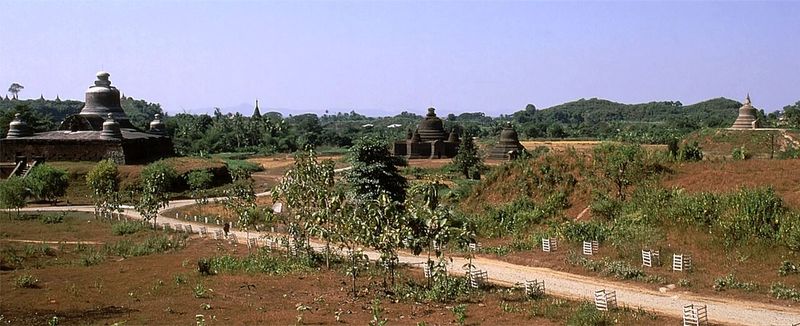
All casualty figures in this article are those reported by the Arakan Army and local media and could not be independently verified in a closed conflict zone. Myanmar’s military had not commented on the strikes at the time of publication. Photographs are file photographs via Wikimedia Commons, as credited: Mrauk U by Stefan Fussan (CC BY-SA); Ngapali Beach by Stefan Fussan (CC BY-SA).