War · Russia · Nuclear
The Medvedev preventive nuclear attack argument, published Monday in a Moscow law journal, is not an order and not a doctrine change. It is something subtler and, in its way, more deliberate: a legal brief for striking first, written by the man the Kremlin uses to say the unsayable — five days after Vladimir Putin sat with Donald Trump and Xi Jinping in Shenzhen and agreed to talk about reducing nuclear risks.
Track it live: Wars tracker — Live Global Trackers · Ukraine war map
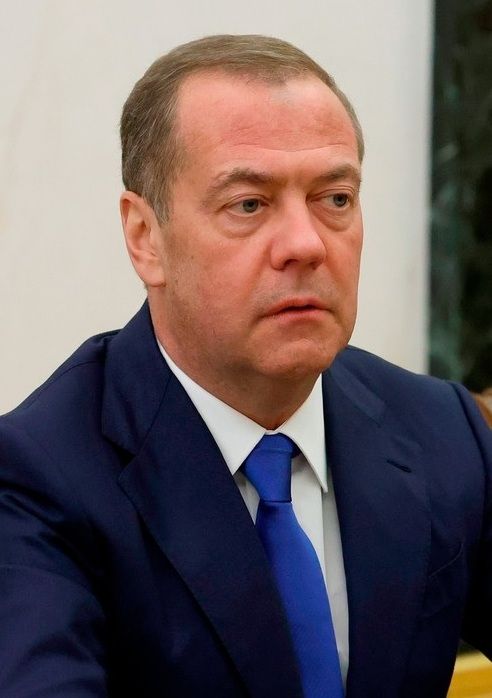
MOSCOW, November 23, 2026 — The Medvedev preventive nuclear attack warning arrived in the driest possible packaging: an academic article, titled “State Sovereignty and Nuclear Weapons: International Legal Aspects of Ensuring National Security,” published Monday in the Moscow Journal of International Law and excerpted by the state news agency TASS. Its author is Dmitry Medvedev — former president, former prime minister, and since 2020 deputy chairman of Russia’s Security Council. Its central sentence is anything but dry: “The massive use of non-nuclear means that cause catastrophes makes a preventive nuclear attack by the Russian Federation possible.” Medvedev also warned that “secret or hidden supplies of nuclear weapons from the West to Kyiv will provoke a legitimate preventive nuclear attack by Russia,” and wrote that Kyiv and its allies “must remember that the Russian Federation not only has the right, but in various situations has the obligation to use nuclear weapons.” Fox News and the New York Post both reported the article on Monday and Tuesday. No order was given, no doctrine was amended, and Medvedev himself conceded the conditions he describes have not yet produced what he called a “direct necessity” to strike. Precision matters here, and this article keeps his claims labelled as his claims throughout.
What Medvedev actually wrote
Russia preventive nuclear strike: the conditions he names
The Russia preventive nuclear strike case, as Medvedev builds it in the excerpts published by TASS, rests on three claims. First, scale: a massive conventional — that is, non-nuclear — air and space attack that causes man-made, environmental or social catastrophes, he writes, “effectively brings the question of launching a preemptive nuclear strike into practical consideration.” The trigger in this scenario is not a nuclear detonation but a conventional campaign whose consequences he judges catastrophic. Second, transfer: covert Western supplies of nuclear weapons to Ukraine would, in his argument, justify a preventive strike before those weapons could ever be used — the scenario behind his warning about “secret or hidden supplies.” Third, and most sweeping, he asserts the threshold may already have been met: “Formally, in a number of cases, the parties collectively opposing us (Ukraine, NATO countries, and several Western countries outside the alliance) have already created situations in which Russia considers the possibility of launching a nuclear strike.” That sentence does the article’s real work: it converts a hypothetical doctrine into a standing claim about the present. It should be read with its limits attached. There is no evidence that any Western state has supplied, or announced plans to supply, nuclear weapons to Ukraine; Medvedev’s transfer scenario is conditional and hypothetical, and it is presented here as exactly that.
The restraint clauses he included in the same article
The same text that floats a first strike also contains its own brake, and the two halves cannot honestly be separated. Medvedev wrote that Russia’s nuclear doctrine does not explicitly authorise preventive strikes — an admission that the permission he describes is an interpretation, not a quotation. He wrote that “so far the course of events in the Ukrainian crisis has not created a state of direct necessity to use nuclear weapons,” which is his own assessment that the conditions he names have not, in fact, compelled a strike. And he placed the decision where Russia’s system has always placed it: with President Vladimir Putin, who, in Medvedev’s words, “is always guided by a comprehensive analysis of all factors and the proportionality between the actual damage inflicted and the retaliatory measures.” The warning and the restraint are in the same article, addressed to the same readers. Which half a given audience hears — the threat in Western capitals, the reassurance in Moscow — is part of how the text is designed to work.
A legal brief, citing The Hague against the West
Medvedev is a lawyer by training, and the article is built like one: its centrepiece is an argument from authority, and the authority he chooses is the International Court of Justice at The Hague. Citing the court’s 1996 advisory opinion on the legality of nuclear weapons, he contends that international law does not categorically prohibit nuclear use when a state’s very survival is at stake, and he argues that a preventive strike in the scenarios he describes “would not be considered a crime under international law.” The irony is structural: a court Western governments treat as the apex of the rules-based order is being cited, by the deputy chairman of Russia’s Security Council, as the foundation for a Russian first strike. The contestability matters as much as the irony. The 1996 opinion was famously equivocal — the court could not conclude definitively whether use in an extreme circumstance of self-defence would be lawful — and most legal scholars read it far more restrictively than Medvedev does. His reading is advocacy by an interested party in a live conflict, not a ruling, and no court has endorsed the preventive-strike construction he builds on it.
Background: the doctrine he is stretching
Russia nuclear doctrine preventive strike: what the 2024 text actually says
The document Medvedev is glossing is the current Fundamentals of State Policy on Nuclear Deterrence, signed by President Putin on 19 November 2024. That revision already widened the listed conditions for nuclear use: it treats an attack on Russia by a non-nuclear state backed by a nuclear power as a joint attack by both, and it lists a massive conventional air and space attack threatening Russia’s sovereignty among the conditions that could bring a nuclear response into consideration. What the 2024 text does not do, in terms, is authorise a preventive strike. Medvedev’s article reads that permission into the decree’s language about “military threats” and threats to the very existence of the state — language the decree itself does not state in the form he gives it, as his own concession that the doctrine does not explicitly authorise preventive strikes effectively admits. The timing completes the picture: one year later, almost to the day, the Security Council’s deputy chairman is publishing the gloss — an interpretation with no legal force of its own, offered in a law journal, that asks readers to treat the doctrine as if it said more than it does.
Medvedev's assigned role: the hawk with a law degree
Since Russia’s full-scale invasion of Ukraine in 2022, Medvedev has occupied a specific place in the Kremlin’s division of labour: he is the designated escalation voice, the former liberal president reinvented as the official who says what Putin does not. The pattern is consistent enough that Western capitals price it in. He floats the extreme — annexation rhetoric, nuclear threats, personal invective against Western leaders — so that the president can occupy the reasonable ground beside him, and his statements are read as signals to be weighed rather than orders to be tracked. Our earlier coverage of Medvedev urging Trump and the CIA to remove Zelenskyy is one entry in that catalogue: maximal language, no operational consequence, and a message aimed as much at audiences abroad as at anyone in Moscow. The journal article fits the role with one refinement — where his social-media interventions are improvised in tone, this one is dressed in the full apparatus of legal scholarship, which gives the same signal a longer shelf life and a citable form.
Why this matters
Timing is the message: Shenzhen, Benghazi and the Baltic in one week
The article did not land in a quiet week, and its meaning is inseparable from its company. It appeared five days after the November 19 Shenzhen trilateral, where Presidents Trump, Putin and Xi agreed to pursue talks on reducing nuclear risks — the summit we covered in our report on the first Trump–Xi–Putin trilateral. It appeared on the same Monday that Moscow summoned Estonia’s envoy and warned Tallinn that its actions were “on the verge of triggering open war” over the Baltic border closure. And it came two days after Ukrainian sea drones struck Russian ships at Benghazi, Libya — the operation Kyiv claimed in the Benghazi strike on the corvette Merkury. Read together, the week is a study in contradiction: arms-control language at the summit table, first-strike language in the journal, open-war language at the border. The pattern that connects them is the use of nuclear and war rhetoric as a general-purpose pressure instrument, applied across every theatre at once. That has a cost Moscow may or may not be counting: a deterrent threat repeated everywhere, about everything, loses the specificity that makes deterrence legible — even as the background risk that someone, somewhere, misreads it continues to rise.
Who benefits, who loses
Moscow’s gain is a movable red line. A threshold defined by observable events — a nuclear detonation, an invasion of Russian territory — constrains the state that declares it. A threshold defined by interpretation, by words like “catastrophes” and “unacceptable damage,” constrains only the other side: it maximises deterrent ambiguity and lets the Kremlin claim a crossing whenever it chooses, including retrospectively, as Medvedev’s “already created situations” sentence demonstrates. Kyiv loses room to manoeuvre. Every long-range Ukrainian strike campaign — against refineries, airfields, ships in distant ports — now carries a published, argued claim that it edges Russia toward a legalised first strike, and that claim will be quoted back at Ukraine’s partners each time a new weapons package is debated. NATO governments lose the clarity they need to sustain public consent for continued aid, because the argument they must answer is no longer a single declared doctrine but a shifting gloss on one. And arms control loses most quietly: a preventive-strike interpretation published in a Moscow journal days after a risk-reduction summit tells negotiators that, whatever the communiqués say, the doctrinal conversation inside Russia is moving in the opposite direction.
What the numbers imply — and what they don't
The scale behind the story is real: Russia and the United States together hold roughly nine-tenths of the world’s nuclear warheads, which is why a doctrinal argument in a Moscow law journal is a global story rather than a regional one. But the operative numbers in Medvedev’s text are not warhead counts. They are thresholds — and his thresholds have no numbers attached at all. “Catastrophe” and “unacceptable damage” are nowhere defined, quantified or illustrated with a measurable case, and that absence is deliberate: a defined threshold can be approached, tested and priced, while an undefined one hangs over every decision the other side makes. Set the article beside the 2024 doctrine and the direction of travel is visible. The decree, for all its widened conditions, still works by enumeration — a list of situations a planner can read. The gloss works by discretion. In nuclear doctrine, that movement from lists toward discretion is itself a form of escalation, because it transfers the trigger from events to interpretations.
What happens next
Rhetorical containment. The article is absorbed as another Medvedev signal: Western governments note it, decline to answer it in public, and nothing in Russia’s nuclear posture observably changes. This is, historically, the most common outcome of his interventions — the threat is filed, the division of labour holds, and the text waits in the archive. Watch for silence from the Kremlin spokesman, which in this scenario is the tell.
Doctrinal drift. The gloss escapes its author. Other officials repeat its formulations, the Foreign Ministry adopts its language, or a future revision of the doctrine absorbs the preventive construction outright — converting a journal argument into stated policy without any single dramatic announcement. The indicators are repetition by the Security Council secretary and by ministry spokespeople, and any echo of the phrase “preventive” in official doctrine-adjacent documents.
Crisis use. In a future confrontation — a mass Ukrainian strike on Russian strategic infrastructure, or a Baltic incident of the kind Moscow’s Estonia protest foreshadows — the article is cited retrospectively as the legal groundwork for a threat made in real time: we published the reasoning, we named the conditions, we warned you. That is the scenario the text seems built to enable, and the one that gives a law-journal article an operational afterlife. What to watch across all three: whether Putin or the Kremlin endorses, ignores or distances the text; whether NATO’s Nuclear Planning Group responds in any form; and whether the Shenzhen risk-reduction talks produce a second meeting at all.
Sources
- TASS, “Medvedev article excerpts” — the state news agency’s published excerpts of Dmitry Medvedev’s article in the Moscow Journal of International Law, including the preventive nuclear attack passage, the warning on covert Western nuclear supplies to Kyiv, and the restraint clauses on doctrine and presidential decision.
- Fox News, “Russia warns of ‘preventive nuclear attack’ as Medvedev claims Ukraine, NATO crossed line” — reporting on the article and its claims that Ukraine and NATO have already created situations in which Russia considers a nuclear strike.
- New York Post, “Russia warns of ‘preventive nuclear attack’ as Medvedev claims Ukraine, NATO crossed line,” November 24, 2026 — reporting on the article and its reception.
Medvedev’s article was published in Russian in the Moscow Journal of International Law; quotations in this report are from English translations of the TASS excerpts. Claims attributed to Medvedev are his. Signal Post News has seen no evidence of any Western nuclear transfer to Ukraine, and no Russian nuclear order or doctrine amendment has been announced.