War · Ukraine · Russia · Libya
A day after an explosion tore through a Russian corvette in Benghazi with no one claiming it, President Volodymyr Zelenskyy claimed the attack for Ukraine — saying seven sea drones sank the Merkury, hit a Russian weapons cargo ship and destroyed a helicopter, 2,400 kilometres from the front line. Libyan officials describe a severely damaged ship, not a confirmed sinking.
Track it live: Ukraine war map · War tracker
KYIV / BENGHAZI, November 23, 2026 — President Volodymyr Zelenskyy said on Monday that Ukraine attacked a Russian warship moored at a port in Libya on Sunday, claiming that Ukrainian sea drones sank the vessel. The claim, made in a post on X and in a live video address to a meeting of the NATO Parliamentary Assembly in Berlin, is the first time Kyiv has publicly taken responsibility for the explosion at Benghazi Naval Base — an incident that, as our earlier reporting set out, the Russian corvette Merkury Benghazi drone explosion had left unattributed, with Ukraine pointedly not claiming it. Monday’s statements changed that position completely, and they changed it in front of two audiences at once: the Ukrainian public online, and NATO parliamentarians gathered in Berlin.
What Zelenskyy announced
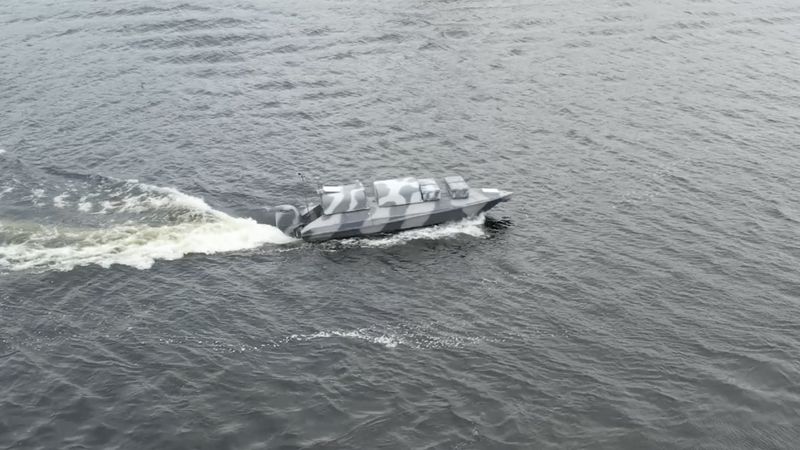
Zelenskyy said seven domestically made sea drones were deployed against the Russian navy corvette Merkury, one of Russia’s newest warships, commissioned in 2023 — a year after Russia’s full-scale invasion of Ukraine began. He described Sunday’s attack as “exemplary” and said “the targets we set were achieved.” In words that framed the strike as one episode in a continuing campaign rather than a one-off, he added: “We continue our operations in designated waters. We are responding to Russia’s aggression. We are developing Ukrainian weapons.” And, in a line aimed at Ukrainian morale after weeks of Russian strikes on the country’s infrastructure, he said: “We keep finding ways to get back on our feet after every Russian attack.”
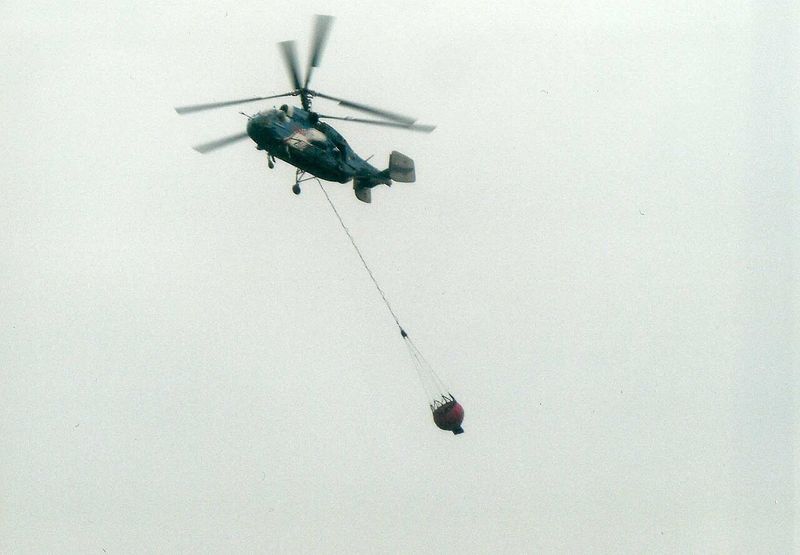
The target set, on Kyiv’s account, was wider than a single warship. Zelenskyy said Ukrainian forces also struck the Russian dry cargo ship MV Angara, which he said Moscow used to transport weapons, and destroyed a Ka-27 military helicopter in the attack. The operation, he said, was conducted some 2,400 km (1,500 miles) from the front line in Ukraine — a distance that, if the account holds, places it among the longest-range naval operations Ukraine has publicly claimed in the war.
The SBU account: a mothership, an escort and a helicopter
Ukraine SBU sea drone operation Libya: how Kyiv says it was done
Ukraine’s Security Service, the SBU, described the operation as “unique” and filled in the operational logic. On the SBU’s account, the MV Angara was a sanctioned vessel used to transport Russian military equipment, and the multipurpose corvette Merkury regularly escorted Russian naval convoys — including guarding the MV Angara itself. The two ships were therefore not separate targets of opportunity but a pair: an escort and the cargo vessel it protected, caught together at the same anchorage.
The method, as the SBU described it, answers the obvious range question. The drones did not sail 2,400 km under their own power. They were delivered to a designated location and launched from a so-called “mothership” near the target. A Ka-27 helicopter was on board the corvette, the SBU said, and also went under with it. Russian defenses tried from the air, from the sea and from land to hit the attacking drones, according to the SBU — a detail that, if accurate, means the attack was contested on the way in rather than unopposed. The service summed up the intended message in a single sentence: “Ukraine’s defense forces have once again shown that the Russian navy and its logistics have no safe routes, even far beyond the Black Sea.”
What Libyan officials say: severely damaged, at least 10 wounded
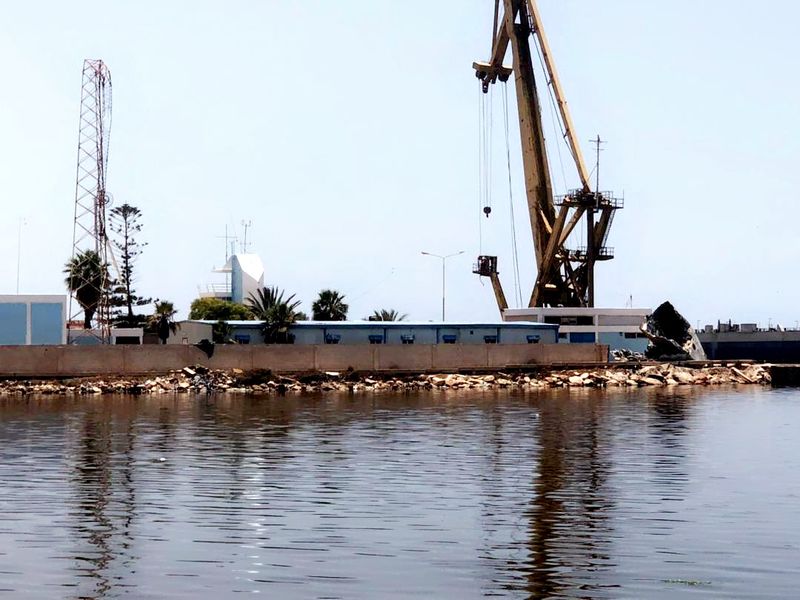
The account from the ground in Benghazi differs from Kyiv’s on the central question of the ship’s fate, and the difference must stay visible. Libyan officials affiliated with the Libyan National Army, which controls eastern and southern Libya and who spoke anonymously to the Associated Press, said the corvette was severely damaged at Benghazi Naval Base in eastern Libya. Zelenskyy and the SBU claim the ship sank; Libyan officials say severely damaged. Neither characterisation has been independently confirmed, and this article does not present the sinking as established fact.
On the Libyan officials’ account, at least four of the attacking drones were intercepted while two hit the corvette, which they described as a coastal patrol and escort vessel. At least 10 people, including Libyan and Russian nationals, were wounded. Residents heard loud explosions and saw flames early on Sunday, and civil defense crews extinguished the fire that followed. The British maritime security firm Ambrey said some of the explosions were likely caused by the detonation of ammunition on board the warship — a secondary-effects explanation consistent with a vessel hit while armed and fuelled in port. The Merkury had docked at Benghazi to refuel and take on supplies under a cooperation agreement between Russia and the eastern-based government in Libya.
A second strike off Benghazi — and no established attribution
Hours after the warship attack, another sea drone strike hit a Maltese-flagged commercial vessel sailing off Benghazi, according to the Libyan coast guard. That second incident is reported here exactly on that attribution and no further: who carried it out has not been established, and nothing in the reporting attributes it to Ukraine. Zelenskyy’s claim on Monday covered the warship operation; it did not, in the accounts published by AP or in France 24’s live coverage, claim the strike on the commercial vessel. Keeping the two incidents separate matters, because a strike on a third-country commercial ship would raise legal and diplomatic questions of a different order from a strike on a belligerent’s warship and its military cargo escort.
Russian officials, for their part, made no immediate comment on Zelenskyy’s claim. The silence leaves Moscow’s position formally open: it has neither confirmed the loss of one of its newest corvettes nor disputed Kyiv’s account of how the attack was carried out.
Background: from the Black Sea to the Mediterranean
The sea-drone campaign that preceded Benghazi
Ukraine’s naval drone campaign began as an improvisation and became a strategy. Lacking a conventional navy capable of contesting the Black Sea, Kyiv built fleets of explosive uncrewed surface vessels — the sea drones Zelenskyy invoked on Monday — and used them, alongside missiles, to damage and sink Russian warships, drive the Black Sea Fleet away from Sevastopol and reopen maritime space Russia had tried to close. The Benghazi claim extends that logic geographically: the same class of weapon, delivered by a mothership to waters Russia treated as a safe rear area. The pattern of reaching far beyond the front is not new in itself. In June last year, Ukraine’s Operation Spiderweb used drones launched from trucks to hit more than 40 aircraft at air bases across Russia, and Ukrainian strikes have since reached Russian oil refineries as far away as western Siberia. Along the roughly 1,250 km front line itself, Kyiv’s drones and ground robots help hold back Russia’s larger army.
Russia in Libya and the Mediterranean
Russia’s presence in eastern Libya, built through years of support for the Libyan National Army and formalised in cooperation agreements of the kind under which the Merkury docked, gives Moscow a working foothold on the Mediterranean’s southern shore: a place to refuel, resupply and sustain naval movements between Russia, the Mediterranean and Africa. The Merkury’s port call was routine logistics of exactly that kind — which is the point. On Kyiv’s account, the target was not only a warship but the logistics chain behind it, with the sanctioned cargo ship MV Angara struck alongside its escort. Russia’s strategic bombing campaign, meanwhile, has devastated Ukraine’s power grid ahead of winter, a pressure campaign whose human cost we reported in the Russian strike on Dymer, where a boy was rescued from the rubble. Zelenskyy’s Monday framing — “we are responding to Russia’s aggression” — explicitly linked the distant naval strike to that ongoing bombardment at home.
The 24 hours when no one claimed it
The sequence matters for judging Monday’s announcement. When the explosion happened on Sunday, no government claimed it. Our November 22 report recorded a severely damaged warship, wounded crew and officials, and an unclaimed attack. Kyiv’s decision to claim it a day later — publicly, by name, with operational detail from the SBU and a presidential address to NATO parliamentarians — was therefore a deliberate second act, not an automatic one. Ukraine has form for delayed, choreographed disclosure of long-range operations: as Zelenskyy’s confirmation of the Crimean Bridge attack as a seven-stage operation showed earlier this month, Kyiv sometimes confirms an operation only when the confirmation itself serves a purpose. Claiming Benghazi in Berlin, before the NATO Parliamentary Assembly, placed the claim in front of the alliance audience whose support Ukraine’s long-range campaign depends on.
Why this matters
2,400 kilometres rewrites the risk map
The single most consequential number in Monday’s claim is the distance: 2,400 km from the front line. A Ukraine long range sea drone attack of that reach does not mean a drone boat crossed the Mediterranean under its own power — the SBU’s mothership account explains the mechanics — but it does mean that, on Kyiv’s account, no Russian naval anchorage within mothership range of a reachable coastline is automatically a sanctuary. Every Russian port call in the Mediterranean, every refuelling stop under a partner agreement, now has to be planned against the possibility that a small number of cheap, expendable craft can be delivered quietly to nearby waters. That is a planning burden imposed on an entire logistics network by one operation, whether or not the Merkury is ultimately confirmed sunk.
Seven launched, at least four intercepted, two hits: the arithmetic
The numbers from the two sides fit together more closely than the headlines suggest. Zelenskyy said seven drones were deployed. Libyan officials said at least four were intercepted and two hit the corvette. Those accounts are compatible: a seven-craft salvo, a majority stopped by defenses firing from air, sea and land, and two craft getting through. The data point that matters is the exchange ratio. Even on the least favourable reading for Kyiv — five of seven drones expended without effect — two hits were enough, on the competing accounts, either to sink a corvette commissioned in 2023 or to damage it severely, wound at least 10 people and ignite its ammunition. Sea drones cost a small fraction of a modern corvette. That cost asymmetry is the strategic engine of the whole campaign: the defender must stop every attacker, every time, in every port; the attacker needs a small number of hits, occasionally, anywhere.
Who gains, who loses — and the critics’ case
On Kyiv’s telling, Ukraine gains a demonstrated reach, a morale answer to the winter bombing campaign and a deterrent message to Russian logistics planners. Russia loses, at minimum, the use of a 2023 corvette for the foreseeable future, the cargo capacity of a sanctioned transport on that voyage, a Ka-27 helicopter, and the assumption that Benghazi is a safe stop. The critics’ case deserves equal weight. A strike in a third country’s port, wounding that country’s nationals, tests the legal and political tolerance of Ukraine’s backers; the unexplained second strike on a Maltese-flagged commercial vessel, whoever carried it out, shows how quickly operations in crowded waters can blur into incidents no one claims; and every long-range spectacular invites a Russian response whose target and scale Kyiv does not choose. Supporters answer that the targets were a belligerent’s warship and a sanctioned military cargo ship. Both readings were live on Monday, and neither Russian confirmation nor independent verification has yet settled the factual ground beneath them.
Libya, caught between two patrons
The sharpest dilemma belongs to Libya’s divided governments. The eastern-based government, whose forces control Benghazi, responded diplomatically: it sent a letter to UN Secretary-General António Guterres and the UN Security Council calling for an international investigation into the potential use of western Libya to prepare and launch Sunday’s attack. Libyan officials told AP that Ukrainian forces are operating in western Libya under a covert deal endorsed by the West, mainly at an air base in Misrata and also in facilities in Tripoli and Zawiya, and that Ukrainian forces used Libyan territory to strike a Russian tanker in the Mediterranean in March. Those claims are attributed here to Libyan officials, and they place the western authorities in an exposed position: accused by the east of hosting a foreign belligerent’s operations, while the east itself hosts the Russian presence that was struck. If the investigation call gains traction, Libya’s internal division becomes the terrain on which a Russia–West dispute is formally argued at the United Nations.
What happens next
Three scenarios now compete. The first is Russian response. Moscow made no immediate comment, but silence after a public claim of this kind rarely holds indefinitely: options range from a formal denial or minimisation of the damage, through diplomatic protest aimed at Libya’s western authorities and their Western backers, to a military answer in Ukraine or against Ukrainian interests elsewhere. The second scenario is institutional: the eastern Libyan government’s letter to Guterres and the Security Council starts an investigation process that forces evidence — about the launch point, the mothership and the alleged western Libya facilities — into the open, where it can be tested rather than asserted. The third is operational contagion: Russian Mediterranean logistics are re-routed, re-escorted or suspended, insurers reprice the basin, and other actors study the Benghazi method. Which scenario dominates depends on facts not yet public: the Merkury’s true condition, any Russian statement, and whether a second operation follows. What Monday settled is narrower but real: the Benghazi explosion now has a claimant, a stated method and a stated purpose — and a dispute, between “sank” and “severely damaged,” that only evidence will close.
Related coverage: Russian corvette Merkury Benghazi drone explosion: the November 22 attack, before Ukraine claimed it · Russian strike on Dymer: boy rescued from the rubble near Kyiv · Zelenskyy confirms Crimean Bridge attack as seven-stage operation
Sources
Sources: Associated Press, 23 November 2026 (Hanna Arhirova and Samy Magdy) — reporting that President Volodymyr Zelenskyy, in a post on X and a live video address to the NATO Parliamentary Assembly in Berlin, claimed Sunday’s attack on a Russian warship in Libya, said seven domestically made sea drones sank the corvette Merkury, struck the dry cargo ship MV Angara and destroyed a Ka-27 helicopter, and put the operation some 2,400 km from the front line; the SBU’s description of the operation as “unique,” including the sanctioned status and military cargo role of MV Angara, the Merkury’s convoy escort role, delivery of the drones to a designated location and launch from a “mothership,” the Ka-27 on board the corvette, and Russian defensive efforts from air, sea and land; Libyan officials affiliated with the Libyan National Army, speaking anonymously, who said the corvette was severely damaged at Benghazi Naval Base, at least four drones were intercepted and two hit the corvette, at least 10 people including Libyan and Russian nationals were wounded, residents heard explosions and saw flames, civil defense extinguished the fire, the vessel had docked to refuel and resupply under a cooperation agreement, the eastern-based government wrote to UN Secretary-General António Guterres and the Security Council seeking an international investigation, and Ukrainian forces were said by those officials to be operating in western Libya (Misrata, Tripoli, Zawiya) under a covert deal endorsed by the West, including a March strike on a Russian tanker; the Libyan coast guard’s report of a second sea drone strike on a Maltese-flagged commercial vessel off Benghazi, attribution not established; Ambrey’s assessment that some explosions were likely caused by detonation of ammunition on board; and the absence of immediate Russian comment. France 24 live coverage, 23 November 2026, with AFP, AP and Reuters — corroborating Zelenskyy’s claim of the Benghazi strike and its presentation to the NATO Parliamentary Assembly. Analysis in this article is Signal Post News’s own and is distinguished from the reported facts above; the sinking of the Merkury is claimed by Zelenskyy and the SBU and described by Libyan officials as severe damage, and is not independently confirmed.