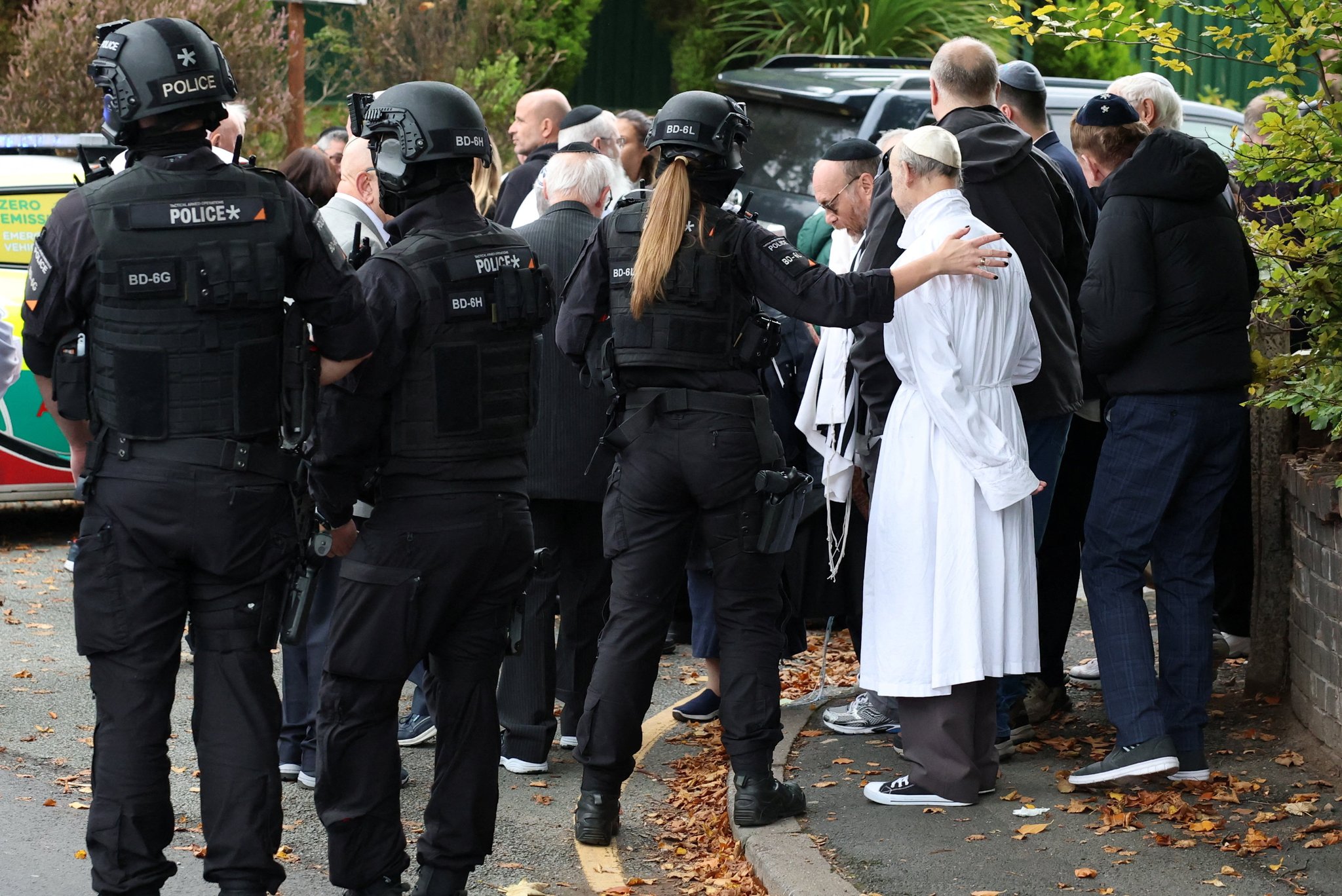

Manchester terror plot arrests Yom Kippur is the shorthand now attached to a developing counterterrorism case: two men in their 30s were arrested at about 2:45 p.m. on Sunday, September 20, on Newton Street in Manchester’s Northern Quarter. Police say the operation disrupted what they believe was a plot targeting the city’s Jewish community. The men were detained under Section 41 of the Terrorism Act 2000 and taken to a London police station. On Tuesday, warrants authorized their continued detention through Sunday, September 27.
That is the confirmed frame—and its limits matter. Police have not publicly described a proposed target, weapon, motive or operational plan. They have not identified the men, and an arrest is not a charge. Continued detention allows investigators more time to examine evidence; it does not establish that either man committed an offence. Both are entitled to the presumption of innocence.
The known police activity extends beyond Newton Street. Officers searched premises on Epworth Street in Liverpool and Lancaster Road in Salford, the latter described in reports as a men’s hostel. Forensic officers were photographed examining a white Mercedes surrounded by police vehicles on Newton Street. The Metropolitan Police is leading the inquiry with Counter Terrorism Policing North West, Greater Manchester Police and Merseyside Police.
Deputy Assistant Commissioner Vicki Evans, the senior national coordinator for Counter Terrorism Policing, said: “This has been a long-running proactive investigation which has led to the disruption of what we believe to be a plot to target the Jewish community in the Manchester area.” Police say they do not assess an ongoing threat to the public in connection with the case, while asking people to remain vigilant and report concerns.
Why this matters
The significance is not merely that arrests occurred. It is the combination of timing, asserted target and recent memory. The arrests came shortly before Yom Kippur, the holiest day in the Jewish calendar, and almost a year after an attacker struck Heaton Park Hebrew Congregation Synagogue during Yom Kippur in October 2025. Melvin Cravitz and Adrian Daulby were killed in that attack.
For Manchester’s Jewish residents, those facts turn an abstract national warning into a local burden: deciding whether to attend worship, escorting children to school, noticing police vehicles outside community buildings and calculating whether ordinary routines are safe. A prevented attack leaves no crater and no casualty list, but it can still change behavior. The Community Security Trust, which monitors antisemitism and provides security support, called the latest development “utterly chilling.”
The Jewish Representative Council of Greater Manchester thanked police and security services for preventing “another potential tragedy.” Home Secretary Shabana Mahmood pledged continued action against threats to Jewish people and against antisemitism. Those responses convey relief, but also a warning against treating disruption as the end of the story. Protection must continue after the headlines fade, and it must be delivered without attributing suspicion to entire neighborhoods or faith communities.
This case also tests institutional trust. Successful counterterrorism work often depends on public acceptance of two propositions at once: that police sometimes must act before a suspected plan reaches execution, and that exceptional powers require exacting legal control. A democracy weakens if it accepts only one side of that bargain.
What “proactive disruption” means—and what it does not
Counterterrorism investigations frequently begin before the public sees any crime scene. Intelligence may come from human sources, communications data, surveillance, financial activity, border information, tips from the public or cooperation between agencies. Investigators try to understand intent, capability, associates and timing while deciding when waiting for more evidence becomes too dangerous.
The decisive judgment is an intervention threshold. Act too early and prosecutors may lack admissible evidence for a charge; act too late and a suspected plot may advance beyond control. An arrest can therefore serve several lawful purposes at once: stop suspected activity, secure devices and locations, prevent evidence from being lost, and permit questioning under a statutory framework. Searches in Manchester, Salford and Liverpool suggest detectives are reconstructing a network of places, movements and material rather than examining one isolated street encounter.
Reporting by the BBC, attributed to sources rather than an official police statement, described the suspected plot as fairly imminent and in later-stage planning. The Guardian separately reported that police believed they had stopped an imminent plot. Those characterizations are important but remain attributed claims. Police have not officially disclosed a motive or published evidence establishing imminence. Responsible coverage should not convert background briefings into adjudicated fact.
The transfer to London is consistent with a nationally coordinated investigation, not evidence about guilt. The Metropolitan Police’s counterterrorism command has specialist custody, forensic and investigative capabilities, while regional units contribute local intelligence and operational reach. The multi-force structure—Counter Terrorism Policing Manchester and the North West network working with Greater Manchester and Merseyside officers—is designed for cases that cross municipal boundaries.
Section 41 and the detention clock
A Section 41 Terrorism Act arrest permits a constable to arrest without warrant a person reasonably suspected of being a terrorist. It is a gateway into a special pre-charge detention regime, not a criminal verdict. The statutory process imposes custody reviews and permits judicially authorized extensions under Schedule 8 when investigators say more time is necessary and the inquiry is being conducted diligently and expeditiously.
The calendar illustrates the power and its safeguards. The arrests occurred on September 20. Under the ordinary initial terrorism-arrest timetable, detention beyond four days requires judicial authorization. Warrants obtained on September 22 allow custody until September 27—seven days after arrest. That date is an authorized ceiling for the current period, not a forecast that custody must last until then and not a promise that charges will follow.
The maximum pre-charge detention period in this regime is 14 days. Reaching that outer limit would require further legal steps; the present warrants do not automatically grant it. Investigators could charge before September 27, seek another lawful extension, release the men without charge, or release them while pursuing other investigative avenues if the law permits. Detainees have a right to consult a solicitor privately, subject to limited statutory provisions that can delay access in specified circumstances.
Civil-liberties concerns are not an afterthought. Seven days in custody without charge is a major deprivation of liberty, particularly when public statements describe a grave suspected plot but disclose little evidence. Judicial scrutiny, access to counsel, custody records and the requirement that police pursue the inquiry diligently are the mechanisms meant to restrain that power. Critics are right to ask whether each additional day is necessary, whether public language prejudices a future case and whether intelligence can be converted into evidence that can be challenged in court.
The counterargument is operational: digital devices can contain encrypted, deleted or multilingual material; forensic examination can be slow; associates and addresses may span jurisdictions; and premature release can carry public-safety risk. The sound position is neither reflexive deference nor reflexive disbelief. It is to demand that police meet the legal test at every extension while refusing to treat the extension itself as proof.
The severe threat level, properly understood
The UK terror threat level severe means an attack is “highly likely.” It is the second-highest of five levels, below critical, which means an attack is highly likely in the near future. The Joint Terrorism Analysis Centre sets the national level using intelligence and judgments about capability, intent and timescale.
Severe is an aggregate national assessment. It does not mean an attack is certain, identify a city, establish the truth of this allegation or show that every Jewish institution faces a specific threat. It informs protective posture: staffing, patrols, security advice, event planning and the attention agencies give to suspicious activity.
The distinction matters because threat language can be misused in two directions. Minimizing “severe” as routine understates the burden facing police and vulnerable communities. Treating it as proof of a particular defendant’s guilt collapses intelligence assessment into criminal adjudication. The Yom Kippur terror threat UK context supports vigilance; it does not suspend due process.
Heaton Park and the long shadow of October 2025
The Heaton Park synagogue anniversary is not incidental background. The 2025 attack occurred at a place of worship on Yom Kippur and killed two congregants, Melvin Cravitz and Adrian Daulby. CST described it as Britain’s first fatal antisemitic terrorist attack since the organization began recording in 1984. Its anniversary concentrates memory, media attention and security concern in the same season as the new investigation.
Anniversary risk is difficult to discuss without amplifying fear. Security agencies must consider whether dates, previous attacks and public symbolism could influence hostile actors. Yet communities also have the right to mark holy days without allowing an attacker’s calendar to define religious life. Visible protection can reassure worshippers, but checkpoints and armed patrols can also make an ordinary service feel like a defended event.
The regional memory adds weight to the claim of disruption, but it must not be used as a shortcut around evidence in the present case. The deaths at Heaton Park are established facts about a separate attack. They do not tell us what the two detained men intended, whether they acted together or whether prosecutors will have a chargeable case.
Antisemitism after October 7, 2023: the numbers
The latest annual figures show why community anxiety is not confined to one investigation. CST recorded 3,700 antisemitic incidents in the United Kingdom in 2025. That was 4% above 2024’s 3,556, though 14% below the record 4,298 incidents in 2023. For comparison, CST recorded 1,662 incidents in 2022 and 2,261 in 2021.
The trajectory is more revealing than any single percentage. The 2025 average was 308 incidents a month—exactly twice CST’s monthly average of 154 in the year before the Hamas-led attacks of October 7, 2023 and the war that followed. Every month of 2025 exceeded 200 incidents, the first year in CST’s dataset to do so. The decline from the 2023 peak therefore did not represent a return to the earlier baseline.
These are recorded incidents, not a complete census of prejudice. Reporting behavior, awareness, classification and police referrals affect totals. Nor should criticism of a government or military campaign be automatically labeled antisemitic; the relevant distinction depends on language, target and conduct. But the sustained elevation across years is strong evidence of a changed security environment for Jewish institutions and individuals.
That context explains why the phrase CST utter chilling Manchester gained attention after the arrests. The quote expresses accumulated experience as much as reaction to one police announcement. The policy task is to address specific threats and wider antisemitic abuse without stigmatizing peaceful political expression or entire communities.
Who gains—and who pays
The clearest winners, if police’s assessment is borne out, are potential targets and the wider public. A disruption before violence protects life. It also creates space for Yom Kippur observance and other community activity to continue under a more informed security plan. Police credibility gains when a long-running investigation produces a controlled intervention rather than an emergency response after casualties.
There is an institutional gain as well. Cooperation among national and regional forces can demonstrate that intelligence flows across boundaries. That matters after any attack that prompts questions about missed warnings. Transparent updates—limited enough to protect the inquiry, specific enough to distinguish fact from inference—can reinforce that trust.
The costs are real even if no attack occurs. Jewish residents absorb fear, extra security and the repeated message that ordinary communal life may be targeted. Businesses and residents around Newton Street, Lancaster Road and Epworth Street face disruption and unwanted association with an allegation they did not create.
Another cost can fall on the suspects’ families and on communities outsiders assume they represent. Police have not officially disclosed a motive, nationality or ethnicity. Speculation can turn neighbors into proxies for unknown individuals and generate harassment before evidence is tested. Precision is therefore a security measure as well as an editorial discipline: name only what is known, do not invent group culpability and do not turn a place of residence into a communal indictment.
The suspects themselves bear the immediate coercive cost of Section 41 detention. If they are charged, the evidence belongs in court; if they are released, the absence of a charge should be reported as prominently as the arrests. Either outcome requires continued scrutiny of how official claims were framed.
What critics should watch
Criticism will come from different directions. Some community advocates will ask whether protection was sufficiently visible before the arrests, whether security funding matches the threat and whether warnings from Jewish organizations receive prompt action. Others will question broad terrorism powers, long pre-charge detention and how much the public can evaluate when officials cite operational secrecy.
Both concerns deserve evidence-based answers. More patrols can deter and reassure, but security cannot depend solely on police standing outside every school and synagogue. Grants for barriers, cameras, trained guards and emergency planning can help, while intelligence work and trust with communities address threats earlier. At the same time, funding should be allocated by transparent risk criteria and reviewed for effectiveness.
On detention, the critical safeguards are concrete: judicial hearings, legal representation, documented necessity, proportionate searches and accurate public statements. Exceptional powers gain legitimacy when oversight is visible and errors are acknowledged. The demand for due process is not indifference to terrorism; it is part of the democratic resilience terrorism seeks to damage.
Comparative cases show why patience matters. The lengthy criminal process after Sri Lanka’s 2019 Easter attacks, examined in our report on the Colombo High Court verdict, illustrates the distance between immediate security claims and evidence tested over years. Our analysis of the White House press-ban lawsuit addresses the same broader principle in another setting: state power is most credible when courts can examine its asserted justification.
What happens next
The first deadline is September 27. Before then, detectives will likely continue examining digital devices, communications, financial and travel records, vehicle evidence and material seized from searched premises. They may conduct further interviews, seek specialist forensic analysis and test whether intelligence is admissible and sufficient for a criminal charge.
Prosecutors must distinguish suspicion from a realistic evidential case. Possible outcomes include charges under terrorism or other criminal statutes, another application to extend detention within the 14-day maximum, or release without charge. Different outcomes for the two men are possible. A release would not necessarily mean the original intervention was unlawful; a charge would not mean conviction.
The next public update should clarify any charging decision, the legal basis of any further detention and whether police assess the public-threat picture differently. Officials should avoid filling evidential gaps with suggestive labels. Media organizations should correct the record if attributed claims about timing, motive or capability are not substantiated.
Beyond the custody clock, attention turns to protective security. The government will face questions about funding for Jewish schools, synagogues and community centers; how grants are distributed; whether local forces have enough officers for sustained patrols; and how threat reporting is shared without creating panic. Mahmood’s promise to confront threats and antisemitism will be measured in budgets, prosecutions, prevention programs and durable relationships—not only statements after arrests.
The most responsible near-term conclusion is deliberately narrow. Police say a long-running operation disrupted an alleged plot against Manchester’s Jewish community; two men remain lawfully detained under warrants; officers say there is no ongoing threat linked to this matter; and major factual questions remain unanswered. Reassurance is justified by the intervention. Judgment must wait for evidence.
Sources
- Reuters: UK police arrest two men over a suspected plot targeting Manchester’s Jewish community.
- The Oldham Times / PA: arrest details, Newton Street vehicle search and community reaction.
- The News Now: detention warrants, searches and attributed BBC reporting.
- UK Home Office: operation of police powers under the Terrorism Act 2000.
- MI5: terrorism threat levels and definitions.
- Community Security Trust: Antisemitic Incidents Report 2025.
- European Jewish Congress: background on the October 2025 Heaton Park synagogue attack.
Reporting cutoff: September 23, 2026 at 12:50 a.m. PDT. This is a fixed news snapshot, not a live police feed. “Imminent” and “later-stage” descriptions are attributed to news organizations’ sources; police had not officially disclosed a motive, target site or operational method at the cutoff. The suspects have not been convicted, and detention is not proof of an offence. Analysis of policing trade-offs, community effects and civil-liberties safeguards is Signal Post News synthesis.