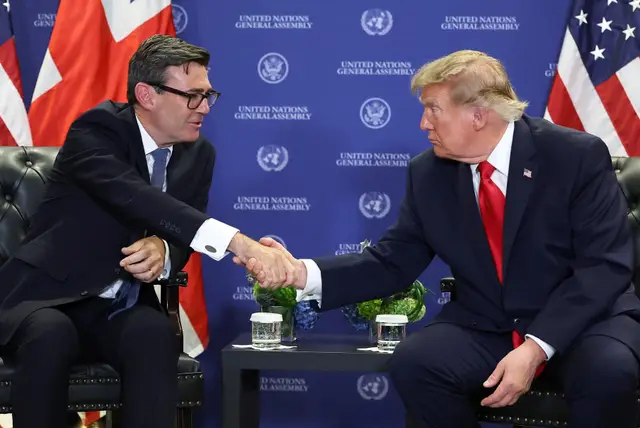
President Donald Trump told Britain’s new prime minister, Andy Burnham, that US–UK relations were “more up now” than under Sir Keir Starmer during the leaders’ first bilateral meeting on the fringes of the United Nations General Assembly in New York on Tuesday. Trump opened by saying Burnham was “going to be a great prime minister,” but paired the welcome with two unmistakable rebukes: he said Starmer’s language about Russia had been “too tough” and called Britain’s agreement to transfer sovereignty over the Chagos Islands to Mauritius a “terrible deal.”
Burnham answered in deliberately constructive terms. “We are going to lay out a plan for Britain,” he said, adding that “the country’s got so much going for it.” When he suggested that Trump saw the same potential—“I think you were saying today that very much is how you see it”—Trump responded: “Right.” The exchange gave Burnham the image his team wanted from a first encounter: recognition from Washington without an open rupture over the alliance’s hardest disputes.
The public remarks were reported by The Times, the Washington Examiner, The Sun and The Oldham Times. Reuters separately reported that the leaders discussed Ukraine, the Falkland Islands and trade. As of this article’s 1:05 p.m. PDT reporting cutoff, the White House had not published a detailed official readout. That leaves the pool exchange and attributed accounts as the clearest public record, not a complete inventory of the private discussion.
Why this matters
This was the first post-Starmer reset at leader level. Burnham inherited an alliance with deep military and intelligence integration but widening political disagreement. A smooth opening matters because Trump treats personal chemistry as part of statecraft; yet the issues he chose to raise show that warmth is not the same as policy alignment.
The sharpest dispute, Chagos, directly touches American military posture in the war with Iran. Diego Garcia is not an abstract sovereignty question for Washington: the joint UK–US base is a long-range logistics and staging hub in the Indian Ocean. Britain’s refusal to allow the outpost to support the initial February strikes on Iran intensified White House objections to a handover arrangement that would leave the base under a 99-year lease. Trump’s public pressure therefore connects legal status, alliance trust and day-to-day operational access.
The Russia remark sends a second signal. Trump made it after meeting President Volodymyr Zelensky, who is pressing for more Patriot interceptor support and has not received a concrete answer on producing the missiles in Ukraine. By calling Starmer’s rhetoric “too tough” and “too nasty,” Trump publicly narrowed the space available to a close ally even as Kyiv sought stronger backing. Burnham’s first foreign trip was to Kyiv, so Ukraine will watch whether the new prime minister can maintain that commitment without becoming another target of Trump’s criticism.
What Trump said about Starmer and the alliance
Asked about the danger of a direct Russia–Britain confrontation, Trump said: “I think you’ll be okay. But I’ll say the rhetoric from your last prime minister was too tough. I’ve seen that dialogue and it’s too nasty.” Asked about Burnham’s position, he replied: “I haven’t heard the rhetoric but I think he’s going to be good.” The Times reported the remarks after Trump’s talks with Zelensky.
Later, when a reporter described the bilateral relationship as “up and down,” Trump said it was “more up now than they were with your last prime minister” and added: “I think we’re doing very well.” The endorsement was unusually personal but also conditional. Trump praised Burnham as a “natural business person” who understood what he needed to do; the implication was that the new relationship would be judged by outcomes on issues Washington cares about.
Burnham’s task is to use that opening without implying automatic agreement. As Le Monde noted before the meeting, the “special relationship” rests on three pillars: foreign-policy alignment, institutional intelligence and security ties, and personal bonds between leaders. All three are under strain. Britain refused to join the US–Israel war against Iran; disputes remain over Ukraine, Chagos and the Falklands; and Burnham arrived without the history of cooperation Trump once had with Starmer.
The Chagos confrontation
Trump was categorical. “I don’t support it. I think it’s terrible. It was a terrible deal,” he told reporters. “They all of a sudden say they have ownership. Somebody has ownership that never showed up before, after decades and centuries. I think it’s ridiculous.” He called Diego Garcia “a very important piece of real estate, militarily and strategically” and said Burnham was “going to be looking at it.” Burnham agreed that he would.
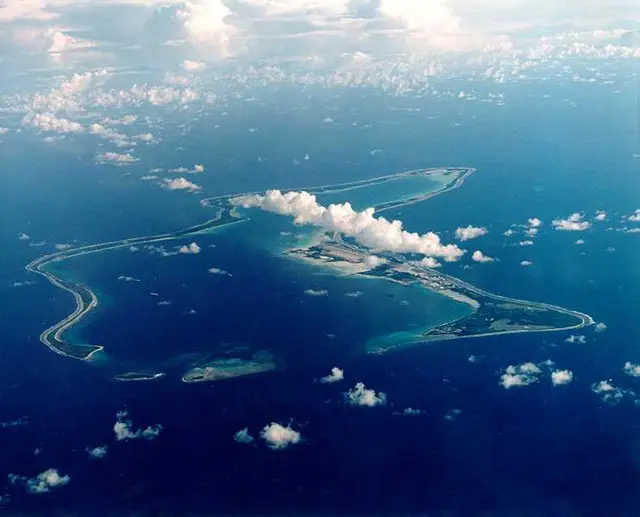
The agreement would transfer sovereignty over the Chagos Archipelago—a group of seven atolls—to Mauritius while Britain leases back Diego Garcia and the joint base for 99 years. The Starmer government argued that the treaty secured the installation’s long-term future after a 2019 International Court of Justice advisory opinion backed Mauritian claims. The plan has been on hold since April 2026 amid White House opposition, according to the Oldham Times and Reuters reporting.
On the flight to New York, Burnham said he had told Mauritius’s prime minister he would work toward a resolution but acknowledged that his government did not have one “at the moment.” That language kept both options open: revise the agreement enough to restore US support, or abandon it and accept the diplomatic and legal consequences with Mauritius.
The numbers in context
The Sun reported a cost of about £90 million a year and a potential total of as much as £34 billion. The term is 99 years. A flat £90 million multiplied by 99 equals £8.91 billion, so the two headline figures are not directly comparable. The larger number depends on assumptions about inflation, indexation, financing and how future payments are counted; estimates have been politically disputed. Without the full final payment schedule, £34 billion should be treated as a reported upper estimate rather than a settled cash price.
The 99-year term matters more strategically than the annual figure alone. It is designed to outlast governments and generations, offering continuity for a base that supports operations stretching from the Gulf to the Indo-Pacific. Yet a long lease is only as credible as the sovereignty, access and security arrangements around it. The February dispute—when Britain declined US use of Diego Garcia for the initial strikes against Iran—showed that physical access does not eliminate political veto points.
Burnham’s domestic mandate is also important, though the accessible reporting reviewed here does not supply a single comparable vote-loss total. The Washington Examiner described Labour’s 2025 and 2026 local-election defeats as historic and tied Starmer’s summer resignation to growing public dissatisfaction. Burnham, formerly mayor of Greater Manchester, returned to Parliament through the Makerfield by-election and then took office. The sequence shows the scale of Labour’s political rupture; it does not by itself establish that voters endorsed every foreign-policy change now associated with the new government.
Background and historical parallels
Burnham’s rise gives the relationship a different political texture. He comes from English regional government rather than the conventional Westminster-to-Downing Street route, and he used a lighter moment in New York to remind Trump that Manchester was more than the “town” the president had previously called it. The jibe helped signal that civility did not require deference.
The more serious history is that US–UK closeness has always contained argument. During the 1982 Falklands War, Margaret Thatcher eventually secured intelligence and other support from Ronald Reagan’s administration despite hesitation in Washington. Trump recently said he could “settle” a future UK–Argentina conflict; Burnham said he raised the issue, but the two avoided a public flare-up. The same pattern appeared on artificial intelligence: Burnham told business leaders he wanted global standards for regulating technology, while Trump used his UN speech to rebuke greater regulation. Neither leader turned that disagreement into the headline of the meeting.
Trump has repeatedly intervened in British politics, from criticizing Theresa May’s Brexit strategy to calling Starmer “no Winston Churchill” over Britain’s refusal to join the Iran war. The contrast with Tuesday’s praise of Burnham is therefore best read as an opening bid, not a durable verdict. Personal favor can create access, but recent history shows how quickly it can reverse when policy diverges.
Who wins and who loses
Burnham gains immediate validation. He left the public session praised rather than humiliated, with Trump calling the relationship “up.” For a new prime minister trying to establish authority abroad, that is useful political capital. The cost is that Trump has now publicly attached expectations to the relationship, especially on Chagos.
Starmer absorbs the rebuke. Trump contrasted the former prime minister unfavorably with his successor and attacked his Russia language. Because Starmer has left office, the practical effect is less about his own leverage than about setting the boundary Burnham is expected to observe.
Mauritius faces greater uncertainty. It has an agreement recognizing its sovereignty claim, rooted in years of international legal and diplomatic pressure, but implementation now depends on satisfying a US administration that opposes the current terms. Reopening the treaty could change the financial or security bargain; killing it would prolong the sovereignty dispute.
The base’s future remains unresolved. US planners benefit if pressure produces clearer operational guarantees. Britain benefits if it can preserve the base while settling the sovereignty question. Both lose if a prolonged standoff creates legal uncertainty or weakens cooperation at a facility now used as a forward staging ground in the Iran war.
Ukraine is watching. Burnham’s Kyiv visit and expected push for Patriots suggested continuity in British support. Trump’s swipe at Starmer’s Russia rhetoric raises the price of that position. Kyiv’s near-term measure of success is concrete: whether Washington permits more Patriot deliveries or production, not whether the leaders’ body language was friendly.
UNGA context: Iran today, China next
The bilateral followed a confrontational Trump address to the General Assembly. He touted his record as a peacemaker, threatened to “annihilate” Iran if diplomacy failed and suggested a resolution could come after the November midterm elections. Those claims and threats formed the background to every allied meeting that followed: partners were not only managing a relationship with Washington but reacting to a president linking military pressure, diplomacy and US electoral timing.
Trump is expected to meet Chinese President Xi Jinping on Thursday. Burnham reportedly asked him to raise the case of jailed British citizen Jimmy Lai, according to The Times. That gives the first bilateral a possible test beyond rhetoric: whether Trump carries a British priority into a higher-stakes US–China meeting.
What happens next
The first question is whether Burnham reopens, revises or kills the Chagos agreement. A revised deal would need to reconcile Mauritius’s sovereignty claim, Britain’s obligations, Chagossian concerns and US demands for operational certainty. Abandoning it might please Trump but could deepen legal and diplomatic exposure. Continuing unchanged appears politically difficult while Washington objects.
The second test is Diego Garcia’s actual Iran-war role. If the base remains limited to defensive support while long-range strike missions operate from elsewhere, Trump’s criticism will intensify. If Britain expands permissions, Burnham will face scrutiny at home over whether a cordial meeting changed policy without a full public debate.
The third is whether “up” survives contact with policy. Honeymoon language is cheap; durable alignment requires choices on Ukraine, Iran, AI, trade, the Falklands and Chagos. A formal White House or Downing Street readout, follow-up working groups and concrete decisions will matter more than Tuesday’s compliments. Until then, the fairest conclusion is narrow: the meeting avoided a rupture and opened a channel, but it did not resolve the disputes weakening the special relationship.
Sources and reporting notes
- The Times: Trump on Starmer’s Russia rhetoric, US–UK relations, the Chagos exchange and the Trump–Zelensky meeting
- Washington Examiner: Trump’s praise of Burnham, the “up” comparison and Chagos remarks
- The Sun: first-meeting details, Manchester exchange, Falklands and AI context, and reported Chagos costs
- The Oldham Times / PA: Chagos quotations, 2019 ICJ context, April hold and meeting photographs
- Le Monde: special-relationship framework, Iran disagreement, Burnham’s Kyiv visit and historical context
- Reuters via WIXX: the leaders’ “good connection,” topics discussed and status of the 99-year lease
Reporting cutoff: Tuesday, September 22, 2026 at 1:05 p.m. PDT. Direct quotations are attributed to the outlets that reported the public exchange. No detailed White House readout had been published by the cutoff. Cost estimates are reported figures and remain disputed; analysis and arithmetic comparisons are Signal Post News’s synthesis.