Italy withdraws troops from Iraq
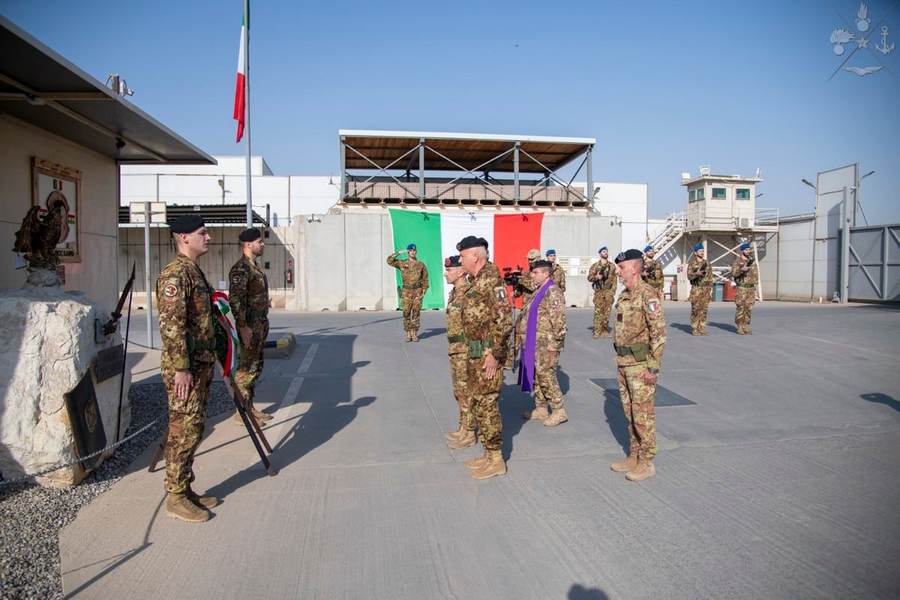
ROME — Italy withdraws troops from Iraq: on Tuesday, Rome completed the pullout of its last soldiers from the country, ending a 12-year military presence, the defence ministry said in a statement. Most of the contingent had already been recalled by March 2026, after an overnight airstrike targeted a military base in the Kurdistan region — and the final departure, one day ahead of a September 30 deadline agreed with local authorities, closes one of Europe's longest-running overseas missions.
Italian forces served in two overlapping missions: the U.S.-led Operation Inherent Resolve, the coalition campaign against the Islamic State, and NATO Mission Iraq, the alliance's non-combat advisory and capacity-building mission. Defence Minister Guido Crosetto said the withdrawal marked a transition "towards greater Iraqi responsibility for its own security." Two Italian Carabinieri officers will remain in the country under the European Union's EUAM Iraq mission, which operates with the Iraqi government's approval — a civilian advisory footprint, not a military one.
The announcement, reported by Reuters, makes Italy one of the first major European contributors to fully exit Iraq in 2026 — and it lands in a year when the entire Western military posture in the country is being renegotiated, with the United States itself winding down its own mission, as we reported earlier this month.
Why this matters
Twelve-year missions do not end quietly, and this one is ending at the worst possible moment for the idea behind it. Italy's presence in Iraq was premised on a simple bargain: Western training, airpower and advice would build an Iraqi security apparatus capable of holding the country together after the Islamic State's territorial defeat, while the troops themselves stayed largely out of combat. That bargain is now being unwound not because it succeeded, but because the region around it caught fire.
The deeper significance is about what the withdrawal signals to everyone watching — and everyone is watching. For Baghdad, it is a sovereignty milestone: an Iraqi government that has spent years insisting foreign troops must leave can now point to a European ally that actually left. For Tehran and its aligned factions, it is one fewer Western flag in the country. For the Kurds in Erbil, who hosted the Italian contingent and relied on it as both a shield and a signal of international commitment, it is a loss that will be felt in morale before it is felt in capability.
And for the rest of Europe, Italy's exit is a precedent with momentum. When one NATO ally concludes that the force-protection calculus no longer works — that keeping a few hundred soldiers at Erbil is worth less than the political cost of a casualty — others start doing the same arithmetic. The March airstrike did not injure Italian personnel, but it changed the mission's risk profile overnight. Missions that begin as counter-terrorism partnerships and end as force-protection exercises rarely survive the transition.
How we got here: twelve years in Iraq
Italy's Iraq deployment began in the summer of 2014, when the Islamic State's lightning seizure of Mosul and a third of the country triggered the formation of the U.S.-led coalition. Rome's contribution grew into one of the larger European footprints: training Iraqi and Kurdish forces, protecting infrastructure like the Mosul Dam works, and later staffing NATO Mission Iraq, the alliance's advisory mission launched to professionalise Iraq's security institutions.
For most of that decade, the mission was a quiet success story of the kind European defence ministries like to cite — no combat deaths in the headlines, steady partnership work, a visible flag in the coalition. The turning point came in March 2026, when an overnight airstrike hit the military base in the Kurdistan region hosting Italian personnel. Rome's response was swift: most of the contingent was recalled within weeks, and what remained became a rear-guard managing the logistics of departure rather than a functioning mission.
That sequence — strike, drawdown, negotiated exit — is worth dwelling on, because it is becoming the template for how Western missions in the Middle East end in the 2020s. Not with a victory parade or a formal defeat, but with a threat assessment, a charter flight, and a deadline agreed "with local authorities." The September 30 date in the defence ministry's statement is doing diplomatic work: it frames the exit as orderly and consensual, the opposite of a rout.
The numbers, in context
12 years. Italy's presence spanned the entire arc of the anti-ISIS campaign: the 2014 collapse, the grinding reconquest of Mosul completed in 2017, the declaration of the caliphate's territorial defeat in 2019, and the long insurgent tail that followed. Few European deployments of the post-9/11 era lasted that long without a single dramatic inflection point — which is precisely why the March airstrike mattered so much. It supplied, in one night, the inflection the mission had lacked.
23 years. The American mission in Iraq, which Washington is also winding down this year, lasted nearly twice as long — a reminder that Italy's exit is part of a general Western retrenchment, not an Italian exception. When the coalition's largest contributor and one of its most committed European partners both head for the door in the same year, the trend is structural: the era of the big Western footprint in Iraq is ending, and Baghdad knows it.
2. The number of Italians staying behind — two Carabinieri officers under EUAM Iraq, the EU's civilian advisory mission. The figure is symbolic more than operational, but symbols are the point: Rome is not abandoning Iraq, it is downgrading from a military partnership to a civilian one. Whether that distinction survives contact with a deteriorating security environment is the open question.
September 30. The agreed departure deadline, met a day early. Compare that with withdrawals that missed their dates, renegotiated them, or never set them: hitting the deadline is Rome's way of telling Baghdad, Brussels and Washington that this was a managed transition, not a panicked evacuation. In the diplomacy of exits, punctuality is a message.
Who wins, who loses — and what the critics say
The winners are easy to name. Iraq's government gets the sovereignty win it has been demanding — every foreign flag that comes down is domestic political capital for a prime minister who must show that Baghdad, not Washington or Rome, guarantees Iraqi security. Iran-aligned factions, which have spent years attacking the legitimacy of the foreign presence (and occasionally the bases themselves), get to claim the outcome as their victory. And Giorgia Meloni's government gets its soldiers home before a casualty forces a harder conversation — force protection is also domestic politics.
The losers are quieter but real. The Kurdistan Regional Government loses a partner whose presence at Erbil was a tripwire: an attack on the base risked hitting Italians, which raised the cost of attacking it. NATO Mission Iraq loses one of its contributing nations at the exact moment the mission's rationale — building Iraqi institutions — is being tested by regional escalation. And the counter-ISIS mission loses continuity: the Islamic State's insurgent remnants did not leave Iraq when the Italians did.
The critics' case comes in two versions. The charitable version says the timing is terrible: withdrawing while the region slides toward wider confrontation — the Iran confrontation we have been tracking live — reads as abandoning partners at the moment of maximum danger. The harsher version says the March airstrike revealed the truth: the mission persisted for years on institutional inertia, and it took incoming fire to force a decision that should have been taken on strategy. Both versions agree on one thing — exits conducted under threat look like retreats whatever the press release says.
Rome's answer is Crosetto's phrase: "greater Iraqi responsibility for its own security." It is the standard language of every managed withdrawal, and it is not wrong — Iraq's forces are vastly more capable than in 2014. But it elides the harder truth: Iraqi responsibility was always the goal, and the goal was declared achieved at the moment staying became too dangerous. That is not a strategy; it is a rationalisation. Whether history treats it as wisdom or evasion will depend on what happens in Iraq next.
What happens next
Three things to watch. First, NATO Mission Iraq itself: Italy was a contributor, not the mission, and the alliance's advisory presence continues — but every national exit raises the question of whether the mission has a future as anything more than a flag and a headquarters. If France or Germany follows Rome's logic, the mission hollows out from within.
Second, the Kurdistan base network. Erbil hosted multiple national contingents in a shared security environment; Italy's departure changes the force-protection math for everyone who remains. Expect quiet bilateral conversations in the coming weeks about who covers which gaps — and expect some of those conversations to end with further drawdowns.
Third, Baghdad's test. The "greater Iraqi responsibility" Crosetto invoked is about to be graded in real time: can Iraqi forces hold the line against ISIS remnants and manage the Iran-aligned militias without the Western advisory scaffolding that has underpinned them for a decade? The two Carabinieri staying under EUAM Iraq will be watching from the civilian side. Everyone else will be watching from farther away than they were yesterday.
Sources and further reading
Reuters, "Italy completes troop withdrawal from Iraq," 29 September 2026 (reporting by Angelo Amante), reuters.com; the wire carried by TBS News, WIXX, Devdiscourse and MENA Today; Italian Ministry of Defence statements via difesa.it. Related Signal Post News coverage: U.S. forces exit Iraq, ending a 23-year mission, Iraq suspends all Iranian flights amid sanctions, and the Iran/UNGA live blog.