War · Middle East · Gaza
Eight dead in one day under a ceasefire that has not stopped the fire — five police officers in the south and a 4-year-old boy in the north.
Track it live: Israel war map
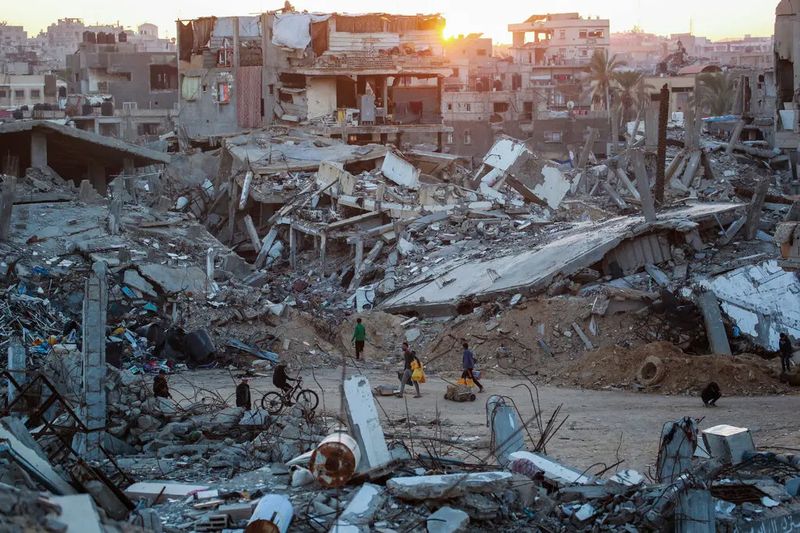
KHAN YOUNIS, Gaza Strip, November 1, 2026 — Israeli strikes kill eight in Gaza on Sunday in two separate attacks at opposite ends of the territory, according to medics and the Hamas-run interior ministry: five people in al-Mawasi, west of Khan Younis in the south, and three in Gaza City’s Rimal neighbourhood in the north. Gaza’s Ministry of Interior said the five killed in the south were police officers carrying out their duties. The dead in the north included a four-year-old boy, according to Shifa Hospital. The killings came more than a year into a US-brokered ceasefire that has reduced the war’s scale without ending its daily toll — and on a day when each side again accused the other of breaking the deal both signed.
No names of Sunday’s dead were published in the reports available at publication time. What follows is what the day’s reporting establishes, what each side claims, and why a toll of eight in a single day has become, in this ceasefire’s arithmetic, an almost ordinary number — which is precisely the problem it poses for the agreement’s future.
What happened in Khan Younis
The Khan Younis strike today: five dead in al-Mawasi
The southern strike hit al-Mawasi, the coastal strip west of Khan Younis that Israel has designated a humanitarian zone and to which displaced families were ordered to move, according to Al Jazeera, which cited hospital sources for the toll: five people killed and several others wounded. Reuters, reporting from Cairo, placed the strike in western Khan Younis and attributed the identification of the dead to the Hamas-run interior ministry: the five were police officers. The Associated Press, in its Middle East roundup, reported that the five bodies were taken to Nasser Hospital in Khan Younis, the south’s main medical facility.
Gaza’s Ministry of Interior said the officers were targeted while carrying out their duties. Al Jazeera’s Hani Mahmoud, reporting from Gaza City, put it in the ministry’s terms: “They were targeted as they were doing their jobs.” That characterisation — police at work, struck from the air — is the Palestinian account of the al-Mawasi strike in November 2026, reported here as that account. Israel’s account of the same strike is different, and is set out in full below; the two accounts agree on the location and the number of dead, and on little else.
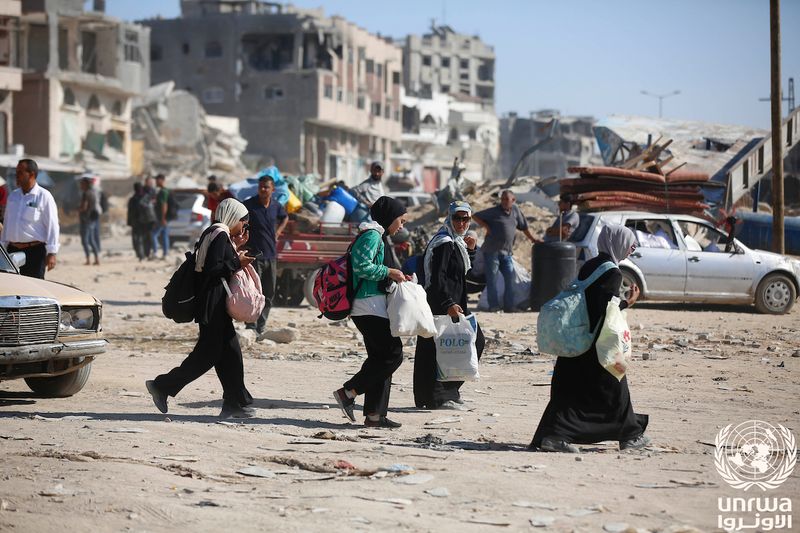
Al-Mawasi’s status is part of why this strike will be argued over: it is the zone Israel itself directed civilians toward, and where much of southern Gaza’s displaced population now lives in tents. A strike there that kills five men whom Gaza’s authorities call police officers and Israel’s military calls militants compresses the war’s central argument — who counts as a combatant inside a crowded, half-ruined territory — into a single incident. Neither side published evidence for its description of the five men on Sunday.
What happened in Gaza City
The Gaza City Rimal strike: three dead, including a 4-year-old
In the north, a strike on Gaza City’s Rimal neighbourhood killed three people, including a four-year-old boy, and seriously wounded a woman, according to Shifa Hospital, as reported by the Associated Press. Reuters’ account, attributed to medics, likewise reported three people killed in an Israeli airstrike in Gaza City. Al Jazeera, citing sources at al-Shifa Hospital, also reported three killed in Rimal, among them the four-year-old. The three reports, from three news organisations drawing on the two hospitals that received the casualties, agree on the count and on the child’s age.
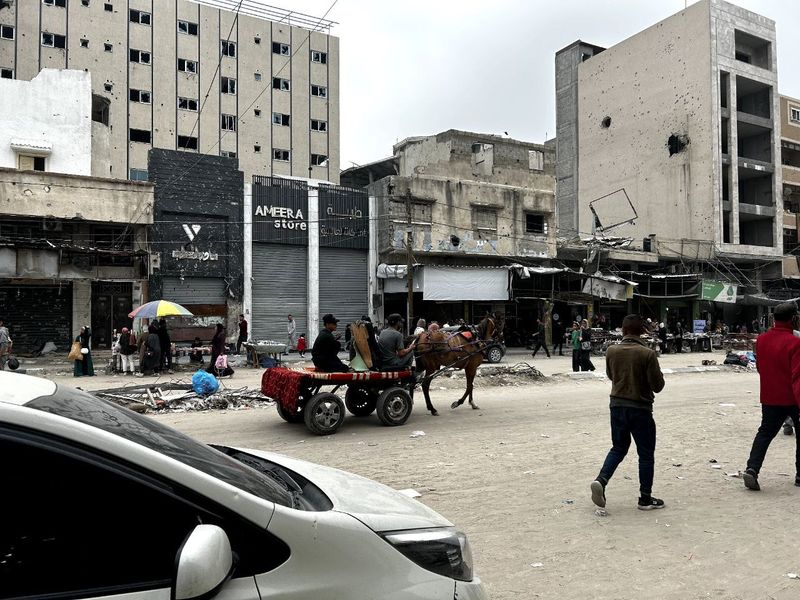
Rimal was, before the war, one of Gaza City’s most built-up commercial districts, in the part of the territory that remains under effective Hamas control, outside the roughly two-thirds of Gaza that Israeli troops now hold. No Israeli statement specifically addressing the Rimal strike had been published in Reuters’ initial report; the military’s broader account, which arrived in stages through Sunday, is detailed in the next section.
What each side says
Israel’s account, in the order it emerged
Israel’s military descriptions of Sunday’s strikes reached the public in stages, and the sequence matters because the accounts are not identical. In Reuters’ initial reporting, the military said it had struck several militants in Khan Younis, gave no further information, and did not immediately comment on the Gaza City strike. Al Jazeera reported that the army told the AFP news agency it was targeting “a terrorist” in southern Gaza. In the Associated Press’s later roundup, the military said it had struck several militants in Khan Younis and one Hamas militant in northern Gaza. None of the statements, in the reporting published Sunday, addressed the Interior Ministry’s statement that the five men in al-Mawasi were police officers, or Shifa Hospital’s report that a four-year-old was among the dead in Rimal.
That framing sits inside Israel’s standing position, as Reuters summarised it: Israel says Hamas has been rearming and launching attacks in violation of the ceasefire, and it has stepped up strikes in recent weeks. The AP adds the other standing element: that Israel’s strikes aim at militant targets, and that Israel accuses Hamas of using civilians as human shields. Those are Israel’s claims, stated as Israel states them; Sunday’s incidents have not been independently verified by any of the three news organisations, and neither side’s description of the targets is presented here as established fact.
Hamas’s and the Palestinian position
Hamas’s standing position is the mirror image. Hamas has denied that it is trying to carry out attacks or rebuild its arsenal, and it accuses Israel of undermining the Gaza peace deal, according to Reuters. Gaza’s Interior Ministry — part of the Hamas-run administration that still governs the third of the territory Israel does not hold — framed Sunday’s southern strike specifically as an attack on police performing their duties. The Health Ministry folds Sunday’s eight into a ceasefire toll it puts at more than 1,570 dead. Palestinian officials’ broader claim is that near-daily strikes of this kind are themselves the violation: a ceasefire that permits one side to keep firing is, on that reading, not being implemented at all.
Why this matters
A ceasefire that still produces lethal days
The first reason Sunday matters is the calendar. The ceasefire took effect in October 2025; Sunday’s strikes came in its second year. A truce in its thirteenth month that still produces eight deaths in a day, in two places, is performing a different function from the one its name announces: it caps the war’s intensity rather than ending it. Both sides continue to invoke the agreement — Israel to demand Hamas disarm under it, Hamas to accuse Israel of breaching it — but its central promise to Gaza’s residents, that the killing would stop, is the one part of it Sunday’s hospitals would not recognise.
Gaza police officers killed: governance, or militancy?
The second reason is the argument inside the al-Mawasi strike itself. Gaza’s police are employed by the Hamas-run administration. To Palestinian officials, they are the territory’s civil order — the men who direct traffic, guard aid distribution and staff checkpoints — and killing them is an attack on governance. To Israel, which describes its Khan Younis targets as militants, armed men serving a Hamas-run security apparatus are part of the organisation it is fighting, whatever their day-to-day duties. That disagreement is not a detail of Sunday’s strike; it is the unresolved question of the whole post-ceasefire order, because any eventual settlement has to decide who polices Gaza. Signal Post News reports both readings without adopting either.
The deadlock the strikes keep exposing
The third reason is structural. The ceasefire’s unfinished business is a pair of linked moves: Hamas disarming, and Israeli troops withdrawing — and Reuters’ summary is blunt: little progress has been made, and negotiators have not agreed terms for either. Each lethal day hardens the sequencing argument. Israel’s stated logic is that strikes answer violations, and withdrawal without disarmament invites rearmament. The Palestinian stated logic is that the strikes are themselves the violation, and disarmament without withdrawal is surrender dressed as process. Sunday did not create that circle, but eight more deaths will be cited inside it, by both sides, in opposite directions.
Context and background
The war began on October 7, 2023, when Hamas-led fighters attacked southern Israel, killing about 1,200 people, according to Reuters; the Associated Press adds that 251 people were abducted into Gaza. Israel’s ensuing military campaign in Gaza has, by the counts examined below, killed more than 74,000 Palestinians. Last year’s US-brokered ceasefire, which took effect in October 2025, halted the largest-scale fighting and called, in its later phases, for eventual reconstruction of the territory.
The Gaza that Sunday’s strikes landed in is a divided territory. Israeli troops control about two-thirds of it, from which residents were ordered out, according to Reuters. Nearly all of Gaza’s more than 2 million residents live in the remaining third, among the ruins, mostly in makeshift tents and damaged buildings, in the part still under effective Hamas control. Khan Younis and Gaza City both sit in that crowded third. Our earlier explainers trace how this pattern formed: why Israel strikes Gaza despite the ceasefire, and how the deal reached this point in the Trump Gaza plan a year on and the ceasefire’s one-year anniversary.
What the numbers actually imply
Eight in a day, against 1,500 since the ceasefire
Asked plainly — how many killed in Gaza since ceasefire? — the sources give a range, not a figure. Reuters cites Gaza health officials for at least 1,500 Palestinians killed in Israeli attacks since the ceasefire; the Associated Press puts the Health Ministry’s figure at more than 1,570. Across the roughly 387 days between the ceasefire taking effect in October 2025 and Sunday, that is an average of about four deaths a day, every day, for thirteen months. Sunday’s eight is therefore about double an average ceasefire day — a bad day by the truce’s own grim standard, and nowhere near the tolls of the war’s open phase. Israel says four of its soldiers have been killed since the ceasefire, according to Reuters; that figure, from the other side of the same ledger, is part of Israel’s stated case that the truce is being violated against it too.
Why the Gaza ceasefire death toll differs by source
The overall war toll shows the same pattern at larger scale: more than 74,000 dead, according to Palestinian authorities cited by Reuters; more than 74,500 in the AP’s rendering of the Health Ministry’s count; and 74,594 in Al Jazeera’s, attributed to the Gaza Ministry of Health. The differences are mostly timing — the ministry updates its count continuously, and each organisation froze it at a different hour — plus the deeper caveat the AP attaches: the Health Ministry does not distinguish between civilians and militants in its figures. A toll that does not separate combatants from non-combatants can establish the scale of death without settling its composition, which is exactly the ground on which Sunday’s argument over five men in al-Mawasi is being fought.
What happens next
Three scenarios cover most of what could follow, and they are not equally likely. The first, and on the evidence of the past thirteen months the most probable, is continuation: the strike tempo of recent weeks persists, each incident is logged by the other side as a violation, and the disarmament and withdrawal talks continue to not conclude. The second is pressure: a day that kills police officers in a designated humanitarian zone and a four-year-old in the north is the kind of incident mediators use, and the coming days will show whether the US and the regional brokers treat November 1 as a reason to force the sequencing question — who moves first on disarmament and withdrawal — rather than let it drift. The third is deterioration: if either side concludes the framework no longer restrains the other at all, the cap the ceasefire places on the fighting is itself at risk, and the residents crowded into a third of Gaza have the most to lose from its removal. Reconstruction, the ceasefire’s promised third act, waits behind all three: it was conditioned on the security questions that remain unanswered.
For now, the established facts of Sunday are narrow and should be stated narrowly: eight people were killed in two strikes — five of them men Gaza’s Interior Ministry calls police officers and Israel’s military calls militants, and three of them residents of Rimal, one of them four years old. Everything beyond that — intent, justification, consequence — is claim and counter-claim, and this article has labelled it as such.
Related coverage: Why Israel Strikes Gaza Despite the Ceasefire, Explained · Trump Gaza Plan One Year On: The Ceasefire Stalled · Gaza Ceasefire One-Year Anniversary
Sources
- Reuters, November 1, 2026 (Nidal al-Mughrabi, Cairo) — “Israeli strikes kill eight people in Gaza, medics say”: at least eight Palestinians killed in two attacks, five police officers in western Khan Younis per the Hamas-run interior ministry and three in a Gaza City airstrike per medics; the military’s statement that it struck several militants in Khan Younis and its initial non-comment on Gaza City; Israel’s position that Hamas is rearming in violation of the ceasefire and Hamas’s denial; at least 1,500 killed since the ceasefire per Gaza health officials and four Israeli soldiers killed; more than 74,000 killed overall per Palestinian authorities; and the ceasefire background, including the two-thirds/one-third territorial split and the stalled disarmament and withdrawal talks.
- Al Jazeera, November 1, 2026, as carried by Barbados Gazette — “At least eight Palestinians killed in Israeli attacks across Gaza”: hospital sources for the toll; the al-Mawasi strike west of Khan Younis killing five and wounding several; the Interior Ministry’s statement that police officers were targeted on duty and Hani Mahmoud’s reporting from Gaza City; the army’s statement to AFP that it was targeting “a terrorist” in southern Gaza; three killed including a four-year-old boy in Rimal per al-Shifa Hospital sources; more than 1,500 killed since the ceasefire; and 74,594 killed overall per the Gaza Ministry of Health.
- Associated Press, November 1, 2026, Mideast roundup, as carried by Listen Up Y’all — “Israeli strike kills boy in Gaza as Qataris say vessel struck in Gulf, and other Mideast news”: five killed in Khan Younis per Nasser Hospital, where the bodies were taken; three killed in Gaza City including the boy, and a woman seriously wounded, per Shifa Hospital; the military’s later statement that it struck several militants in Khan Younis and one Hamas militant in northern Gaza; more than 1,570 killed since the truce began and more than 74,500 overall per Gaza’s Health Ministry, which does not distinguish civilians and militants; and the October 7, 2023 attack toll of about 1,200 killed and 251 abducted.