gaza ceasefire anniversary
One year after the war in Gaza was declared over, more than 100 humanitarian groups say the ceasefire "exists in name only" — and the numbers back them up: over 1,400 Palestinians killed, the boundary line moved, and almost none of the deal's big promises kept.
October 10, 2026, marks exactly one year since the announcement of an end to the war in Gaza — and the anniversary arrived the way the year itself has unfolded: with airstrikes. Overnight, Israeli warplanes bombed residential buildings in Gaza City and Khan Younis after ordering nighttime evacuations, killing a child and a woman from a displaced family and wounding at least seven people, according to local medical and civil-defense reports. By morning, more than 100 humanitarian, human-rights and civil-society organizations had issued a joint verdict on the twelve months since the deal: the Gaza ceasefire, they said, "exists in name only."
The collision of those two facts — a formal truce and a bombing campaign — is the story of the year. The question the anniversary forces is not whether the ceasefire failed in some technical sense. It is what a "ceasefire" means when 1,400 people are killed under it.
Track it live: follow the Israel–Gaza conflict on our Live Global Trackers.
Why this matters: anniversaries are verdicts
Anniversaries are the moments when conflicts get audited. A year ago, President Donald Trump stood at a summit marking the agreement and declared a "once-in-a-lifetime chance to put the old feuds and bitter hatreds behind us." The deal was supposed to end the killing, start the rebuilding, and hand Gaza's administration to a new internationally backed body. One year on, the audit reads like an indictment — not of one side's intentions, but of the entire architecture of the agreement.
Consider the timing. The ceasefire anniversary lands just days after Israel marked the third anniversary of the October 7, 2023 Hamas-led attack, with memorials at the Nova festival site and Kfar Aza kibbutz and a national ceremony in Tel Aviv's Yarkon Park. Prime Minister Benjamin Netanyahu lit a memorial candle for every victim and said Israel had killed 4,000 of the 6,000 Palestinians who infiltrated Israel that day; Hamas issued a defiant statement calling October 7 a "glorious day." This was, the BBC noted, the first anniversary with no hostages remaining in Gaza. And yet strikes on Gaza continued through the commemorations — AFP reporters heard explosions that Gaza officials said killed five people. A ceasefire that cannot pause for its own anniversary is not a pause at all.
There is a second layer of significance. On October 9 — one day before the ceasefire anniversary — the Nobel Peace Prize went to Navi Pillay, the chair of the UN inquiry into Gaza (read our coverage of the announcement and Israel's furious reaction). The world's most famous peace prize and the world's most contested ceasefire collided in the same news cycle, and the contrast is hard to miss: one honors the documentation of what happened in Gaza, the other was supposed to prevent more of it from happening.
What the 100+ organizations actually said
The joint statement, released October 9 and signed by groups including Amnesty International, Oxfam, and Save the Children, does not mince words: the killing and deprivation in Gaza "must not be normalised under the cover of a ceasefire agreement."
Their core findings:
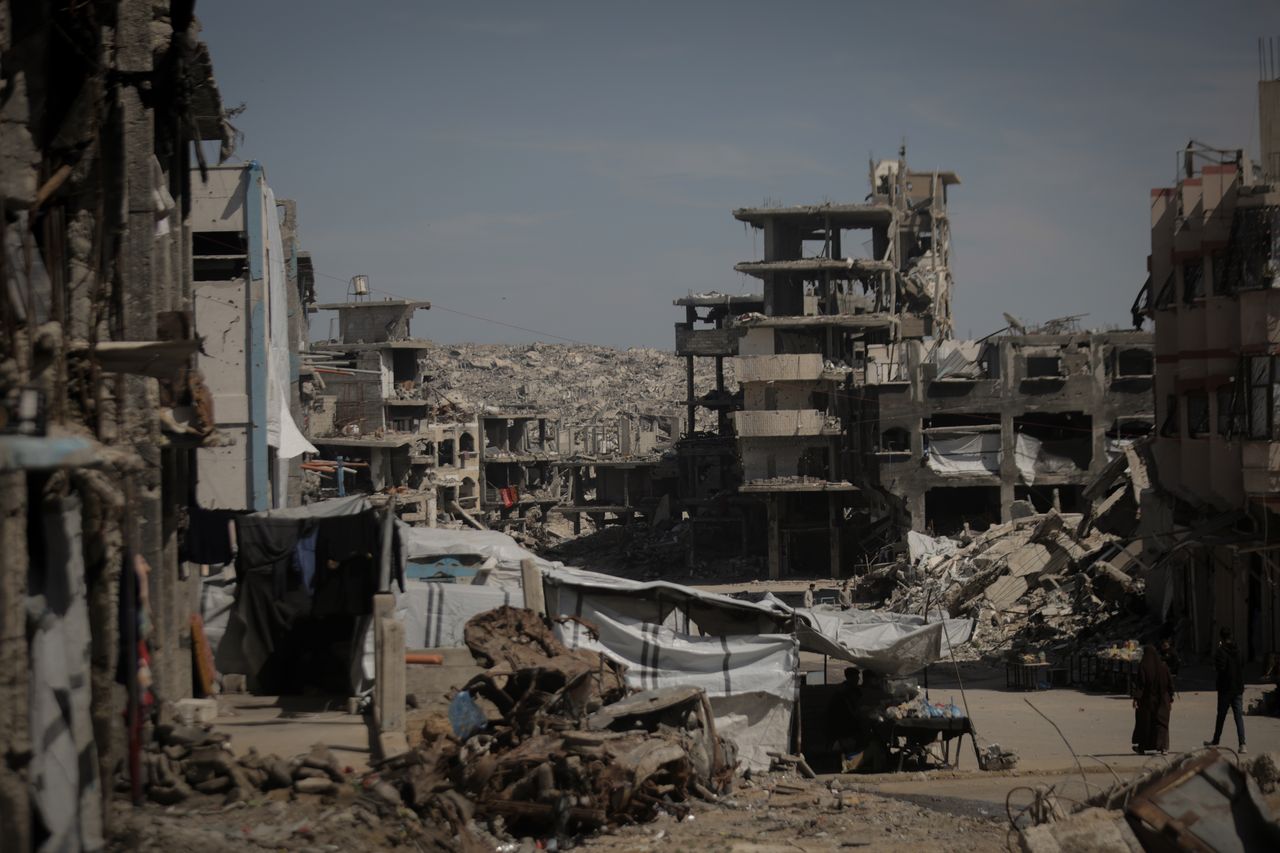
- More than 1,400 Palestinians killed by Israeli strikes, shootings and military operations since the truce took effect — including at least 327 children. Families and rescue workers have recovered hundreds of bodies from the rubble, often with their bare hands, because Israeli authorities restrict the entry of the heavy machinery needed to reach the buried. Many more bodies remain unreachable.
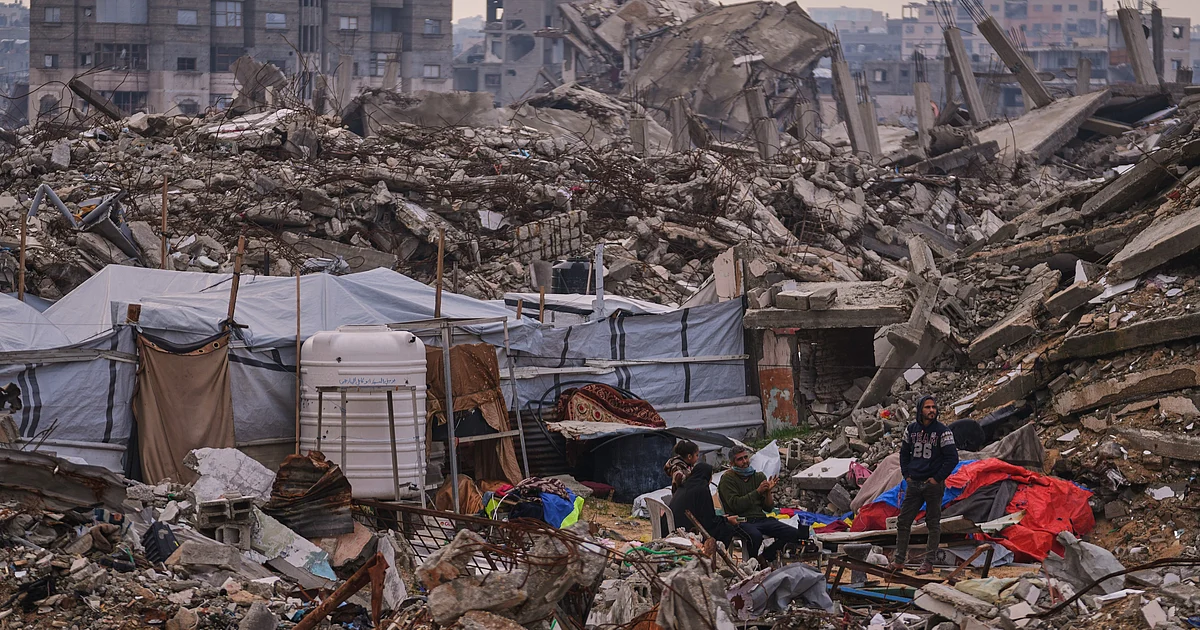
- Nearly two million people still need shelter. According to UNRWA, 235,000 displaced Gazans are sheltering in 400 flood-prone sites, and 44,000 remain in unstable buildings at risk of collapse — with winter approaching.
- Not a single hospital is fully functioning. OCHA reports 20 of Gaza's 37 hospitals remain only partially functional.
- 1.4 million people face crisis-level hunger, while restrictions on aid, equipment and rebuilding materials prevent any recovery.
- The "Yellow Line" — the withdrawal boundary set in the agreement — has been moved further into Gaza by the Israeli military, beyond the line the deal specified, squeezing Palestinians into an increasingly small and overcrowded area.
"Governments must act to end Israel's attacks and restrictions on our work," said Mohsen Abu Ramadan of the Palestinian NGO Network, "and donors must provide direct, flexible funding to meet the needs." Save the Children CEO Inger Ashing warned against the normalization of a war conducted under a ceasefire's name.
What the numbers actually imply
Figures in a conflict this contested need context, not just repetition. Here is what the anniversary numbers mean when you put them against the war that preceded them.
The Gaza Health Ministry, which operates under the Hamas-run government and maintains detailed records generally considered reliable by UN agencies and independent experts (its toll does not distinguish between civilians and combatants; it says women and children account for about half of those killed), puts the full war's death toll above 74,000. The 1,400 killed during the ceasefire year is roughly 2 percent of that total — but it averages to nearly 120 deaths a month under a deal whose entire premise was that the killing had stopped. UN human rights chief Volker Türk, noting at least 85 civilians killed and 346 injured in Gaza strikes since Monday alone, called the scale and manner of the attacks "reprehensible."
The child figure deserves its own line: 327 of the 1,400 dead — about 23 percent — were children. That is lower than the roughly 50-percent women-and-children share reported during the full war, which is consistent with a shift from area bombardment to targeted strikes and shootings. It is also, plainly, more than 300 dead children under a ceasefire.
On the Israeli side, the same period saw five Israeli soldiers killed in Gaza, according to recent reporting — a reminder that the truce has not been one-directional in its violence, and that Israeli forces operating inside the strip remain exposed. The BBC's tally puts the post-ceasefire toll at more than 1,460 Palestinians and seven Israeli soldiers.
Then there is the displacement math. Nine in ten Gazans are internally displaced, many repeatedly. OCHA's September update counted 1,334 deaths and 4,429 injuries since the ceasefire began — and warned that winter preparedness at overcrowded displacement sites is "severely constrained" by funding shortages and entry restrictions. The anniversary is arriving at the worst possible seasonal moment: hundreds of thousands of people in tents and flood zones, with the rains coming.
What was promised versus what happened
The October 2025 agreement was not just a halt to the shooting. It was a political program — and nearly every element of that program is unfulfilled.
The Board of Peace and the new administration
The deal called for Hamas to transfer power to a committee of Palestinian administrators vetted by a new "Board of Peace" chaired by Trump. Hamas formally dissolved its government in July but retained the civil service — and, crucially, remains the dominant force in the roughly 40 percent of Gaza not controlled by Israeli troops. Meanwhile, Israel has prevented the new Palestinian administration from entering Gaza through Egypt. The result: a power vacuum filled by the two armed parties, and no functioning civilian authority. (Palestinian elections, meanwhile, have been postponed — another institution that failed to materialize.)
The International Stabilisation Force
Plans for an International Stabilisation Force were announced in February. It has never been established. Indonesia, which pledged the largest contingent at 8,000 troops, suspended its plans last spring as international attention shifted to the war involving Iran. No other country filled the gap. The force that was supposed to guarantee the truce does not exist.
Withdrawal and the Yellow Line
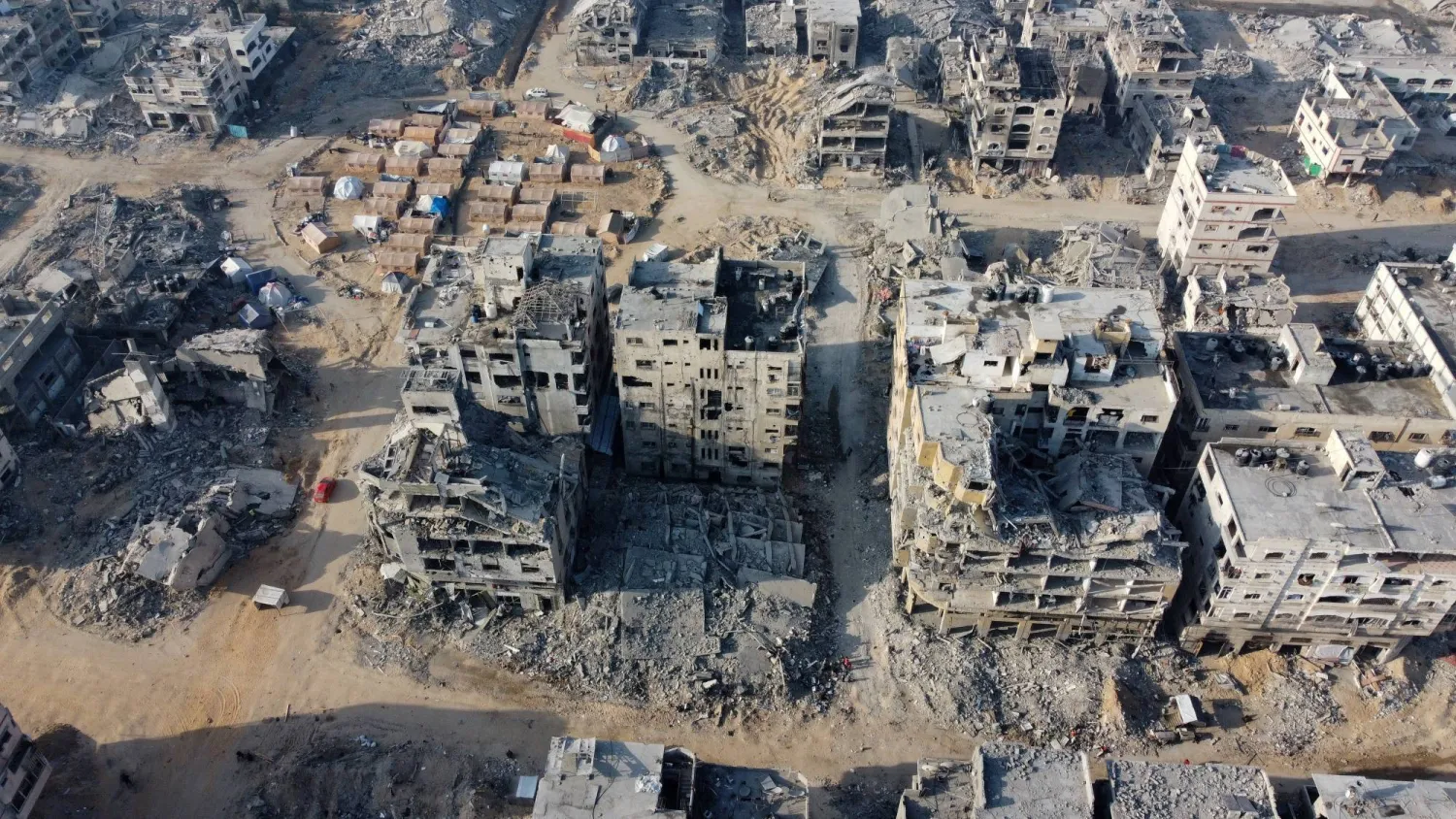
Israel was expected to withdraw under the agreement. Instead, it has taken control of additional territory, pushing the so-called Yellow Line of Control westward toward the Mediterranean Sea. Estimates of Israeli-controlled territory have crept from the 53 percent envisioned in the deal toward 60 percent and beyond, with Netanyahu reported to have ordered an expansion toward 70 percent. Each westward shift of the line is, in effect, a territorial gain achieved under a ceasefire — the precise thing ceasefires are meant to prevent.
Reconstruction
The framework was supposed to open the door to rebuilding Gaza's collapsed healthcare system and shattered infrastructure. Instead, according to OCHA, entry restrictions on construction materials, machinery and even rubble-clearing equipment remain in place. The UN Environment Programme has estimated it would take seven years of daily truck convoys to clear Gaza's debris — work that cannot begin while the materials to do it are blocked at the border.
Disarmament
The deal's most sensitive requirement — the disarmament of Hamas — is where the entire structure jammed. Hamas officials have said the group will not hand over its weapons yet, with the fate of its arsenal to be decided only after discussions with other Palestinian factions. Israel, in turn, treats Hamas's continued armament as the reason the other commitments cannot proceed. Each side's precondition is the other's red line.
Both sides' stated reasons — and what critics say
Israel's position, as stated by its military and government, is that its strikes target people who violate the ceasefire: those approaching or crossing the Yellow Line, those who participated in the October 7 attack, and Hamas operatives who refuse to disarm. From this view, the 1,400 deaths are the cost of enforcing a truce against a group that never disarmed — and the Yellow Line's westward movement is a security buffer, not a land grab. Israeli officials also point to the five to seven soldiers killed in Gaza since the truce as evidence that their forces face real threats.
Hamas's position is that the group will not surrender its weapons without a comprehensive political settlement, and that Israel's strikes — which frequently kill civilians — are the actual ceasefire violations. From this view, the truce was supposed to end the killing and begin reconstruction; Israel's continued operations, territorial expansion and aid restrictions are a continuation of the war by other means.
The humanitarian organizations' position — the one that made the anniversary news — is that the debate over who violated what misses the point: whatever the justifications, a "ceasefire" under which 1,400 people are killed, 2 million go unsheltered, and no hospital functions is a fiction, and calling it a ceasefire normalizes the killing.
Readers should note where the facts are genuinely disputed: casualty attribution (the Health Ministry's figures are considered reliable by the UN but are compiled under Hamas-run administration), the circumstances of individual strikes (Israel says it targets violators; Palestinian sources say civilians are hit), and the status of the Yellow Line (an agreed boundary versus a moving security perimeter). What is not disputed is the direction of travel: more territory under Israeli control, more dead, no reconstruction, no second phase.
What happens next: three scenarios
Scenario 1: The slow erosion continues (most likely). The current pattern — periodic strikes, a creeping Yellow Line, no Phase 2, no reconstruction — simply extends into a second year. The "ceasefire" becomes a permanent condition: not war, not peace, but a managed level of violence that the world stops noticing. This is already happening; the anniversary coverage is the exception, not the rule. In this scenario, the 1,400 becomes 2,800, and Gaza's humanitarian indicators — hunger, shelter, healthcare — keep deteriorating through another winter.
Scenario 2: Outside pressure forces movement. The U.S. midterm elections on November 3 give Washington a reason to want a visible win — or at least no visible disaster. A post-midterms push could revive the Board of Peace, pressure Israel on the Yellow Line, and extract a disarmament framework from Hamas via regional mediators. The obstacles are the same ones that have blocked every previous push: Hamas will not disarm without political guarantees, and Israel's government has shown no appetite for the withdrawals disarmament would supposedly buy.
Scenario 3: The truce collapses back into full war. A mass-casualty strike, a major cross-border attack, or a miscalculation around the Yellow Line could end the fiction in a day. Both sides retain the capacity for rapid escalation, the International Stabilisation Force that was supposed to prevent it does not exist, and the region is already inflamed by the wider US–Iran confrontation. The anniversary's overnight strikes are a reminder of how thin the membrane is between "ceasefire in name only" and no ceasefire at all.
One year ago, the announcement in October 2025 was sold as the end of the war. The honest accounting, twelve months later, is that the war changed shape instead of ending: from bombardment to strikes, from invasion to occupation, from a declared conflict to an undeclared one. The 100 organizations are right about the label. The harder question — the one the second year will answer — is whether anyone with the power to change the reality still wants to.
Sources
- Amnesty International — "Gaza ceasefire exists in name only, say more than 100 organizations" (Oct 9, 2026) — amnesty.org
- Oxfam Canada — "Gaza ceasefire exists in name only, say more than 100 organizations" (Oct 9, 2026) — oxfam.ca
- TBS News — "Gaza ceasefire stalls a year after US-brokered deal as Israeli strikes continue" (Oct 2026) — tbsnews.net
- UN News — "World News in Brief: Russian attacks continue in Ukraine, Gazans shelter in flood-prone areas" (Oct 2026) — news.un.org
- UN/OCHA via GlobalSecurity — "Six UN staff killed in Gaza school strike" (Sept 14, 2026) — globalsecurity.org
- NewsBeep — "A Year into Ceasefire, Israel Wages a Scaled-Down War in Gaza" (Oct 10, 2026) — newsbeep.com (overnight strike details attributed to local medical and civil-defense reports)
- CVRD News — "Israel Marks Three Years Since October 7 Hamas Attack Amid Ongoing Gaza Strikes" (Oct 8, 2026) — cvrdnews.com