Israel closes Gaza crossings October 7

Israel closes Gaza crossings October 7 anniversary — the order came on Sunday from Defense Minister Israel Katz: a general closure of every crossing into the Gaza Strip and the West Bank on October 5 and October 7, the two days framing the third anniversary of the October 7, 2023 Hamas attack. The Coordinator of Government Activities in the Territories — COGAT, the Israeli military body that administers the crossings — supplied the detail that gives the order its weight: while the crossings are closed, no humanitarian aid will enter Gaza.
Katz said the closure was imposed ahead of memorial ceremonies marking the anniversary, and stressed that it does not apply to Israelis using West Bank checkpoints. Palestinian “essential workers in the healthcare sector” will be permitted to cross, as will Palestinians whose movement is required by what Katz described as “commitments by the state to the High Court of Justice.” Any other exceptions fall to COGAT, which will rule on humanitarian, medical and other exceptional cases one by one.
The announcement, reported on October 4 by AzerNEWS, the Quds News Network, News Beep and others, lands in a Gaza that is technically living under a ceasefire — aid has been flowing through COGAT-overseen mechanisms — and in a West Bank where closures for holidays and security anniversaries are a grimly familiar ritual. This one is different in scale and symbolism: a full seal of both territories, with the aid tap turned off, for the anniversary that defines the current era of the conflict.
Why this matters
The October 7 anniversary is the emotional and political center of gravity of this war. For Israel, the ceremonies on October 7 are a national moment of mourning; the government’s first duty, in its own telling, is to make sure the commemorations pass without a security incident. A general closure is the bluntest tool available for that job: freeze movement, reduce the variables, and deny anyone the opportunity to turn a day of remembrance into a day of violence.
But the closure does not land on an empty map. It lands on a Gaza where, by COGAT’s own accounting, the humanitarian pipeline is the difference between subsistence and crisis — and on a West Bank where tens of thousands of Palestinians depend on daily passage through Israeli checkpoints to reach jobs, hospitals and universities. Sealing both territories for two days, and switching off the aid flow into Gaza entirely, converts a security precaution into a humanitarian event. That is why the order made international news within hours: it sits exactly at the intersection of Israel’s security logic and the world’s humanitarian alarm.
There is a third dimension, and it is political. Anniversaries are performances — every government uses them to tell a story about itself. The story Israel is telling with this closure is one of control: the state can still seal the territories at will, three years into a war that was supposed to have ended Hamas’s capacity to threaten it. The story its critics will tell is the mirror image: that three years on, the anniversary still requires locking millions of people in.
How we got here
October 7, 2023 needs no retelling here, but its shadow explains everything about this decision. The Hamas-led attack killed some 1,200 people in Israel and saw more than 250 taken hostage; the war that followed has killed tens of thousands in Gaza and redrawn the region. Each anniversary since has been a security event as much as a memorial one — the Israel Defense Forces routinely raise alert levels around the date, and this year is no exception, with the IDF reported on high alert across the Gaza border ahead of the commemorations.
The closure mechanism itself is not new. Israel has imposed general closures on the West Bank and Gaza for decades — during Jewish holidays, during elections, during periods of heightened tension. What is notable this time is the pairing: both territories sealed at once, explicitly tied to the anniversary ceremonies, with the aid cutoff stated openly by COGAT rather than left ambiguous.
According to Spanish outlet Demócrata, citing The Times of Israel, the decision followed a recommendation from the armed forces after a security assessment — the standard choreography for such orders, in which the defense minister acts on military advice. That matters because it frames the closure as a professional security judgment rather than a political gesture, a distinction the government will lean on if the humanitarian criticism sharpens.
The timing also matters. Gaza is in a ceasefire, fragile but holding, and aid has been moving — COGAT says roughly 1.78 million tons of food entered between October 2025 and June 2026. A closure that explicitly halts that flow, even for two days, tests the proposition that the ceasefire has normalized anything at all.

What the closure actually does
The order covers October 5 and October 7 — not the 6th, a detail that underscores the ceremonial logic: the closures bracket the anniversary events rather than blanketing the whole week. During those two days, no Palestinians will be permitted to enter Israel from the West Bank, and the Gaza crossings will be shut.
The exceptions are narrow and, in one case, entirely discretionary. Palestinian essential healthcare workers may cross. So may Palestinians whose passage is covered by state commitments to the High Court of Justice, and people crossing for matters connected to the Seam Zone — the strip of West Bank land between the separation barrier and the Green Line. Everything else goes to COGAT, which will decide “humanitarian, medical and other exceptional cases” individually. In practice, as the Quds News Network notes, that gives Israeli military administrators case-by-case control over who moves and who does not.
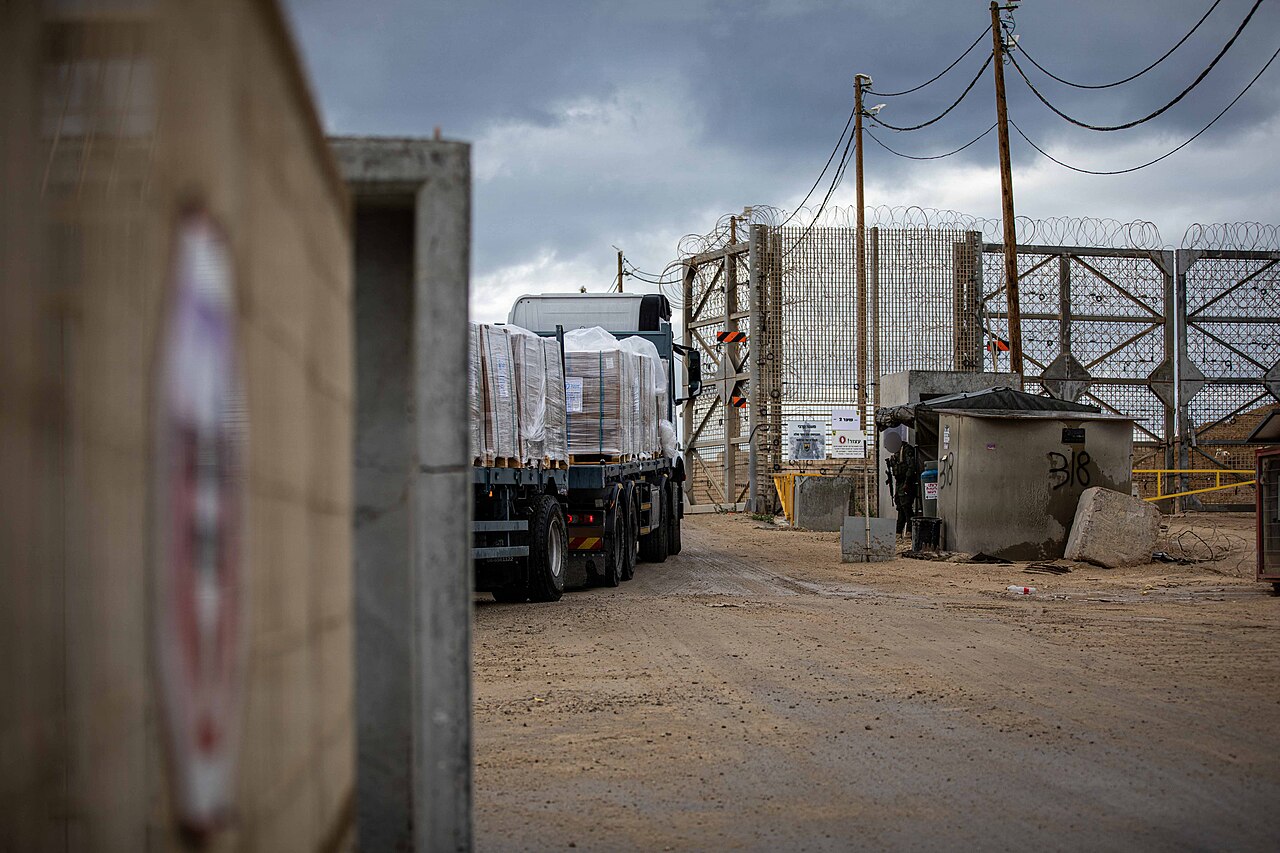
On the Gaza side, the aid cutoff is total for the duration: no humanitarian shipments will enter. COGAT added two qualifiers — aid already on the Gazan side of the Kerem Shalom crossing will continue to be collected “as usual,” and the agency asserts the closure “will not affect the humanitarian situation in the Gaza Strip.” The Quds News Network reports the closure also cuts the crossing with Jordan, sealing the West Bank’s last external outlet.
What does not close: the checkpoints for Israelis. Settlers and Israeli citizens moving through West Bank checkpoints face no restrictions during the same period — a asymmetry that is standard for general closures, and the detail critics seize on first.
Who wins, who loses
Israel’s government gets the security posture it wants for the anniversary: a controlled environment for ceremonies that will draw the nation’s attention and, inevitably, its enemies’. If the days pass quietly, the closure will be cited as the reason.
Palestinian workers lose two days’ income. Tens of thousands of West Bank Palestinians work in Israel and the settlements; a closure day is a day without pay, and this one was announced with barely 24 hours’ notice. Patients with hospital appointments across the barrier face the COGAT lottery. Aid-dependent families in Gaza lose two days of inbound shipments — COGAT says the pipeline can absorb it; the families cannot verify that.
COGAT and the IDF get operational simplicity: fewer moving parts on days when the security establishment is already stretched thin by the anniversary alert.
Hamas and its sympathizers get a narrative gift. Every closure is presented by critics as collective punishment, and an anniversary closure — sealing Palestinians in while Israel mourns — writes its own propaganda. Whether that narrative moves anyone who was not already convinced is another question.
What the critics say
The sharpest criticism comes from the Palestinian press. The Quds News Network frames the closure as collective punishment: Palestinians, it notes, are “the occupied population in whose land the events are taking place,” yet they are the ones sealed in while Israelis move freely. The outlet points to conditions inside Gaza — hospitals running on failing generators, 87 percent of households without proper sanitation — as the context in which even a two-day aid halt matters.
International humanitarian organizations have not issued fresh statements on this specific closure at the time of writing, but their standing position is well documented: general closures that restrict civilian movement and aid, they argue, must be necessary and proportionate, and the burden of proof lies with the authority imposing them. The UN’s humanitarian chief has previously called for all Gaza crossings to be open with “completely unimpeded access.”
COGAT’s answer is on the record: the closure will not affect the humanitarian situation, aid collection on the Gaza side continues as usual, and the measure follows a security assessment. The Israeli government’s broader position — consistent across years of closures — is that the restrictions are a regrettable but unavoidable cost of preventing attacks, and that the exceptions process exists precisely to keep the cost from falling on the genuinely vulnerable.
The honest accounting is that both claims can be partly true. A two-day halt in a functioning aid pipeline is absorbable; a two-day halt at the end of a long chain of disruptions is not obviously so. Which description fits Gaza in October 2026 depends on facts — stockpile levels, distribution capacity, what was already in the pipeline — that neither side has fully published.
The numbers, and what they mean
Put the figures side by side and the shape of the decision comes into focus. Two closure days out of 365 — a fraction of a percent of the year, and the government’s case in miniature: a minimal, time-boxed precaution. Zero aid shipments entering Gaza on those days — the critics’ case in miniature: the tap can be turned off at will, and was.
The 1.78 million tons is COGAT’s shield: roughly 1.78 million tons of food entered Gaza between October 2025 and June 2026, the agency said in July, maintaining that supply levels exceeded UN benchmarks. If true, it means the pipeline entering the closure is the fullest it has been in years — which is precisely why COGAT feels able to assert that two closed days “will not affect the humanitarian situation.” The figure has not been independently verified by Signal Post News, and UN agencies have repeatedly disputed Israeli accounting of aid flows — but as a statement of the government’s confidence, it is revealing.
The 87 percent — the share of Gaza households the Quds News Network says lack proper sanitation — is the counter-number. It describes not the flow of aid but the stock of devastation: three years of war have left Gaza’s infrastructure in ruins, which means the population’s margin for absorbing any disruption, however brief, is thinner than the tonnage figures suggest. Tonnage measures what goes in; it does not measure what people can do with it once the generators fail.
There is a historical number worth keeping in mind: three. This is the third October 7 anniversary, and the pattern of anniversary closures is now an institution. Institutions persist because they work for the people who maintain them — the question, as with every general closure since the 1990s, is who pays for them to work.
What happens next
The immediate timeline is fixed: closures on October 5 and October 7, reopening on the 8th. The practical test comes in the days after — whether the aid backlog clears quickly through Kerem Shalom, whether workers’ permits resume without friction, and whether COGAT’s case-by-case exceptions during the closure function as advertised or become a source of grievance stories.
The political test is the ceremonies themselves. If October 7 passes without incident, the government will claim vindication and the closure will join the long list of security measures nobody debates afterward. If anything goes wrong despite the seal, the questions will be sharper: what was the closure for, and what did it cost the people it locked in?
The longer arc is the one nobody controls. Each anniversary closure normalizes the next; each one also deepens the record that critics cite. Three years into the war, the October 7 anniversary has become a date on which the conflict’s entire asymmetry — one side mourning in security, the other sealed in place — is visible in a single frame. That visibility is itself a fact both sides will use, and neither can avoid.
Sources
- AzerNEWS — “Katz orders closure of crossings into Gaza, West Bank” (October 4, 2026)
- Quds News Network — “Israel Seals West Bank and Gaza to Mark October 7” (October 4, 2026)
- News Beep — “Israel to close West Bank, Gaza crossings for October 7 remembrance ceremonies” (October 4, 2026)
- Demócrata — “Israel closes the crossings with the West Bank and Gaza for the anniversary of October 7” (October 4, 2026)
Closure dates, exception categories and COGAT statements in this article are as reported by the outlets above on October 4, 2026, citing Defense Minister Israel Katz and COGAT announcements. Aid-flow figures are COGAT’s stated figures as reported by News Beep and have not been independently verified by Signal Post News. Casualty and conditions figures attributed to the Quds News Network are that outlet’s reporting.