Ireland teachers strike

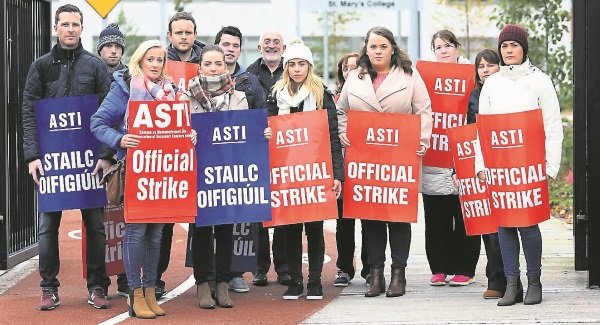
The Ireland teachers strike campaign moved from warning to action on Monday, October 5, as members of the Irish National Teachers’ Organisation and the Association of Secondary Teachers, Ireland began working strictly to contract in a dispute over a new public-sector pay agreement.
The immediate result is not a nationwide closure. Schools remain open, and teaching continues. But the system around the classroom narrows sharply: teachers will not provide pre-school or after-school supervision, complete the 36 annual additional hours commonly known as Croke Park hours, answer calls or email outside contracted time, or attend out-of-hours meetings. Parent-teacher meetings may take place only during school hours.
That is the opening move. A full one-day strike is set for Wednesday, October 14, when schools are expected to close nationwide. The official Fórsa education action FAQ lists strike days on October 14 and October 21. INTO General Secretary John Boyle has also said he expects the second day to proceed and warned that the campaign will intensify after Halloween if the Government’s approach does not change.
Ireland teachers work to rule: what changes from today
Contracted hours only, with supervision and Croke Park hours withdrawn
The phrase “work-to-rule” can sound abstract. In schools, it is designed to make visible how much daily operation depends on duties performed around formal teaching time. INTO’s roughly 50,000 primary-teacher members are limiting work across more than 3,300 primary schools. ASTI’s approximately 20,000 secondary teachers are taking parallel action. The Teachers’ Union of Ireland is scheduled to begin industrial action one week later, on October 12.
Under the union instructions, teachers will arrive and leave within contracted hours. They will not undertake before- or after-school supervision, the Croke Park hours that add 36 hours annually for planning and other duties, or work calls, emails and meetings outside the school day. Parents can still meet teachers, but only when a meeting fits inside school hours.
The purpose is calibrated pressure. Unions can impose operational friction without immediately removing classroom instruction. Principals must rearrange supervision, meetings become harder to schedule, and tasks normally absorbed at the edges of the day return to the timetable. For parents, the visible impact will vary by school, but changes to drop-off, pickup and meeting arrangements may appear before the strike date.
Why this matters
An Ireland school closures strike would test families and the Government at once
This dispute matters because education is both a public service and the timetable around which working life is organized. A withdrawn meeting can be rescheduled. A nationwide school closure forces families to find childcare, miss work or rely on relatives. The cost therefore travels quickly beyond teachers and the education budget.
Exam-year students carry a different risk. One day of lost instruction will not determine a Leaving Certificate result, but a sequence of work-to-rule restrictions, strike days and post-Halloween escalation can interrupt revision plans, practical coursework and the regular teacher contact on which students rely. The uncertainty is more damaging than any single date because schools cannot plan confidently around an open-ended campaign.
For the unions, that public inconvenience is also their leverage. A 99% mandate among voting INTO members and a 95%-to-5% ASTI result on 56% turnout are not narrow leadership decisions. They tell ministers that members are prepared to act and that a settlement imposed without a meaningful opening pay offer may not hold.
For the Government, conceding under pressure could set terms across the wider public service. Refusing to move could produce Ireland’s largest school disruption in a decade and deepen a wave already involving more than 100,000 public-sector workers. That is why a teachers work to rule Ireland dispute has become a test of the entire pay-setting framework.
The pay agreement expired June 30
Ireland teacher pay dispute grew from a failed opening to negotiations
The previous public-sector pay agreement expired on June 30. Unions say the Government did not engage seriously enough on a successor capable of addressing living costs, recruitment and retention. Their demand is procedural as well as financial: they want an offer on the table at the beginning of negotiations, rather than entering a process without a defined pay proposal.
The Government rejects that condition. Education Minister Helen McEntee has said strikes “won’t benefit anybody,” while Public Expenditure Minister Jack Chambers has called the action “unfair on the public.” Ministers argue that formal talks cannot begin with a precondition dictating the opening offer.
The unions’ response is that the existing framework offers no credible basis for talks. ICTU-affiliated unions wrote to Chambers saying there was “no basis” to enter negotiations under the current approach. The disagreement is therefore not yet about whether a particular percentage is adequate; it is about what must exist before bargaining starts.
That distinction explains the pace of escalation. If both sides were haggling over a number, mediation could split the difference. Here, the Government says an advance offer would compromise the process, while unions say no offer means there is no serious process. Each side is asking the other to move first.
Ballot numbers show unions are displaying muscle
INTO strike October 2026 mandate reached 99%; ASTI recorded 95%
INTO’s 99% vote for action gives John Boyle and the union executive an unusually strong mandate among participating members. ASTI reported a 95%-to-5% vote on a 56% turnout, placing General Secretary Linda Kelly in a similarly firm position. Combined, the two unions represent roughly 70,000 teachers before TUI action begins.
Those figures matter in two directions. They strengthen the unions’ credibility with the Government, but they also reduce room for leaders to accept a cosmetic concession. When members vote almost unanimously, negotiators must be able to show that any settlement addresses the substance of pay and the pressures that pushed staff toward action.
The 2016 ASTI dispute offers the relevant caution. Industrial action over pay and Croke Park obligations escalated into school closures and prolonged confrontation. The circumstances are not identical, but the precedent shows how quickly a dispute over additional duties can become a test of authority, membership discipline and public patience.
Recruitment and retention sit beneath the headline numbers. Unions argue that the cost of living and the attractiveness of alternative careers make staffing harder, particularly where housing costs are high. That claim will require detailed bargaining over pay scales and workforce data, but politically it gives the action a second frame: not only what current teachers earn, but whether schools can keep enough teachers in classrooms.
October 14 strike: Ireland schools face nationwide closure
ASTI pickets, INTO participation and a likely October 21 sequel
On Wednesday, October 14, ASTI members plan pickets at every school where the union is represented. INTO is joining the broader public-sector strike that day. The practical expectation is nationwide school closure, not the uneven disruption of a work-to-rule.
The calendar is intentionally compressed. TUI action begins on October 12; the all-school strike follows two days later; a second strike day is listed for October 21. Boyle has said, “We realise we are in for a long battle,” and indicated that action will “ratchet up” if there is no change in mindset by the end of October, with further intensification after Halloween.
That sequence gives the Government a short negotiating window. It also gives families little time to arrange care. Working parents are not bargaining parties, but they become an economic transmission mechanism: school closure creates absenteeism and lost hours across retail, health care, offices and small businesses.
The political risk for unions is equally clear. Public support can weaken when households repeatedly absorb the cost. The unions’ strategy therefore depends on convincing voters that inconvenience is the consequence of Government inaction, not an end in itself. McEntee and Chambers are trying to reverse that attribution by emphasizing harm to the public.

The Government is facing a 100,000-worker wave
Ireland public sector pay deal pressure now reaches health and universities
The teachers are not acting in isolation. More than 100,000 public-sector workers are already engaged in work-to-rule action, with Fórsa, SIPTU and Irish Nurses and Midwives Organisation members having begun earlier in the week. Health Service Executive contingency planning shows that the dispute has moved beyond symbolic protest.
The Irish Dental Association is due to join the October 14 strike, the first such action in its history. The Irish Federation of University Teachers scheduled a one-hour stoppage on October 5. Each group has its own workplace concerns, but the common argument is that the expired agreement must be replaced by a credible cost-of-living settlement.
That breadth changes the Government’s calculation. A school-only compromise could divide the coalition of unions, but it could also encourage every group to escalate for sector-specific gains. A uniform public-service offer is easier to administer, yet may not resolve acute recruitment pressures in teaching, nursing or other professions.
Analysis: the 100,000-plus figure is the unions’ strongest strategic asset and their largest coordination challenge. A broad front can force ministers to engage, but workers in schools, hospitals, universities and civil-service offices do not experience identical labor markets. A durable agreement will need a common pay spine plus a mechanism for hard-to-staff sectors, or it risks solving the headline dispute while leaving the workforce problem intact.
What a settlement would require
Three routes before October 14 — and escalation after Halloween
An opening offer unlocks talks. The Government could place a costed pay proposal into the process without conceding that unions may dictate the outcome. That would satisfy the unions’ demand for something concrete while preserving negotiation over timing, percentages and sectoral measures.
A mediator bridges the procedural gap. An independent labor-relations intervention could allow both sides to move without publicly surrendering. The mediator could table parameters rather than a Government “precondition,” creating enough ambiguity for formal talks to start and industrial action to be paused.
No agreement before October 14. The work-to-rule continues, TUI joins on October 12 and schools close two days later. If the October 21 strike proceeds and there is still no change by month’s end, the unions’ stated trajectory points toward more intensive action after Halloween.
A sustainable settlement needs more than a one-off headline payment. It must address purchasing power since the previous deal, provide a predictable term for future increases and confront recruitment and retention where staffing data justify targeted measures. It must also create a route back from industrial action: restoration of supervision, out-of-hours contact and Croke Park obligations cannot be left to drift school by school.
The immediate watchpoints are concrete. Will the Government place an offer before unions? Will TUI proceed on October 12? Will contingency plans be published early enough for families? And will union leaders suspend October 14 if talks begin, or require a negotiated package first? Until one side changes the opening conditions, the timetable favors disruption.
Sources
- The Irish Sun, October 5 — start of the work-to-rule, school impact, INTO membership, supervision restrictions and John Boyle’s escalation timetable.
- The Irish Sun — Helen McEntee and Jack Chambers on the dispute, and the timing of INTO, ASTI and TUI action.
- Fórsa education industrial-action FAQ — official union details on ballots, work-to-rule instructions and the October 14 and October 21 strike dates.
- Labour Party Ireland, September 18 — confirmation of the October 5 work-to-rule following the union votes.
- Social Democrats — INTO and ASTI action dates and the October 14 strike.
Reporting note: Dates, membership figures, ballot results and quoted positions are attributed to the sources above. Assessments of leverage, political risk and settlement scenarios are Signal Post News analysis.