War · Middle East · Iraq
The Iraq Kataib Hezbollah standoff entered its most dangerous phase on Wednesday: Iraq’s top military commanders met to study redeployment plans around Jurf al-Sakhar, mediation led by Iran’s Quds Force commander Esmail Qaani failed, and the armed group holding the closed Babil town refused any extension of the deadline — Friday, November 20, at about 8pm — to hand over its positions.
Track it live: Middle East tracker · Live wars tracker
BAGHDAD, November 18, 2026 — The Iraq Kataib Hezbollah standoff is no longer a war of statements. Iraq’s top military commanders met on Wednesday to discuss redeployment plans around Jurf al-Sakhar, the closed town in Babil province about 60 kilometres (37 miles) southwest of Baghdad that Kataib Hezbollah has held since it was retaken from the Islamic State group in October 2014 and renamed Jurf al-Nasr, Shafaq News reported. On the same day, mediation led by Esmail Qaani, commander of Iran’s Quds Force, and figures from Iraq’s ruling Coordination Framework failed: Kataib Hezbollah leader al-Zaidi refused any extension of the deadline of Friday, November 20, at about 8pm for the group to hand over and vacate its positions, according to AFP and Shafaq News reporting. Military reinforcements continued to arrive in Babil province on Wednesday to deploy around the town, Arab News reported, carrying AFP. Two days remain before the Iraqi state is due to test, with soldiers, whether its writ runs in a town it has not controlled for twelve years.
What changed on Wednesday
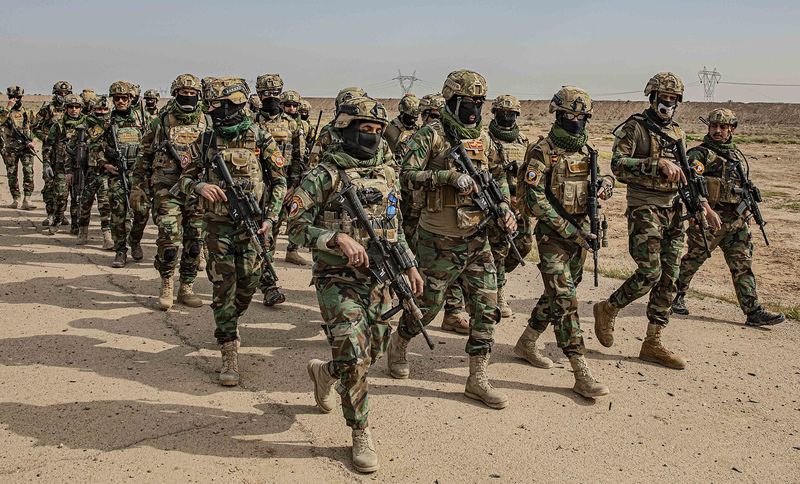
Three things moved on Wednesday, and together they closed most of the space in which this crisis could have been quietly settled. The first was military. Iraq’s top security commanders agreed to study plans to redeploy forces and redraw areas of responsibility in Jurf al-Sakhar, the office of the commander-in-chief said, in a meeting called on Prime Minister Ali al-Zaidi’s orders and chaired by Lt. Gen. Abdul Amir al-Shammari, Shafaq News reported. The heads of the Counter Terrorism Service, the ground forces and the Federal Police sat in the room, alongside senior army, Interior Ministry and Popular Mobilization Forces operations officials. A redeployment study is not an attack order — but it is the paperwork an army completes before positions change hands, by agreement or otherwise, and Baghdad published it two days before its own deadline.
The second was diplomatic, and it failed. Negotiations between the Coordination Framework and Kataib Hezbollah, involving Qaani, did not resolve the standoff, and no extension of the Friday evening deadline was granted, a political source told Shafaq News on Wednesday; AFP’s reporting likewise recorded the refusal of any extension. Qaani’s presence in the mediation is itself a measure of the crisis: the Quds Force commander is Tehran’s senior officer for its allied armed groups abroad, and his involvement means Iran has been asked — by Baghdad, by the Framework, or both — to deliver the compliance of its most powerful Iraqi ally. On Wednesday, on the reporting available, he could not, or the group would not be delivered.
The third was positional. Reinforcements from both directions continued to thicken the cordon and the defence: government forces, including Federal Police and Counter Terrorism Service units, have strengthened positions around the area, and Kataib Hezbollah has deployed fighters across Jurf al-Sakhar, according to Shafaq News reporting across the week. Each side’s deployment is described by its own camp as defensive. The geometry does not care about the description: two armed forces, one deadline, and a town between them.
The proposed plan that did not become a deal
The mediation did produce a plan — and the distinction between a plan discussed and a deal agreed is the most important precision in this story. Under the proposal that emerged from talks between Coordination Framework leaders and Qaani, Kataib Hezbollah brigades would redeploy toward the Iraq–Syria border, three Popular Mobilization Forces brigades would move into Jurf al-Sakhar in their place, and the Federal Police would also help secure the district, a source within the alliance told Shafaq News. A three-member committee — Badr Organisation leader Hadi al-Amiri, PMF chairman Falih al-Fayyadh and PMF chief of staff Abdul Aziz al-Muhammadawi, known as Abu Fadak — was expected to present the proposals to Kataib Hezbollah. That is a proposed arrangement, sourced to one alliance insider, not an agreed settlement: Wednesday’s reports that the talks had failed and the deadline would not move are, on their face, the plan’s rejection or at least its suspension. Readers should also know that earlier reports this week suggested a tentative understanding might be within reach; those reports stand unreconciled with Wednesday’s failure reporting, and this article presents both, dated, rather than smoothing them into a single narrative. As of Wednesday evening, the failure reports are the later and more specific accounts.
Timeline: November 9–18
- November 9 — A leaked intelligence report alleges that oil pipelines running through the Jurf al-Sakhar area have been tapped since 2021, with crude siphoned from state lines near the closed town.
- November 13 — An 11-member committee formed by the prime minister’s office and chaired by a PMF official enters Jurf al-Sakhar under heavy escort to inspect the alleged smuggling sites, according to Iraqi reporting summarised by Amwaj Media.
- November 14 — The government confirms oil smuggling and dismisses nine Babil officials — security and oil officials among them — and refers suspects to the judiciary. None of the nine dismissed officials is a Kataib Hezbollah member.
- November 15 — Kataib Hezbollah denies any involvement in smuggling, saying the highlighted site held storage tanks and a simple plant. Government and political sources tell Shafaq News that the Counter Terrorism Service will enter at 8pm on November 20 if the group does not hand over security in the town.
- November 16 — The entry order and a tanker ban follow: the prime minister orders the armed forces to enter Jurf al-Sakhar and sets the deadline for the faction to leave, as this newsroom reported in its account of the crackdown on Kataib Hezbollah oil smuggling. Al Jazeera reports about 8,000 fighters mobilised by the group.
- November 17 — Amwaj Media publishes its Deep Dive on the crisis. A Kataib Hezbollah commander tells AFP the group will not leave Jurf al-Sakhar. The Syria-border redeployment proposal emerges from Coordination Framework talks with Qaani, per Shafaq News.
- November 18 — Top commanders meet under Shammari to study redeployment; mediation fails and any extension of the Friday deadline is refused; reinforcements continue to arrive in Babil.
The town at the centre of it
Jurf al-Sakhar covers about 345 square kilometres (133 square miles) of Babil province, astride the pilgrimage route between Baghdad and Karbala, about 60 km southwest of the capital. Before 2014 it was a mostly Sunni farming town. The Islamic State group seized it; in October 2014, Popular Mobilization Forces-led operations retook it, and Kataib Hezbollah — one of the largest factions inside the PMF umbrella — took full control, renamed it Jurf al-Nasr, “Rock of Victory,” and sealed it. State institutions have since entered only with the group’s consent, and the town’s original residents have not been allowed to return.
How many people that exclusion covers depends on the source, and the figures should not be merged. Al Jazeera’s explainer puts the number of displaced residents prevented from returning at approximately 140,000. Monitors cited by Amwaj Media put the number still displaced from Jurf al-Sakhar and neighbouring Iskandariya at over 40,000 in 2024, naming Kataib Hezbollah as the primary barrier to return. The two figures count different things — a wider district population barred from return, against a monitored displaced caseload across two towns at a point in 2024 — and both are reported here with their sources attached, because the gap between them is itself part of the politics: the larger figure is the measure of a community’s claim, the smaller the measure of what monitors could still count a decade on. What neither source disputes is the fact beneath the arithmetic: a town inside Iraq, an hour from its capital, has been closed to its own people for twelve years, and the force keeping it closed is, on paper, part of the Iraqi state.
What each side says
Baghdad
The government’s public position has been consistent since November 15: oil smuggling has been confirmed by its committee, nine officials have been dismissed, the armed forces have been ordered to enter, and a deadline — the end of the week, specified by security sources as Friday, November 20, at about 8pm — has been set for the faction to hand over security and leave. On Wednesday, Baghdad added process to position: the commanders’ meeting under Shammari, and a separate decision, reported by Shafaq News, to assign the Energy Police to protect the pipeline in Jurf al-Sakhar and to replace the force currently stationed in the area. The framing matters to Baghdad: this is presented as an anti-corruption and sovereignty operation — the recovery of a pipeline and a town — not as a war against a fellow component of the security forces.
Kataib Hezbollah: two registers
The group has spoken in two distinct registers, and conflating them would misread its position. In the field register, relayed by an Iraqi commander quoted by AFP, the militia’s position is that the army would enter “not even over our dead bodies” — a formulation, reported by AFP, in which the group’s fighters set the price of entry at their own lives. In the public register, Kataib Hezbollah official Abu Taleb al-Saeedi, speaking during a press visit to the stronghold, publicly called a confrontation “a distant dream” and said he could say with absolute certainty that the hope the group would withdraw from Jurf al-Sakhar would never be realised, according to AFP reporting carried by Arab News. The two registers are not contradictory; they are addressed to different audiences. The field message tells Baghdad what an entry would cost. The public message tells everyone else that no entry is coming — that the deadline is theatre, and the town will still be held on Saturday. A reader who hears only the defiance misses the dismissal; a reader who hears only the dismissal misses the deployment of fighters across the town that Shafaq News has also reported.
Washington and the mediators
The United States has kept its comment narrow and pointed. The US State Department commented that it expects Iraqi militias to be held accountable, according to Shafaq and AFP reporting — a formulation that backs Baghdad’s accountability framing without committing Washington to any position on the Friday entry itself. The mediators, for their part, have said least of all in public: the Coordination Framework and Qaani conducted their work through sources and leaks, which is why the Syria-border plan exists in the record as a sourced proposal rather than a published text, and why its failure on Wednesday was also reported through sources rather than announced. Silence from the mediation table, two days before a deadline, is its own datum.
Why this matters
Analysis: begin with the constitutional oddity at the centre of the Iraq army militia confrontation Babil is now staging. Kataib Hezbollah is not an insurgency hiding from the state; it is a faction of the Popular Mobilization Forces, a state-recognised body whose fighters draw state salaries and whose chairman, Falih al-Fayyadh, sits in the very committee proposing the group’s redeployment. When Iraq’s army prepares to enter Jurf al-Sakhar, one organ of the Iraqi state is preparing to confront another — and the question being tested is whether the state’s monopoly on force is a fact or a form of words. Every previous prime minister has chosen accommodation at this exact threshold. Analysts who follow the file read Wednesday’s commanders’ meeting against that history: Lahib Higel, the International Crisis Group’s Iraq analyst, has assessed Baghdad’s long pattern of managing the factions through negotiation rather than enforcement — the pattern a Friday entry, if it happens, would break. Amwaj Media’s Deep Dive of November 17 frames the town’s fate the same way, as a proxy for the larger clash over Iraqi state sovereignty.
The second test is Iran’s leverage, and it runs in both directions. Qaani mediation Iraq watchers treat as routine — the Quds Force commander as the one man who can deliver the factions — has, on Wednesday’s reporting, failed to deliver the smallest deliverable: a few more days. If Tehran cannot or will not move Kataib Hezbollah off a deadline, then either Iran’s control over its strongest Iraqi ally is thinner than the standard account assumes, or Tehran has judged that a confrontation in Babil costs it less than the precedent of ordering a retreat under an Iraqi ultimatum. Neither reading is comfortable for Baghdad: the first means there is no one to negotiate with who can actually sign; the second means the negotiation was never the point.
The third test is the timetable. Iraq’s militia disarmament deadline was moved from September 30, 2026 to June 30, 2027 — the Iraq militia disarmament deadline 2027 around which Baghdad’s whole gradualist strategy is built, and the subject of this newsroom’s earlier reporting on the June 2027 disarmament deadline. Analyst Michael Kittleson’s April assessment of that timetable, cited in the analytical coverage of the disarmament campaign, treated the deadline as a political horizon rather than an enforcement mechanism — a date factions could wait out. Jurf al-Sakhar is what happens when a horizon meets a pipeline: a single town, a single accusation and a single Friday have compressed a nine-month timetable into a seventy-two-hour one. If Baghdad enforces at Jurf, the 2027 deadline acquires a demonstration effect no communiqué could give it. If Baghdad blinks, every faction in Iraq will reprice the deadline accordingly — including the groups watching from inside the PMF itself, whose chairman is simultaneously the state’s mediator and, structurally, the accused group’s umbrella chief. That dual role is not a detail. It is the Iraqi system describing itself.
The numbers
345 km² — the area of Jurf al-Sakhar, per Al Jazeera: a district-sized territory, not a compound, which is why “entering” it is an operation and not an arrest. 60 km — its distance southwest of Baghdad, close enough that a clash there is a capital-city event, not a border skirmish. About 140,000 — residents Al Jazeera reports have been barred from returning since 2014. Over 40,000 — people monitors cited by Amwaj counted as still displaced from Jurf and neighbouring Iskandariya in 2024; the two figures measure different populations and are not interchangeable. About 8,000 — fighters Al Jazeera reported the group mobilised as the committee approached, a show of force whose size is the group’s own signal and has not been independently verified. Nine — Babil officials dismissed on November 14, none of them Kataib Hezbollah members. Three deadlines tell the strategic story in one line: September 30, 2026, the original disarmament date; June 30, 2027, the date it was moved to; and Friday, November 20, 2026, at about 8pm — the Jurf al-Sakhar Friday deadline that has overtaken both. Only weeks ago, the pressure ran the other way: Kataib Hezbollah suspended its attacks as the last US troops left Iraq, a pause that now reads as a group conserving itself for the domestic contest it always expected.
What could happen by Friday — and after
Four scenarios cover the plausible space; they are scenarios, not predictions, and the reporting supports each as a possibility rather than a probability. First, handover under the mediation plan: the Syria-border proposal is revived at the last moment, Kataib Hezbollah brigades redeploy, three PMF brigades and the Federal Police enter, and both sides claim the outcome as their own design — Baghdad gets the town, the group keeps its weapons and its dignity, and the committee of al-Amiri, Abu Fadak and al-Fayyadh becomes the template for every future standoff. Second, a last-hour extension: the deadline that was refused an extension on Wednesday is quietly extended anyway, dressed as a technical pause for the redeployment study the commanders commissioned — the historically most travelled road in Iraqi crisis politics, and the one Wednesday’s public refusals were probably designed to make expensive. Third, a limited clash: the Counter Terrorism Service moves at 8pm on Friday, meets the resistance the field register promised, and the fighting is contained — by exhaustion, by clerical and political intervention, by the shared interest of every Shia faction in not beginning a Shia-on-Shia war — after casualties that reset the politics for a generation. Fourth, a wider PMF split: the confrontation escapes Jurf entirely, factions choose sides between the state and Kataib Hezbollah, and the PMF — the umbrella that was supposed to dissolve the militia problem into the state — becomes the arena in which it is fought out. The honest summary of Wednesday is narrower than any of these: the commanders have their study, the mediators have their failure, the group has its two registers, and the clock has two days left on it.
Related coverage
Kataib Hezbollah Oil Smuggling: Iraq’s Prime Minister Readies Troops to Confront the Militia
Iraq’s Militia Disarmament Deadline — Signal Post News
Kata’ib Hezbollah Suspends Attacks as Last U.S. Troops Leave Iraq
More war coverage: Signal Post News — War
Sources
- Shafaq News, November 18, 2026 — “Iraqi commanders study redeployment plans for Jurf Al-Sakhr” (en.hathalyoum.net): Iraq’s top security commanders agreed on Wednesday to study plans to redeploy forces and redraw areas of responsibility in Jurf al-Sakhar; the meeting was called on the prime minister’s orders, chaired by Lt. Gen. Abdul Amir al-Shammari, and brought together the heads of the Counter Terrorism Service, the ground forces and the Federal Police with senior army, Interior Ministry and PMF operations officials, two days before the Friday evening deadline. Shafaq News, November 18, 2026 — “Jurf Al-Sakhr talks stall as Iraqi PM deadline nears, source says” (en.hathalyoum.net): negotiations between the Coordination Framework and Kataib Hezbollah, involving Quds Force commander Esmail Qaani, failed to resolve the standoff, with the Friday evening deadline not extended. Shafaq News, November 17–18, 2026 — “Source: Kataib Hezbollah relocation to Syria border proposed” (en.hathalyoum.net): the proposal to relocate Kataib Hezbollah brigades to the Iraq–Syria border, replace them with three PMF brigades alongside the Federal Police, and present the plan through a committee of Hadi al-Amiri, Falih al-Fayyadh and Abu Fadak — reported as a proposal, and presented as such in this article.
- AFP, November 17–18, 2026, including reporting carried by Arab News, November 18, 2026 — “Military reinforcements mass outside Kataeb Hezbollah stronghold in Iraq as standoff escalates” (arabnews.com): military reinforcements continued to arrive in Babil province on Wednesday to deploy around Jurf al-Sakhar after Kataib Hezbollah vowed not to leave despite the government deadline; a Kataib Hezbollah commander told AFP the group would not leave; Abu Taleb al-Saeedi spoke during a press visit to the stronghold; a security source told AFP the deadline was Friday; and an Iraqi commander quoted by AFP relayed the militia’s field position that the army would enter “not even over our dead bodies.” AFP reporting, via Arab News and Shafaq News, also carried the US State Department’s comment that it expects Iraqi militias to be held accountable.
- Al Jazeera, November 18, 2026 — “What is Iraq’s Jurf al-Sakhar and what is behind gov’t push to control it?” (syndicated copy: trinidadtribune.com): Jurf al-Sakhar spans roughly 345 square kilometres about 60 km southwest of Baghdad on the pilgrimage route to Karbala; PMF-led forces recaptured it from ISIL in 2014 and Kataib Hezbollah took full control, renamed it Jurf al-Nasr and barred state institutions, preventing the return of approximately 140,000 displaced residents; the leaked intelligence report alleged crude siphoned from state pipelines since 2021; the investigative committee entered on November 13; about 8,000 fighters were mobilised by the group; and the disarmament deadline, initially September 30, 2026, has been pushed to June 2027.
- Amwaj Media, Deep Dive, November 17, 2026 — “Fate of secretive town becomes proxy for Iraqi clash over state sovereignty” (amwaj.media): the town was recaptured by PMU-led forces in October 2014 and renamed Jurf al-Nasr; it has since been a closed zone outside federal control; monitors put the number still displaced from Jurf al-Sakhar and neighbouring Iskandariya at over 40,000 in 2024, naming Kataib Hezbollah as the primary barrier to return; the oil smuggling allegations began circulating on November 9 with a classified intelligence document describing crude siphoned since 2021; an 11-member committee chaired by a PMU official entered on November 13; Kataib Hezbollah on November 15 denied smuggling, describing the site as storage tanks and a simple plant; and Shafaq-sourced reporting set the Counter Terrorism Service entry threat at 8pm on November 20. Analytical context in this article draws on the assessments of ICG Iraq analyst Lahib Higel and analyst Michael Kittleson’s April assessment of the disarmament timetable, as cited in the analytical coverage.
- Signal Post News, November 16, 2026 — Kataib Hezbollah Oil Smuggling: Iraq’s Prime Minister Readies Troops to Confront the Militia, drawing on Reuters and the Long War Journal (longwarjournal.org): the November 9 publication of the investigation details, the committee’s confirmation of the intelligence findings, the November 14 dismissal of nine officials, and Kataib Hezbollah’s November 15 denial — the background chronology carried into the timeline above.
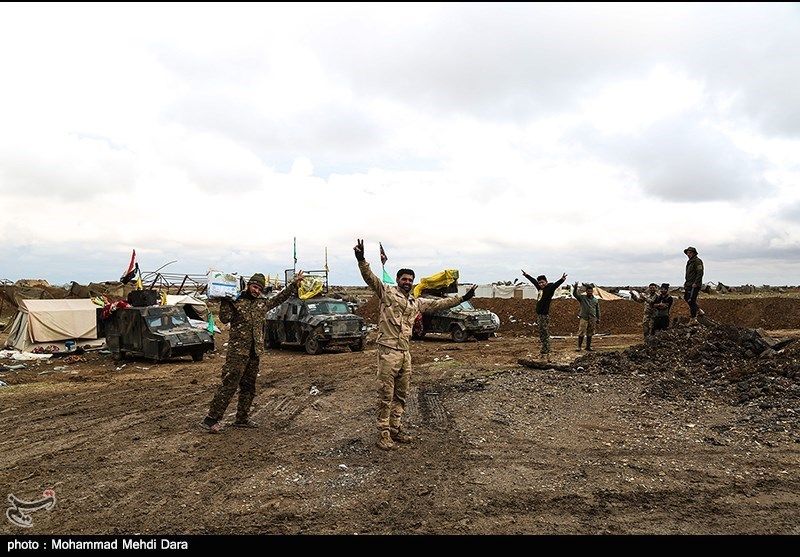
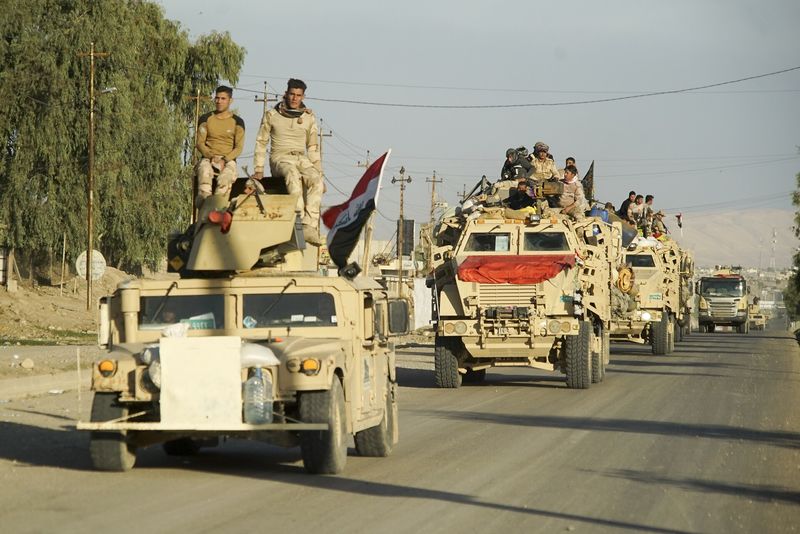
- Photos: file photos via Wikimedia Commons — Iraqi Special Operations Forces at Camp Taji, U.S. Army photo by Sgt. Robert Douglas / DVIDS (public domain); Popular Mobilization Forces north of Tal Afar, by Mohammad Mehdi Dara / Tasnim News Agency (CC BY 4.0); an Iraqi army convoy near Mosul, by Mstyslav Chernov (CC BY-SA 4.0). None depicts Jurf al-Sakhar or the November 2026 deployments, and each is captioned as a file photo.