IDF kills Hamas commander seven hostages
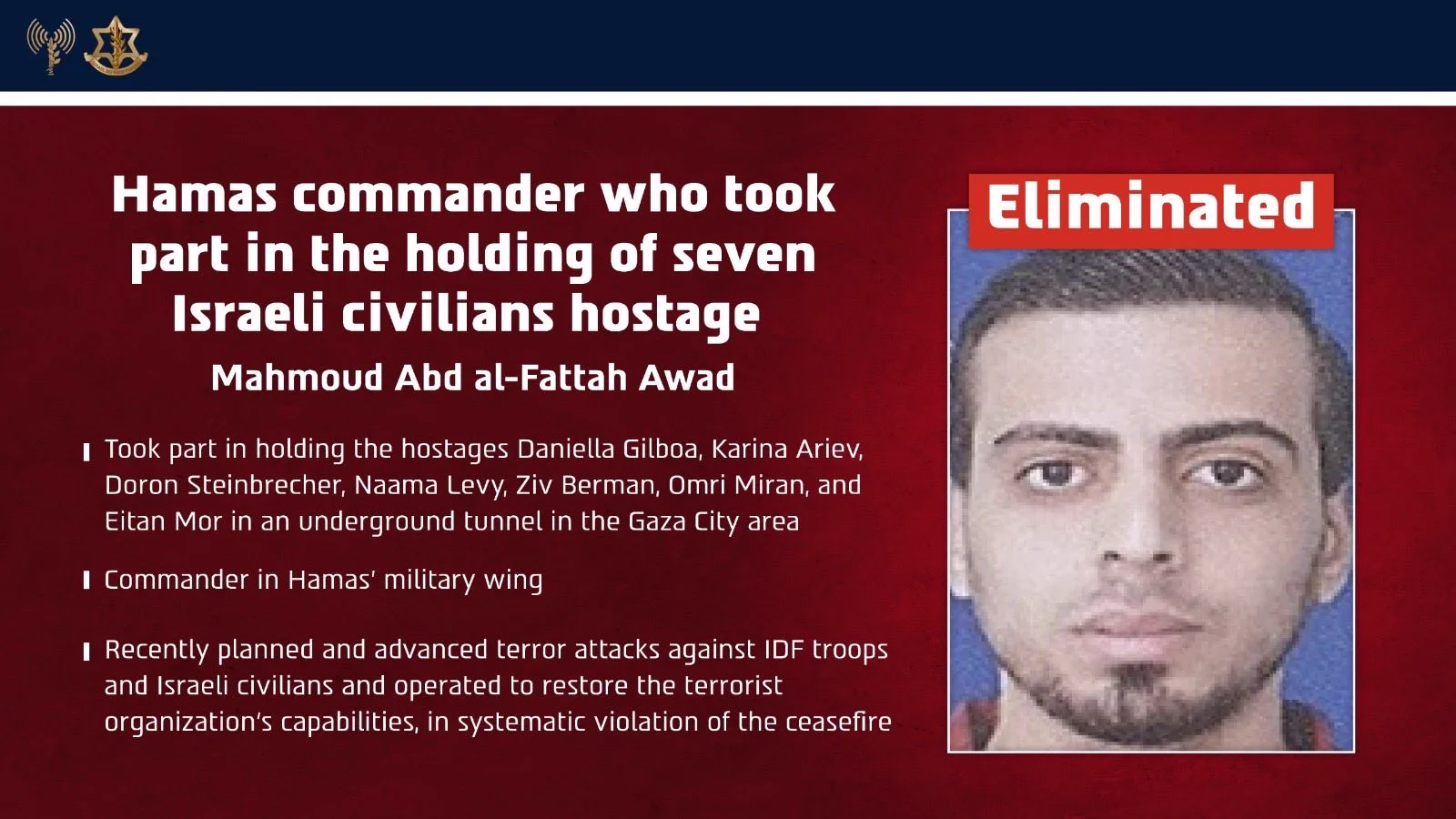
IDF kills Hamas commander seven hostages. That was Israel's announcement on Thursday, September 24, 2026 — and it carried the unmistakable thud of a second shoe dropping. Mahmoud Abd al-Fattah Awad, a commander in Hamas's military wing, was killed in an airstrike in the Gaza City area over the weekend, the Israel Defense Forces said. According to the military, Awad took part in holding seven Israeli hostages in an underground tunnel during the war — and had more recently been plotting attacks and rebuilding Hamas's capabilities "in systematic violation of the ceasefire." It is the second targeted killing Israel has announced in two days, after the killing of Hamas's finance chief on Wednesday. And it is the second time this week that the side policing the ceasefire has been the one breaking its quiet.
What Israel says happened
The announcement came Thursday, in a statement and a red-graphic post on the IDF's official X account. The strike itself, the military said, took place over the weekend, in the Gaza City area — no more precise location was given. The seven hostages Awad is accused of helping hold are named: Daniella Gilboa, Karina Ariev, Doron Steinbrecher, Naama Levy, Ziv Berman, Omri Miran and Eitan Mor — all of them since freed or recovered under the ceasefire arrangements. Beyond the hostage link, the IDF accused Awad of recently planning attacks against Israeli soldiers and civilians and of working to restore Hamas's military capabilities. The military added that "prior to the strike, steps were taken to mitigate harm to civilians, including the use of precise munitions and aerial surveillance" — its standard formulation — and that Southern Command troops remain deployed "in accordance with the agreement" and will "continue to operate to remove any immediate threat." Two things the announcement did not contain: independent confirmation, and any response from Hamas, which had not publicly commented on the claim as of publication. Every operational detail here is, for now, the IDF's account of its own operation.
The second killing in two days
Awad's killing follows, by one day, the killing of Muhammad Abu Alwan, the head of Hamas's Finance Department, in an airstrike near Khan Younis on Wednesday — announced jointly by Prime Minister Benjamin Netanyahu and Defense Minister Israel Katz. Abu Alwan, the two men said, had run Hamas's money for a decade, budgeting all of its branches and directing the transfer of more than one billion shekels during the war to fund its activities; the joint statement said he too had recently been working to restore Hamas's capabilities "in systematic violation of the ceasefire." The statement's closing line was a program, not a eulogy: "We will continue to hunt down Hamas commanders and operatives, target its sources of funding and destroy its terrorist infrastructure. We will not allow Hamas to rebuild its strength, nor will we stop until Hamas no longer exists in Gaza." Read together, the two killings look less like isolated enforcement and more like a campaign — command and money, the two halves of an organization Israel is trying to erase. (Our full report on the Abu Alwan strike is here: article-israel-kills-hamas-finance-chief-abu-alwan-gaza-september-2026.)
Why this matters: a ceasefire that only one side enforces
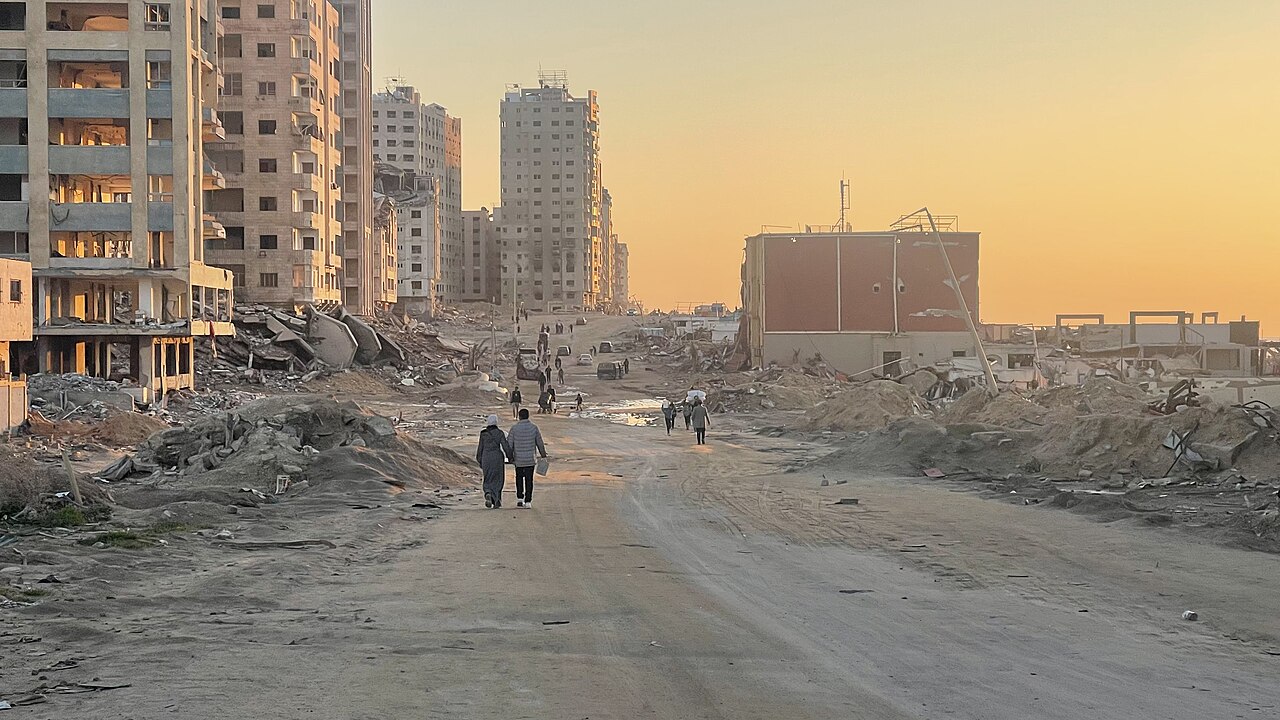
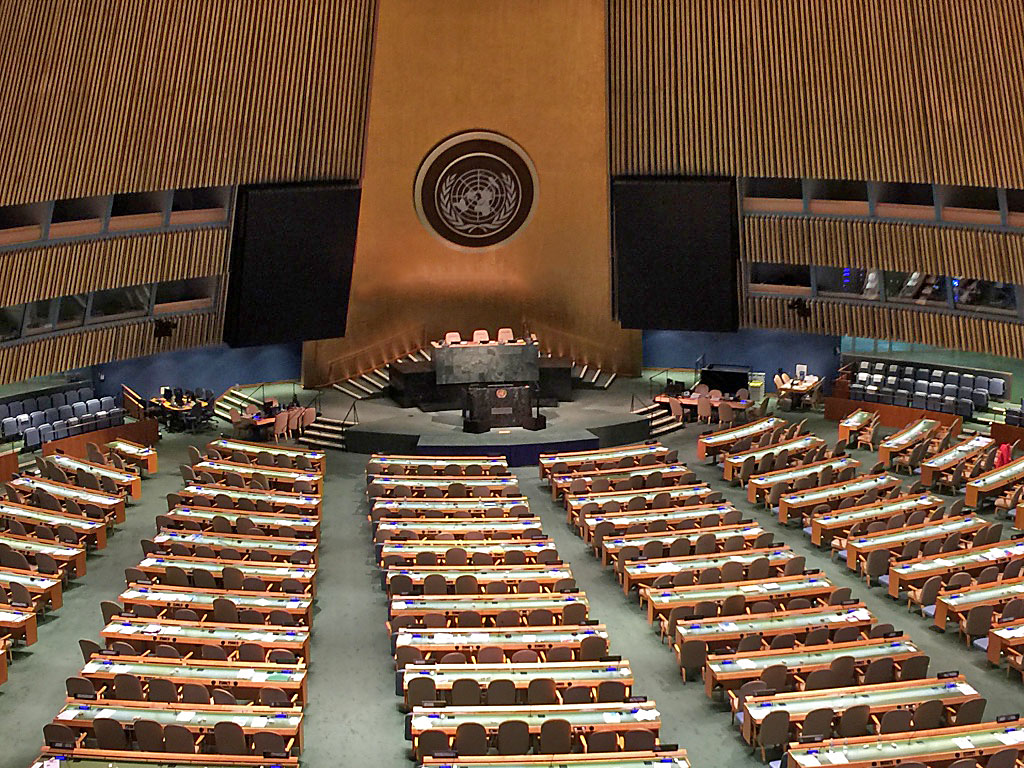
Set the two strikes against what was said in New York this week and the picture gets uncomfortable. On Monday, the Board of Peace — the Trump-chaired international body overseeing Gaza's transition — said the time had come for all parties to "fulfill their commitments and refrain from actions that could undermine the ceasefire or return Gaza to conflict." On Tuesday night it hailed progress toward its 15-point roadmap while conceding the road "will not be easy." On Tuesday, Donald Trump told the UN General Assembly that the war had ended and "the remaining hostages returned home, both living and dead; every single one of them." And then, on Wednesday and Thursday, two more men were killed in Gaza by Israeli airstrikes. This is the deeper significance of the Awad killing: it exposes what the "ceasefire" in Gaza actually is — not a mutual halt, but a condition Israel enforces by air, deciding for itself what counts as a violation. That may be strategically coherent. It is also a ceasefire in name drifting toward a ceasefire in fiction.
Who benefits, who loses, what the critics say
Start with who benefits. For Israel's government, the pair of killings sends a double message: to Hamas, that its commanders are reachable anywhere; to the Israeli public, weeks before next month's elections, that the security establishment is still hunting. Officials at the Board of Peace meeting themselves acknowledged the elections have made every discussion with Israel "more emotional, more politically sensitive." Operationally, removing a commander tied to the hostage apparatus and the man who ran Hamas's wartime finances degrades two functions — force and funding — that any attempted Hamas rebuild would need. (Internal link: article-netanyahu-unga-speech-walkout-moral-cowards-september-2026 for the UNGA context.)
Now who loses. The first loser is the ceasefire's credibility. Gaza's health officials say more than 1,400 Palestinians, mostly civilians, have been killed since the truce took effect; the IDF says four Israeli soldiers have died in the same period. Each "enforcement" strike widens that asymmetry and hardens the belief in Gaza that the truce is a pause Israel grants itself. The second loser is the civilian future the Board of Peace is trying to build: a demilitarized Gaza under a technocratic administration, $2.45 billion in recovery pledges unveiled on September 23 for schools, hospitals and a police force. Reconstruction money and targeted killings are being announced in the same week, from the same diplomatic process, and nobody has explained how they coexist. (Internal link: article-israeli-airstrike-khan-younis-vehicle-two-killed-september-2026 on the week's earlier strike.)
And the critics have noticed. The Board of Peace's Monday plea for restraint reads, after this week, like a request that was filed and ignored. France's Emmanuel Macron, in his final UN address before stepping down next year, rebuked Trump's victory narrative outright: some speak proudly of an alleged peace, he said, yet "that peace has not restored humanitarian access for even a moment." The allegation from Paris and the airstrikes from Tel Aviv point at the same gap — between the peace that is declared in New York and the war that continues in Gaza.
What the numbers actually mean
The figures around this story deserve a cold reading. Seven named hostages: the IDF named them deliberately — Gilboa, Ariev, Steinbrecher, Levy, Berman, Miran, Mor — because the hostage trauma of October 7, 2023 remains the moral license for everything Israel does in Gaza, and naming the victims renews it. More than one billion shekels moved through Abu Alwan's finance department: that is the number that explains why Israel killed an accountant the day before it killed a commander — money is infrastructure, and Hamas without money is a memory. The wider ledger: Palestinian authorities say more than 73,000 people have been killed in Gaza since Israel's assault began after the October 7 attacks that killed about 1,200 people in Israel; since the US-brokered ceasefire took effect, the territory's health officials count at least 1,400 dead, the IDF counts four of its own. And the political numbers: a 20-point peace plan in UN Security Council Resolution 2803, a 15-point roadmap from the Board of Peace, a six-month $2.45 billion recovery proposal unveiled September 23 — plans multiplying while the fundamentals they depend on (Hamas disarmed, Israel withdrawn) remain exactly where they were: unresolved. Numbers, in this story, are not trivia. They are the evidence that the architecture of peace is being built over a foundation that is still being bombed.
What happens next
Three scenarios, in descending order of likelihood. First, managed erosion: Israel keeps striking periodically, calling each one enforcement; Hamas absorbs the losses and avoids retaliation that would invite a larger operation; the ceasefire limps forward as a technicality. This is the path of least resistance, and the one both sides' recent behavior points to. Second, the spiral: one strike too many — or one kidnapping attempt, which Defense Minister Katz has already priced at the evacuation of Gaza City's roughly one million residents southward and the treatment of the city "in the same manner in which Rafah and Beit Hanoun and 70% of the Gaza Strip were dealt with" — and the truce collapses into open war. Katz also pledged no withdrawal from the so-called Yellow Line while Hamas remains in Gaza and the Strip is not demilitarized; that is a structural deadlock, not a negotiating position. Third, the diplomatic freeze: with Israeli elections next month, concessions become politically toxic, the disarmament-for-withdrawal bargain stalls, and the Board of Peace's roadmap joins the long shelf of Gaza plans. Whichever path, the Awad killing has already written the week's lesson: in Gaza, the ceasefire is not an agreement being kept. It is a permission slip being interpreted — and only one side holds the pen.
Sources
- New York Post, “IDF kills Hamas commander who had held seven Israeli hostages in Gaza tunnel,” September 24, 2026
- JNS via Janglo, “IDF kills Hamas commander who had held seven Israeli hostages,” September 24, 2026, including the IDF’s official X announcement
- USA Today, “Trump’s Board of Peace touts $2.45B recovery plan for Gaza,” September 23, 2026
- Reuters, “Israeli fire kills two people in Gaza, medics say,” September 23, 2026
Reporting cutoff: September 24, 2026 at 8:35 p.m. PDT. The reported killing and all operational details remain attributed to the Israel Defense Forces. Signal Post News found no independent confirmation; Hamas had not publicly responded as of publication.