Smotrich West Bank war call

JERUSALEM — Israeli Finance Minister Bezalel Smotrich said in a Ynet podcast interview published Sunday that Israel should "go to war" in the West Bank — "do there what we did in Gaza" — and dismantle the Palestinian Authority, which he called "a terrorist authority." The West Bank war call came packaged with a wider territorial demand: Smotrich said he wants Israel to annex "at least up to the Yellow Line in Gaza" and "up to the [Litani] River in Lebanon," arguing that Israel's enemies must "pay a price" for the October 7, 2023 attacks. The interview landed on the same day Defense Minister Israel Katz ordered a week-long general closure of the West Bank through October 3 for the Sukkot holiday, barring roughly 9,000 Palestinian permit-holding workers from Israeli communities and settlements and tightening controls at crossings and checkpoints.
What Smotrich said — and where he said it
Smotrich, who leads the far-right Religious Zionism party, made the remarks in a podcast on the Ynet news site, as reported Sunday by the Times of Israel. "I believe we must go to war in Judea and Samaria, do what we did in Gaza and dismantle the Palestinian Authority, which is a terrorist authority," he said, using the biblical name Israeli authorities apply to the West Bank.
He spelled out what that war would look like: "We have to tell the Israel Defense Forces: just as they dismantled Hamas in Gaza, there will be no terrorist infrastructure in Judea and Samaria. There will be no terrorists, there will be no weapons, there will be no tunnels." He also noted that Israeli forces had already expelled thousands of residents from three refugee camps in the northern West Bank.
On territory, Smotrich was explicit about the map he wants. "I would very much like to annex at least up to the Yellow Line in Gaza and up to the [Litani] River in Lebanon," he said. He framed the demand as deterrence, not only ideology: "not only because of the issue of settlements in the Land of Israel, but simply because, if a war ends at the borders from which it began, what will prevent the enemy from going to war again? They must pay a price."
The Palestinian Foreign Ministry condemned the remarks as "an explicit call for escalation, annexation, and displacement."
The closure: a sealed West Bank for Sukkot
Hours before the interview circulated, Katz announced that the army would implement a "general closure" in the West Bank for Sukkot, lasting until October 3. "Palestinian workers will not be permitted to enter the communities of Judea and Samaria during the holiday of Sukkot," he said, adding that "essential workers" could still access certain industrial areas and that further exceptions could be considered "within the framework of the state's commitments to the Supreme Court."
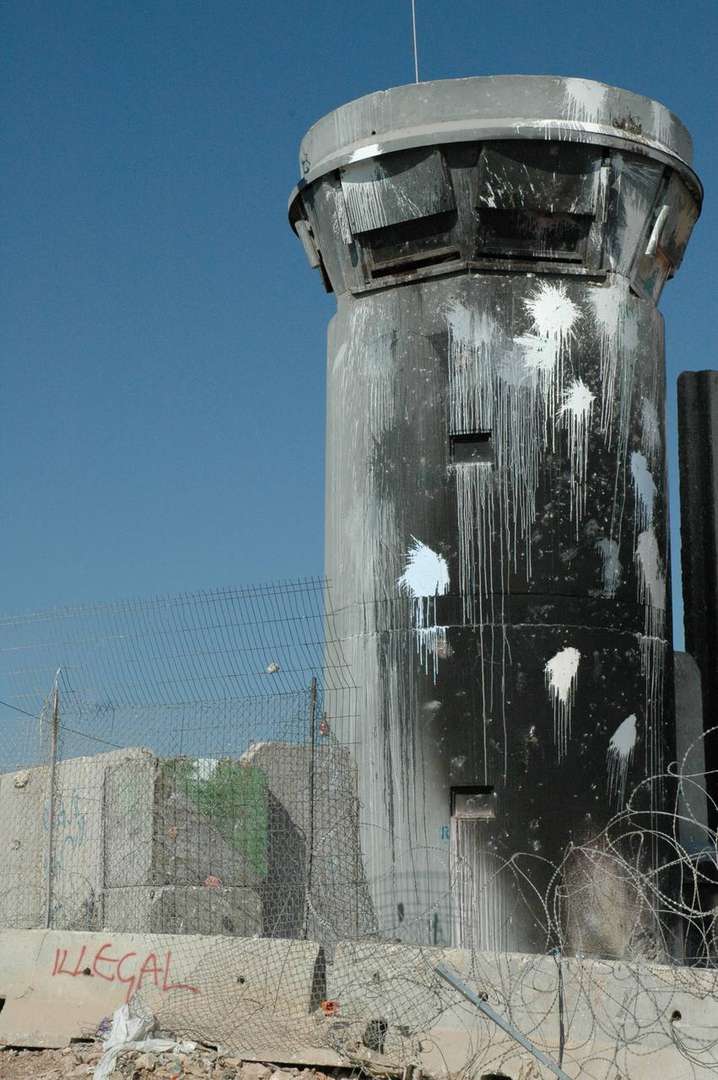
The scale is significant: according to 2025 figures cited by the Times of Israel, around 9,000 Palestinians hold authorization to work in settlements or in industrial zones in the West Bank. The official Palestinian agency WAFA reported that the restrictions also include the closure of border crossings and increased military controls at checkpoints, further complicating movement for a population already affected by intensified Israeli army incursions and settler attacks. Entrances around Ramallah — Taybeh, Beitunya, 'Abud, Nabi Saleh and 'Attara — were sealed, with new checkpoints erected.
Holiday closures are a long-standing Israeli practice. What gives this one political charge is the calendar collision: a week-long seal on Palestinian movement imposed on the same day a senior minister publicly demanded a Gaza-style war and the dismantling of the Palestinian Authority.
Why this matters
A sitting cabinet minister — one who also holds West Bank civil-affairs powers inside the Defense Ministry — has now publicly called for a Gaza-scale military campaign in a territory where roughly three million Palestinians and more than 500,000 Israeli settlers live intermingled, alongside annexation across two international borders. Even by Smotrich's own record of blunt statements, the explicitness is new: "war" in the West Bank named as policy, the Palestinian Authority named for dismantling, and a map drawn to the Litani.
Three things make the remarks more than podcast provocation. First, coalition arithmetic: Religious Zionism is a load-bearing pillar of Prime Minister Benjamin Netanyahu's government, and Smotrich's demands set the outer boundary of what any "day after" arrangement for the West Bank can look like while he sits in the cabinet. Second, trajectory: the West Bank has moved in two years from periodic raids to open talk of Gaza-style dismantling — language that reframes the territory's future from occupation management to something closer to conquest. Third, the Palestinian Authority's vise: an institution already fiscally strangled by withheld tax transfers is now being publicly marked for elimination by the minister who controls the taps.
Attribution discipline matters here. These are Smotrich's positions, and they go beyond the stated policy of the Netanyahu government. Netanyahu has not echoed the annexation demands, and Israel's official posture toward Lebanon remains the November 2024 ceasefire framework. Readers should not mistake one minister's podcast for cabinet policy. But they should not dismiss it either: Smotrich has a record of converting rhetoric into administrative facts, from the E1 settlement plan to the approval of 19 new West Bank settlements.
Who Smotrich is — and what he has already pushed through
Smotrich has led Religious Zionism since 2019 and served as finance minister since December 2022. In February 2023 he was handed broad authority over civil affairs in the West Bank inside the Defense Ministry, with a mission to develop settlements and unify their administration with Israel's. He is himself a settler, living in Kedumim.
His platform has been consistent for a decade. His 2017 "Decisive Plan" envisioned flooding the West Bank with settlements until Palestinians accepted subjugation, emigration, or confrontation. In August 2025 he announced the resumption of the 3,400-home E1 settlement plan linking Ma'ale Adumim to Jerusalem, a project the Palestinian Authority and international observers say would bury the idea of a Palestinian state. In September 2025 he called for Israel to annex roughly 82 percent of the West Bank. In June 2026 he went further still: dismantle the Palestinian Authority, abolish the Oslo Accords, erase the distinctions between Areas A, B and C, and apply Israeli sovereignty across the territory — floating a military administration to replace the PA. In December 2025 the security cabinet approved 19 new West Bank settlements under a proposal backed by Smotrich and Katz.
The statements have drawn an unusual international response. In June 2025 the United Kingdom, Canada, Australia, New Zealand and Norway imposed travel bans and asset freezes on Smotrich and National Security Minister Itamar Ben-Gvir, citing incitement of settler violence against Palestinians. Slovenia and the Netherlands followed in July 2025, Spain in September 2025, and Ireland and France in June 2026. Smotrich answered the first sanctions round by moving against the PA's banking lifelines, ordering the cancellation of a policy enabling correspondence between Israeli and Palestinian banks. In October 2023 he had already frozen the transfer of tax revenues to the Palestinian Authority, a move criticized by the United States.
A West Bank already on edge
Smotrich's call lands in the deadliest period for West Bank Palestinians in two decades. Since October 2023, United Nations data has recorded the sharpest sustained rise in killings, displacement and settler attacks since the Second Intifada. Israel's Operation Iron Wall, launched in January 2025, emptied the Jenin, Tulkarem and Nur Shams refugee camps in the north — the three camps Smotrich referenced — displacing tens of thousands. Settler violence has surged alongside the military operations, and checkpoints have become flashpoints: the recent ramming attack that critically wounded Neria Leiter, son of Israel's ambassador to the United States, at a West Bank checkpoint underscored how quickly friction at crossings turns lethal.
The Palestinian Authority, which administers Palestinian population centers under the Oslo framework, enters this week weakened on every front: its revenues throttled, its security coordination with Israel frayed, its political legitimacy eroded, and now its existence openly questioned by an Israeli minister.
Who benefits, who loses, what the critics say
The settler movement gains momentum
For the settlement enterprise, Smotrich is the most effective advocate it has ever had inside government. Each statement shifts the boundaries of acceptable discourse, and the record shows the words are followed by facts on the ground: E1 advancing, 19 new settlements approved, planning committees accelerating. Annexation talk that once lived on the fringe now arrives from the finance minister's mouth.
The Palestinian Authority faces an existential threat
No actor loses more directly than the PA. Dismantling it would end the Oslo framework entirely and replace limited Palestinian self-rule with direct Israeli military administration — the outcome Smotrich explicitly floated in June 2026. For the roughly three million Palestinians living under PA civil administration, the prospect is not abstract: it means the end of Palestinian-run institutions in Ramallah and the return of full military rule.
Lebanon is pulled back into the frame
The Litani demand reaches beyond the Palestinian arena into a second sovereign state. Annexation up to the Litani River would mean seizing a large swath of southern Lebanon and would collide directly with the November 2024 ceasefire framework. It comes days after Lebanon's prime minister used UN General Assembly week to demand full Israeli withdrawal and state control of arms — a diplomatic track Smotrich's map would render moot.
The critics — and Smotrich's own rationale
The Palestinian Foreign Ministry's condemnation — "escalation, annexation, and displacement" — captures how Ramallah reads the interview: not as deterrence theory but as a program. The governments that sanctioned Smotrich over settler violence are likely to treat the remarks as confirmation. Under international law, acquiring territory by force is prohibited by the UN Charter — a principle critics will invoke against both the Gaza and Lebanon annexation demands.
Smotrich's own rationale deserves a fair hearing: he argues that wars which end at their starting borders invite repetition, and that only a territorial price deters the next October 7. It is a coherent deterrence doctrine. Its critics reply that deterrence purchased through annexation and the dismantling of the PA destroys the very framework — however battered — through which a negotiated end to the conflict could ever be reached.
The numbers behind the rhetoric
The figures give the interview its weight. Monitoring groups estimate more than 500,000 Israeli settlers now live in the West Bank alongside roughly three million Palestinians — the intermingled demography that makes any "Gaza-style" campaign there a different proposition from Gaza itself. About 9,000 Palestinian workers are directly affected by this week's closure, each representing household income suspended for the holiday week.
The Yellow Line — the demarcation from the October 2025 US-brokered agreement — already leaves more than half of Gaza under Israeli troop deployment; annexing "at least up to" it would formalize Israeli sovereignty over most of the Strip. The Litani River lies deep inside Lebanese territory, well north of the Israeli border; annexation to the river would mean absorbing a large area of a sovereign state that has just demanded Israel's withdrawal at the United Nations.
What happens next: the Sukkot week and three scenarios
The immediate test is the closure itself, running through October 3. Sealed entrances around Ramallah, new checkpoints and barred workers are a recipe for friction; holiday weeks have historically produced checkpoint confrontations, and this one arrives with annexation rhetoric ringing in Palestinian ears.
Diplomatically, the interview will reverberate through the post-UNGA week. The Palestinian leadership has fresh condemnation language on the record; the sanctioning countries have a new data point; and Washington — which brokered the October 2025 Gaza agreement whose Yellow Line Smotrich now wants to turn into a border — has not publicly responded to this specific interview in the reporting reviewed for this article. Its response, or silence, will signal how much room the administration gives annexation talk.
Scenario one: rhetoric as election positioning. Israel votes next month in its first election since the October 7 attacks. Smotrich's party is fighting for its political life, and maximalist statements mobilize his base. In this scenario the interview is campaign material, and policy continues on its current track.
Scenario two: operational preview. The West Bank campaign intensifies along the lines Smotrich described — wider operations, more camp clearances, deeper IDF entrenchment — with the PA progressively hollowed out until dismantling becomes a formality. The December 2025 settlement approvals suggest the administrative track is already moving.
Scenario three: the PA breaks first. Fiscal strangulation plus political delegitimization could collapse the Authority from within, forcing Israel to assume direct administration of three million Palestinians — the outcome Smotrich says he wants, arriving through bankruptcy rather than decree.
The honest caveat: Smotrich does not command the IDF. Operations are decided by the prime minister and the security cabinet, and coalition math ahead of an election constrains everyone. But the direction of travel — in settlements approved, in camps emptied, in language used — is consistent, and it points away from any negotiated two-state framework.
Conclusion: words that move the boundaries of the possible
Smotrich's interview does not change the West Bank's legal status or the IDF's orders. What it changes is the sayable: a finance minister can now publicly demand war, dismantling and annexation across three territories in a single podcast, on the same day his government seals the West Bank. Whether the map changes on the ground depends on Netanyahu, the security cabinet, and an electorate voting next month. But the trajectory — in rhetoric, in settlements, in emptied camps — is no longer deniable, and neither is the collision course it sets with the Palestinian Authority, with Lebanon's ceasefire, and with the countries that have already sanctioned the man demanding it.
Sources
Reporting basis: Published September 27, 2026. Smotrich's remarks are reported via the Times of Israel's account of his Ynet podcast interview, corroborated by LaPresse, News Central TV and Demócrata; the closure details via Demócrata and WAFA. Settlement and sanctions figures are attributed to monitoring groups and the governments that imposed them. Analysis is Signal Post News's.