World · North Korea · Nuclear
The North Korea uranium enrichment expansion moved faster this autumn than the diplomacy meant to contain it. In Vienna on Wednesday, the head of the UN nuclear watchdog told governments that Pyongyang had added a further extension to the original enrichment hall at Yongbyon and finished the outside of it within weeks — while a second enrichment site runs at Kangson, another new enrichment building rises at Yongbyon, and both of the complex’s reactors show signs of operation. The warning arrived less than a day before Presidents Trump, Xi and Putin sit down together for the first time in Shenzhen, with the size of Kim Jong Un’s arsenal — and the price of limiting it — unavoidably on the table.
Track it live: Wars
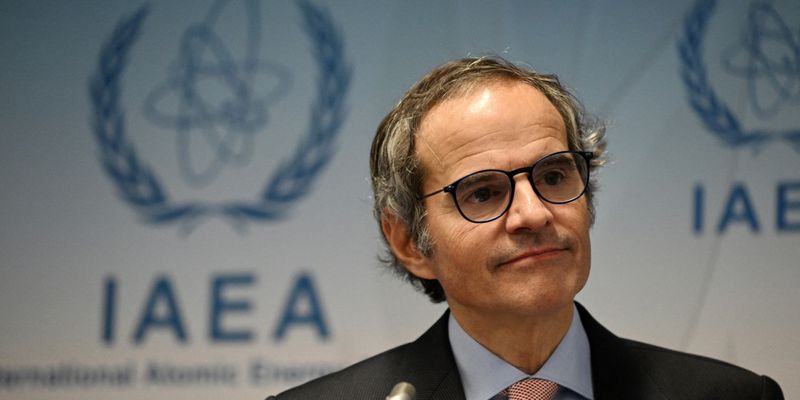
VIENNA, November 18, 2026 — North Korea uranium enrichment expansion at the Yongbyon nuclear complex has entered a new phase, the International Atomic Energy Agency said on Wednesday, as its Director General, Rafael Grossi, told the agency’s 35-nation Board of Governors that North Korea has built a further extension to the original uranium-enrichment facility at Yongbyon, the sprawling complex about 100 kilometres north of Pyongyang that North Korea itself calls the “heart” of its nuclear programme. Grossi’s language was precise, and its precision matters. “Since mid-September 2026, a further extension to the original Yongbyon enrichment facility has been under construction with the new extension externally complete by late-October 2026,” he said. Externally complete: the building work visible from above was finished in roughly six weeks. The agency did not say the extension is operating, did not say when it might operate, and did not say what, if anything, has been installed inside it — and this article does not claim otherwise. What Grossi said next was the judgment, not the engineering: “The ongoing expansion of the DPRK’s uranium enrichment programme remains a cause for serious concern.” And: “The continuation and further development of the DPRK’s nuclear programme are clear violations of relevant UN Security Council resolutions and are deeply regrettable.”
What Grossi told the Board: enrichment at two sites, a third building rising
The extension to the original hall is only one strand of what Grossi reported. He described ongoing operation of enrichment facilities at Kangson, southwest of Pyongyang, and at Yongbyon; construction of an additional enrichment facility at Yongbyon, separate from the extension announced on Wednesday; and reported further expansion of weapons-grade material production. In September, IAEA reporting assessed that the additional Yongbyon building could hold up to 28 centrifuge cascades — an assessment of capacity based on the building’s size, not a count of installed machines, and this article treats it as exactly that. Taken together, the picture is of a programme widening on several fronts at once: more floor space at the oldest known enrichment hall, a second new hall at the same complex, and continued operation at a second site whose existence was for years a matter of intelligence assessment rather than public confirmation.
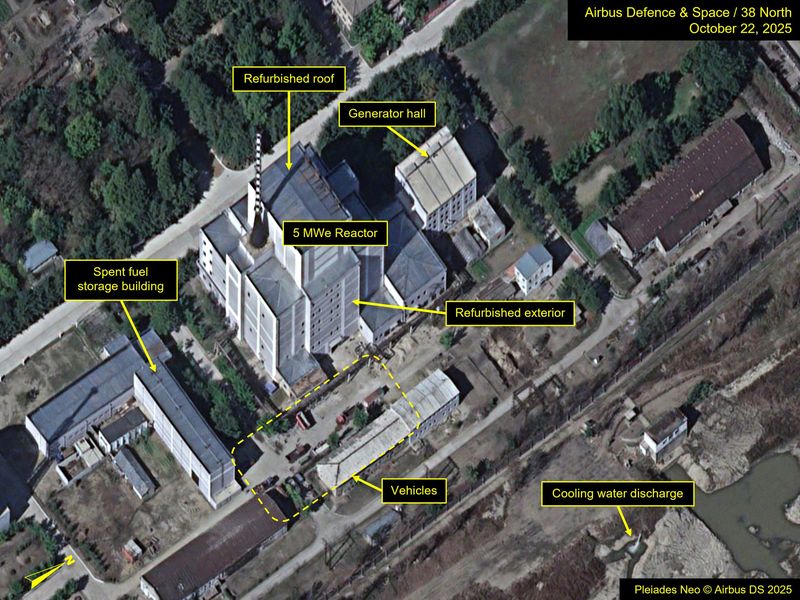
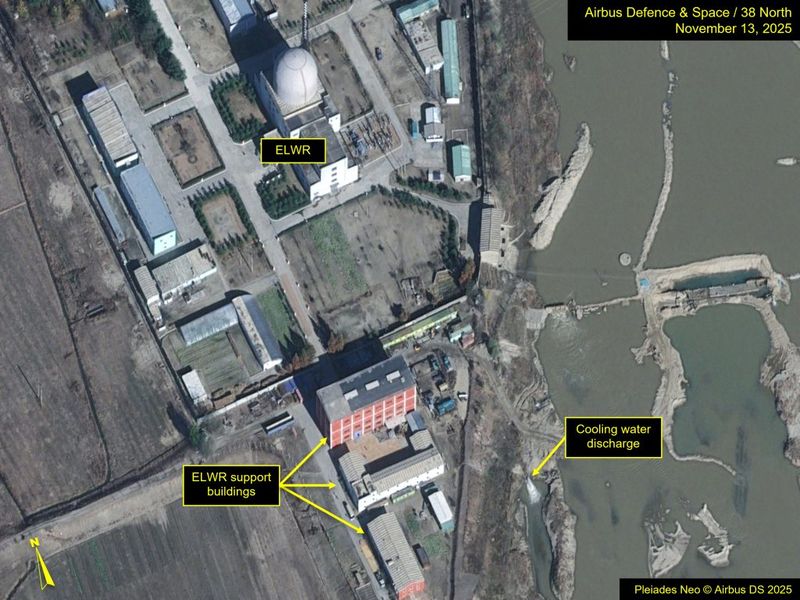
The reactors at Yongbyon are expanding the other half of the equation. A nuclear weapon’s core can be made from highly enriched uranium or from plutonium, and Yongbyon produces both: the enrichment halls make the first, and the reactors make the second, because plutonium is created inside reactor fuel and separated afterwards by reprocessing spent fuel. Grossi said the agency has “observed indications” that the 5MW(e) reactor at Yongbyon likely continues to operate in its seventh irradiation cycle — the hedging is his, and it is preserved here deliberately — after which spent fuel would be removed for reprocessing. He also reported that the light-water reactor at Yongbyon has been operating since the end of April 2026. Each completed reactor cycle is, in practical terms, another batch of potential plutonium; each enrichment hall is another stream of potential uranium. The two production lines are now running, and growing, in parallel.
The Kangson enrichment facility and the second front
Kangson matters because it breaks the oldest assumption in North Korea diplomacy: that the programme lives at one address. For decades, Yongbyon was the negotiable object — the site inspectors visited, the site offered up at summits, the site whose disablement could be photographed. A second, operating enrichment site southwest of the capital means that any future agreement confined to Yongbyon would cap only part of the production system. South Korea’s Unification Minister, Chung Dong-young, said last year that the North operates four uranium enrichment facilities, running every day — a claim that, if accurate, widens the problem further still. The IAEA’s public reporting confirms operation at Kangson and Yongbyon; beyond that, the map is drawn by national intelligence services, not by inspectors, for a reason that defines this entire story: the agency has not set foot in North Korea since Pyongyang expelled its inspectors in 2009. Everything in Grossi’s statement — every roofline, every discharge of cooling water, every inferred reactor cycle — rests mainly on satellite imagery and open sources. The world’s nuclear watchdog is watching the world’s fastest-growing declared-in-all-but-name arsenal through a camera in orbit, seventeen years after the door was closed in its face.
Why this matters
An enrichment hall is not a warhead. But in the arithmetic of nuclear programmes, floor space is destiny: centrifuge halls set the ceiling on how much weapons-grade uranium a state can produce each year, and production rates — not speeches — determine how fast an arsenal can grow. A further extension at Yongbyon, externally finished in about six weeks, tells every government watching that Pyongyang is investing in throughput, at speed, at the very moment its leader is being courted as a summit guest. That timing is the second half of the story. Grossi spoke on Wednesday in Vienna. On Thursday, November 19, Presidents Donald Trump, Xi Jinping and Vladimir Putin meet in Shenzhen on the sidelines of APEC — the first-ever Trump–Xi–Putin trilateral, confirmed by China ahead of the APEC meetings in Shenzhen — where nuclear arms are expected to be discussed. Trump said on Tuesday that Kim Jong Un “would like to” attend the APEC summit, leaving open the possibility of a Trump–Kim meeting on the margins. A negotiator’s hand is weakened by exactly the kind of news Grossi delivered: every month of construction raises the stockpile that any freeze would freeze, and raises the price Kim can charge for freezing it.
A bigger hall, a faster-growing arsenal, a weaker hand
Consider what expansion does to each of the three classic diplomatic objectives. Denuclearisation — the complete dismantlement that remains the formal demand of the United States and of successive Security Council resolutions — recedes with every new cascade hall, because the physical and human infrastructure to be dismantled grows. A freeze, the fallback that arms-control advocates increasingly propose, becomes more valuable to Kim and more expensive for Washington with every quarter of added capacity, because what is being frozen is larger. And deterrence, the posture favoured by critics who argue the arsenal is a fact to be managed rather than a problem to be solved, must be sized against a moving target: planning in Seoul and Washington this winter is being done against production lines that did not exist, in their present form, last winter. None of this requires the new extension to be operating today. Diplomacy prices the future, and Grossi’s statement is a statement about the future rate of production — which is why a building with no confirmed contents still moved the week’s diplomacy.
The heart of the programme: Yongbyon’s long history
Yongbyon has been the centre of North Korea’s nuclear effort for four decades, and its biography is the biography of every failed attempt to stop that effort by agreement. Its 5MW(e) reactor produced the plutonium for the North’s early weapons work; its reprocessing lines separated that plutonium; its enrichment hall, revealed to visiting American scientists in 2010, announced the second, uranium path to the bomb. North Korea conducted six nuclear tests between 2006 and 2017, the last in September 2017, and the Security Council answered with successive rounds of sanctions that now blanket much of the North’s trade. In April 2009, after the Council condemned a North Korean rocket launch, Pyongyang expelled the IAEA’s inspectors — the last time international monitors verified anything on the ground. In 2022, North Korea went further, writing into law a doctrine reserving the preemptive use of nuclear weapons. The state that Grossi described on Wednesday is therefore not a state edging toward a weapon it might trade away. It is a state that has tested six devices, codified first use, expelled the inspectors, and is now enlarging the factories — while insisting, as Kim’s stated condition for any talks, that the United States drop its denuclearisation demand and negotiate with North Korea as a nuclear-armed state.
From Hanoi 2019 to the freeze debate
Yongbyon was once, briefly, the currency of a deal. At the Hanoi summit in 2019, Kim offered to dismantle the complex in exchange for relief from the toughest UN sanctions. Trump walked out, citing nuclear sites beyond Yongbyon that the offer did not cover — a judgment that Kangson’s confirmed operation has, in retrospect, only sharpened. The Hanoi exchange frames the argument that now divides Seoul and Washington. Arms-control advocates argue that a verified freeze — halting production at Yongbyon, Kangson and wherever else enrichment occurs, with inspectors readmitted to confirm it — would cap the arsenal at roughly its present size and is worth sanctions relief even if dismantlement is postponed indefinitely. Deterrence-first critics answer that a freeze legitimises a nuclear North Korea, rewards two decades of Security Council violations, and leaves Seoul exposed to an arsenal that can resume growth the day the deal collapses — as, they note, every previous agreement eventually did. Between those positions sits the uncomfortable fact Grossi underlined: while the debate proceeds, the production base the debate is about keeps getting bigger. The activity has not paused for the region’s diplomacy, either: as Signal Post News reported, North Korea’s missile launches from Sondok and Kim Yo Jong’s accompanying statements have continued through the autumn.
How many nuclear weapons does North Korea have? The estimates, kept apart
No outside body counts North Korea’s warheads; every figure in circulation is an estimate built on assumptions about production history, and the honest way to present them is separately, with their owners attached. The Stockholm International Peace Research Institute, in its Yearbook 2026, estimates that North Korea has assembled approximately 60 nuclear warheads, up from roughly 50 in January 2025, and possesses enough fissile material to build up to about 90 in total, with production accelerating. The Federation of American Scientists offers a similar estimate of roughly 60 assembled warheads; an older FAS capacity assessment put potential production at 6 to 12 warheads a year. President Trump, in August 2026, put the figure at 57 nuclear weapons — his figure, stated as such. South Korea’s Defence Minister, Ahn Gyu-back, has cited a higher range of 80 to 120 drawn from private research assessments, while stressing the uncertainty involved. And South Korean President Lee Jae Myung said in January that the North produces enough fissile material each year for up to 20 weapons — a production-rate claim that, if sustained, would outrun every stockpile estimate above within a few years.
What one more enrichment hall does to North Korea weapons-grade uranium production
The spread between 57 and 120 is not a rounding error; it is the measurable size of the verification gap. Without inspectors, estimators must infer how many centrifuges spin, at what efficiency, for how many hours — and each new hall widens the range of plausible answers. That is the concrete significance of the Yongbyon extension and of the September assessment that the additional building could hold up to 28 cascades: capacity of that order, once installed and operating — neither of which the IAEA has confirmed — would support a materially higher annual output of highly enriched uranium than the original hall alone. Whether the true production rate is closer to the older FAS range of 6 to 12 warheads a year or to President Lee’s figure of material for up to 20, the direction is the same, and it is the direction SIPRI flagged: the stock of fissile material, sufficient today on its estimate for up to roughly 90 weapons against about 60 assembled, is growing. The gap between “assembled” and “material for” is, in effect, the headroom Pyongyang is building into — and halls like the one finished in October are how headroom becomes warheads.
Kim’s leverage, and what Beijing and Moscow gain
Kim Jong Un’s nuclear programme in 2026 is best read as a leverage strategy conducted in concrete. Each expansion is announced — or, as here, detected and announced by others — in the middle of a diplomatic season, when its bargaining value is highest. Kim’s stated price for talks has not moved: Washington must abandon denuclearisation as the goal and treat North Korea as a nuclear-armed state. A larger, faster production base makes that price easier to defend at home and harder to refuse abroad, because the alternative to accepting it is an arsenal that grows while the refusal is maintained. The strategy also exploits the calendar. With Trump publicly leaving a meeting open and Kim publicly said to want one, Pyongyang can present the Yongbyon extension not as an obstacle to a summit but as the reason a summit is urgent — and urgency, in negotiation, is a concession extracted before anyone sits down.
Beijing and Moscow, meanwhile, gain from the expansion without lifting a finger. For China, a North Korea that commands Washington’s attention is a buffer state whose value rises with its arsenal, and a file on which Beijing can offer help — or withhold it — at the Shenzhen table. For Russia, every American hour spent on Pyongyang is an hour not spent elsewhere, and a Security Council in which two permanent members have little interest in enforcing sanctions on the North is a Council whose resolutions Grossi can cite but no one will execute. The debate in Seoul runs on a parallel track: a South Korea anxious about the credibility of American guarantees against a growing Northern arsenal is also a South Korea debating its own options, as this newsroom reported in its coverage of South Korea’s nuclear-powered submarine ambitions under President Lee. Enlargement at Yongbyon thus radiates outward: it changes Kim’s price, Beijing’s and Moscow’s leverage, and Seoul’s strategic debate simultaneously — which is precisely what a leverage strategy is for.
What happens next: three scenarios to watch
The first scenario is a meeting. If Kim attends APEC and a Trump–Kim encounter materialises on the Shenzhen margins, expect Yongbyon to be its unspoken agenda: Trump would be negotiating with a leader whose production base has just been certified, by the UN’s own watchdog, to be expanding — and whose opening position is recognition, not dismantlement. A handshake under those conditions would itself be a partial payment of Kim’s price. The second scenario is a freeze-for-relief bargain: production halted and inspectors readmitted in exchange for sanctions relief, on the arms-control advocates’ model. Grossi’s statement defines its minimum terms — any freeze that omits Kangson, or the additional Yongbyon building, or the reactors’ spent fuel, would freeze only the fraction of the programme the satellites can see. The third scenario is the absence of any bargain: unchecked growth toward the material ceiling SIPRI estimates at roughly 90 weapons, deepening debate in Seoul, and — a watched risk, not a prediction — the possibility of a seventh nuclear test, which would be the North’s first since 2017 and would signal that the programme’s next phase is qualitative as well as quantitative.
What none of the scenarios changes is the fact at the centre of Grossi’s statement. Seventeen years after the inspectors were expelled, the most reliable sentence anyone can write about North Korea’s nuclear programme is the one the IAEA wrote on Wednesday: it is continuing, it is developing further, and its enrichment arm has just grown — externally complete, in a matter of weeks, in plain view of the satellites, on the eve of a summit of the three leaders best placed to do something about it. Whether Shenzhen produces a meeting, a bargain or merely a photograph, the builders at Yongbyon have already cast their vote on the outcome: more capacity, more material, more leverage. The diplomacy now has to catch up with the construction.
Sources
- International Atomic Energy Agency (iaea.org) — Director General Rafael Grossi, Introductory Statement to the Board of Governors, Vienna, November 18, 2026: the further extension to the original Yongbyon enrichment facility, under construction since mid-September 2026 and externally complete by late-October 2026; “The ongoing expansion of the DPRK’s uranium enrichment programme remains a cause for serious concern”; “The continuation and further development of the DPRK’s nuclear programme are clear violations of relevant UN Security Council resolutions and are deeply regrettable”; ongoing enrichment operation at Kangson and Yongbyon; construction of an additional enrichment facility at Yongbyon; observed indications that the 5MW(e) reactor likely continues to operate in its seventh irradiation cycle; and the light-water reactor operating since the end of April 2026. The IAEA has had no access to North Korea since inspectors were expelled in 2009 and monitors mainly by satellite imagery and open sources; its September 2026 reporting assessed the additional Yongbyon building could hold up to 28 centrifuge cascades.
- Reuters, November 18, 2026 — reporting on Grossi’s statement to the Board of Governors on the Yongbyon enrichment extension, the Kangson and Yongbyon enrichment operations, and the status of the Yongbyon reactors.
- Associated Press, November 18/19, 2026 — reporting on the IAEA warning, the Yongbyon complex’s role as the centre of North Korea’s nuclear programme, and the diplomatic context ahead of the APEC meetings in Shenzhen.
- Fox News, November 18, 2026 — reporting on the IAEA statement and on President Trump’s remarks leaving open a meeting with Kim Jong Un at APEC.
- SIPRI Yearbook 2026, Stockholm International Peace Research Institute — estimate of approximately 60 assembled North Korean nuclear warheads (up from approximately 50 in January 2025), fissile material sufficient for up to approximately 90 in total, and accelerating production. Other estimates cited in this article are attributed individually in the text: Federation of American Scientists (approximately 60; older capacity assessment of 6–12 warheads a year); South Korean Defence Minister Ahn Gyu-back (80–120 range from private research assessments, with uncertainty stressed); President Trump (57, August 2026); South Korean President Lee Jae Myung (fissile material for up to 20 weapons a year, January); South Korean Unification Minister Chung Dong-young (four uranium enrichment facilities operating daily, last year).
- Signal Post News, related coverage: China Confirms the Xi–Trump–Putin Meeting at APEC in Shenzhen; North Korea Missiles From Sondok and Kim Yo Jong; South Korea’s Nuclear-Powered Submarines Under President Lee.
- Photos: satellite imagery of the Yongbyon 5MW(e) reactor complex, October 22, 2025, and of the Yongbyon experimental light-water reactor, November 13, 2025 — Airbus Defence & Space via 38 North; IAEA Director General Rafael Grossi — Europe 1.