War · World · Korean Peninsula
North Korea fired several missiles from the Sondok area of South Hamgyong Province toward the sea off its east coast on Wednesday, November 4, South Korea’s military said — Pyongyang’s fourth weapons launch in a month, on the count kept by Reuters, and part of what The Wall Street Journal calls the most concentrated burst of North Korean testing since 2023. The launch landed hours after Kim Yo Jong, the sister of Kim Jong Un, ruled out dialogue with Washington until the United States abandons what she called its hostile policy, and repeated Pyongyang’s denial that it was behind the Binance hack.
Track it live: Live Global Trackers — Wars
SEOUL, November 4, 2026 — The North Korea missile launch reported on Wednesday began in the Sondok area of South Hamgyong Province, on the country’s east coast, and ended in the sea. South Korea’s Defence Ministry and Joint Chiefs of Staff said North Korea fired multiple missiles toward the sea off its east coast — the waters known in Korea as the East Sea — and that Seoul and Washington are closely analysing the launch while remaining ready to respond to any provocation. No casualties or damage were reported, and the missiles fell into the sea.
What kind of missiles they were is, at the time of writing, still an open question — and this article keeps it open. Analysts cited by Yonhap News Agency and reported by Korea JoongAng Daily have not ruled out close-range ballistic missiles with ranges under 300 kilometres, surface-to-air missiles or cruise missiles. One named analyst, Shin Jong-woo of the Korea Defense and Security Forum, assessed that the weapons appeared to be the Hwasong-11 Ra tactical ballistic missile. That is an expert assessment, presented here as such; neither Seoul nor Pyongyang has confirmed a type, and the range and exact number of missiles were still being analysed. Signal Post News does not state a count, a distance or a confirmed type beyond what the sources below support.
What Seoul confirmed
Sondok missile launch: what the Joint Chiefs said, and what remains unconfirmed
The confirmed core of the event is narrow, and it comes from South Korea’s military. The Defence Ministry and the Joint Chiefs of Staff said the missiles were fired on Wednesday, November 4, from the Sondok area in South Hamgyong Province toward the sea off North Korea’s east coast. The two allies, Seoul added, are closely analysing the launch and maintain a posture ready to respond to any provocation — the formulation South Korea uses to signal that surveillance was shared, tracking was continuous and no gap in preparedness is being conceded.
Beyond that core, the record thins quickly. On the South Korea Joint Chiefs North Korea missiles assessment, the type and range were still being analysed when the first reports were filed by Reuters and the Associated Press. Korea JoongAng Daily, reporting Yonhap’s account, laid out the range of possibilities analysts were working with — close-range ballistic missiles under 300 km, surface-to-air missiles, or cruise missiles — and Shin Jong-woo’s Hwasong-11 Ra reading. The Hwasong-11 family is North Korea’s line of short-range tactical ballistic missiles, the same family at the centre of our report last week on North Korea’s cluster-bomb warhead test for tactical ballistic missiles. Whether Wednesday’s firing belongs to that family is precisely what the analysis in Seoul and Washington is now meant to settle.
Hours earlier: Kim Yo Jong closes the door on talks
Kim Yo Jong US talks refusal: “no need to sit face to face”
The launch did not arrive alone. Hours earlier, Kim Yo Jong — sister of North Korean leader Kim Jong Un and one of the most senior voices in Pyongyang’s messaging toward Washington — ruled out dialogue with the United States until it abandons what she called its hostile policy. In a statement carried by the state news agency KCNA and reported by Reuters, the Associated Press and Korea JoongAng Daily, she said: “It is our clear stand that we have no need to sit face to face with such unreliable and hostile persons.”
She addressed the language of peace directly, and qualified it: “The choice for peace includes dialogue of course, but this is not surely equated with national interests for us.” The demand she attached to any future contact was broad. It was not limited to a single file: she ranged across U.S. policy on denuclearization, human rights, cyber issues, sanctions and military policy, and said North Korea’s countermeasures should set new records. Read as a negotiating document, the statement does not set a price for talks; it disputes the premise that talks, as currently framed by Washington, are in Pyongyang’s interest at all.
North Korea Binance hack denial, repeated in the same statement
The same statement repeated Pyongyang’s denial that North Korea was behind the hack of the cryptocurrency exchange Binance, after the FBI accused North Korea of carrying it out. The two positions should be kept distinct, because they are claims, not findings of this newsroom. The FBI’s position, as we reported in our coverage of the FBI’s attribution of the $6.3 billion Binance hack to North Korea, is that North Korean hackers were responsible for the theft. Binance has said hackers stole more than $6 billion — the figure carried by the FBI and The Wall Street Journal is $6.3 billion — in what appears to be the largest crypto heist on record. North Korea’s position, restated by Kim Yo Jong, is a denial. Signal Post News reports the allegation as the FBI’s and the denial as Pyongyang’s; it does not present the allegation as proven fact.
Observers cited by the Associated Press read the pairing of the statement and the launch as pressure: in their assessment, Pyongyang was likely pressing the United States to drop what it calls hostility and to offer concessions if Washington wants to restore the Trump–Kim ties of 2018–19. That is an interpretation offered by analysts, and it is labelled as one here; Pyongyang’s own stated position is the one in Kim Yo Jong’s words above.
A shipyard visit, reported the same morning
Kim Jong Un naval shipyard destroyer: the Nampho visit and a reported 10,000-ton cruiser
The launch also followed a North Korean state media report, published Wednesday, that Kim Jong Un had visited the Nampho Shipyard — the visit itself took place on November 2 — where a destroyer is under construction. In the report, Kim stressed the importance of a powerful naval force. Analysts cited in the coverage pointed to a new vessel that appears to be a 10,000-ton strategic guided missile cruiser.
The sequencing is the calendar’s, and this article does not claim the events were coordinated as a single package. But the elements Pyongyang put on display within the same news cycle are consistent in theme: a leader inspecting naval construction and calling for a powerful fleet, a senior statement closing the door on talks on Washington’s current terms, and a missile launch from the east coast. Each element is separately sourced; the pattern they form is a matter of interpretation, and the interpretations differ — which is what the analysis section below is for.
The busiest testing tempo since 2023
North Korea fourth missile launch in a month — and a fourth show of force in a week
Reuters counted Wednesday’s firing as Pyongyang’s fourth weapons launch in a month. Korea JoongAng Daily, on Yonhap’s reporting, put the shorter count differently: a fourth show of force in a week, in a run that included a cruise missile launch on Monday. The Wall Street Journal supplied the widest frame: the past two months are the most concentrated burst of North Korean testing since 2023, with nine known launches — a run that follows the recent cluster-munition test and the submarine-launched cruise missile test we covered in our report on North Korea’s submarine-launched cruise missile test.
North Korea hypersonic missile test and a 900-kilometre flight: this year’s backdrop
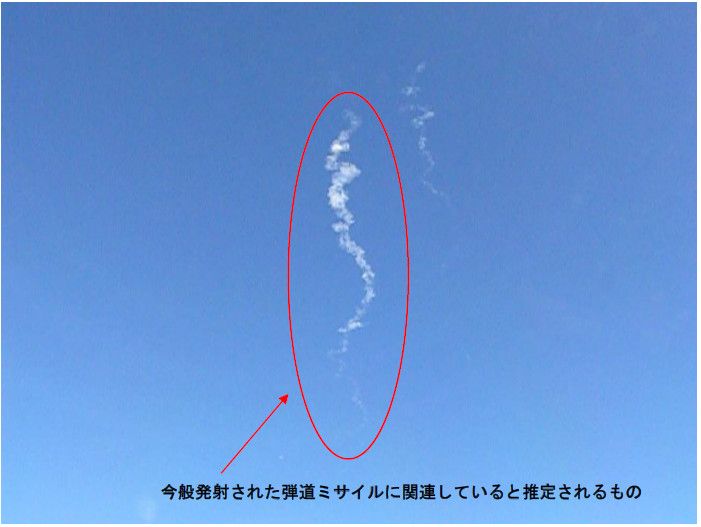
Wednesday’s launch also sits inside a longer year of testing that Reuters summarised in its Wednesday report: North Korea has carried out a series of tests this year, including a missile that flew more than 900 km (559 miles) and hypersonic missile tests. The variety matters as much as the volume. A programme testing long-range systems, hypersonic vehicles, cluster warheads, submarine-launched cruise missiles and — on Shin Jong-woo’s assessment — tactical ballistic missiles in the same season is not demonstrating a single weapon. It is working across its inventory at once, which is one reason analysts watch the tempo, and not only the individual launches.
Why this matters
North Korea missiles East Sea November 2026: what the numbers imply
Analysis: three counts describe the same curve at three zoom levels. Four launches in a month is a rhythm, not an event; it means the interval between tests has shrunk to roughly a week, which compresses the time in which Seoul, Washington and Tokyo can assess one launch before the next arrives. Four shows of force in a week tightens that further. Nine known launches in two months, against a 2023 baseline that The Wall Street Journal treats as the last comparable period, says the current burst is not a spike around a single date but a sustained campaign. Sustained campaigns are usually read in one of two ways — as signalling, which is cheap to sustain, or as a test programme working through a schedule, which implies hardware being finished rather than messages being sent. The facts reported above do not by themselves choose between those readings; the analyst assessments below are where that argument happens.
The mass-production question — and the export assessment
One assessment, offered to Reuters, points toward the second reading. Lee Choon-geun of the Korea Advanced Institute of Science and Technology told Reuters that the frequent tests suggest Pyongyang may be nearing completion of preparations for mass production — potentially including weapons for export to Russia. That is Lee’s assessment, attributed to him and reported by Reuters; it is not a finding by any government cited in Wednesday’s reporting, and no export has been confirmed in connection with these launches. Its significance, if the assessment is right, is that a testing tempo can mark the end of a development cycle rather than the middle of one: tests validating production-standard weapons look similar, launch by launch, to tests validating prototypes, and the difference only becomes visible later — in inventories, exercises and, potentially, transfers.
Who gains, who loses
Analysis: the gains and losses from a week like this one are asymmetric, and each side’s ledger is argued in its own terms. Pyongyang gains bargaining weight in its own framing: a closed door, stated by Kim Yo Jong, plus hardware in the air, is a position that says concessions must be offered before contact resumes — and the Associated Press’s observers read the pressure exactly that way. Washington loses room for manoeuvre in the analysis offered by The Wall Street Journal: engaging Pyongyang without preconditions could risk de facto recognition of North Korea as a nuclear state, while letting Pyongyang demand steeper concessions for the same meeting. Seoul and Washington retain the asset they cited on Wednesday — shared analysis and a stated readiness posture — but each launch consumes political attention in three capitals at once. The party with the least ambiguous loss is the diplomatic track itself: there have been no formal U.S.–North Korea talks since 2019, and nothing in Wednesday’s statement or Wednesday’s launch shortens that distance on its own.
The midterm timing analysts flagged
Analysts cited by Yonhap also noted the calendar: Wednesday’s launch fell in the U.S. midterm election period, and North Korea has conducted similar launches on U.S. election days in 2022 and 2024. That observation is attributed to those analysts; whether timing of that kind is deliberate messaging or coincidence is not something the launch data alone can establish, and Pyongyang has not said it chose the date for that reason. What can be said factually is that the pattern the analysts describe — launches coinciding with American votes in 2022 and 2024 — is the record they are pointing at, and Wednesday’s firing is consistent with it.
No talks since 2019: the road to a frozen relationship
The background to Kim Yo Jong’s statement is a relationship that has been frozen for seven years. President Donald Trump and Kim Jong Un met three times in 2018–19, in the most direct leader-level diplomacy ever attempted between the two countries. No formal U.S.–North Korea talks have taken place since 2019. The Wall Street Journal reported that Trump said he would talk to the Kim regime after the FBI’s Binance announcement — an openness stated publicly, and now answered, in sequence, by Kim Yo Jong’s conditions and a missile launch.
The two positions, stated plainly, are these. Washington’s stated door, as the Journal and the analysts it cites frame the debate, comes with a dilemma: talks without preconditions risk conferring de facto recognition of a nuclear-armed North Korea and inviting steeper demands, while insisting on preconditions has produced no talks at all since 2019. Pyongyang’s stated position, in Kim Yo Jong’s words, is that the obstacle is U.S. policy itself — across denuclearization, human rights, cyber issues, sanctions and military policy — and that North Korea has no need to sit face to face until that changes. Signal Post News presents both positions as their holders state them; the distance between them is the story, and Wednesday added a missile launch to it.
What happens next
Four scenarios follow from the facts and assessments above, and they are not mutually exclusive. First, more tests: a tempo of nine launches in two months, sustained, suggests the schedule has further entries, and each will test whether the mass-production assessment gains or loses support. Second, the production and export question: if Lee Choon-geun’s reading is right, the evidence to watch is not launches but what follows them — unit deliveries, exercises at scale, and any confirmed transfer reporting. Third, the conditions for talks: Kim Yo Jong has stated Pyongyang’s terms in maximal form, and the Journal’s analysis describes Washington’s dilemma in answering them; a channel reopening would require one side to move first, and neither statement this week announced such a move. Fourth, miscalculation: launches toward the sea that fall harmlessly, as Wednesday’s did, are the managed version of this pressure; the risk in a high-tempo campaign is the unmanaged version — a launch misread, a response mistimed — which is the contingency Seoul’s readiness language is written for.
Until one of those scenarios produces its evidence, the established facts of Wednesday are these: North Korea fired several missiles from the Sondok area toward the sea off its east coast, South Korea’s Defence Ministry and Joint Chiefs of Staff said; the launch was Pyongyang’s fourth in a month on Reuters’ count; Kim Yo Jong had hours earlier ruled out dialogue until the United States abandons what she called its hostile policy and repeated North Korea’s denial over Binance; and Kim Jong Un’s reported shipyard visit put naval construction in the same news cycle. The missile type remains unconfirmed, no damage was reported, and the analysis — in Seoul, Washington and Tokyo — is, by the allies’ own statement, still under way.
Related coverage: FBI Blames North Korea for the $6.3 Billion Binance Hack, the Largest Crypto Theft Ever Recorded · North Korea Cluster Bomb Test: KCNA Says a Cluster-Bomb Warhead Can Destroy 12 to 13 Hectares · North Korea Submarine Cruise Missile Test Fires Two Missile Types From an East Sea Submarine
Sources
- Reuters, November 4, 2026 (Seoul), by Heejin Kim, as syndicated by KWSN — North Korea fired multiple missiles from the Sondok area toward the sea off its east coast, per South Korea’s military; the fourth weapons launch in a month; Kim Yo Jong’s statement ruling out dialogue and her quoted remarks via KCNA; this year’s test series including a missile that flew more than 900 km and hypersonic missile tests; and Lee Choon-geun of KAIST’s assessment on mass production and possible exports to Russia.
- Associated Press, November 4, 2026, by Hyung-Jin Kim, via Military.com — the launch toward the sea as Pyongyang protested the U.S. claims on the Binance hack; Kim Yo Jong’s rejection of dialogue and denial of the hack allegation; and observers’ assessment that Pyongyang was likely pressuring Washington to drop what it calls hostility and offer concessions to restore Trump–Kim ties.
- Korea JoongAng Daily, November 4, 2026 — Pyongyang pairs tough talk with missiles in a message to Washington: the fourth show of force in a week including Monday’s cruise missile launch; the analyst range of possible missile types; Shin Jong-woo’s Hwasong-11 Ra assessment; the Yonhap-cited analysts on U.S. midterm timing and the 2022 and 2024 election-day precedents; and Kim Jong Un’s reported Nampho Shipyard visit and the destroyer under construction there.
- The Wall Street Journal, November 4, 2026 — North Korea on its busiest missile-testing spree in years rebuffs Trump diplomacy: nine known launches in two months, the most concentrated burst since 2023; the FBI’s $6.3 billion Binance figure; Trump’s statement that he would talk to the Kim regime; and the analysis that engaging without preconditions could risk de facto recognition of North Korea as a nuclear state while letting Pyongyang demand steeper concessions.