World / Asia
The Hong Kong Tai Po fire report — more than 1,000 pages from a judge-led independent committee — held four government departments partly responsible for the blaze that killed 168 people last November, described a construction industry captured by a 'corrupt ecosystem' of bid-rigging, and brought down the housing secretary. Chief Executive John Lee bowed in apology. Whether the reforms he promised outlast the apology is now the city's real question.
Hong Kong's leader apologised on Thursday for a fire the city will measure itself against for a generation. Chief Executive John Lee, releasing the Hong Kong Tai Po fire report compiled by a judge-led independent committee, bowed alongside seven other top officials and apologised for the blaze that killed 168 people at Wang Fuk Court last November. He also announced the resignation of Housing Secretary Winnie Ho — the first official to fall over the disaster. "As chief executive and head of the government, I am deeply saddened," Lee said. "On behalf of the SAR government, I offer my apologies to the victims and the public at large."
The sequence mattered, and everyone in the room understood it. An apology in Hong Kong's political culture is not a courtesy; it is an admission that the system, not merely a contractor, failed. By bowing at the opening of the news conference — before a single recommendation had been discussed — Lee tied his government's authority to a document that does not spare it. The report held four government departments and bodies partially responsible for a catastrophe that residents had warned about, in writing and in person, for more than a year. The committee's own summary of that failure is the sentence that will follow this government: "no Government department took effective ownership of various fire safety issues and complaints about fire hazards fell into a vacuum."
Ho's resignation, which the Associated Press reported took effect on Wednesday, was framed with care. Lee said she should bear political responsibility for the failings of the Housing Bureau and its independent checking unit, while noting that no personal wrongdoing on her part had been found. That distinction — political responsibility without personal fault — is the oldest formula in official accountability, and displaced Wang Fuk Court residents, who have waited nearly a year for someone senior to answer for 168 deaths, will judge for themselves whether it is an ending or a beginning. An independent team will now examine which individual officials should face disciplinary action.
What the report found
The Wang Fuk Court fire investigation was not a narrow inquiry into a single night. The committee held 30 hearings, heard 80 witnesses, and reviewed more than one million files and submissions before producing a report of more than 1,000 pages and about 120 recommendations. Its conclusions operate at three levels: what started the fire, who failed to prevent it, and what kind of industry made prevention so easy to evade.
Four departments, one vacuum
On the government's side, the committee found that four departments and bodies bore partial responsibility, with the Housing Bureau and its independent checking unit — the unit charged with supervising maintenance work at the estate — bearing a greater share. The failure it described was not a single missed inspection but a structural condition: fire safety issues had no owner. Complaints about hazards at Wang Fuk Court moved between offices, and because each could plausibly treat the problem as another's, none treated it as its own. A complaint that belongs to everyone, the report makes plain, belongs to no one — and at Wang Fuk Court that administrative vacuum was filled, eventually, by fire.
John Lee apologises for the Tai Po fire — and the contractor and consultant take primary blame
Primary responsibility, the committee concluded, rests with the private parties who ran the renovation: the contractor, Prestige Construction & Engineering Co Ltd, and the project consultant, Will Power Architects Co Ltd. That finding is a committee conclusion, not a court verdict, and it sits alongside a criminal process that is still unfolding: at least 25 criminal charges have been brought against the two companies and seven individuals, including manslaughter, conspiracy to defraud, money laundering and tax evasion. Those charges are allegations to be tested at trial, and nothing in the committee's report should be read as a determination of any defendant's guilt. But the alignment is unmistakable — the inquiry that heard the evidence and the prosecutors who reviewed it have pointed at the same two firms.
The report closed with a line Lee's government has now adopted as a mandate: "The fire has been put out, but the reform has only just begun." It is a good sentence. It is also, as the next sections show, an enormous undertaking — because what the committee described was not one estate's bad luck but a system.
How a cigarette became 168 deaths
Wang Fuk Court: what happened on November 26, 2025
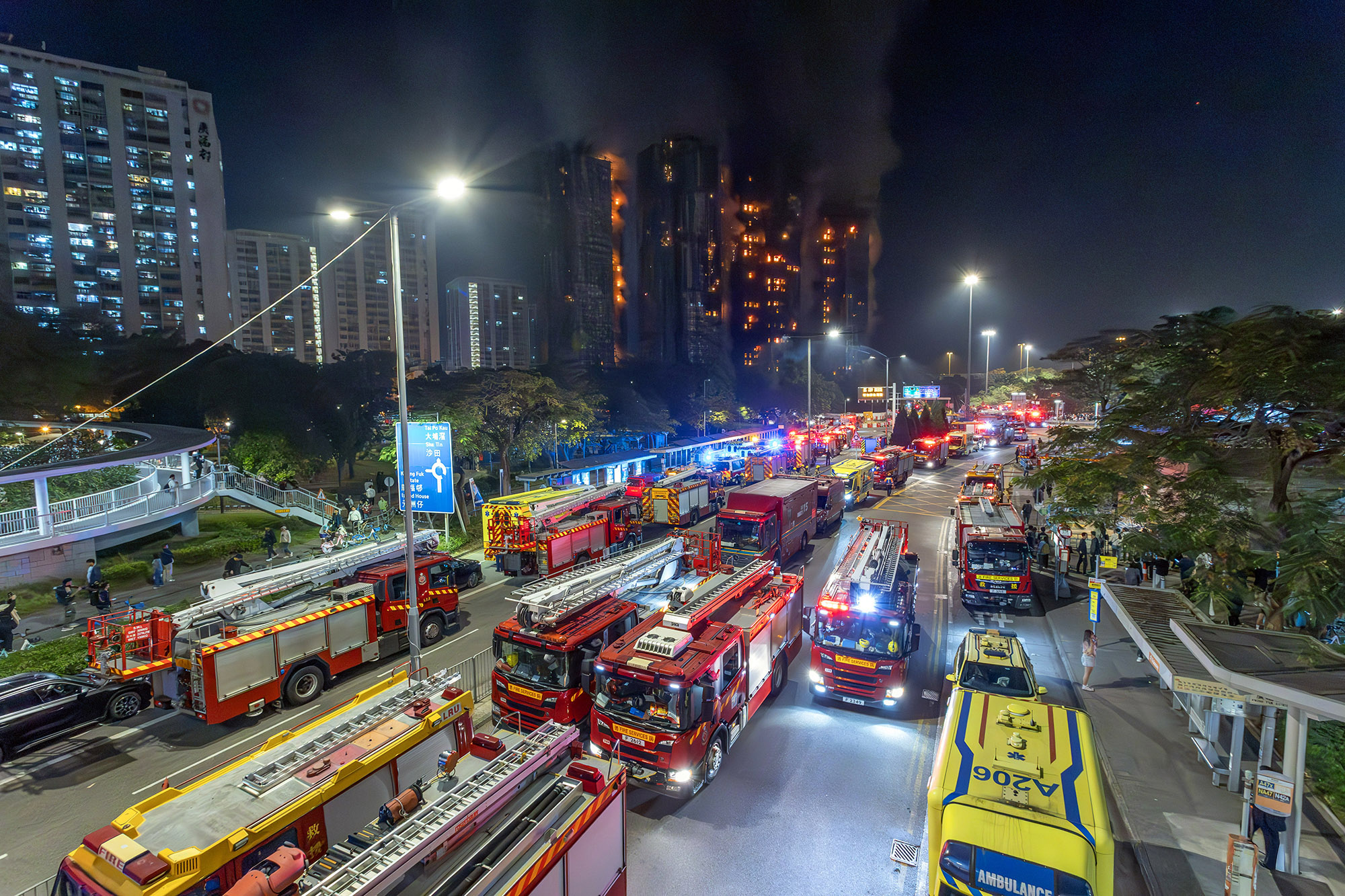
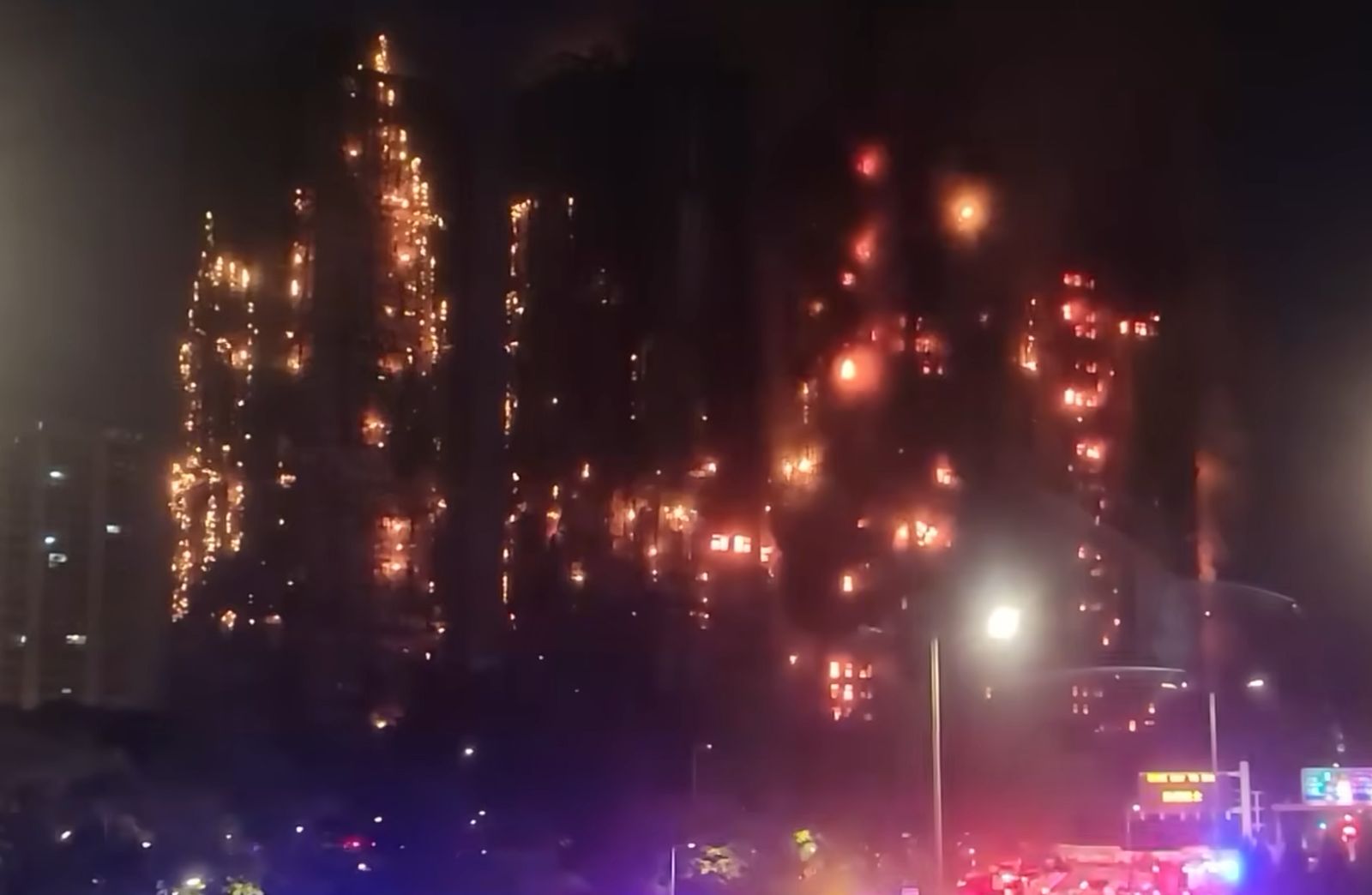
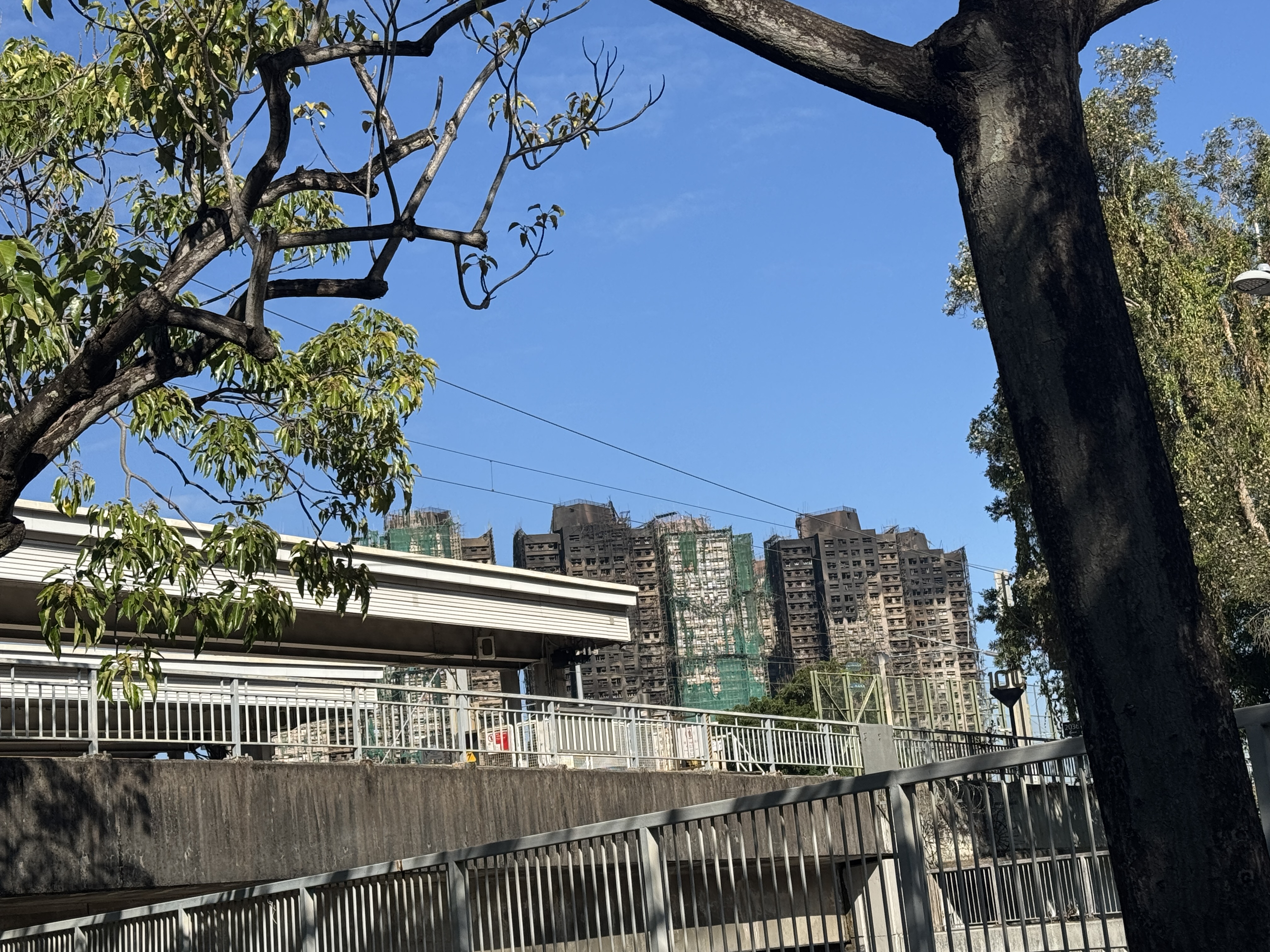
To understand the Hong Kong fire in which 168 were killed, begin with the building as it stood that afternoon. Wang Fuk Court, a housing estate in Tai Po in the northern New Territories, was in the middle of a major renovation. Its 31-storey towers were wrapped in bamboo scaffolding, shrouded in dust netting, and studded with polystyrene boards — foam panels fixed around windows as part of the works. Each element is unremarkable on a Hong Kong building site. Together, on an occupied residential estate, they formed a continuous flammable skin stretched over seven towers.
The committee found that the fire was most likely started by a "glowing source… likely a cigarette" igniting paper materials. A cigarette is among the smallest ignition sources imaginable. It became 168 deaths because everything around it was ready to burn: the netting carried flame up the scaffolding, the polystyrene fed it at the windows, and the fire moved from tower to tower faster than residents — many of them elderly — could escape. The blaze burned for about 44 hours. When it was over, 168 people were dead, including one firefighter; 79 were injured; and thousands were displaced from homes that had become uninhabitable. It was Hong Kong's deadliest fire since 1948 — a statistic that places a 2025 renovation project in the company of the city's wartime-era disasters, and explains why no one in government could treat this as a routine industrial accident.
The warnings had come long before the smoke. Residents had raised safety concerns about the renovation for more than a year before the fire — about the materials, about the works, about the hazards accumulating outside their windows. Those complaints are now the moral centre of the whole affair, because they convert the disaster from misfortune into foreseeability. A hazard that residents can see from their kitchens for a year is not a hidden defect. It is a known risk that the responsible institutions — the contractor and consultant on site, and the departments above them — failed, between them, to act on. Fire safety installations that should have protected residents did not function as they were meant to when they were needed most, the hearings heard; alarms that do not sound turn a building's last line of defence into decoration.
That is the sequence the report asks Hong Kong to sit with: a cigarette, a flammable skin, silent alarms, ignored complaints. Remove any one link and the toll changes. Every link was somebody's job.
A 'corrupt ecosystem': the HK$336 million contract
Hong Kong bid rigging in construction, 'textbook' collusion
The report's most quoted phrase was not about flames at all. Describing the wider world of building renovation in Hong Kong, the committee spoke of unlawful and dubious practices forming a "corrupt ecosystem" — an environment in which bid-rigging was not an aberration but a method, involving parties some of which it linked to triad organised-crime gangs. Hong Kong's Competition Commission, for its part, called the case a "textbook example" of collusion. When a judge-led committee and the competition regulator choose language like that, they are telling the public the problem is cultural as much as criminal: a market in which the honest bidder is the fool.
The renovation contract at Wang Fuk Court was worth more than HK$336 million — about US$42.8 million. At that scale, rigging a tender is not petty corruption; it is the capture of one of the largest cheques a housing estate's owners will ever sign, extracted from thousands of ordinary homeowners who believed a competitive process had protected them. The hearings examined how the winning contractor's record had been presented, and one detail has stayed in the public mind: the project consultant had given Prestige full marks on its litigation record despite the contractor accumulating 24 occupational-safety convictions between 2017 and 2023. Twenty-four convictions is not a blemish on a record. It is a record — one that a scoring system either did not see or chose not to weigh. Either explanation indicts the system that awarded the marks.
It is important to keep the legal categories separate, because Hong Kong's courts will. The committee's findings are conclusions of an inquiry, reached on the material before it; the criminal charges — manslaughter, conspiracy to defraud, money laundering and tax evasion among them — are allegations that prosecutors must prove against specific companies and individuals, who are entitled to defend themselves. Bid-rigging as described in the report is, today, the subject of findings and of a promised new criminal law; it is not yet, in this case, a set of convictions. But inquiries and trials answer different questions. The trials will decide who is punished. The report has already decided what the public is entitled to believe about how its housing market was being run.
Why this matters
Wang Fuk Court is one estate. The system that produced it maintains a city. Hong Kong's housing stock is ageing in bulk: tens of thousands of towers built in the same decades, under the same ownership structures, now cycling through mandatory renovation under the Mandatory Building Inspection Scheme, which requires older buildings to be inspected and repaired. Every one of those projects passes through the same machinery the committee examined — owner committees choosing consultants, consultants scoring contractors, departments supervising the supervisors. If bid-rigging was a textbook practice and complaints fell into a vacuum at Wang Fuk Court, the honest question is not whether other estates face the same risks. It is how many, and whether anyone is counting.
The government's flagship answer is to criminalise bid-rigging across the construction industry, with fines of up to HK$10 million and up to 10 years' imprisonment. As deterrence, prison changes the arithmetic in a way fines never have: a fine is a cost of business that can be priced into a rigged tender, while a decade of personal liability cannot. But deterrence depends on detection, and detection is exactly what failed here — not for want of information, since residents supplied it for a year, but for want of an institution obliged to act on it. A new offence on the statute book will not, by itself, give the next estate's complaints an owner.
There is also a harder institutional question, raised by critics from the start and not settled by Thursday's apology: the committee, for all its rigour — 30 hearings, 80 witnesses, a million documents — lacked the statutory powers of a full public inquiry. It could invite cooperation it could not compel in the way a statutory inquiry can. Its defenders can fairly reply that it produced 1,000 pages of findings, named names and forced a resignation without those powers. Both things can be true, and the tension between them is the standing dilemma of disaster accountability everywhere: the faster, softer process that reports while anger is fresh, against the slower, harder one that can drag the unwilling into the light.
Other cities have walked this road and left markers. London's Grenfell Tower inquiry took years and reordered British building regulation; its lesson was that the gap between a warning and an institution's response is where mass-casualty fires live. Hong Kong's own recent disaster coverage tells a similar story in a different key: when an unlicensed resort in Cox's Bazar burned with inspectors' warnings already on file, the pattern — hazard identified, hazard tolerated, fire — was the same, as Signal Post News reported in Cox's Bazar Resort Fire Kills 10, Including a Child, at Unlicensed Wooden Resort Inspectors Warned About in June. Building failures ask the same question on every continent, as the rescue in Nairobi showed in Nairobi Building Collapse in Eastleigh: Seven People Missing as Rescuers Search the Rubble Through the Night. And major disaster inquiries become tests of whether a state can convert grief into structure, a test Spain is now facing after Spain Train Crash: Two High-Speed Trains Collide Near Urda, at Least 68 Killed. Hong Kong's version of that test began on Thursday. It will be graded on scaffolding netting, alarm systems and tender documents — the unglamorous terrain where 168 people were actually lost.
What happens next
The machinery Lee announced is extensive. Chief Secretary Eric Chan will head a steering committee to drive the reforms. The government plans legislation to criminalise bid-rigging in construction, carrying fines up to HK$10 million and 10 years' imprisonment, and changes affecting building oversight — including the Buildings Ordinance framework — will be needed to give departments clearer ownership of fire safety complaints. About 120 recommendations now require owners, timelines and budgets; a steering committee's first report-back will show whether "the reform has only just begun" is a programme or a slogan.
Accountability runs on a second track. The independent team examining officials will decide who, below Ho, faces disciplinary action — the process that determines whether the "vacuum" the committee found was a failure of individuals, of structures, or of both. On the third track, the criminal trials of the two companies and seven individuals will proceed on the charges brought, including manslaughter and conspiracy to defraud; those proceedings, not the inquiry, will determine criminal guilt, and they may take years.
Hovering over all of it is a political calendar. Lee's term ends next June, and asked on Thursday whether he would seek another, he declined to say — implementing the reforms, he said, "is the goal". It was a deft answer that also amounts to a wager: that a government which apologised this publicly can bind its successors, and itself, to the unglamorous work of fixing tender scoring, complaint ownership and scaffold inspections before the memory of the bow fades. The full report and the committee's work are published through the official Independent Committee in relation to the fire at Wang Fuk Court in Tai Po and listed among the government's reports of special committees and independent enquiries.
For the displaced families of Wang Fuk Court, none of this is abstract. They have waited nearly a year in temporary housing for a reckoning, and Thursday gave them three things at once: an apology from the top of the government, a secretary's resignation, and a report that vindicated the complaints they had been making while the scaffolding was still going up. Vindication is not restitution, and an apology is not a rebuilt home. But a city that writes down, in 1,000 pages, exactly how it failed its own residents has at least denied itself the comfort of forgetting. What it does with the memory is the story of the next year.
Sources: Reuters, Hong Kong, October 29, 2026 (reporting by Clare Jim and Anne Marie Roantree: Lee's apology and the bow with seven officials, the judge-led committee's report of more than 1,000 pages, the four government bodies held partially responsible, the "vacuum" finding, the likely cigarette ignition, residents' complaints over more than a year, Prestige Construction and Will Power Architects bearing primary responsibility, at least 25 criminal charges, the "corrupt ecosystem" finding and triad links, the Competition Commission's "textbook example" of collusion, the Eric Chan steering committee and the plan to criminalise bid-rigging with fines up to HK$10 million and 10 years' imprisonment, 30 hearings, 80 witnesses and more than one million files reviewed, critics' concerns about the committee's lack of statutory inquiry powers, and Lee declining to discuss a further term); Reuters explainer, October 29, 2026, "Who is to blame for Hong Kong's deadly 2025 fire?"; Associated Press, Hong Kong, October 29, 2026 (Ho resigned Wednesday; Lee said she should bear political responsibility although no personal wrongdoing was found; the independent checking unit's failure in supervising the maintenance work; seven people and two companies charged, including with manslaughter and conspiracy to defraud; the renovation contract worth more than HK$300 million as alleged by authorities); the Independent Committee in relation to the fire at Wang Fuk Court in Tai Po and the Hong Kong government index of reports of special committees and independent enquiries (report volumes dated October 29, 2026). Committee findings are reported as findings; criminal charges are allegations that remain before the courts. The renovation contract figure of more than HK$336 million (about US$42.8 million) and the consultant's full-marks assessment despite Prestige's 24 occupational-safety convictions between 2017 and 2023 are as reported from the committee's hearings and report coverage.