France suspends police stun grenades
Interior Minister Laurent Nuñez ordered the provisional halt Wednesday morning as 18 misconduct probes opened, Macron held emergency talks, and the three-week-old school protest movement announced new nationwide demonstrations for Thursday.
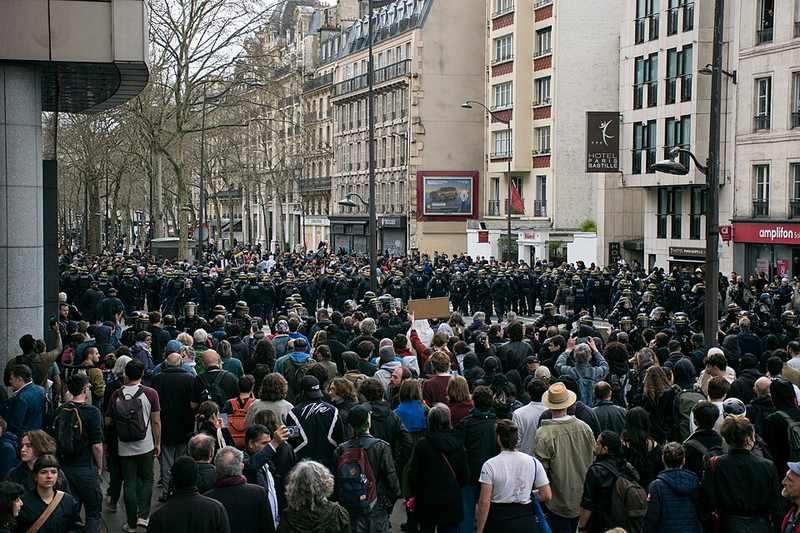
France suspends police stun grenades at student demonstrations, Interior Minister Laurent Nuñez announced on RTL radio Wednesday morning — a provisional halt ordered after a 15-year-old lost his hand to one of the weapons during a school protest in Lens on Monday. The national police director general, Louis Laugier, issued the suspension order on Tuesday: the EF-SON grenades may no longer be used at high-school protests “until all the facts are known regarding what happened in this case,” Nuñez said. The decision lands at a boiling point — more than 260,000 people demonstrated across France on Tuesday by the Interior Ministry's count, organizers claim 450,000, and President Emmanuel Macron convened an emergency meeting with Prime Minister Sébastien Lecornu and key ministers Tuesday evening to find a way out of the crisis.
Why this matters
A government suspending a police weapon in the middle of a protest wave is rare, and it signals that the political cost of the Lens injury has outweighed the tactical value of the grenades. The EF-SON is not an old stockpile item — it is a new-generation weapon French law enforcement has used for only about a year. Its suspension is therefore also an admission, however provisional, that a recently adopted tool may not be safe for crowd control around minors.
Beyond the weapon itself, the decision reframes the entire protest movement: what began on September 17 as a teachers' strike over conditions at a Créteil high school has become a national confrontation over how the state treats its own teenagers. With Lecornu set to address the nation on television at 7 p.m. Wednesday and student unions calling new coordinated protests for Thursday, the suspension looks less like a resolution and more like the opening concession in a longer negotiation — one conducted as much in the streets as at the Élysée.
What was suspended, and what the weapon is
The suspended weapon is the EF-SON, a 40-millimeter stun grenade manufactured by the French company Alsetex, a longtime commercial partner of the Interior Ministry. According to national police documentation reviewed by Le Monde, it has been available to French law enforcement only since the summer of 2025, alongside a Brazilian-made model, the GL-304. Unlike older grenades that need a separate propulsion device, the EF-SON is a single integrated unit with a range of about 80 meters when fired at a 45-degree angle, with an accuracy margin of roughly 20 meters. It is fired from the Cobra dual-barrel launcher, which French police also began using in 2025 — it is not compatible with the older Cougar launcher.
Nuñez stressed the suspension is narrow: “only for the high school student protests” and “just long enough to understand what happened.” The grenades remain available for other policing operations.
The injuries that forced the decision
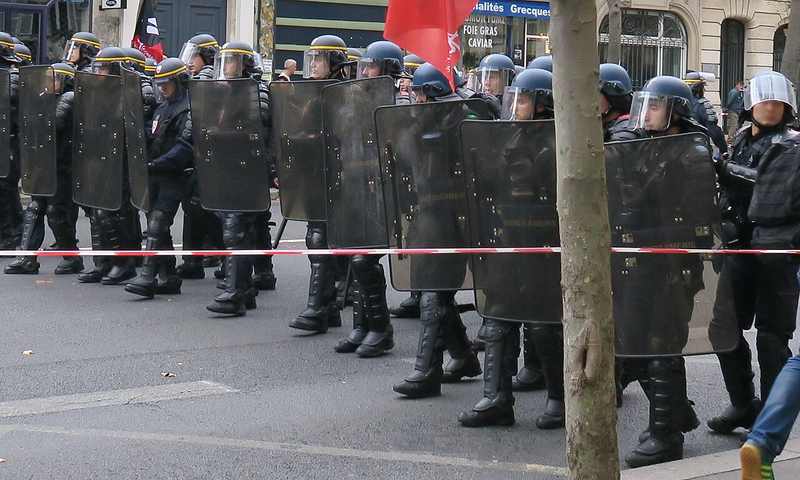
Two cases drove the political pressure. In Lens on Monday, a 15-year-old lost his hand — and, per some reports, part of his lower arm — when a police stun grenade detonated as he apparently tried to pick it up during clashes. Police prefect François-Xavier Lauch said 150 to 250 protesters had been hurling objects at riot officers when police intervened; the boy's life is not in danger and he was rushed to a nearby hospital.
Separately, last week in Saint-Ouen-l'Aumône, northwest of Paris, a 14-year-old was struck in the face by a tear gas grenade fired at such close range that he lost several teeth and suffered a jaw fracture — a policeman was charged on Tuesday over that incident. Nuñez confirmed the IGPN, the national police oversight body, has opened 18 investigations into alleged officer misconduct since the protests began, and insisted police responses must be “proportionate.”
The hard-left France Unbowed (LFI) was unsparing: national coordinator Manuel Bompard said “it took several children being maimed for life” for the minister to act. The government, in turn, blames LFI for stoking tensions around the protests.
Background — three weeks of school protests
The movement began on September 17 in support of a teachers' strike at a high school in Créteil, a Paris suburb, and has since spread nationwide. The grievances are concrete: understaffed schools, crumbling buildings, oversized classes, missing substitute teachers, and classrooms that overheated during the year's heatwaves. “In Saint-Denis, just right outside of Paris, high schools see the ceilings falling apart, water in the walls, rats,” one protester told CBS News.
The student union Union Syndicale Lycéenne said 2,000 high schools were at a standstill Tuesday morning and all universities mobilized. About 500 schools closed Monday; more than 5,000 people have been detained since the protests began, over 4,000 of them teenagers, and minors account for 87% of detentions according to reports. Some demonstrations have turned violent — schools ransacked, barricades and fires, masked protesters clashing with police — which is the context in which officers deployed tear gas and stun grenades. Earlier Signal Post News coverage examined both the closure of hundreds of schools and the Lens injury that intensified scrutiny.
Who benefits, who loses, what critics say
The protesters and their unions benefit immediately: the suspension validates their core complaint that policing of the demonstrations was excessive, and it hands them momentum heading into Thursday's coordinated actions. The government, paradoxically, may also benefit — a visible concession can deflate a protest wave, and Nuñez gets to present himself as responsive while keeping the suspension narrow and temporary.
The losers include the police rank-and-file, who lose a crowd-control tool and face 18 misconduct investigations, and potentially the broader public if Thursday's protests turn violent without the deterrent. Critics split both ways: LFI says the suspension came too late and only after children were maimed; law-and-order voices will argue that stripping officers of non-lethal options while protesters hurl projectiles invites more injuries, not fewer. Both claims deserve scrutiny — the IGPN investigations will determine whether the Lens firing followed protocol, and the 20-meter accuracy margin of the EF-SON raises legitimate questions about using it anywhere near teenagers.
What the numbers say
260,000 demonstrators (Interior Ministry) versus 450,000 (organizers) — the gap itself is political, but either figure makes Tuesday one of the largest student-led mobilizations in recent French history. 5,000+ detained, 87% minors: that ratio is the number that should trouble the government most, because it means the state's coercive apparatus is being deployed overwhelmingly against children. 18 IGPN investigations in three weeks is an unusually high caseload and suggests the misconduct allegations are not isolated. 400+ schools closed and 2,000 high schools at a standstill measure the disruption in educational terms — every day of closures is a day of lost instruction, which undercuts the movement's own demand for better schooling even as it demonstrates its power. And one year: that is how long the EF-SON had been in service before maiming a 15-year-old badly enough to get it suspended — a short service life for a weapon adopted without, apparently, sufficient testing around the exact scenario in which it has now failed.
What happens next
All eyes turn to 7 p.m. Wednesday, when Prime Minister Lecornu addresses the nation on the protests and the 2027 budget — the two crises are now fused, since school funding sits at the heart of both. The government's offer to scrap this week's class schedule in favor of discussion forums has been dismissed as insufficient; expect Lecornu to announce something more concrete or face an escalation.
Thursday's coordinated protests will test whether the grenade suspension calms the streets or simply shifts the confrontation to other tactics. The IGPN's 18 investigations will unfold over weeks, and any finding that the Lens grenade was misused could turn a provisional suspension into a permanent ban — and trigger lawsuits. Watch also for the budget debate: with the government already in a fiscal crisis (see our coverage of the Lecornu budget fight), every euro promised to schools must come from somewhere, and parliament will want to know where.
Sources
- Le Monde: What is the EF-SON stun grenade?
- ABC News, October 7, 2026: French police suspend use of stun grenades after high-school protester loses hand.
- AFP via La Gaceta de México: France suspends stun grenade use at student protests
- Sweden Herald: France suspends flashbang grenades after school protests turn violent
- People: Teen loses hand amid confrontation with police over education protests
Reporting note: Figures attributed to the Interior Ministry, organizers, police or unions are identified as claims by those parties. Analysis and framing are by Signal Post News.