France shuts 900 schools protests
Classes were fully or partly suspended at 891 schools as a local fight over teachers and crumbling buildings became a national test of policing, public spending and political credibility.
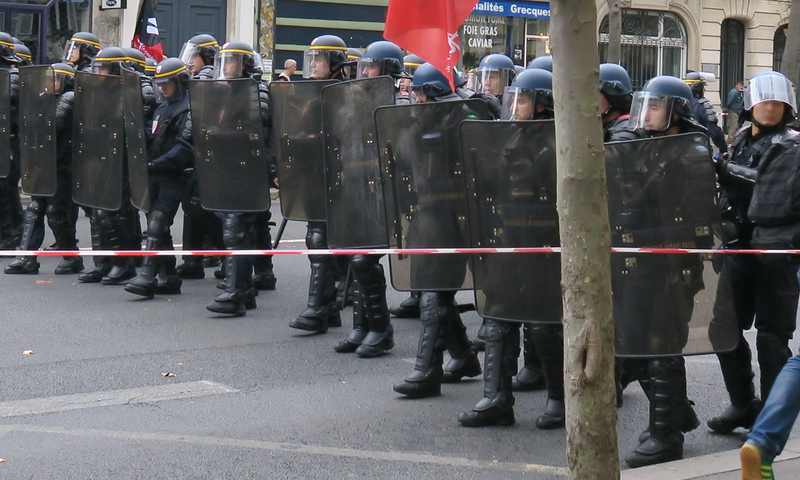
France shuts 900 schools protests entered a more dangerous phase on Wednesday after the Education Ministry said classes had been fully or partly suspended at 891 schools on Tuesday, nearly double the roughly 500 closures reported earlier in the week. More than 250,000 people marched nationwide, while the student union USL said about 2,000 high schools were at a standstill. The escalation now spans several fronts: a devastating injury in Lens, a pause in the use of stun grenades at student protests, a foreign intervention from President Donald Trump, a diesel-price response from Prime Minister Sébastien Lecornu and a government review of €43 billion in proposed savings.
The numbers from the ministry, unions and organizers measure different things and should not be treated as interchangeable. The 891 figure includes both complete and partial suspensions; the union's larger estimate includes blockades and other interruptions. What they collectively show is that a movement that began with concrete problems at one suburban school is now disrupting education nationwide and forcing the government to answer demands that collide directly with its budget plans.
Why this matters
The crisis combines three pressures that governments can usually try to manage separately. Students and teachers want more staff, functioning buildings and dependable classes. Police are being asked to protect schools, streets and bystanders while responding to stone-throwing, fires and vandalism. The government is trying to calm both sides while cutting public spending and limiting the economic damage from high fuel prices. A concession on one front can make another harder.
The Lens injury sharply raises the cost of getting that balance wrong. A 15-year-old lost his hand after picking up a police stun grenade during Monday's confrontation, according to prefect François-Xavier Lauch as reported by Reuters. Interior Minister Laurent Nuñez then ordered the use of stun grenades paused for policing student protests until the facts are clarified. Eighteen cases have been referred to the police inspectorate. The pause does not determine who was legally responsible in Lens, but it signals that officials see enough uncertainty and risk to change tactics while investigators reconstruct what happened.
The political clock is also short. France is roughly six months from a presidential election, President Emmanuel Macron is unpopular, and Marine Le Pen leads in polling cited in coverage of the crisis. That makes schools, fuel costs, public order and spending restraint parts of the same election argument rather than isolated policy disputes.
From one suburban high school to a national movement
The protests began at a high school in a working-class Paris suburb where students and staff complained about teacher shortages and deteriorating facilities. Their grievances were local and practical: classes without teachers, buildings needing repair and a sense that schools serving poorer neighborhoods were being asked to accept conditions that would not be tolerated elsewhere. Videos and student organizing helped similar complaints connect across the country.
Teachers, parents and unions joined as the protests spread. That broadened the movement's legitimacy and capacity, but it also made its demands harder to summarize. Some want emergency repairs and substitute teachers. Others see the schools as evidence of a wider retreat in social support. Organized labor connects education spending with wages, fuel costs and public services. None of those positions requires every participant to share the same ideology.
Authorities offer a different account of the escalation. Police and government officials say peaceful marches have been infiltrated or accompanied in some cities by masked groups throwing projectiles, damaging storefronts and attacking schools. Paris police said a group of roughly 300 masked people confronted security forces while much of the wider march passed without major incident. That distinction matters: the right to protest does not erase the state's duty to prevent violence, and isolated violence does not turn every marcher into a rioter.
Lens and the policing dilemma
The central factual point is not disputed: a teenager suffered a catastrophic hand injury in an incident involving a police stun grenade. The circumstances remain under investigation. Lauch's account says the boy picked up the device. Critics of the police response argue that weapons capable of causing such injuries should not be deployed around minors. Police representatives and officials answer that officers were facing dangerous projectiles and needed tools to disperse violent groups without using firearms.
Nuñez's pause is therefore both operational and political. Operationally, commanders lose one crowd-control option at student demonstrations while guidance is reviewed. Politically, the government acknowledges that normal procedure cannot simply continue after an injury of this severity. The 18 inspectorate referrals widen the question beyond a single device: investigators will have to examine proportionality, distance, warnings and whether officers followed rules in each incident.
The next test is not whether France can police without stun grenades. It is whether revised tactics reduce serious injuries without leaving officers, demonstrators or nearby residents more exposed. Evidence from subsequent demonstrations will matter more than rhetoric from either camp.
Trump's intervention — claim and record
Trump reframed the crisis through his own political lens, writing on Truth Social: “What's happening in France is nothing less than out of control mass migration. This isn't about schools, this is about Islam wanting to take over a once great Country! President DJT.”
The documented demands do not support that explanation. Students, parents and unions have centered teacher shortages, school maintenance, class conditions and education funding. Neither immigration nor religion appears among the movement's stated demands. Reporting by the BBC also noted that Le Pen's National Rally had not linked the protests to migration policy. Trump's statement may resonate with supporters who interpret European disorder through migration and identity, but it does not describe the grievances that started or organized this protest movement.
That correction does not require denying the government's claim that outside activists have joined some confrontations. A movement can begin around school funding and later attract political groups with broader agendas. The evidence should be separated: stated demands explain why students mobilized; police reports help explain particular clashes; neither automatically proves a nationwide religious or migration-driven cause.
The fiscal bind: €43 billion versus school demands
Lecornu's government has begun a budget review centered on a proposed €43 billion savings package. That puts the cabinet in a direct arithmetic conflict with the protesters. Hiring teachers, repairing buildings and restoring services cost money; delivering the savings means cutting expenditure, raising revenue or shifting costs elsewhere. Any serious compromise must say which side of that ledger changes.
Three broad paths are available. The government could protect education while finding deeper reductions in other departments. It could scale back or delay the €43 billion target, accepting more borrowing or revenue measures. Or it could keep the plan largely intact and offer narrowly targeted school repairs and staffing changes. The first creates new opponents, the second risks fiscal credibility, and the third may be too small to demobilize a national movement.
The students' leverage comes from disruption and public sympathy. The government's leverage comes from the difficulty of sustaining closures and marches once families lose instruction, income or mobility. Unions can extend the confrontation, but doing so also creates pressure to define achievable priorities rather than a list the budget cannot absorb all at once.
What the numbers mean
Nearly 900 schools is a system-level disruption
France has about 3,700 high schools. On that denominator, 891 affected schools represent roughly 24% of the total — close to one in four. That does not mean every affected school closed for the entire day, because the ministry count includes partial suspensions. It does mean the disruption is no longer concentrated in a handful of cities. The union's estimate of about 2,000 high schools at a standstill, if measured on a broader definition, would represent more than half the system. The gap between the two counts is a warning to compare definitions before comparing scale.
The human toll is also split among groups. Government figures reported 215 teenagers and 85 education workers injured, while Lecornu's office said more than 700 police officers had been hurt. Those figures support two realities at once: minors and school staff have suffered serious harm, and officers have faced repeated violence. A neutral assessment cannot use one set of injuries to erase the other.
Ten million barrels can buy time, not certainty
Lecornu announced the release of 10 million barrels from fuel reserves to reduce diesel prices. The headline quantity is substantial, but it does not translate into a fixed price cut at the pump. The effect depends on how quickly the barrels enter the market, what products refineries produce, import conditions, taxes, distribution margins and how long the release lasts. It is best understood as a buffer intended to improve supply and expectations, not a guarantee of a particular retail price.
The move addresses a wider source of anger rather than the schools' core demands. That can help households and transport-dependent workers, but it may also look like an attempt to relieve the symptoms around the protest movement while the education dispute remains unresolved.
The grenade pause signals a review of doctrine
A temporary suspension is narrower than a ban. It preserves the government's ability to reinstate the weapon if investigators conclude the rules were followed or can be tightened. Yet pauses can change doctrine even when they are temporary: commanders adapt formations, distances and escalation rules, and those changes create a record that policymakers later compare with earlier outcomes.
Who gains, who loses
Students and education unions gain bargaining power from the scale of the shutdowns and the government's visible tactical retreat on stun grenades. Parents gain influence when they act as a protective bridge between minors and police. But they all lose if prolonged closures deepen the educational harm they are protesting.
The government can gain credibility by producing verifiable repairs, staffing commitments and transparent policing reviews. It loses if concessions appear disconnected or if the budget review contradicts promises to schools. Police gain from clear rules that distinguish peaceful crowds from violent groups; they lose operational flexibility during the pause and public trust if investigations find misconduct.
Le Pen stands to benefit if the election becomes a referendum on disorder, cost of living and Macron's authority. Her advantage is not automatic. If the government's response restores calm without abandoning education investment, the crisis could recede. If voters see the National Rally as interpreting a school-funding protest mainly through identity politics, rival parties may still contest that frame.
What happens next
Budget review: Watch whether the €43 billion package protects education, delays savings or substitutes narrowly targeted funds. The most consequential announcement will not be a total alone but a timetable: which schools get teachers or repairs, when, and from which budget line.
Lens inquiry: Investigators must establish where and why the grenade was fired, whether warnings were given, how the teenager came into contact with it and whether deployment rules were followed. A finding of misuse could make the pause permanent or prompt tighter restrictions. A finding that officers followed policy would shift scrutiny toward the policy itself.
Street mobilization: A decline in violence with turnout holding steady would strengthen protesters' argument that their movement is about schools. Continued attacks on officers or buildings would strengthen calls for tougher control. Fresh serious injuries could overwhelm both narratives and force broader concessions.
Election run-up: Macron's government needs to show that it can protect public order, preserve essential services and manage the budget at the same time. Le Pen and other challengers will test every decision against that three-part standard. With only months until the vote, even a temporary settlement may become an election dividing line.
Sources
- NPR Illinois: France's police fire tear gas and water cannons as school protests sweep the country
- Reuters: France suspends stun grenades at student protests
- Reuters: Lens teenager's hand injury
- Reuters: France braces for school blockades and street protests
- BBC: School protests sweeping France cause “heaviest toll in decades”
- Politico Europe coverage of France's school-protest escalation; a stable public article URL was not available at publication time.
- CNN: France student protests explained
Reporting note: School disruptions, turnout and injury totals are attributed to the ministry, unions, organizers or officials that reported them. Where definitions differ, this article preserves the distinction. Analysis and framing are by Signal Post News.