World · Politics · Türkiye
Ekrem Imamoglu is already in prison, already suspended from the Istanbul mayor’s office, already banned from politics twice over and already stripped of the university degree Turkish law requires of a presidential candidate. On Wednesday, a court in Ankara added one more layer: a further two years and one month behind bars, and a fresh political ban — in a case about how his own party chose its leader three years ago.

ANKARA, November 18, 2026 — The Ekrem Imamoglu political ban grew heavier on Wednesday, as a Turkish court sentenced the jailed former Istanbul mayor to a further two years and one month in prison for violating the country’s election law and imposed a fresh ban on his political activity, according to state broadcaster TRT Haber, in a ruling reported by Reuters and CNN Turk. Imamoglu, held in pretrial detention at Marmara Prison in Silivri since March 2025 and removed from the mayor’s office that same month, is the New Party’s presidential candidate for 2028 and was, before his arrest, widely seen as the main potential challenger to President Recep Tayyip Erdogan. The new sentence does not arise from the sweeping corruption case that put him in prison. It arises from an internal party vote: the November 2023 congress of the Republican People’s Party, the CHP, at which Ozgur Ozel defeated Kemal Kilicdaroglu for the leadership — a contest prosecutors say was tainted by improper inducements offered to delegates, and which the defendants deny. No published text of Wednesday’s judgment was available as this article was written; the ruling is known through the media reports cited here, and whether Imamoglu will appeal this particular sentence has not yet been reported.
What the court did on Wednesday
The core facts, as reported, are these. Reuters, citing TRT Haber, reported that a Turkish court on Wednesday sentenced Imamoglu to a further two years and one month in prison for violating the election law and imposed a new political ban. CNN Turk and other Turkish media also reported the ban. Under the Reuters account, Imamoglu was one of nine defendants sentenced in the case, which centres on the CHP convention of November 2023. The defendants were accused of making improper inducements to encourage delegates to vote for Ozel when the party elected him leader at that congress. They denied the allegations.
Spain’s Democrata, reporting independently, identified the court as the Ankara Court of First Instance 26 and gave a fuller — and differently counted — picture of the outcome: the political ban was ordered against Imamoglu and nine other people who had been indicted, while three other defendants were acquitted. Among those acquitted, Democrata reported, was Cemil Tugay, the mayor of Izmir, who last October left the CHP to join the ruling Justice and Development Party, the AKP. The two accounts are presented here as their sources gave them, because the counts are not the same: Reuters describes nine defendants sentenced, Democrata describes a ban covering Imamoglu and nine others indicted with three acquittals alongside. Until the judgment itself is published, those are the reported contours of the verdict — a new custodial sentence of two years and one month for Imamoglu, and a new political ban whose precise duration and terms have not been set out in the reporting so far.
Two cautions belong in the record immediately. First, this sentence is distinct. It belongs to the CHP-congress and election-law case, and it is separate both from the political bans courts imposed on Imamoglu in 2022 and 2025 and from the corruption mega-trial that opened at Silivri in March of this year. Second, finality: Imamoglu is appealing both of the earlier bans, but the appeal position on Wednesday’s sentence is simply not yet known. Nothing in the reporting establishes that this ban is final, and readers should treat it as a first-instance outcome in a legal campaign that has, at every previous stage, gone to appeal.
A case that began inside the opposition
Most prosecutions of opposition figures begin with the state. This one began, on paper, inside the opposition itself. According to Democrata, the proceedings trace back to a 2024 complaint filed by five CHP delegates alleging irregularities in the party’s 38th ordinary congress, held in November 2023, at which Ozel prevailed over Kilicdaroglu — ending Kilicdaroglu’s thirteen years at the head of the party Ataturk founded. The prosecution theory, as Reuters summarised it, is that inducements were improperly offered to sway delegates toward Ozel. The defendants, Imamoglu among them, denied the allegations.
The strangeness of the case is worth pausing on, because it explains much of what followed. The alleged victim of the alleged rigging was not the government or the electorate; it was a faction of the CHP itself. Yet the case was taken up by prosecutors, pursued through the courts, and has now produced prison sentences and political bans against figures who, in the meantime, had largely left or been pushed out of the party the congress belonged to. In May of this year, an Ankara court set aside Ozel’s appointment as CHP leader and returned the leadership to Kilicdaroglu — a judicial intervention in the internal affairs of the main opposition party that triggered a major internal crisis. Wednesday’s verdict is the criminal-law companion to that civil-law intervention: first the congress’s result was undone, then the people accused of engineering it were sentenced.
The rise: how a district mayor became Erdogan’s chief rival
To understand why so much legal machinery has been trained on one politician, start with the arithmetic of Istanbul. Imamoglu, born on June 4, 1970, and a former district mayor of Beylikduzu, stepped into the national spotlight in 2019 when he won the Istanbul mayoralty — the city that is Turkey’s economic engine, home to roughly a sixth of its population and a still larger share of its output, and the office from which Erdogan himself once launched a national career. When the authorities annulled that first result, Imamoglu won the re-run by a far larger margin, a humiliation for the ruling party that established his defining political asset: he is the rare opposition figure who has beaten the AKP machine in Turkey’s biggest city not once but repeatedly, and he was re-elected in 2024.
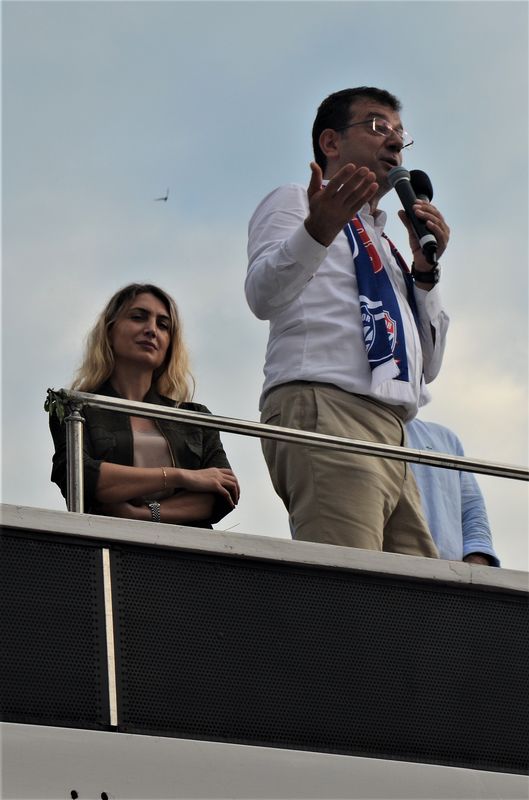
That record is why, by early 2025, Imamoglu was not merely a mayor but the opposition’s presumptive answer to a question Turkish politics has asked for a decade: who could actually defeat Erdogan, or his chosen order of succession, in a national vote? The same President Erdogan who last month was condemning Black Sea attacks after hosting President Zelenskyy in Istanbul has spent two decades ensuring that no rival accumulates an independent power base. Imamoglu accumulated one anyway — a metropolitan government, a national profile and a demonstrated ability to win the city both men treat as the country’s political weather vane. Everything that has happened to him since March 2025 follows from that fact, whichever account of it one believes.
March 2025: arrest, suspension and a stripped degree
The sequence that removed Imamoglu from public life was swift and, in its ordering, much debated. He was arrested on March 19, 2025 — days before the CHP was due to select him as its presidential candidate — and has been held in pretrial detention at Marmara Prison, the complex still widely known by the name of its district, Silivri, ever since. He was removed as mayor in March 2025. His university degree was annulled, a step whose political significance exceeds its bureaucratic sound: a university degree is a constitutional prerequisite for the Turkish presidency, so the annulment struck not at his present office but at his future eligibility. He has denounced, through social media, what he calls an “instrumentalized judicial operation” run by Erdogan’s executive — the phrase Democrata reported, and the organising claim of his defence ever since.
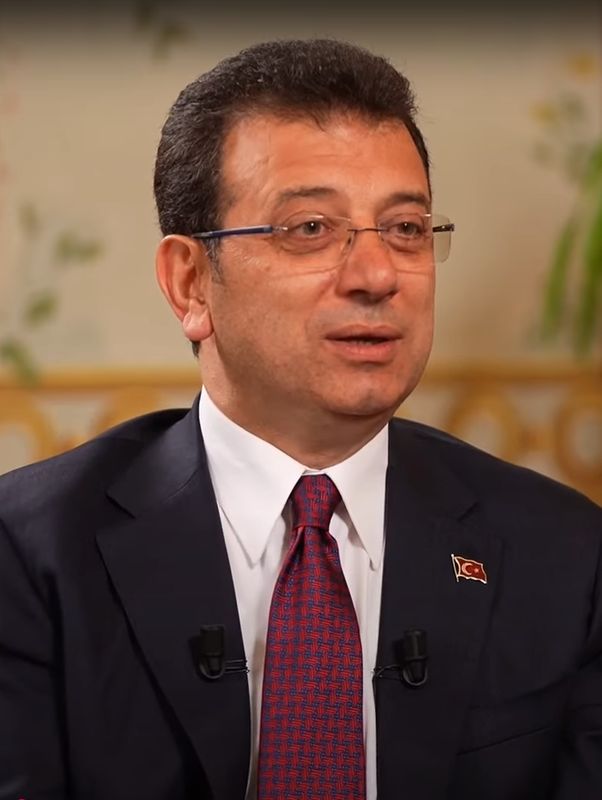
Then, in March of this year, came the largest proceeding of all: the corruption trial linked to the Istanbul municipality, which opened in Silivri on March 9, 2026, with more than 400 defendants. Imamoglu denies the corruption charges, which — in aggregate, across the indictment — carry prison sentences amounting to hundreds of years. That trial is separate from Wednesday’s case in every respect: different allegations, different court, different facts. But politically the two proceedings interlock, because each supplies what the other lacks. The corruption case supplies the detention and the spectacle of scale; the smaller, older cases — the 2022 ban, the 2025 ban, and now the congress case — supply the political bans that, if upheld, bar the candidacy itself. A candidate can campaign from many disadvantages. Under a final political ban, he cannot be a candidate at all.
A party split in two: the CHP takeover and the Yeni Party
Wednesday’s sentence also lands in the middle of the strangest opposition story in modern Turkish politics: the judicial dismantling and re-founding of the CHP. When the Ankara court in May set aside Ozel’s leadership and restored Kilicdaroglu, the party that had run Istanbul and led the opposition was, by court order, handed back to the man its congress had voted out in 2023. Ozel’s response was to walk out and build anew: he launched a new party, Yeni — the New Party — and took officials with him. Imamoglu, from prison, was among those who joined. In August 2026, after the judicially enforced leadership takeover was complete, he resigned from the CHP altogether and backed Ozel’s Yeni Party, becoming its presidential candidate for 2028.
Hold that sequence against Wednesday’s verdict and the full picture emerges. The congress case concerns the 2023 vote that made Ozel leader of the CHP. By the time it produced sentences, the CHP of 2023 no longer existed in that form: its elected leader had been removed by a court, its most famous mayor had resigned from it, and both men were building a different party. The verdict therefore does not, in practical terms, discipline the internal politics of today’s CHP. Its practical weight falls elsewhere — on the eligibility of the New Party’s presidential candidate, twenty months before the election he is meant to contest.
Why this matters
Strip the case to its mechanism and this is what remains: Turkey’s next presidential election is being shaped, in significant part, not by campaigning but by litigation, and Wednesday’s verdict is the clearest single illustration yet. Consider what the accumulated legal position now is. A politician who won Istanbul three times sits in pretrial detention in a corruption case he denies. His university degree — the eligibility key for the presidency — has been annulled. Political bans imposed in 2022 and 2025 are under appeal. And now a further sentence, in a case about his old party’s internal congress, adds two years and one month and another ban on top. Each element is, formally, the product of an individual court in an individual case. The opposition’s argument is that the pattern is the point: that the cases are cumulative in effect even if separate in law, and that their combined effect is to decide the 2028 election in courtrooms before a ballot is cast.
There is a second reason this matters, and it is institutional rather than personal. The congress case establishes, in practice, that the internal delegate politics of an opposition party — its congresses, its leadership contests, the inducements and bargains that are the ordinary currency of party conventions everywhere — can be re-litigated years later as election-law crimes carrying prison and political bans. Whatever one thinks of the specific allegations, which the defendants deny, the precedent reaches beyond Imamoglu: any future opposition leadership contest in Turkey now takes place in the knowledge that its losers’ complaints can become prosecutions, and its winners’ mandates can be annulled and then criminalised. That is a structural change in how Turkish opposition politics can be conducted, and it will outlast this defendant.
And there is a third, quieter point. Turkey is a state whose parliament this month ratified a collective-defence pact with Saudi Arabia and Pakistan, whose president mediates between Kyiv and Moscow, and whose stability Western governments treat as a strategic asset. The Imamoglu cases are the domestic counterpart to that international weight: the question of whether Turkey’s elections remain a genuinely open contest is now inseparable from the question of what Turkey is as a partner. Allies who say little in public about the prosecutions still price them in private.
Three ways to read the verdict
The government’s framing: courts, not politics
The position of Erdogan’s government and the AKP, in this and the earlier cases, is that Turkey’s judiciary acts independently, that no one is above the law, and that the cases against Imamoglu concern alleged wrongdoing — corruption in the municipality case, inducements in the congress case — rather than his politics. On that reading, Wednesday’s verdict is unremarkable in kind: an election-law conviction arising from a complaint, brought by members of Imamoglu’s own former party, about a party congress. The government also notes, when pressed on the candidacy question, that bans and sentences alike are subject to appeal through the ordinary courts. That framing has the virtue of matching the formal record. Its difficulty is the calendar: the arrest days before a candidate selection, the degree annulment, the annulment of a party congress, and now a sentence against the same man in a fourth proceeding are a sequence the government asks observers to read as coincidence of independent processes, and much of the Turkish public — like much of the opposition — declines to read it that way.
The opposition’s claim: an instrumentalized judiciary
Imamoglu’s own verdict on the verdicts is already on record: an “instrumentalized judicial operation” by the executive, delivered through social media from detention. The opposition’s wider argument builds from the same sequence read in reverse — each case arriving at the moment of maximum political effect, the complainants in the congress case being internal rivals, the acquittal of a defendant who had meanwhile defected to the ruling party, and a leadership annulment that handed the CHP to the faction most convenient to the government. None of that, by itself, proves direction from the palace; Turkish courts have their own institutional history and their own internal politics. But the opposition does not need to prove a telephone call from the presidency to make its political point. It needs only the undisputed chronology, and the chronology is devastating enough to campaign on — which is, in the end, what the New Party intends to do.
The 2028 field: a candidate running against the courts
The electoral consequence is the hardest to overstate. Erdogan, in office as president since 2014 and as the dominant figure of Turkish politics for a generation, faces a 2028 contest in which the opposition’s most proven vote-winner may be legally unable to appear on the ballot. That transforms the opposition’s strategic problem. Instead of asking which candidate can beat the incumbent — a question to which Imamoglu was the data-backed answer — the New Party must ask which candidate can beat the incumbent and survive the legal process long enough to be voted for. Every month the appeals run is a month the party cannot finalise its ticket, its message or its coalition arithmetic, while the incumbent campaigns undisturbed. Even if every ban were ultimately overturned, the process itself consumes the scarcest resource in politics: time.
The numbers: a candidacy buried under sentences
The figures, kept in their separate cases as the record requires, are these. Prior proceedings: political bans imposed in 2022 and 2025, and prison sentences totalling more than six years, both bans under appeal. Wednesday’s addition: two years and one month, plus a new ban, in the congress case — bringing the stacked custodial total, across the concluded cases, to more than eight years, before the largest case is even decided. The corruption trial: more than 400 defendants, charges Imamoglu denies, exposure measured by prosecutors in the hundreds of years. And the political denominator beneath all of it: Istanbul, a city of some sixteen million people, whose mayoralty Imamoglu won in 2019, won again in the re-run by a landslide, and held again in 2024 — the single largest electoral prize in the country, and the platform that made a municipal politician into a presidential one. Turkey does not lack opposition politicians. It lacks, at present, another one with that record, which is precisely why the record’s owner is the one accumulating sentences.
What happens next
Three scenarios now compete, and they are not equally likely. The first is appellate relief: Imamoglu’s lawyers appeal Wednesday’s sentence as they appealed the 2022 and 2025 bans, and the higher courts — eventually, in the Turkish system, the Court of Cassation and, on the eligibility questions, potentially the Constitutional Court and Strasbourg beyond it — unwind some or all of the structure before the 2028 ballot is set. This is the path the New Party publicly assumes, and it is genuinely available; Turkish appellate courts have reversed politically charged verdicts before. Its weakness is timing: relief that arrives after candidate registration closes is relief in name only.
The second scenario is substitution. If the bans harden into finality, the New Party must field another candidate — Ozel himself, or a unity figure acceptable to a wider opposition — with Imamoglu campaigning, in effect, as the imprisoned symbol of the ticket rather than its name. Substitution is not hopeless: outrage is a mobiliser, and a substitute running as the stand-in for a jailed rival inherits his voters’ grievance along with their votes. But substitutes do not inherit his Istanbul machine, his cross-party reach or his three victories, and everyone in Ankara knows it — including, the opposition would say, the people who designed the legal strategy.
The third scenario is the one the New Party is already, visibly, preparing for: run the campaign as a referendum on the courts themselves. On that strategy, Wednesday’s verdict is not an obstacle to the campaign; it is the campaign. Every new sentence becomes a rally, every ban a poster, and the election a choice between a president whose rivals are prosecuted and a movement asking voters to free its candidate with their ballots. It is a strategy born of necessity, and it has a real historical logic in Turkey, where Erdogan himself once converted a political ban and a short prison sentence, in 1999, into the founding myth of a movement that has governed ever since. The symmetry is not lost on anyone in Turkish politics. Whether it can repeat, with the state’s machinery now in other hands, is the question the next twenty months will answer.
For now, the plain facts are narrower than the stakes. A court in Ankara has, according to TRT Haber and the reporting of Reuters and Democrata, sentenced Ekrem Imamoglu to two more years and banned him again. He remains where he has been since March 2025: in a cell in Silivri, suspended from an office he won three times, stripped of a degree, and still — on paper, and in the plans of the party he joined from prison — the man the opposition intends to put against Recep Tayyip Erdogan in 2028. The courts have had their say again. The appeals, and then the voters, have yet to have theirs.
Related coverage
An Attack on One Is an Attack on All: Turkey’s Parliament Ratifies the Mecca Defence Pact
Erdogan Condemns Black Sea Attacks on Civilian Ships After Zelenskyy Talks in Istanbul
Sources
- Reuters, November 18, 2026 (15:59 UTC) — “Turkish court hands new sentence, political ban to jailed Istanbul mayor, media says”: the two-year, one-month sentence for violating the election law and the new political ban, as reported by state broadcaster TRT Haber, with CNN Turk and other media reporting the ban; Imamoglu as one of nine defendants sentenced in the CHP November 2023 convention case; the inducement allegations and the defendants’ denials; the 2022 and 2025 bans, the more than six years of prior sentences and the appeals; and the separate corruption trial of more than 400 defendants that opened in March (reuters.com).
- Democrata (Spain), November 18, 2026 (21:26 CET) — independent reporting identifying the Ankara Court of First Instance 26 as the sentencing court; the ban ordered against Imamoglu and nine other indicted persons; the acquittal of three defendants including Izmir mayor Cemil Tugay; the case’s origin in a 2024 complaint by five CHP delegates over the 38th congress; the May ruling that set aside Ozel’s leadership and restored Kilicdaroglu, and the founding of the Yeni Party; and Imamoglu’s detention since March 2025, removal as mayor, annulled degree and “instrumentalized judicial operation” denunciation (democrata.es).
- Background as reported across both sources and Signal Post News’s earlier coverage: Imamoglu, born June 4, 1970, won the Istanbul mayoralty in 2019 and again in that year’s re-run, and was re-elected in 2024; he was arrested on March 19, 2025, days before the CHP was to select its presidential candidate, and is held at Marmara (Silivri) Prison; the corruption trial opened in Silivri on March 9, 2026; in August 2026 he resigned from the CHP and became the New Party’s (Yeni Parti) presidential candidate for 2028. No published text of the November 18 judgment was available at publication; the sentence and ban are reported as the cited outlets reported them, and the appeal status of this sentence had not been reported. Photographs: Ekrem Imamoglu, February 2024 — Serkan Yakın via Wikimedia Commons (CC BY-SA); Ekrem Imamoglu, March 2024 — Wikimedia Commons; Imamoglu campaigning with Dilek Imamoglu in Silivri, June 2019 — Wikimedia Commons. All credited in place.