War · Ukraine · Russia
The Kerch crossing has been attacked for the third time in four days. Traffic is suspended again, the railway section is reported — unofficially — to have been the target this time, and the extent of the damage from the overnight strike is simply not yet known.
Track it live: Wars tracker · Ukraine war map tracker
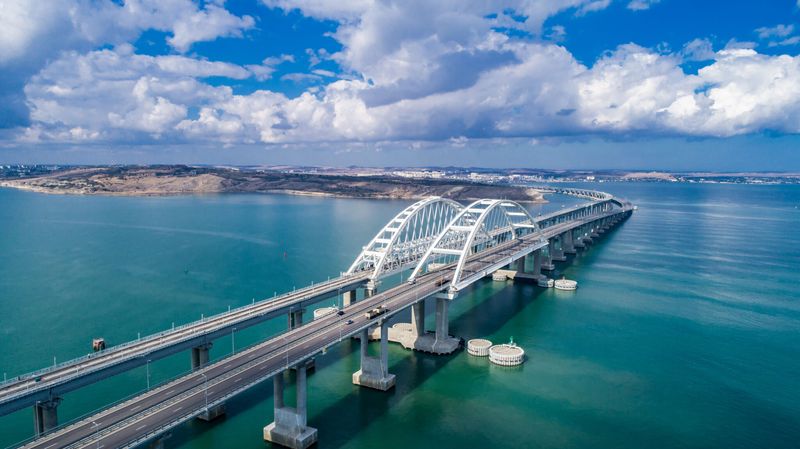
KERCH — The Crimean Bridge third strike of this week halted traffic across the Kerch Strait again in the early hours of Thursday, after Sergei Aksyonov, the Moscow-backed head of Crimea, announced that the crossing had come under another attack just after midnight local time. The Kyiv Independent reported that Ukrainian forces again hit the bridge on November 19, less than two days after the strike that collapsed an entire section of it. The extent of the damage from this latest strike is unknown, the Kyiv Independent said it cannot independently verify it, and no casualty figures have been reported by any source.
Those three qualifications are not boilerplate; they are the story’s hard edges at this hour. What is confirmed is narrow: an attack happened, according to the Russian-installed authorities in Crimea; traffic was suspended; and an assessment was under way. Everything beyond that — including reporting that the railway section was the target — rests on attribution, and this report keeps it that way. The strike also lands on a day of unusual diplomatic density: within hours, Presidents Donald Trump, Xi Jinping and Vladimir Putin are due to meet in Shenzhen for the first trilateral summit of its kind, while Ukraine’s European backers gather in Berlin for a Coalition of the Willing meeting that U.S. envoys Steve Witkoff and Jared Kushner are expected to attend.
What happened overnight
Aksyonov posted his announcement on Telegram in the early hours of Thursday local time, as reported by CNN. “As a result of another attack on the Crimean Bridge, traffic has been temporarily suspended,” he wrote. “All relevant emergency services are on the scene. An assessment of the damage is underway.” The Kyiv Independent, publishing at 00:23 UTC, reported that Aksyonov confirmed the hit just after midnight local time, and that Ukrainian forces were responsible. No Ukrainian official claim specific to the November 19 strike appears in the reporting available at publication: Kyiv’s public statements this week concern the earlier operation, and attributing a fresh official claim to Ukraine for Thursday’s attack would go beyond the record.
The word “temporarily” in Aksyonov’s statement deserves a caution of its own. Suspensions on this crossing have meant very different things at different times: a precaution measured in hours, as when rail traffic resumed later on November 17, or the prelude to a long closure while a destroyed span is surveyed. A suspension notice, on its own, establishes that traffic stopped. It does not establish why, for how long, or what was hit — and on Thursday morning, neither Aksyonov’s statement nor independent reporting filled in those blanks.
Three strikes in four days
The overnight attack is the third distinct strike on the crossing this week, and the sequence matters because each blow has landed on a structure already weakened by the one before. The first attack came on November 16, when, according to Russian media reports, a strike shifted the bridge’s road arch by about 15 degrees. The second, on November 17, was far more destructive: the road arch and the main span collapsed, a 227-metre section of the road bridge was destroyed, and rail traffic was suspended before resuming later that day. Signal Post News covered that attack as the Crimean Bridge’s second strike, with traffic suspended, and the picture that emerged over the following day was of a road crossing severed at its most recognisable point.
President Volodymyr Zelenskyy subsequently described the operation against the bridge as a seven-stage “unprecedented operation” prepared over several weeks — the subject of our report on Zelenskyy’s account of the seven-stage operation. Weapons reported in connection with the November 17 strike included Palianytsia drones and Neptune missiles, with the drones reported against the road section and missiles against the adjacent rail section. That division of labour is the context for Thursday’s reporting: if the road bridge was the focus of the first two strikes, the surviving railway bridge was the obvious remaining target — which is precisely what the first accounts of the November 19 attack describe, though not yet on the record.
The railway question
Estonia’s public broadcaster ERR reported that the November 19 attack targeted the railway section of the bridge, the part of the crossing that had survived the earlier strikes — and that, unofficially, the railway bridge was hit at least twice. The unofficial character of that detail cannot be stressed enough. It is not confirmed by Aksyonov, whose statement did not specify what was struck; it is not confirmed by any Ukrainian official statement in the reporting; and it has not been independently verified. It is carried here as attributed, unofficial reporting, because if it proves accurate it changes the military meaning of the night — and if it does not, readers should know exactly how thin the sourcing was.
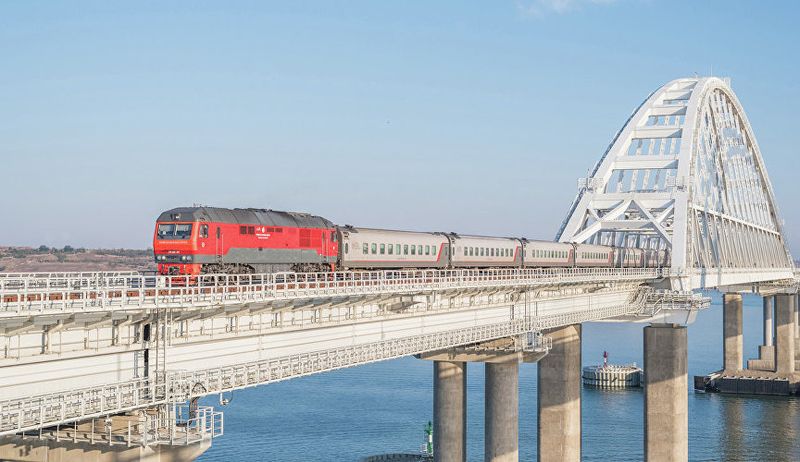
Why the distinction between the two decks matters is straightforward. The road bridge, already missing a 227-metre section since Tuesday, was out of the supply equation for heavy purposes until repaired. The railway bridge is the crossing’s heavy lifter: fuel, ammunition and armoured vehicles move to Crimea and the southern front in quantity by rail, not by road. A strike that merely closes the railway for inspection is an inconvenience. A strike that damages the rail arch, its bearings or its approaches is a logistics event of a different order. As of Thursday morning, the public record supports only the first of those statements with confidence; the rest awaits the damage assessment Aksyonov said was under way, imagery, or an official account from either side.
Why this matters
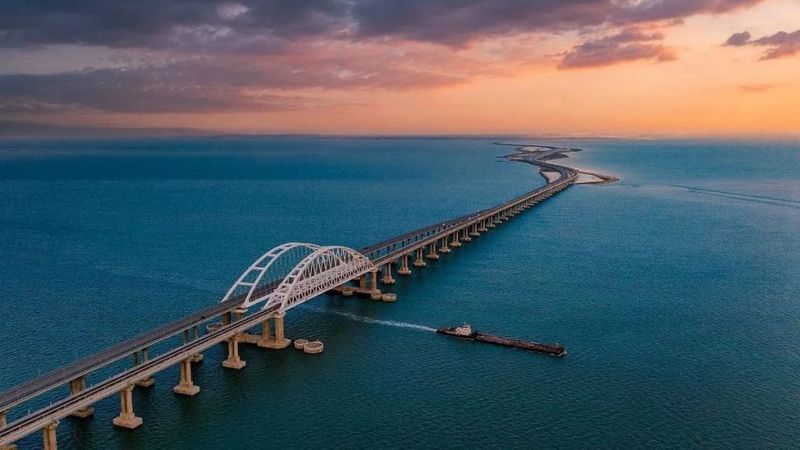
The Crimean Bridge is not one supply route among many. Built after Russia’s 2014 annexation of Crimea and opened under President Putin’s personal patronage, it is the only fixed link between the Russian mainland and the peninsula, and a vital supply line for Russian forces in Crimea and occupied southern Ukraine. Its design figures, as cited by Russian state media, convey the scale of what a full closure removes: a $3.7 billion crossing, about 12 miles (19 kilometres) long and the longest in Europe, built to handle 40,000 cars a day, 14 million passengers a year and 13 million tons of cargo a year. Every day the crossing is closed, that theoretical capacity has to be replaced by something smaller, slower or more exposed — or not replaced at all.
The alternatives, and their limits
The substitutes are known, and none is equivalent. Kerch Strait ferries carried the peninsula’s traffic before the bridge existed, but ferry capacity is a fraction of the bridge’s, is weather-dependent in a strait that turns hostile in winter, and concentrates vehicles and cargo at two exposed terminals. The land corridor through occupied southern Ukraine — the route via Melitopol and Mariupol — avoids the strait entirely but is far longer for traffic originating in Russia’s south, and its road and rail lines run within reach of Ukrainian long-range weapons, as Kyiv’s wider strike campaign has repeatedly demonstrated. That campaign reached a record tempo in the same week as the bridge strikes, as Signal Post News reported in our coverage of Ukraine’s 1,300-drone barrage against Moscow and the Crimea bridge. A closed bridge does not starve Crimea overnight; it raises the cost, in time, tonnage and risk, of everything Russia moves into the peninsula, and it does so at the start of winter.
Repair timelines: the promise and the precedent
After the earlier strike this week, Kremlin spokesman Dmitry Peskov said the bridge would be rebuilt “even better than before,” according to the TASS news agency via Izvestia. The pledge is politically necessary and may even prove true, but the precedents counsel patience about timelines. After the 2022 truck-bomb attack and the 2023 sea-drone attack, traffic was restored in stages while full structural repairs ran on for months behind the reopening headlines. For the November 17 damage, experts cited by the Kyiv Independent put repairs at a year or more. A destroyed arch span is not a resurfaced deck: it is a fabricated steel structure that must be manufactured, transported, lifted into place over a shipping channel and re-certified, in wartime, on a target that has now been struck three times in four days. What Thursday’s strike adds to that bill is, once again, unknown — which is itself the point. Until engineers publish an assessment, every repair estimate for the crossing as a whole is provisional.
A bridge built as a symbol
The crossing’s military value is only half of why it is targeted, and only half of why its loss is felt in Moscow. The bridge was the flagship project of Crimea’s annexation: proof, in concrete and steel, that the peninsula’s connection to Russia was permanent. Ukraine, which considers the structure illegal, has treated it accordingly — as both a logistics artery and a statement to be answered. The truck bomb of October 2022 and the sea-drone attack of July 2023 each damaged it and each was followed by Russian repairs and Russian assurances. This week’s campaign is different in kind rather than degree: not a single spectacular attempt but a sequenced operation, described by Zelenskyy as seven stages, that first shifted the road arch, then brought it down, and has now — if the unofficial reporting holds — turned to the railway. The symbolism cuts both ways, and both capitals understand it: a bridge Putin opened cannot be seen to fall, and a bridge Kyiv can repeatedly strike cannot be presented as secure.
What Kyiv gains, what Moscow loses, what sceptics note
For Kyiv, the gains are concrete before they are symbolic. Each closure day subtracts throughput from Russia’s southern logistics and adds it to the ferry queues and the land corridor’s mileage. The timing compounds the effect: striking the crossing hours before Putin sits down with Trump and Xi in Shenzhen ensures the war’s most recognisable infrastructure story is in front of every delegation, and it answers any suggestion that Ukraine’s long-range campaign has culminated. For Moscow, the losses mirror the gains — a prestige project visibly unrepaired, a supply line visibly intermittent, and a repair promise, in Peskov’s words, that must now be kept under fire.
The sceptical notes deserve equal space, because they are substantial. The damage from the November 19 strike is unverified: the Kyiv Independent says so explicitly, no imagery had been independently assessed at publication, and the only first-hand official statement — Aksyonov’s — confirms an attack and a suspension, nothing more. The railway-hit detail is unofficial. Traffic suspensions on this bridge have previously been lifted within the day. And a bridge can be simultaneously a genuine logistics problem for Russia and a story whose immediate military effect is smaller than its headlines: ferries sail, trucks reroute, and armies adapt. Readers should hold both truths at once — the crossing matters enormously, and what happened to it on Thursday is not yet established — because the reporting, read carefully, supports exactly that and no more.
What happens next
The day’s diplomacy now runs in parallel with the damage assessment, and each will colour the other. In Shenzhen, the first-ever Trump–Xi–Putin trilateral convenes on Thursday with the Ukraine war at the top of its agenda; a freshly struck Crimean Bridge is the backdrop none of the three leaders chose and all of them must price in. In Berlin, the Coalition of the Willing meets the same day, with Witkoff and Kushner expected, to discuss support for Ukraine — a meeting at which the bridge strikes will be read by some delegations as evidence that pressure works and by others as a complication for any ceasefire sequencing. Neither meeting was called because of the bridge, and neither will conclude with a statement about it; but negotiations are conducted by people reading the same headlines as everyone else.
On the ground, the sequence to watch is procedural. First, the product of Aksyonov’s assessment: whether Moscow publishes a damage account, and whether it distinguishes road from rail. Second, resumption notices: a railway that reopens within hours tells one story, a railway that stays closed tells another. Third, independent imagery, which settled the argument about November 17 within a day and will likely settle this one too. The scenarios branch from there. If the railway section is intact or lightly damaged, Thursday becomes the third disruption of the week rather than a second severing — serious, but absorbable. If the unofficial reporting is borne out and the rail link is badly hurt, Russia faces its most difficult Crimea logistics problem of the war, with winter ferries and a long land corridor as the fallback, and a repair programme measured in seasons. And a fourth strike can no longer be treated as unlikely by either side: three attacks in four days have established a tempo, and the air defences around the Kerch Strait have not yet shown they can break it.
Sources
Sources: CNN, “Bridge connecting Russia to occupied Crimea has been hit again,” November 19, 2026 — Aksyonov’s Telegram statement, the Shenzhen and Berlin meeting context, the Peskov “even better than before” remark via TASS and Izvestia, and the bridge’s cost and capacity figures via Russian state media — cnn.com. The Kyiv Independent, “Ukrainian forces once more hit Russia’s Crimean Bridge, days after devastating strike,” November 19, 2026 (00:23 UTC) — Ukrainian responsibility for the November 19 hit, its timing just after midnight local time, the statement that the extent of damage cannot be independently verified, and expert repair estimates of a year or more for the November 17 damage — report text. ERR (Estonian public broadcasting), via its English service, November 19, 2026 — the railway section as the reported target and, unofficially, at least two hits on the railway bridge — en.reflect.ee. Reuters, November 19, 2026 — independent wire confirmation of the third attack of the week and the traffic suspension — wixx.com. Related Signal Post News coverage: the second strike, Zelenskyy and the seven-stage operation, and the 1,300-drone barrage.