World · Asia · China · Taiwan
Beijing calls them routine law-enforcement patrols, stepped up since October. Taiwan, which rejects China's sovereignty claims, reads the same ships differently: rehearsals for a maritime blockade, run with military, paramilitary and civilian assets overlapping.
Track it live: Live global wars tracker
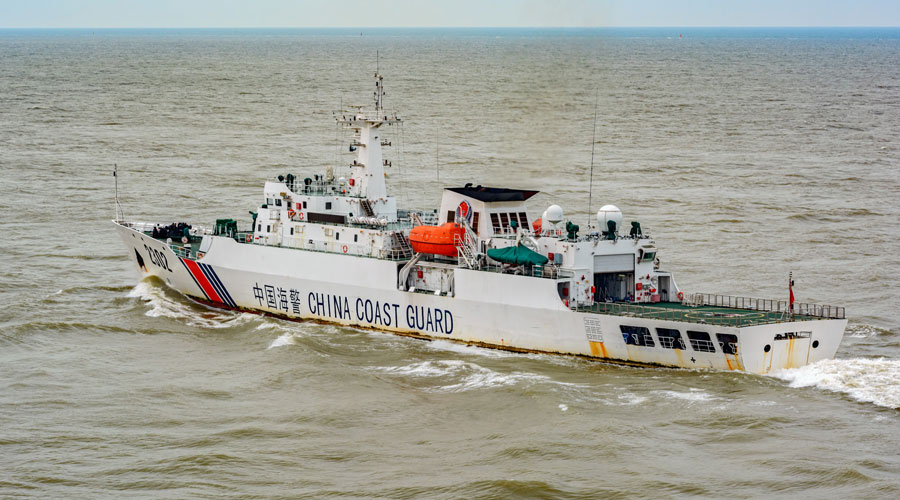
BEIJING / TAIPEI, October 31, 2026 — The China coast guard Taiwan patrols announced on Saturday were described by Beijing in the language of routine administration — and read in Taipei as something more rehearsed. China's coast guard carried out what it described as routine law-enforcement patrols in waters east of Taiwan on Saturday, state broadcaster CCTV reported. Coast guard spokesperson Jiang Lue said the service has continued to strengthen control over the waters since the start of October, to protect the lawful rights and safety of Chinese people including Taiwan compatriots, and that it will continue to step up law-enforcement patrols in waters under its jurisdiction. Reuters reported the statement the same day. Taiwan's officials, who reject Beijing's sovereignty claims outright, say they believe China is practising for a potential maritime blockade of the island, using overlapping military, paramilitary and civilian assets.
Why 'east of Taiwan' is the detail that matters
Most Chinese pressure on Taiwan is applied from the west — the Taiwan Strait side, facing the mainland. The waters east of the island are different: they are Taiwan's Pacific-facing rear, the direction from which resupply and reinforcement would come in a conflict, and the side Taipei has historically treated as its strategic depth. Patrols there are part of an increase in Chinese activity in the waters east of Taiwan that reporting dates to June. A coast guard presence on the Pacific side asserts that there is no “back” of the island outside Beijing's claimed jurisdiction — which is precisely the geography a blockade would need to normalise in advance. China's position is that Taiwan is its territory and the seas around it are its own; it recognises no Taiwanese sovereignty claims, including over those seas. Taiwan's democratically elected government rejects that claim, maintaining that only Taiwan's people can decide the island's future.
Why this matters: the grey-zone ladder
The coast guard is the ideal instrument for this kind of pressure, and understanding why explains the escalation ladder both sides are climbing. A navy destroyer east of Taiwan is a military act that invites military answers. A white-hulled coast guard cutter, conducting what its government calls law enforcement in what it calls its own waters, is framed as policing — an act allies must work harder to answer, and one that builds a legal-administrative record Beijing can cite later: we patrol there; we have always patrolled there. Each uneventful patrol makes the next one more routine and the eventual interdiction of a cargo ship easier to present as enforcement rather than war. Taiwan's reading — blockade practice — treats the same facts as rehearsal: coast guard, maritime militia and naval assets learning to overlap around the island's sea lanes without ever crossing a line that would unify Taipei's partners against Beijing. Taiwan's own capability picture is shifting underneath the argument; this newsroom recently covered the delivery of Taiwan's first F-16V fighter jets, a reminder that Taipei is arming against the scenario its officials describe.
Context: a dispute with no agreed map
The sovereignty dispute is the water itself. Beijing's claim rests on its position that Taiwan is a province of China; Taipei's rejection rests on the island's separate, democratic self-government since 1949 and the absence of People's Republic rule over it at any point. Between those positions, practical arrangements — median lines, coast guard jurisdictions, fishing rights — have historically been managed by deliberate ambiguity. The pattern of the last several years has been the steady erosion of that ambiguity from the Chinese side: median-line crossings normalised, coast guard patrols extended around Taiwan-held islands, and now a sustained presence east of the main island. Each step is individually deniable as routine; cumulatively they redraw the practical map. Saturday's statement is notable less for the patrols than for the announcement's matter-of-factness — “strengthen control” and “step up” are the verbs of an administration describing a programme, not an incident.
The economic geography underneath the dispute is not abstract. Taiwan manufactures the overwhelming majority of the world’s most advanced semiconductors, and the sea lanes east of the island are among the routes along which Northeast Asia’s energy and container trade moves. A jurisdiction claim enforced against commercial shipping in those waters would not stay a sovereignty story for long — it would become a supply-chain event within hours, felt in chip lead times and freight rates on other continents. That is why coast guard statements from Beijing are read as carefully in boardrooms as in defence ministries, and why Taipei publicises its blockade reading rather than treating each patrol as beneath comment.
Multiple angles: law enforcement, rehearsal, or both
Beijing's account is internally consistent on its own premise: if the waters are China's, patrols are a coast guard's job, and protecting “Taiwan compatriots” folds the island's people into the frame as citizens to be served rather than a polity to be coerced. Taipei's counter is that premise is the coercion — asserting jurisdiction is the act, whatever the ships do while there. Regional governments and Washington read the patrols through shipping: Taiwan's ports and the sea lanes east of the island carry a large share of Northeast Asia's trade and the semiconductors the world's technology runs on, so a “law-enforcement” stop of commercial shipping in those waters would be an economic event far beyond the strait. Critics of Taipei's blockade framing note that coast guard patrols are still far from a blockade, and that crying rehearsal at every patrol risks exhausting the alarm. The answer from Taiwan's side is that rehearsals are precisely what patrols are for — and that the time to name them is before they stop being rehearsals.
What happens next
Jiang Lue's statement promises continuation: more patrols, stepped up. Watch for three escalatory markers — the first coast guard boarding or inspection of a commercial or fishing vessel east of Taiwan; joint patterns where naval vessels hold over the horizon while coast guard ships work the foreground; and any move to announce regularised patrol zones or schedules, which would convert presence into administration. On the other side, watch Taiwan's coast guard response posture, its partners' freedom-of-navigation transits, and whether Taipei publishes its own tracking of the eastern patrols to contest the “routine” label in public. The ships will keep sailing either way; the contest is over what their sailing means.
Related coverage: Taiwan F-16V Fighter Jets Delivered: The Strategic Message in Two Jets · China Dismisses Taiwan's Accusation Over Comedian Attack as Five Are Indicted · Iran Claims Four Tankers Hit Mines and Caught Fire in the Strait of Hormuz
Sources
- Reuters (October 31, 2026) — China's coast guard conducts patrols east of Taiwan, CCTV reports — spokesperson Jiang Lue on strengthened control since the start of October; Taiwan officials' view that Beijing is practising for a potential maritime blockade with overlapping military, paramilitary and civilian assets.
- CCTV (October 31, 2026) — The original broadcast of the coast guard statement by spokesperson Jiang Lue, as reported by Reuters.