War · Ukraine · Britain
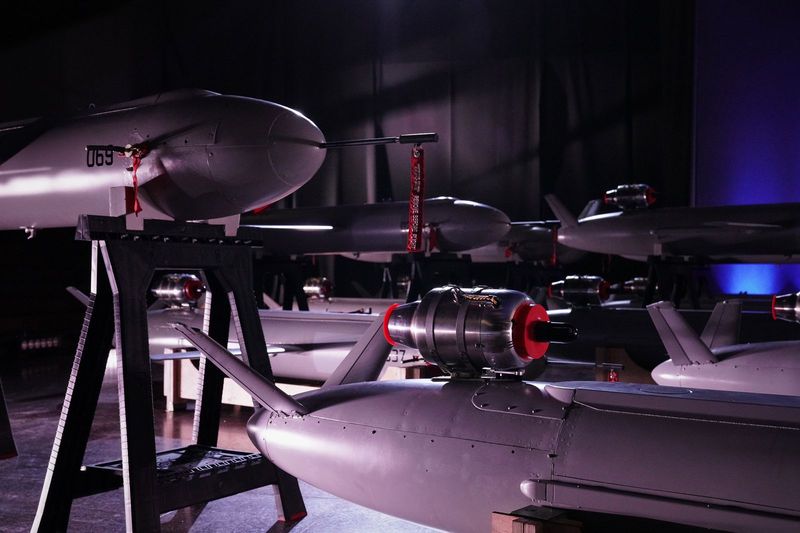
More than 1,000 strike drones — some ranging beyond 1,000 kilometres with heavy warheads — headline a £260 million Berlin package that makes deep strike, not just air defence, the centre of Britain’s week of Ukraine announcements.
Track it live: Ukraine war map — live tracker
BERLIN, November 19, 2026 — The announcement, set out by the UK government and reported by Reuters from Berlin, is a deliberate change of emphasis. Britain’s Ukraine announcements this week began with defence — missiles to protect Ukrainian cities from Russian attack. Thursday’s package is about offence: mass-produced strike drones intended to hold Russia’s war industry at risk at ranges no Ukrainian weapon could reach in the war’s first years. Burnham framed it against Russia’s winter campaign against Ukrainian civilians. “Plunging millions of Ukrainians into the freezing cold and starving them of heat and warmth won’t see Putin win this war, it will only cement our resolve to support Ukraine,” he said.

What is in the package
The headline item is the strike force: more than 1,000 long-range strike drones, funded in a single £260 million package — approximately $338 million to $342 million at reported conversions. GOV.UK states that some of the drones can fly beyond 1,000 kilometres and carry heavy warheads, and that they are aimed at military production facilities far behind the front lines. Read that targeting language carefully. It does not describe a weapon for the trenches or even for the operational rear — depots and headquarters within a few hundred kilometres of the front. A 1,000-kilometre radius drawn from Ukrainian launch areas covers the industrial depth of western Russia: the factories that build the missiles, drones and munitions the front consumes. The package is, in design, an investment in Ukraine’s ability to tax Russian production itself.
The rest of the package is less spectacular and, for the soldiers who use it, possibly more immediate. It includes maritime drones, logistical drones and surveillance drones, with the logistics element aimed at frontline resupply — including the delivery of blood and refrigeration for medical stores to positions that are dangerous or impossible to reach by road. That detail deserves a pause. The same technology family that carries a warhead 1,000 kilometres also carries plasma the last few kilometres to a casualty who cannot wait for a vehicle. Modern drone warfare is a logistics revolution wearing a strike weapon’s publicity, and the British package, unusually, funds both ends of it in one announcement.
Two industrial provisions complete the announcement. More than 80% of the money will be spent in the UK, including with small and medium-sized enterprises in Wales, Northern Ireland and Scotland — a distribution the government plainly intends to be noticed in every nation of the kingdom. And 12 UK defence firms have been granted access to Ukraine’s Avengers AI Labs, the programme through which Ukrainian battlefield data and software development are shared with partner industry. That second item may outlast the drones themselves. Airframes are expended; the data pipeline — real strike footage, real electronic-warfare conditions, real failure modes, fed back into British design cycles — is a compounding asset, and access to it is the kind of thing money alone usually cannot buy.
What the announcement does not contain should be recorded with equal precision: it names no drone types, and it gives no delivery dates. Both omissions are addressed below, because both matter to how the package should be weighed.
The Berlin meeting
The setting was the Coalition of the Willing — the grouping of more than 30 governments that has taken over the political organisation of support for Ukraine — meeting in Berlin under Burnham’s co-chairmanship. Reuters reported that the Berlin meeting brought together the leaders of Germany, France, Britain, Poland and Italy, together with NATO’s secretary general, Mark Rutte. The coalition format matters because of what it is not: it is not NATO acting as NATO, and it is not the Ramstein supply format. It is the political layer — the governments willing to commit, meeting to align what they will fund, guarantee and say — and Britain used its turn in the chair to put a British-funded capability at the centre of the table.

The announcement also lands at the end of a deliberately sequenced British week. It follows Tuesday’s UK air-defence package — the subject of the comparison below — and last week’s UK sanctions on all ten of Russia’s major oil producers. Sequencing is a message in itself: sanctions against the revenue, missiles against the incoming strikes, and now drones against the production base. Whether by design or by accumulation, London has spent ten days addressing each layer of Russia’s war economy in turn, and Berlin was chosen as the stage for the largest single item.
Why this matters
The strategic context is that Ukraine’s deep-strike campaign is, at this moment, visibly working — and working on the part of Russia’s war machine that Moscow can least afford to lose. Ukrainian strikes have disrupted or stopped 15 of Russia’s 35 major refineries over the past 20 days. Reuters, citing industry sources on November 18, reported that drone attacks have cut Russian refineries’ combined crude processing by 45% since late October. Those are not pinpricks on a map. Refineries are the conversion point between Russia’s crude wealth and the fuel its army, air force and economy run on; a sustained 45% cut in processing is a macroeconomic event delivered by air.
The refinery campaign this package feeds
Britain is therefore not funding an experiment. It is scaling the one Ukrainian capability with a demonstrated, measurable effect on Russia’s capacity to sustain the war — at the moment that effect is peaking, and against the near-certainty that Russia is repairing, dispersing and defending the target set as fast as it can. Strike drones are consumables in a race between production and adaptation: each new wave must be large enough to saturate improving defences and cheap enough to be replaced. A four-figure drone order is what “staying in the race” looks like in procurement language. The same week supplied the campaign’s other emblem: Ukraine hit the Crimean Bridge for a third time, in the attack Signal Post News covered as the Crimean Bridge’s third strike of the week, which halted traffic again. Refineries and the bridge are the same argument at different addresses — fixed, valuable, far behind the lines, and no longer safe.
There is a second, quieter significance. For most of the war, Western governments rationed Ukraine’s deep-strike ability — through the ranges of the systems they supplied, through targeting conditions, through public anxiety about escalation. A package whose stated purpose is heavy warheads on military production 1,000 kilometres inside Russia is what the end of that rationing looks like when it is done by funding rather than by permission slip. London is not merely allowing the deep-strike campaign; it is buying a larger one.
Transatlantic friction, in the open
The Berlin meeting was also a negotiation about who negotiates. Reuters reported that US envoys Steve Witkoff and Jared Kushner were attending, and that Europe is pushing to be included in the US-backed talks — a push that only makes sense against a European fear of being presented with a settlement negotiated over its head. That fear has a name in Kyiv’s rhetoric: President Volodymyr Zelenskyy has warned against a new Yalta-style carve-up, the danger Signal Post News examined in our report on Zelenskyy’s ‘Yalta 2.0’ warning over a Trump-Europe security deal. The European answer visible in Berlin has two parts: be in the room, and arrive with funded capability rather than communiqués. A £260 million drone package announced from the chair is, among other things, an argument that Europe is a principal in this war’s ending, not an audience for it.
The money argument runs in parallel. Reuters reported that the European Commission has proposed a new €45 billion loan to Ukraine, toward a €70 billion funding gap Kyiv faces for next year. The status of that loan must be stated exactly: it is a proposal, not an agreed facility. But its scale reframes every national package announced this week. Britain’s £260 million buys a specific capability at a specific moment; the €70 billion question is whether Ukraine’s state and army are funded at all through next year. Berlin was where those two conversations — capability and solvency — were deliberately held in the same room.
Two packages in five days: the shield and the sword
The cleanest way to understand Thursday’s announcement is against Tuesday’s. On Tuesday, Britain announced a £240 million air-defence package: more than 1,000 short-range air-defence missiles and launchers, plus more than a dozen radars, built by Thales in Belfast, with deliveries from mid-December — the package Signal Post News set out in our report on Britain’s 1,000 air-defence missiles in the £240 million winter package. The two packages are easily confused in headlines and must not be merged: £260 million is not £240 million, and long-range strike drones are not short-range air-defence missiles. They are opposite instruments. Tuesday’s missiles defend Ukrainian cities against what Russia launches; Thursday’s drones attack the Russian facilities that produce what Russia launches.
Together, though, they describe a complete theory of the air war, bought within five days for a combined £500 million. The shield deepens the layer that keeps Ukrainian power stations, bridges and apartment blocks alive through the winter strike season. The sword lengthens the arm that is currently cutting Russian refinery output nearly in half. Either half alone has a known failure mode: defence without strike concedes the initiative and the production race; strike without defence wins refinery fires while cities freeze. London has now funded both halves in the same week, and the pairing — not either figure in isolation — is the real announcement.
The numbers in context
The package’s arithmetic rewards a slow read. £260 million (roughly $338 million to $342 million, at the conversions reported around the announcement) buys more than 1,000 strike drones plus the maritime, logistics and surveillance elements — a per-unit economics that only works because strike drones are, by design, cheap relative to the missiles and aircraft they are replacing in the deep-strike role. Of that money, more than 80% — over £200 million — is spent in the UK, spread deliberately across Wales, Northern Ireland and Scotland as well as England, which makes the package an industrial-policy instrument as well as a military one. Twelve British firms gain Avengers AI Labs access. And the whole sum, set against the €70 billion funding gap the European Commission’s proposed loan only partly addresses, is a reminder of the difference between buying a capability and underwriting a state: Britain has done the first this week, in Berlin it argued about the second, and the second is the larger bill by two orders of magnitude.
Critics and what is not known
The honest caveats are substantial, and they start with the calendar. The announcement gives no delivery dates. Nothing in it states when the first funded drones reach Ukraine, at what rate they follow, or whether the 1,000-plus figure describes production to be built, stock to be transferred, or a framework to be drawn down. Every previous package of this war warns against assuming the answer: pledges are made in a day and redeemed across seasons, and Ukraine’s need is measured in weeks. Until a schedule appears, the package is a funded intention with a price and a purpose — real money, real policy, but not yet a single additional drone over a Russian refinery.
One clarification belongs in the record, because the first hours of coverage muddied it. Some early headlines — in Bloomberg headlines and aggregator summaries — described the package as “1,000 cruise missiles.” The verified announcement, per GOV.UK and Reuters, is drones: more than 1,000 long-range strike drones. No separate cruise-missile pledge was made in Berlin, and readers who saw the missile phrasing should treat it as an error in those headlines, not as a second, larger promise hiding inside this one.
Critics will add two further questions, both fair. The first is scale: 1,000 drones is a large order and a small fraction of the strike volume Ukraine now expends, so the package sustains the campaign rather than transforming it. The second is adaptation: Russia has spent two years learning to defend fixed industrial targets, and the refinery campaign’s 45% processing cut was achieved against yesterday’s defences. Neither question diminishes what was announced; both define what will decide its value — the delivery schedule, the production rate behind it, and whether the drones arriving in 2027 are smarter than the defences built to stop the drones of 2026. The Avengers AI Labs provision, notably, is aimed at exactly that last variable.
What happens next
The markers to watch follow directly from what the announcement left blank. First, the schedule: any statement of delivery dates or production rates will convert this package from policy into logistics, and its absence in coming weeks will be its own kind of news. Second, the coalition’s follow-through: whether other governments use the Berlin meeting to announce strike-capability funding of their own, or whether Britain’s sword remains a mostly British purchase. Third, the money track: whether the European Commission’s proposed €45 billion loan advances toward agreement against the €70 billion gap, because the drones matter only inside a Ukrainian state that can pay its army. And fourth, the target set: Russia’s refinery repair effort and air-defence redeployments will show, in processing figures like the ones Reuters’ industry sources provided this week, whether the campaign Britain has just paid to extend is still gaining.
On Thursday in Berlin, Britain stopped describing deep strike as something Ukraine does and started describing it as something Britain funds — 1,000 drones at a time, at ranges measured in capital-to-capital distances. The winter will grade the deliveries. The intention is no longer in doubt.
Reporting based on the UK government (GOV.UK) announcement and Reuters reporting from Berlin (Nov. 19, 2026). Refinery processing figures are Reuters reporting citing industry sources (Nov. 18, 2026). The European Commission loan is a proposal, not an agreed facility. Dollar figures are approximate reported conversions of the £260 million total.
Sources
Sources: GOV.UK / UK Ministry of Defence — the £260 million Berlin package announcement: more than 1,000 long-range strike drones, some flying beyond 1,000 km with heavy warheads against military production facilities; maritime, logistical and surveillance drones including frontline resupply of blood and medical refrigeration; more than 80% of spending in the UK including SMEs in Wales, Northern Ireland and Scotland; 12 UK defence firms granted access to Ukraine’s Avengers AI Labs; and Prime Minister Andy Burnham’s statement — gov.uk. Reuters, Berlin, November 19, 2026 — the Coalition of the Willing meeting’s attendance (the leaders of Germany, France, Britain, Poland and Italy, and NATO Secretary General Mark Rutte), US envoys Steve Witkoff and Jared Kushner attending, Europe’s push to be included in US-backed talks, and the European Commission’s proposed €45 billion loan toward a €70 billion funding gap — reuters.com. Reuters, November 18, 2026 — industry sources: drone attacks cut Russian refineries’ combined crude processing by 45% since late October; Ukrainian strikes disrupted or stopped 15 of Russia’s 35 major refineries over 20 days. Related Signal Post News coverage: Tuesday’s £240 million air-defence package, the Crimean Bridge’s third strike, and Zelenskyy’s ‘Yalta 2.0’ warning.