Belgium F-16 Ukraine transfer
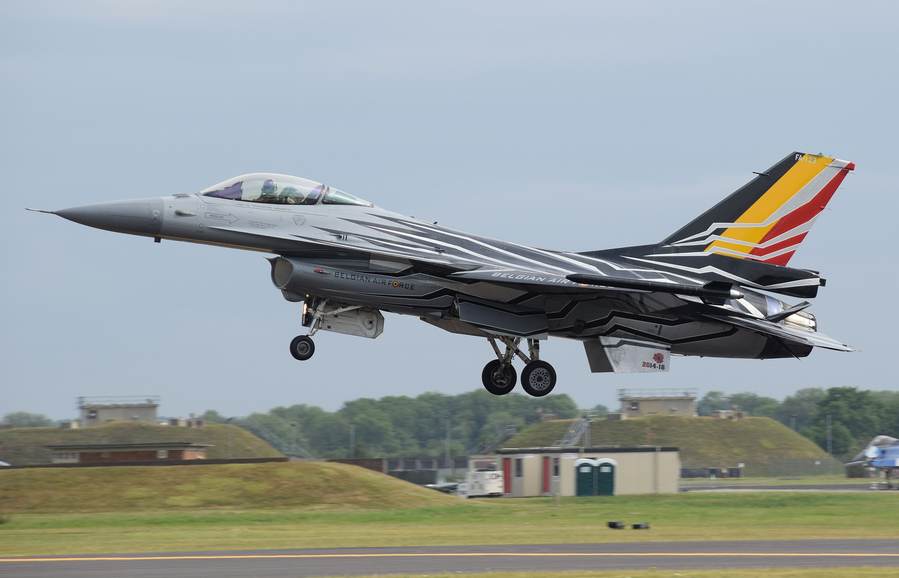
The Belgium F-16 Ukraine transfer will deliver three fighter jets by the end of 2026, according to Ukrainian President Volodymyr Zelenskyy, who said Kyiv and Brussels would use an “accelerated procedure” to move the aircraft. He thanked Belgian Prime Minister Bart De Wever and said Ukraine had already received urgent F-16 ammunition shipments from Belgium and Spain.
Three fighters will not overturn the air war. Russia operates a far larger aviation fleet and continues to pressure Ukraine with ballistic missiles, conventional drones and faster jet-powered drones. The practical significance of the Belgian pledge is therefore not the number alone. It is that the jets are arriving inside a broader defensive chain that also includes ammunition for existing F-16s, a newly delivered NASAMS package, negotiations over Patriot missiles and tests of dedicated drone interceptors.
What Belgium and Ukraine agreed
Zelenskyy described an agreement for three Belgian F-16s to reach Ukraine before the end of this year. He did not publicly spell out the technical steps covered by the accelerated procedure, and the announcement did not provide serial numbers, basing plans or a handover date. Those gaps matter: a political transfer date and the date an aircraft becomes operational can be separated by inspection, modification, ferrying, pilot conversion and maintenance preparation.
The announcement also tied aircraft to munitions. Zelenskyy said urgent deliveries of F-16 ammunition from Belgium, Spain and other partners had already reached Ukraine. That is the less visible but essential part of the pipeline. A fighter without compatible missiles, bombs, spare parts and trained ground crews is an expensive symbol; a smaller fleet with a reliable flow of weapons can keep flying defensive sorties.
Reuters reported the agreement and Zelenskyy's remarks on Tuesday. His official statement thanked De Wever and the Belgian government, framing the transfer as an answer to Russia's escalating daily attacks. The number is definite; the delivery mechanics remain to be demonstrated.
Why three jets matter only as part of a layered defense
Air defense is a geometry problem before it is a headline number. Long-range Patriots are especially valuable against ballistic missiles. NASAMS covers a different part of the envelope and can defend cities and critical sites against aircraft, cruise missiles and drones. F-16s add a mobile layer that can carry air-to-air weapons and shift between threatened corridors. Lower-cost interceptors are intended to chase drones without spending scarce high-end missiles on every target.
Zelenskyy said Ukraine had received a “very good” NASAMS package on September 28 and thanked the United States and Norway. He also said talks were continuing to secure a supply of Patriot missiles, which Kyiv regards as critical against Russian ballistic missiles. The sequence is important: the Belgian jets are not a substitute for ground-based systems, and ground-based systems cannot economically cover every drone or every approach. The layers have to overlap.
The phrase “accelerated procedure” signals political urgency, but it is not a waiver of physics or safety. Western governments can shorten paperwork, prioritize inspections and release equipment faster. They cannot skip airworthiness checks, manufacture trained pilots overnight or eliminate the maintenance burden of an older airframe. The real test of acceleration is whether those bottlenecks were solved before the announcement rather than deferred until after it.
The numbers show the gap Ukraine still has to close
Zelenskyy said Russia launched more than 100 drones on Tuesday. Of those, 29 were jet-powered and 18 were reported shot down. On that account, roughly 62% of the jet-powered subset was intercepted, leaving 11 that were not reported downed. The larger “more than 100” total prevents a precise overall percentage, and wartime interception figures are difficult to verify independently. Still, the split shows the operational problem: faster targets can stretch defenses even when a majority are stopped.
Ukraine has been testing interceptors against the newer jet-powered threat, including the Geran-5 problem identified in Ukrainian reporting. Jet propulsion gives these drones more speed and altitude than many conventional one-way attack drones, narrowing engagement windows for mobile gun teams and slower interceptors. Expensive surface-to-air missiles can defeat some of them, but using a premium missile against every relatively cheap drone would favor the attacker economically.
That is where the Belgian contribution fits. Three additional F-16s enlarge the patrol and alert roster, but their value depends on ammunition supply and mission availability. The statistic that matters is not how many tails cross the border; it is how many aircraft can generate sorties on a given night, with missiles loaded, pilots rested and maintenance teams supplied.
Europe's F-16 pipeline and Belgium's place in it
Ukraine's F-16 force has always been a coalition project rather than a single donation. European operators are releasing older aircraft as they transition to newer fleets, while training and sustainment are distributed among partners. Belgium's role is that of a donor whose own force transition creates both an opportunity and a constraint: jets can move east only as Brussels protects its remaining readiness and completes the work needed to hand over safe, supportable aircraft.
That makes the year-end promise a test of alliance scheduling. An accelerated transfer can show that European timelines are becoming more responsive to battlefield changes. A delay would reinforce the criticism that Western commitments often arrive in politically impressive packages but move at peacetime administrative speed.
The pipeline also exposes the long tail of every delivery. Ukraine needs pilots, maintainers, hardened operating locations, runway repair, spare engines and a steady inventory of compatible weapons. Russia, in turn, has an incentive to target airfields and logistics before incoming jets can raise sortie capacity. The contest begins well before the aircraft's first combat mission.
Who benefits, who loses and what critics argue
Ukraine benefits from added flexibility and from proof that the European fighter pipeline is still moving. Even a small increase can ease scheduling pressure, create reserve capacity and replace combat or maintenance losses. The ammunition deliveries may have a more immediate effect than the airframes because they can support aircraft already in service.
Belgium benefits diplomatically by converting an older-platform transition into visible support for Kyiv. The commitment also binds Brussels more closely to the training, maintenance and supply network around Ukraine's F-16 fleet. That is influence, but it is an obligation too.
Russia loses some freedom of action if Ukraine can sustain more fighter patrols and integrate them with NASAMS and Patriot coverage. Yet Moscow retains the advantage of scale and can complicate the transfer through strikes on bases, electronic warfare and continued mass attacks designed to exhaust interceptors.
Critics of the announcement will call three jets symbolic beside Russia's fleet. They are right about the imbalance but can overstate the conclusion. Air defense is not a one-for-one contest between total aircraft inventories. Geography, radar coverage, weapons stocks, readiness and the ability to concentrate force over a threatened area all matter. The stronger criticism is about sustainment: if pilot conversion, maintenance capacity or missile supply cannot support the aircraft, the transfer adds less usable defense than the headline suggests.
What happens next
First, watch the Belgian timetable. The important milestones are not another statement of intent but the completion of inspections, handover and operational integration by December 31. Public disclosure may remain limited for security reasons, so a precise arrival date may not be announced in advance.
Second, watch the Patriot missile supply talks. Jets and NASAMS cannot replace the ballistic-missile role Kyiv assigns to Patriot. If missiles for those batteries remain scarce, Russia can continue forcing Ukraine to make difficult choices about which cities and infrastructure receive the highest protection.
Third, watch the interceptor tests. The gap between 29 jet-powered drones launched and 18 reported downed is the clearest measure in this announcement. Improving that ratio with cheaper, scalable interceptors would preserve high-end missiles for harder targets and could matter more over months than the arrival of three fighters.
The Belgian pledge should therefore be judged as one component in a system, not as a miniature air force. If the jets arrive on time with ammunition and support, while NASAMS, Patriots and drone interceptors cover the threats they are best suited to defeat, three aircraft can have operational value beyond their small number. If any link in that chain fails, the transfer risks becoming a symbol of urgency rather than an instrument of it.
Sources
- Reuters, “Belgium to transfer three F-16s to Ukraine this year, Zelenskiy says” (September 29, 2026) — transfer, ammunition, NASAMS, Patriot talks and drone figures: reuters.com
- President Volodymyr Zelenskyy's official X statement (September 29, 2026), quoted and reported by Reuters — agreement with Belgium, accelerated procedure and thanks to Prime Minister Bart De Wever.
- Aircraft image: Wikimedia Commons file page.
Operational figures and delivery details are attributed to Zelenskyy as reported by Reuters. Signal Post News did not independently verify the interception count. The image is a file photograph and does not depict the announced transfer.