Bahrain sounded the all-clear early on Wednesday, nearly an hour after its Interior Ministry warned residents of a potential threat and urged them to move to the nearest safe location, Reuters reported — and, in the same pre-dawn hours, Kuwait’s air defences were countering hostile drone attacks, the Kuwaiti army said. Gulf Business reported two separate potential-threat alerts in Bahrain in the early hours, each followed by an all-clear. Neither country reported casualties or damage in the overnight round. The alerts were the fourth episode in a five-day run of attacks and warnings across the Gulf that has already drawn in the United States, which struck an Iranian missile launch site on Qeshm Island on Tuesday. What follows is what each government actually said overnight, what it pointedly did not say, and why two short alerts in two small states now carry weight well beyond their size.
Track it live: Iran war tracker · Middle East tracker
MANAMA, Bahrain, November 18, 2026 — Bahrain all-clear Kuwait drones: Bahrain issued an all-clear early on Wednesday, nearly an hour after its Interior Ministry warned of a potential threat and urged residents to move to the nearest safe location, Reuters reported at 00:16 UTC. The ministry, which posted its warning on X, did not specify the nature of the threat. Separately, and in the same overnight hours, Kuwait’s air defences were countering hostile drone attacks, the Kuwaiti army and General Staff said, adding that the sound of explosions residents heard was the sound of those interceptions. No casualties or damage were reported in the overnight round in either country. The twin episodes extended a five-day sequence — attacks or alerts on Friday, November 13, Sunday, November 15 and Tuesday, November 17, and now overnight into Wednesday, November 18 — that has kept the Gulf’s smallest states, and the American forces based in them, on a near-nightly footing.

Bahrain: two alerts, two all-clears, and a threat never specified
The Bahraini sequence, as reported by Reuters and Gulf Business, was short and deliberately uninformative. The Interior Ministry warned of a potential threat on X and urged residents to move to the nearest safe location. Nearly an hour later, the all-clear followed. Gulf Business reported that there were in fact two separate potential-threat alerts in the early hours of Wednesday, each followed by its own all-clear — a rhythm of warning and release that has become familiar to residents this week. What the ministry did not do, in either alert, was specify the nature of the threat: no weapon, no direction, no origin was named in the warning itself.
That silence sits against a busier official record from earlier in the week. Bahrain had also issued an alert on Tuesday, and the Bahrain Defence Force said on Tuesday that it had intercepted and destroyed several aerial threats before they reached their targets. Two days before that, Bahrain said it had intercepted an Iranian aerial attack which Tehran said had targeted a US military base in the kingdom. The overnight alerts therefore landed on a population that had already been warned once that week, and on a military that had already fired in anger twice in five days.
What Bahrain did not say
The gap between Tuesday’s specificity and Wednesday’s silence is itself part of the story. On Tuesday, the kingdom named the attacker, described the interceptions and let its defence force speak. Overnight, the Interior Ministry spoke of a “potential threat” and nothing more. Whether that reflects a threat that was detected and stood down, a precaution taken while a neighbour’s airspace was active, or information the authorities chose not to publish, neither Reuters nor Gulf Business reported, and the ministry’s statements as carried by both outlets do not say. This report records the alert and the all-clear as the verified facts, and the nature of the threat as officially unspecified.
Kuwait: air defences counter hostile drones, and no origin named
Kuwait’s overnight episode was described in more operational detail and with equal care about attribution. The Kuwaiti army and General Staff said the country’s air defences were countering hostile drone attacks early on Wednesday. The sound of explosions that residents heard, the military said, was the sound of interceptions — Kuwaiti weapons engaging the drones, not impacts on the ground. Residents were urged to stay calm and to follow official instructions.

Three precision points define the Kuwaiti statement, and they are worth stating plainly because they are easy to lose in a fast-moving story. First, Kuwait named no origin for the drones: its statement described them as hostile and said nothing about who launched them. Second, Kuwait reported no casualties and no damage. Third, Kuwait did not blame Iran. Any account that states Kuwait was attacked by Iran goes beyond what Kuwait itself has said, and this report does not make that claim. The drones over Kuwait and the claims being traded between Tehran, Manama and Washington are connected by timing and by geography; they are not connected, on the present record, by any Kuwaiti attribution.
The Sheikh Isa claim and the American account
Running alongside the two governments’ alerts were the competing claims of the two forces at the centre of the week’s confrontation. Iran’s Islamic Revolutionary Guard Corps claimed to have targeted a US radar at Sheikh Isa Air Base in Bahrain, Gulf Business reported. US Central Command, for its part, said incoming drones were intercepted without injuries to US personnel or damage to US equipment, according to the same report. The two statements are not reconciled in the reporting: the IRGC described a target struck, CENTCOM described attacks defeated, and neither account, as carried by Gulf Business, conceded the other’s premise. Our earlier report on how Bahrain intercepted Iranian drones as Tehran claimed a US radar target at Sheikh Isa sets out the first round of those claims, and our report on the Guards’ widening claims, Iran’s Guards say they struck a US radar in Bahrain as Hormuz tanker claims mount, tracks how the radar claim has been repeated and contested.
Context: a five-day run, and the Qeshm strike
The overnight alerts were the latest turn in a sequence that began on Friday, November 13, and has shortened its intervals as it has gone on. On Sunday, November 15, Bahrain said it intercepted an Iranian aerial attack that Tehran said targeted a US military base. On Tuesday, November 17, Bahrain issued a further alert and its defence force said it intercepted and destroyed several aerial threats; the same day, the United States struck an IRGC missile launch site on Qeshm Island, in the Strait of Hormuz, after IRGC drones targeted a US radar at Sheikh Isa. Overnight into Wednesday, November 18, came the Bahraini alerts and the Kuwaiti interceptions. Four episodes in five days, each answered within hours, none so far producing reported casualties in the overnight round — the pattern is one of calibrated exchanges whose calibration depends on every interception working, every time. Our report on the U.S. strikes on the IRGC missile site on Qeshm Island after Iran’s third Bahrain drone attack in five days details the American strike and the radar attack that preceded it.
Why Bahrain is exposed: the Fifth Fleet
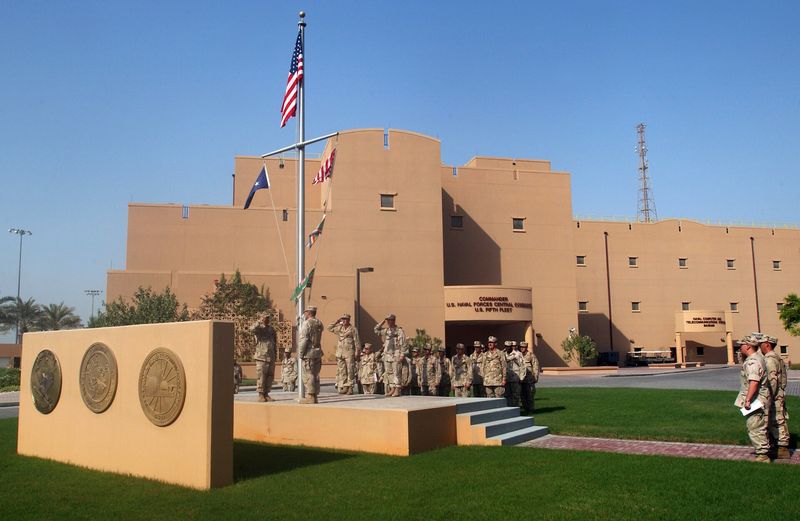
Bahrain’s place in this confrontation is structural. The kingdom hosts the headquarters of the US Navy’s Fifth Fleet at Naval Support Activity Bahrain, the command responsible for American naval forces across the Gulf, the Red Sea and parts of the Indian Ocean. That presence is precisely why Tehran frames its attacks as strikes on the United States rather than on Bahrain, and precisely why a threat warning in Manama is never only a Bahraini event: any aerial attack on the kingdom risks engaging the American command that directs US naval power in the region. Kuwait, which hosts US forces of its own and sits at the head of the Gulf beside Iraq and Iran, occupies a similar position — which is why its refusal, so far, to name the drones’ origin carries diplomatic weight of its own.
The overnight round in numbers
Stripped to the figures the two governments and the two wire and regional reports actually support, the night looks like this. Bahrain issued two potential-threat alerts in the early hours, per Gulf Business, with the all-clear Reuters timed at nearly an hour after the warning it tracked. Kuwait engaged an unspecified number of hostile drones; the number launched, and the number intercepted, were not stated in the Kuwaiti account as reported. Casualties reported in the overnight round: none, in either country. Damage reported: none, in either country. US personnel injured or US equipment damaged, per CENTCOM as reported by Gulf Business: none. Origins officially named overnight: Bahrain named none for its unspecified threat; Kuwait named none for its drones. The week’s wider ledger is heavier — interceptions over Bahrain on Sunday and Tuesday, an American strike on Qeshm Island on Tuesday, and a radar at Sheikh Isa claimed as a target by the IRGC and described by CENTCOM as defended — but the overnight round itself closed, on the official record, at zero.
Why this matters
Analysis. The first reason the overnight alerts matter is what repetition does to warning systems. An alert that ends in an all-clear within the hour, twice in one night, after a week of alerts, trains a population in one of two directions: disciplined compliance, or fatigue. Civil-defence systems across the Gulf are built on the assumption that residents will move when told; every uneventful all-clear spends a little of that willingness, and every real interception replenishes it. Bahrain’s authorities are managing that balance in public, on X, in near-real time — and the fact that the ministry chose to warn without specifying a threat suggests it judged the cost of silence, if anything had followed, higher than the cost of another stood-down alert.
The second reason is the attribution gap, which widened overnight rather than narrowing. Bahrain did not say what threatened it. Kuwait did not say whose drones it destroyed. The IRGC and CENTCOM traded claims about a radar in Bahrain that cannot both be wholly right. In a confrontation where each side’s next move is justified by the last attack’s authorship, unnamed threats and unclaimed drones are not a footnote; they are the mechanism by which escalation can proceed without any government having formally accused another. Kuwait’s restraint in particular reads as a deliberate diplomatic choice: a state that names an attacker acquires obligations; a state that merely reports interceptions keeps its options, and its channels to Tehran, open.
The third reason is geographic. The week’s map has widened in stages: Bahrain on Sunday, Bahrain and Qeshm Island on Tuesday, Bahrain and Kuwait overnight. Each new capital added to the alert map multiplies the number of air-defence crews, commanders and political leaders whose split-second decisions shape the crisis, and multiplies the chance that one interception fails or one warning is misread. The exchanges have so far been contained by the quality of the interceptions and by the care each capital has taken with its words. Neither of those is a resource that can be assumed indefinitely.
What to watch
Three scenarios now branch from the overnight round. In the first, the sequence simply stops: no further launches, no further alerts, and the five-day run is remembered as a bounded exchange in which the Qeshm strike answered the Sheikh Isa attacks and both sides let the matter rest. Nothing in the overnight statements rules that out, and the absence of casualties in the latest round removes the strongest pressure for immediate retaliation. In the second, the rhythm continues at its current tempo — alerts or interceptions every second night, claims traded, nothing conceded — and the risk migrates from any single night’s drones to the cumulative probability that one night goes wrong: a drone that gets through, a casualty that cannot be absorbed quietly, a warning misread in a third capital. In the third, attribution hardens: Kuwait names an origin, or Bahrain specifies its threat, or Washington publishes its own account of the week, and the diplomatic space that unnamed drones currently occupy closes. Which scenario unfolds will be visible first in the same places this week’s crisis has been conducted — in ministry statements posted in the small hours, in the interval between a warning and its all-clear, and in whether the next all-clear is the last one for a while.
Sources
Sources: Reuters, November 18, 2026, 00:16 UTC — Bahrain issued an all-clear early Wednesday, nearly an hour after its Interior Ministry warned of a potential threat on X and urged residents to move to the nearest safe location, the ministry not specifying the nature of the threat; Bahrain’s Tuesday alert and its account of intercepting an Iranian aerial attack two days earlier, which Tehran said targeted a US military base; the Bahrain Defence Force’s statement that it intercepted and destroyed several aerial threats on Tuesday. Gulf Business, November 18, 2026 — two separate potential-threat alerts in Bahrain in the early hours, each followed by an all-clear; the Kuwaiti army and General Staff statement that Kuwait’s air defences were countering hostile drone attacks, that the sound of explosions was the sound of interceptions, and that residents should stay calm and follow official instructions, with no origin named and no casualties or damage reported; the IRGC’s claim to have targeted a US radar at Sheikh Isa Air Base; and CENTCOM’s statement that incoming drones were intercepted without injuries to US personnel or damage to US equipment. The Qeshm Island strike context is as reported in Signal Post News coverage of the November 17 US strike on the IRGC missile launch site, linked above. Photographs are file photos and do not depict the events of November 17–18, 2026.