Xi greets Trump Shenzhen airport style — in person, at the foot of the aircraft stairs, with a red carpet, a military guard, a flyover and a hug. It was, by the account of the reporters who watched it, unprecedented: Xi Jinping had never before gone to an airport to receive a visiting president of the United States. The gesture landed on Wednesday, as Trump arrived from the Philippines for the APEC leaders’ summit, and it set the tone for the most consequential 24 hours of the diplomatic year — a Trump–Xi bilateral on trade and rare earths on Thursday, followed by the first-ever meeting of the American, Chinese and Russian leaders at one table.
Track it live: Wars tracker
SHENZHEN, China, November 18, 2026 — Xi greets Trump Shenzhen airport arrivals are not supposed to work this way, and that is precisely the point. Chinese President Xi Jinping personally welcomed President Donald Trump at Shenzhen Bao’an International Airport on Wednesday, waiting on the tarmac as Air Force One arrived from Manila and greeting Trump at the foot of the stairs — a welcome CNN’s video report from the scene described as “unprecedented,” and one that CNN and Bloomberg both noted Xi had never before extended to a visiting US president. The two leaders shook hands on a red carpet, and the handshake turned into a hug, in front of a military guard and band, a flyover, and hundreds of performers waving flowers and Chinese and American flags and chanting an enthusiastic warm welcome in Mandarin. Trump had flown in from the Philippines for the Asia-Pacific Economic Cooperation leaders’ summit in Shenzhen, in what is his and Xi’s third meeting of 2026 — and the welcome was the summit’s first headline, hours before either man said a word about trade, rare earths or nuclear weapons. The wider summit choreography is set out in our reporting on Putin’s arrival in Shenzhen and his APEC CEO Summit address, published earlier today.
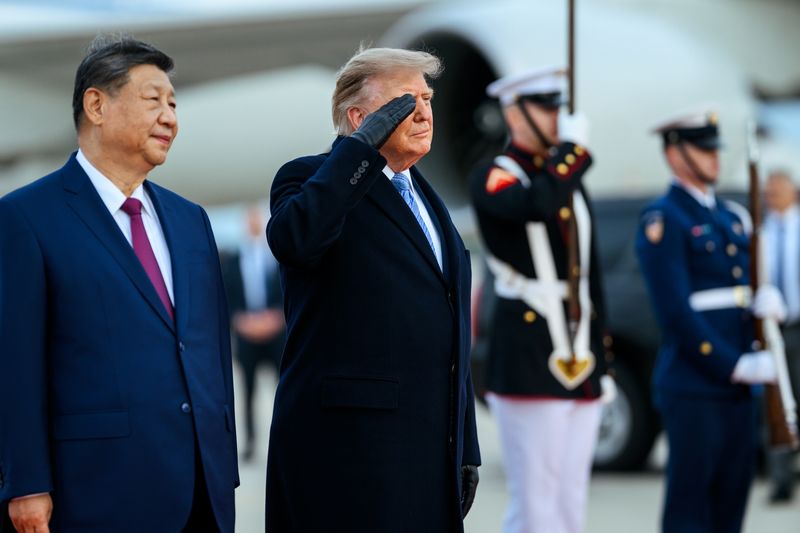
What happened on the tarmac
Arrival ceremonies are the most heavily scripted minutes in diplomacy, which is why deviations from the script carry meaning. The standard choreography for a visiting leader arriving in China runs through a senior but subordinate welcomer: a vice president, a senior party official, a foreign-ministry figure of rank. The head of state waits at the venue. On Wednesday in Shenzhen, the head of state did not wait. Xi was on the tarmac himself as Trump came down the stairs of Air Force One, and the greeting that followed was built for cameras: the red carpet, the guard of honour, the military band, aircraft overhead, and a crowd of performers in the hundreds, flowers and both countries’ flags in hand, chanting their welcome in Mandarin.
The moment that will define the day’s coverage was unscripted in appearance if not in fact: the handshake that became an embrace. The New York Post, publishing a Reuters photograph of Xi welcoming Trump at Shenzhen Airport on November 18, framed the encounter around the hug — two leaders whose governments spent last year in a tariff war, embracing on a red carpet in China’s showcase technology city. Whatever Thursday produces, that image is already the summit’s defining photograph, and both governments know it: arrival imagery is the one part of a summit that no communiqué negotiation can dilute.
A first, stated precisely
The claim for Wednesday’s welcome needs to be kept to what the reporting supports, because protocol superlatives are easily inflated. The supported claim is the narrower one, reported by CNN and Bloomberg: Xi Jinping had never before gone to an airport to receive a visiting president of the United States. That is the precedent that broke on the Shenzhen tarmac — not a claim about every foreign leader, and not a claim about Chinese welcomes in general, which have their own long and graded history. Even in its narrow form, the fact is striking. The Chinese system is the most protocol-conscious in modern diplomacy; its leader’s movements are calibrated to the centimetre. For that leader to place himself at the bottom of another president’s aircraft stairs is a choice, made deliberately, in full knowledge of how it would be read in Washington, in Moscow and at home.
At the time of writing, no official Chinese explanation for the airport gesture had been published. Beijing offered the picture and let it speak. That silence is itself part of the signal: an explained gesture can be negotiated down; an unexplained one hangs over Thursday’s meetings as pure, undiluted goodwill that either side can later describe as it wishes.
Reciprocity: the debt from Joint Base Andrews
The most straightforward reading of Wednesday is repayment. During Xi’s state visit to the United States in September, Trump personally greeted Xi at Joint Base Andrews — an in-person airport welcome that the New York Post noted was the first an American president had extended to a visiting foreign leader since 1962. Trump, who treats protocol as a personal language, had spent a rare honour on his guest. In Shenzhen, Xi returned it in kind, in his own idiom: not merely an airport appearance, but an airport appearance wrapped in the full ceremonial apparatus of the Chinese state.
Reciprocity explains the gesture’s timing, but it does not exhaust its meaning, because Xi was not obliged to repay at this level, at this summit, in front of these cameras. He could have returned the courtesy at a state banquet, a Great Hall ceremony, a private word. He chose the tarmac, the one venue where the repayment would be photographed against Air Force One itself. The message to Trump is personal — your gesture was noticed, and matched. The message to everyone else is structural: the US–China relationship, whatever its frictions, is being conducted this week at the level of leaders who honour each other in public.
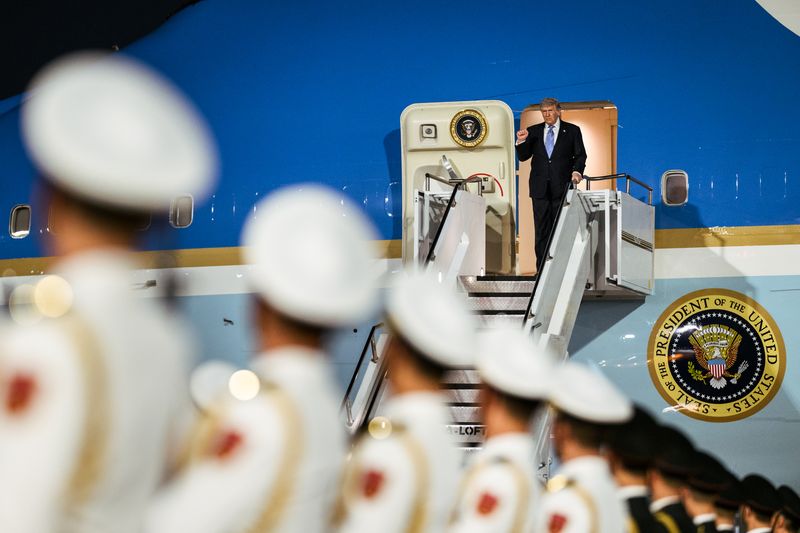
The Putin contrast, measured in one morning
If the Andrews debt explains why Trump was met by Xi, the morning’s other arrival explains why it matters that he was. Russian President Vladimir Putin arrived in Shenzhen earlier on Wednesday — and was met not by Xi, but by Cai Qi, the fifth-ranking official of the Chinese Communist Party. Cai Qi is a powerful welcomer; he runs the party’s central secretariat and Xi’s own office, and his presence at an arrival is itself a mark of favour, as our coverage of Putin’s Shenzhen arrival detailed. But he is not Xi. In the space of a single day, at the same airport, Beijing published a league table of its relationships: the Russian partner received the party’s chief of staff; the American president received the president.
The comparison with Trump’s own last arrival in China sharpens the point further. When Trump came to Beijing in May, the official who welcomed him was China’s vice president — a senior figure, and two full protocol grades below the man who stood on the Shenzhen tarmac on Wednesday. Between May and November, nothing about the formal relationship changed: no treaty was signed, no summit concluded. What changed was September — Trump’s Andrews gesture — and the approach of a Thursday on which Xi needs the American president in a cooperative frame of mind. Protocol, in Beijing’s hands, is a dial, and on Wednesday it was turned visibly upward.
The same day, on the summit stage
The tarmac was not Wednesday’s only stage. At the APEC CEO Summit, Xi delivered the opening speech urging free and open trade and resistance to protectionism, Reuters reported — the host presenting China as the defender of the open trading order on the very day he embraced the president who had tariffed it. The juxtaposition is the week’s central tension in miniature: Beijing’s public doctrine is openness; its guest of honour is the author of last year’s tariff war; and the welcome extended to that guest was warmer than any the doctrine alone would predict.
Putin, addressing the same CEO audience, looked ahead to Thursday and said he expects “big potential benefit” from the trilateral meeting with Trump and Xi, Reuters reported. The Russian president thus spent Wednesday in a curious position: honoured, platformed, billeted at the summit’s centre — and, by the evidence of the airport, ranked second in the host’s affections on the day. How much that ranking matters will be tested at Thursday’s table, where the three men sit as nominal equals.
Thursday, part one: the bilateral
Thursday’s business opens with the meeting the tarmac was really about: the Trump–Xi bilateral, their third encounter of 2026. Its agenda is the unfinished business of a bruising two years. Trade tensions left over from last year’s tariff war sit at the top of it. US officials say China continues to throttle exports of rare-earth minerals and magnets — the inputs on which American defence, automotive and technology supply chains depend — leaving the trade truce the two sides struck last October looking uncertain. A bilateral that was meant to consolidate a truce may instead have to renegotiate one, and the warmth of Wednesday’s welcome will be measured against whatever Thursday produces on export licences and tariff schedules.
Two smaller items trail the main agenda, each revealing in its own way. Trump has said he may raise the alleged Chinese-spy scandal surrounding ousted Nvidia chief executive Jensen Huang, the New York Post reported — while expressing concern about insulting China in doing so; it is a “may,” attributed to Trump, and nothing more should be read into it before Thursday. And Elon Musk will participate in some events during the Shenzhen visit, the Post reported, though his exact role remains unclear — a cameo that underlines how thoroughly the week blends statecraft with the technology rivalry running underneath it. The background to the bilateral is set out in our earlier reporting on China’s confirmation of the Xi–Trump–Putin meeting at APEC in Shenzhen.
Thursday, part two: the first trilateral in history
Then comes the encounter without precedent of a different kind: the first-ever Trump–Xi–Putin trilateral, focused on nuclear disarmament and the reduction of the three powers’ stockpiles. No leaders of the United States, China and Russia have ever sat at one table in this format. Its stated centre of gravity is the nuclear file — the arsenals that make the three countries existential peers whether they wish to be or not — and Trump, departing Washington, said the talks would also address resolving the United States’ war with Iran and ending Russia’s invasion of Ukraine. Trump has also teased that North Korea’s Kim Jong Un may appear during the Shenzhen events; that remains speculation attributed to Trump himself, and nothing in any published schedule treats it as an arranged meeting.
Nothing about Thursday should be pre-judged. No agreement, communiqué or breakthrough exists at the time of writing, and this article claims none. What exists is a schedule, a set of stated intentions that do not fully agree with one another, and — after Wednesday — a stock of publicly banked goodwill between the two leaders whose bilateral opens the day. Trump’s route to Shenzhen, through the Philippines, is covered in our report on Trump’s arrival in Manila for the Quad meeting at the start of his Asia trip.
Why this matters
An airport greeting is not a policy. But in a system where the leader’s person is the state’s most rationed resource, where he spends his presence is a policy statement of a particular kind — and Wednesday’s expenditure deserves to be read as carefully as any speech.
Protocol as signalling, in three directions at once
The Shenzhen welcome speaks to three audiences simultaneously, and says something different to each. To Washington, it says the relationship has a personal floor: whatever the trade negotiators do, the two leaders have now honoured each other in the most visible currency either capital trades in. To Moscow, it says the partnership has a ceiling: Russia is China’s closest strategic partner, but on the day the American president came to town, the partner was met by the fifth-ranking official and the guest by the host himself — a reminder, delivered without a word, that Beijing’s options are wider than Moscow’s. And to the APEC audience of Asian governments and chief executives watching from the summit hotels, it says that the week’s centre of gravity is not a US–China confrontation but a US–China embrace, staged in a Chinese city, on Chinese terms of hospitality.
Who benefits, who is exposed
Xi benefits first and most visibly. He has positioned China as the indispensable host of the year’s defining diplomatic week, repaid a courtesy in a way that obliges its recipient, and done so while preaching open trade to the region’s business elite. Trump benefits differently: he arrives home-able footage of a rival superpower’s leader embracing him on a red carpet, a visual argument that his personal diplomacy extracts honours no predecessor obtained. The exposure sits with Putin, whose welcome was correct, senior and warm — and unmistakably second. It also sits, more subtly, with both greeters: goodwill banked in public creates expectations in public, and if Thursday ends without movement on rare earths, tariffs or the nuclear file, Wednesday’s hug will be re-read as theatre that substituted for substance.
The critics’ reading
Sceptics will not have to work hard. Their case writes itself: that embraces are cheap, that China’s rare-earth licensing has not loosened for a photograph, that a president who was tariffed into a truce last October should count export licences rather than performers, and that protocol flattery is the oldest instrument in Beijing’s statecraft — deployed precisely when Beijing wants something, in this case a calm Thursday and a presentable trilateral. The critics may be right about the motive and wrong about the significance: in summit diplomacy, the theatre is frequently the mechanism, because leaders who have honoured each other in front of the world have raised the personal cost of humiliating each other at the table. Thursday will arbitrate between the readings.
Context: the road from tariff war to red carpet
Wednesday’s warmth is legible only against the cold that preceded it. Last year’s tariff war between the United States and China was the sharpest economic confrontation between the two countries in decades, and its aftershocks structured everything that followed: the October trade truce that paused the escalation without resolving it, and the rare-earths dispute that has kept the truce provisional ever since, with US officials maintaining that Beijing continues to throttle the mineral and magnet exports American industry needs. The three Trump–Xi meetings of 2026 — of which Thursday’s bilateral is the third — have been the truce’s maintenance mechanism: leader-level encounters doing the work that the trading system underneath them could not. Wednesday’s greeting is best understood as maintenance raised to ceremony.
The numbers behind the choreography
Strip the day to its data points and the anomaly stands out cleanly. One airport: Shenzhen Bao’an. Two arrivals in one morning: Putin, met by the fifth-ranking party official; Trump, met by the president himself. One precedent broken: no visiting US president had previously been received at an airport by Xi. One precedent answered: Trump’s September welcome at Joint Base Andrews, the first in-person presidential airport greeting for a visiting foreign leader since 1962, per the New York Post. Two previous Trump–Xi meetings this year; Thursday’s is the third. And one meeting with no number at all, because it has never happened: Thursday’s trilateral is the first of its kind.
Scenarios for Thursday
Three broad outcomes are available when the bilateral and the trilateral conclude. In the first, the goodwill converts: the bilateral produces language on rare-earth exports and the October truce that both sides can present as stabilisation, and the trilateral issues at least a framework statement on nuclear stockpile reduction — in which case Wednesday’s tarmac will be remembered as the overture that made it possible. In the second, the meetings are cordial and empty: warm readouts, no export movement, a trilateral that agrees to meet again — in which case the hug becomes the week’s only deliverable, and the critics’ theatre reading wins by default. In the third, the friction surfaces publicly — a rare-earths rebuke, a Taiwan or technology dispute aired in a readout — and Wednesday’s embrace is recast overnight as the calm before a familiar storm. Nothing in the reporting available at publication chooses among these; the honest position, hours before the meetings, is that the choreography has raised the value of the first outcome and the embarrassment of the third, without guaranteeing either.
What to watch next
Watch, first, the bilateral’s readout language on rare earths: verbs matter, and any shift from complaint to commitment will tell markets whether the October truce has been repaired. Watch, second, whether the trilateral produces a joint text on nuclear disarmament or three separate assessments — the difference between a format and an event. Watch, third, for any official Chinese account of Wednesday’s airport decision, which had not been published at the time of writing: if Beijing later explains the gesture, the explanation will reveal whom it was really for. And watch the photographs. In Shenzhen this week, the pictures have been the policy’s leading edge — a handshake that became a hug, at the foot of Air Force One, from a leader who had never done it before.
Sources
Sources: CNN, November 18, 2026 — video report of Trump’s arrival in China (cnn.com): Xi Jinping personally greeted Donald Trump at Shenzhen Bao’an International Airport; the report described the greeting as “unprecedented”; the handshake turned into a hug on a red carpet with a military guard and band, a flyover, and hundreds of performers waving flowers and Chinese and US flags chanting an enthusiastic warm welcome in Mandarin. CNN and Bloomberg — Xi had never before gone to an airport to receive a visiting US president (the narrow claim used throughout this article). New York Post, November 18, 2026 — “Trump and Xi hug during surprise tarmac greeting in China” (nypost.com), with a Reuters photograph of Xi welcoming Trump at Shenzhen Airport on November 18, 2026: Trump’s in-person welcome of Xi at Joint Base Andrews during the September state visit was the first for a visiting foreign leader since 1962; Putin was received earlier Wednesday by Cai Qi, fifth-ranking CCP official; in May, China’s vice president welcomed Trump to Beijing; Trump said he may raise the alleged Chinese-spy / ousted Nvidia CEO Jensen Huang matter while expressing concern about insulting China; Elon Musk will participate in some events during the Shenzhen visit, his exact role unclear; Trump has teased that Kim Jong Un may also appear (speculation attributed to Trump only). Reuters, November 18, 2026 — Xi’s APEC CEO Summit opening speech urging free and open trade and resisting protectionism (reuters.com); Reuters, November 18, 2026 — Putin told APEC CEOs he expects “big potential benefit” from Thursday’s meeting with Trump and Xi (reuters.com). Thursday’s schedule as reported: Trump–Xi bilateral first (trade tensions after last year’s tariff war; US officials say China continues to throttle rare-earth mineral and magnet exports, leaving last October’s trade truce uncertain), then the first-ever Trump–Xi–Putin trilateral focused on nuclear disarmament and stockpile reduction; Trump said on departing Washington that the talks would also address resolving the US war with Iran and ending Russia’s invasion of Ukraine. No official Chinese explanation for the airport gesture had been published at the time of writing, and no agreement or breakthrough is reported before Thursday’s meetings. Photographs in this article are file photographs from Wikimedia Commons (The White House, public domain; LN9267, CC BY-SA 4.0) and do not depict the November 18, 2026 Shenzhen arrival; the Reuters arrival photograph published by the New York Post was referenced but not reproduced.