Kharkiv apartment building bomb attack September 2026
Kharkiv apartment building bomb attack September 2026Saltivka Kharkiv guided bomb strike September 28Russian KAB glide bomb Ukraine apartmentKharkiv children injured Russian strikeUkraine drone barrage September 2026Russia strikes Kyiv petrol stationUkraine Russia war latest newsKharkiv air defense September 2026Russia winter aerial campaign UkraineUkraine long-range strikes air defense
KHARKIV, Ukraine — A Russian guided aerial bomb struck an apartment building in Saltivka, a sprawling residential district of Kharkiv, in the early hours of Monday, September 28, injuring 22 people, Mayor Ihor Terekhov said on Telegram. Eight of the wounded were children. The Kharkiv Regional Military Administration confirmed the rising toll after initial reports put the number of injured at 15. In Kyiv, city authorities separately said a Russian drone hit a petrol station, without immediately reporting casualties or the extent of damage.
The reported casualty figures, weapon type and sequence of events come from Ukrainian officials and local emergency updates. Reuters reported Terekhov's account but could not independently verify every battlefield claim. Russia's defence ministry had not commented on the Saltivka strike at publication. Moscow says its long-range campaign targets military-linked infrastructure; Kyiv says homes and civilian systems are being deliberately placed under pressure. Those competing claims must be kept distinct from the confirmed fact that local officials reported a direct hit on a residential building.
What happened in Saltivka
Kharkiv officials described two guided aerial bombs, often abbreviated in local reporting as GABs, hitting the city's Saltiv and Kyiv districts. Several residential buildings were damaged. One of the bombs hit an apartment building directly in Saltivka, according to Terekhov and the regional administration. Emergency crews shifted into an enhanced operating mode as medics treated residents and inspected the structure.
The toll changed as rescuers and hospitals reconciled their counts. Early reports said 15 people were injured; the Kharkiv Regional Military Administration later raised the number to 22. Two children, ages 12 and 8, were hospitalized. Children ages 3, 7, 9, 10 and 15 were among those treated at the scene, according to the local-authority account carried by Antikor. The age information did not cover every child in the reported total, and authorities had not published a complete victim list.
That progression is common after strikes on occupied buildings: first responders count people at the scene, hospitals register arrivals and officials consolidate overlapping reports. The final figure may still change. What is already clear is the civilian profile. Children made up more than one-third of the reported wounded, a consequence of a weapon landing where families were sleeping rather than at an isolated military site.
A wider overnight wave reached Kyiv and its suburbs
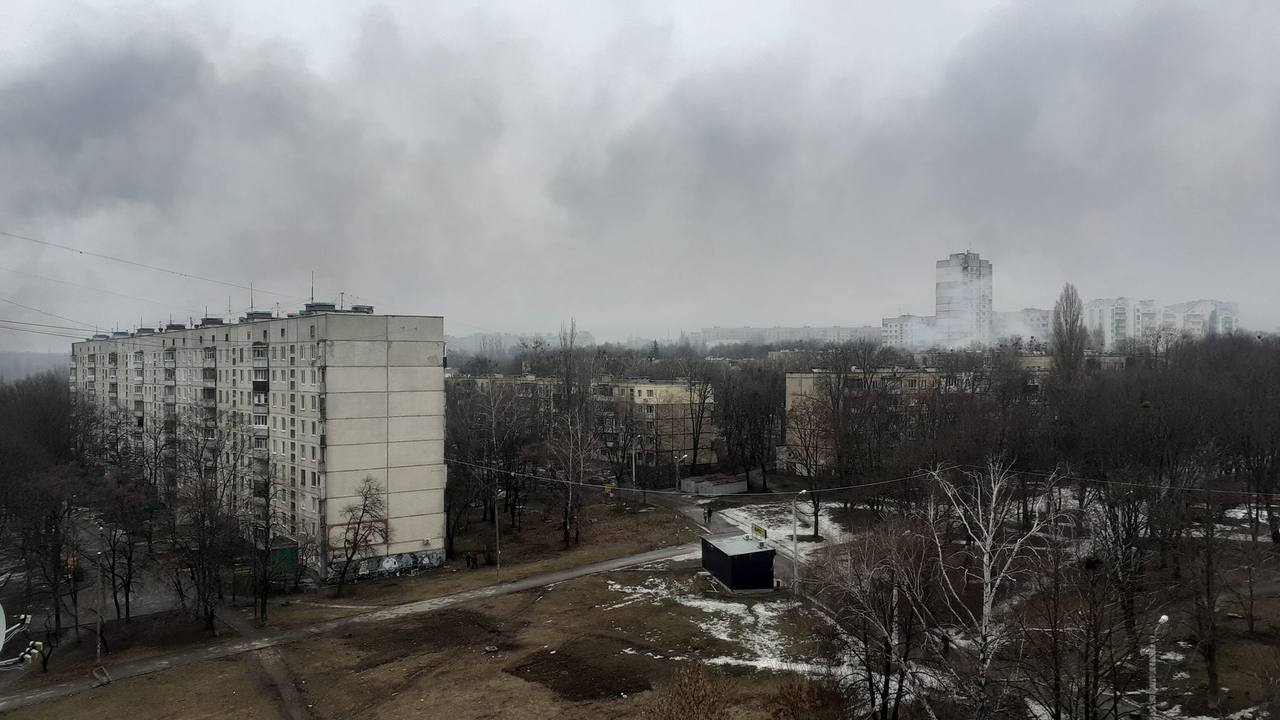
The Saltivka attack did not occur in isolation. An OSINT compilation of Ukrainian military briefings said Russia launched about 165 drones overnight, including roughly 79 jet-powered variants. Ukrainian air defences were reported to have destroyed 112 drones, while impacts were recorded at 14 locations. Those numbers are official Ukrainian assessments assembled during an active operation and remain difficult to verify independently, but they indicate the scale of the air-defence burden spread across the country.
In Kyiv, authorities said a drone hit a petrol station. Their initial Telegram statement offered no further detail, so it would be premature to infer casualties, major fuel disruption or a connection to other reported petrol-station strikes. Outside the capital, the Kyiv Oblast Prosecutor's Office said a drone struck a market in Sofiyivska Borshchahivka, killing two people and injuring about 10. The incidents were geographically separate but part of the same broad pressure on the capital region.
From nightly barrages to nearly continuous attacks
Reuters' Sunday reporting described strikes running almost continuously rather than arriving only in a concentrated overnight wave. At least five people were reported killed across Ukraine that day: two at the market outside Kyiv and three in Sumy and Kharkiv. The exact national tally varied as local authorities updated their figures, but the operational shift matters more than any single snapshot. Air-defence teams, firefighters, medics and utility crews are being asked to sustain alert conditions with shorter recovery windows.
Signal Post News tracked Sunday's daylong attacks across Kyiv, Sumy, Kharkiv and Odesa. Monday's strike on Saltivka extended that rhythm into another morning. For civilians, the change means that work, school, sleep and repairs all take place under a threat that is no longer confined to the darkest hours.
Why Saltivka matters
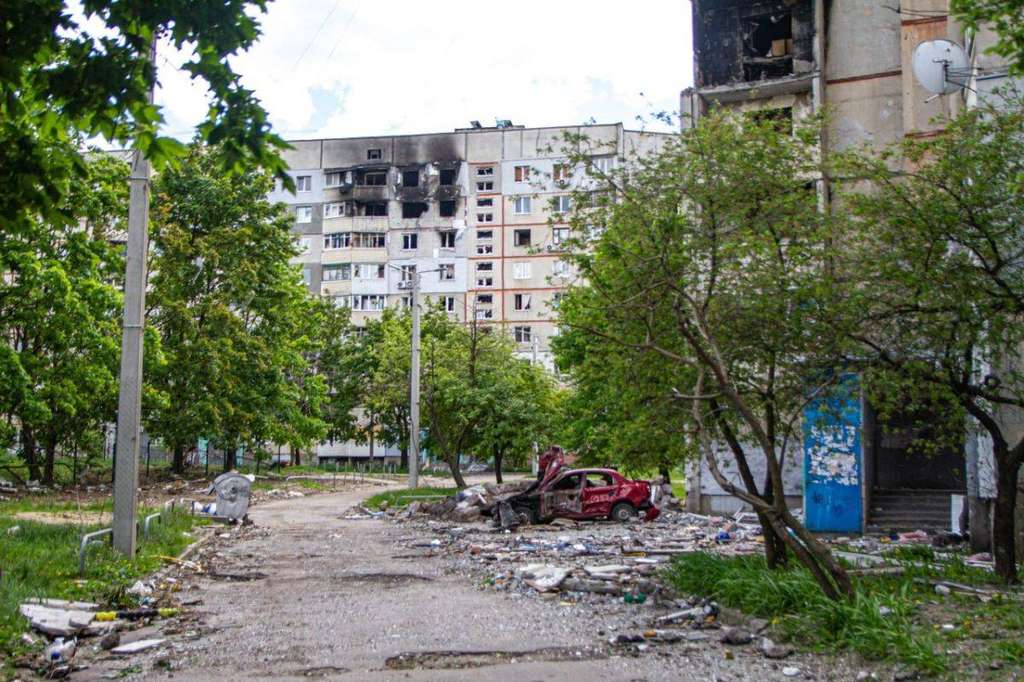
Saltivka carries unusual symbolic weight in Kharkiv. Before the full-scale invasion, estimates placed its population somewhere between 400,000 and 800,000, making it one of Europe's largest residential districts. Its dense towers and microdistricts were built to house an industrial city's workforce. In 2022, when Russian forces pushed toward Kharkiv, Saltivka was shelled almost daily; roughly 70% of its residential buildings were reported damaged.
Much of the district was later repaired and repopulated. A guided bomb landing there again is therefore more than another mark on a strike map. It puts a rebuilt neighborhood back under direct fire and tests whether recovery can hold when residents face the same type of danger they thought they had survived. The archive images accompanying this report show the earlier destruction, not Monday's scene, but they explain why the name Saltivka resonates so strongly in Kharkiv.
Why guided bombs are difficult to stop
KAB-type weapons are typically Soviet-era gravity bombs fitted with guidance and glide kits. They are cheaper than cruise missiles, carry large warheads and can be released from farther away than an unguided bomb, allowing Russian aircraft to remain beyond some Ukrainian air-defence envelopes. Kharkiv's proximity to the Russian border leaves little warning time. Even when the intended aim point is disputed or nearby, the blast effect in a dense apartment district can be catastrophic.
The air-defence problem is also economic. Ukraine can use electronic warfare and lower-cost guns against some drones, but glide bombs and faster jet-powered drones demand different sensors and interceptors. Military intelligence chief Kyrylo Budanov has called Ukraine's shortage of Patriot interceptors critical amid a global supply squeeze. The unresolved question of licensed Patriot production for Ukraine is therefore not an abstract procurement dispute; it determines how many threats can be engaged before they reach cities.
Communications are becoming part of the winter battlefield
Russia's defence ministry said Sunday that its forces struck logistics centres, port and transport infrastructure, data centres and vessels it described as linked to Ukraine's military. Kyivstar said its head office was hit. The Russian ministry also said a Vodafone Ukraine data centre was struck. Reuters said it could not independently verify the ministry's target claims, and the distinction between a claimed military purpose and civilian consequences remains central.
Ukraine's digital ministry said about 100,000 households lost service during the recent communications disruptions. That points toward a campaign whose effects can extend far beyond a damaged building. Mobile networks carry air-raid alerts, emergency calls, banking authentication and coordination for repairs. An attack on communications can slow the response to the next attack, multiplying disruption without producing a dramatic single-site image.
Analysis: The pattern is consistent with warnings of a Russian winter long-range-strike campaign that would pressure electricity, heating, transport and information networks together. Institute for the Study of War assessments summarized in the OSINT brief point in that direction. It is not yet proof of a formal campaign order, but the target mix is widening as temperatures fall.
The scale behind one apartment strike
President Volodymyr Zelenskyy said Russia used about 2,200 attack drones, roughly 1,650 glide bombs and 38 missiles against Ukraine in the preceding week. Those are Ukrainian presidential figures, not an independently audited weapons ledger, yet they show why a single interception rate can be misleading. Even a high percentage leaves dozens of weapons reaching targets when the launch total is large enough.
The OSINT brief also cited aviation expert Kostiantyn Kryvolap's estimate, reported by Meanwhile in Ukraine, that Russia may be producing around 3,000 jet-powered Shahed-type drones a month. That estimate is not a confirmed production figure. If broadly accurate, however, it would explain why faster variants are appearing in larger numbers and why Moscow can trade inexpensive attack systems against costlier Ukrainian interceptors.
Ukraine has tried to change that equation with long-range strikes on Russian refineries and weapons infrastructure. Its reported attack on the Ilsky oil refinery was part of an effort to raise the economic cost of the war. Those counter-strikes also carry escalation and civilian-risk concerns, and Russia cites them when defending its own campaign. Each side denies targeting civilians; neither denial resolves the evidence at individual strike sites.
Diplomacy stalls while the air war supplies leverage
The timing adds a political layer. The Saltivka strike came days after a Trump-Zelenskyy meeting around the United Nations General Assembly, Trump's public call for Zelenskyy to “settle with Putin,” disagreement over Patriot production licenses and Moscow's statement that it would pursue its war aims “no matter the circumstances.” No public evidence establishes that Monday's attack was ordered in response to those events. But the strikes function as battlefield leverage while diplomacy remains stuck.
For Russia, sustained pressure can wear down Ukrainian society, force Kyiv and its partners to spend scarce air-defence stocks and demonstrate that Moscow can keep escalating without a decisive ground breakthrough. Zelenskyy characterizes the campaign as an attempt to break civilian resilience. Russia presents it as an operation against logistics and military-support systems. Reuters' inability to independently verify many official claims is not a reason to treat the narratives as equivalent facts; it is a reason to attribute each claim precisely and keep intent separate from observed damage.
The losses are less ambiguous. Civilians absorb the direct blast risk, children appear among the wounded, Kharkiv's reconstruction is interrupted and emergency workers carry a nearly continuous burden. Ukraine's partners face a narrower but consequential choice: whether to release more interceptors, expand licensed production and permit longer-range Ukrainian strikes, knowing that every option affects escalation as well as defence.
What happens next
The first scenario is continuation: overlapping drone and guided-bomb attacks remain a near-round-the-clock feature, forcing Ukraine to rotate air-defence and emergency crews and accept gaps. The second is a formal winter infrastructure campaign combining power, heating, transport and communications targets. The third is reciprocal escalation, with Ukraine increasing attacks on Russian refineries and military production while Moscow broadens its target set.
There is also a narrower diplomatic possibility. Trump said he asked Zelenskyy to reduce strikes on Russian refineries; Zelenskyy has offered an energy ceasefire if Moscow reciprocates. Such an arrangement would not end the war and would require a way to define covered targets and verify violations. Even a limited pause could protect heating and electricity systems through winter, but neither side has announced an agreed mechanism.
Watch three indicators: the share and type of drones Ukraine intercepts, the next Western decisions on Patriot missiles and long-range permissions, and whether attacks on communications and energy sites accelerate as winter approaches. Also watch casualty updates from Kharkiv. The strategic arguments are contested, but the starting fact is not: local officials say a guided bomb hit a Saltivka apartment building and wounded 22 people, eight of them children.
Sources
- Reuters, September 28, 2026 — Kharkiv guided-bomb strike and Kyiv petrol-station drone report
- Antikor — Terekhov and Kharkiv Regional Military Administration updates
- Reuters, September 27, 2026 — Sunday strikes across Ukrainian cities
- Reuters, September 27, 2026 — Kyivstar and data-centre strikes
- OSINT daily brief, September 28, 2026 — overnight-wave context and compiled Ukrainian briefings
- Times Now World — Sunday casualty context
- Wikipedia — Saltivka district background and 2022 damage context
Reporting note: Casualty counts and battlefield claims were changing at publication. Claims from Ukrainian and Russian authorities are attributed; independent verification remains difficult during active strikes. Archive images are clearly labeled and do not show the September 28 attack.