Russia strikes Ukraine September 27
Russia strikes Ukraine September 27Russian drone strikes Kyiv todaySumy glide bomb strike September 2026Kharkiv drone strike passenger carsOdesa port vessel strikes RussiaKyiv data centre strike children woundedMoscow rejects German de-escalation UNGALavrov Wadephul meeting dismissedUkraine daylong air attacks 2026Zelenskyy 2200 drones week strikes

KYIV, Ukraine — Russia strikes Ukraine September 27 unfolded as a near-continuous aerial assault rather than the familiar nighttime wave: drones and glide bombs killed at least eight people across Kyiv, Sumy, Kharkiv and Odesa on Sunday, Ukrainian officials said, while a Ukrainian strike killed a civilian in Russian-occupied Enerhodar and another person died in Russia's Belgorod region, according to the Associated Press. The daylong barrage struck homes, a nine-story apartment block, passenger cars and — Moscow claimed — data centres and vessels linked to Ukraine's military, just hours after Russia's foreign minister publicly brushed off Germany's call to de-escalate at the United Nations.
A Sunday of strikes, city by city
In Kyiv, a man was found dead after a Russian drone hit a non-residential building overnight, according to Ukraine's emergency service. Later Sunday, drone strikes killed one person and wounded at least five on the capital's outskirts, Kyiv regional administration head Tymur Tkachenko said — one person died and four were wounded in Vyshneve, where a drone damaged five vehicles and caused a blaze, and a security guard was injured at a window manufacturing facility near Fastiv.
Inside Kyiv itself, a drone struck a nine-story apartment block in an eastern district, triggering a fire and wounding at least one woman, Mayor Vitali Klitschko said; drones also hit areas near a kindergarten and a playground, with other districts reporting damage but no casualties.
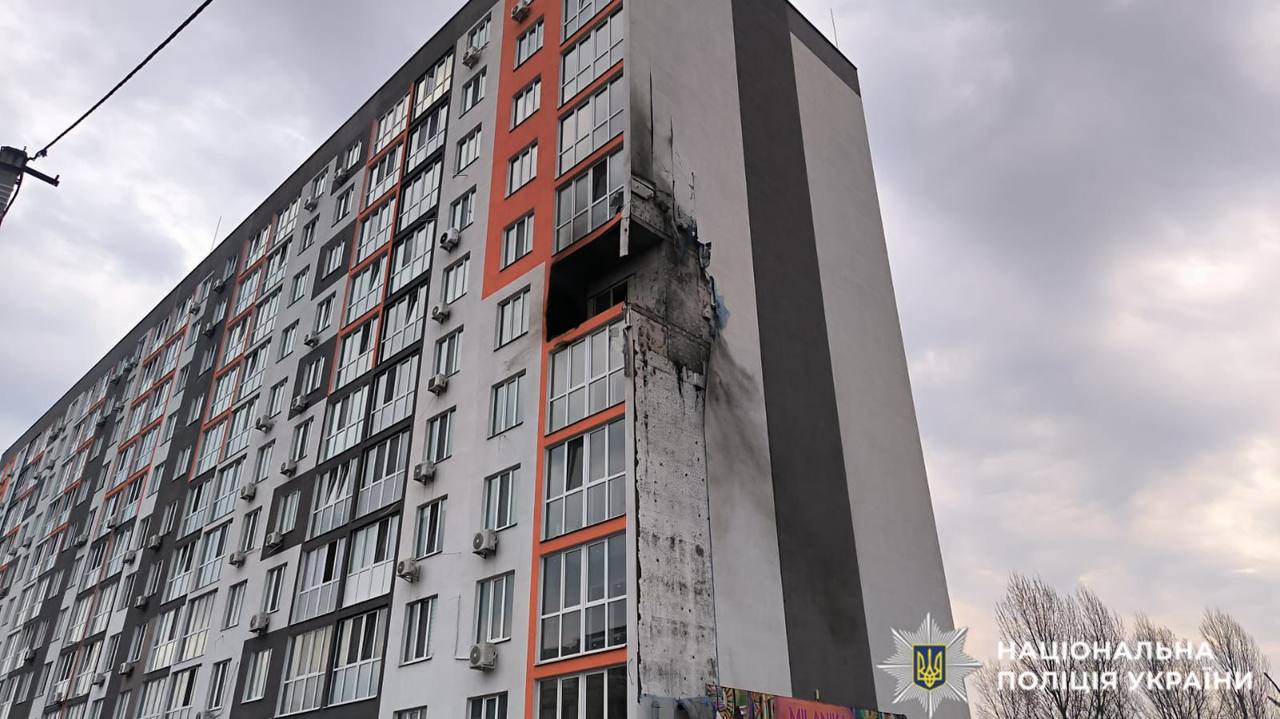
Russian drone strikes Kyiv today; Sumy and Kharkiv count losses
In Sumy on Sunday afternoon, Russian guided glide bombs struck the northern city, killing a woman and a 16-year-old girl and wounding five others, regional administration head Oleh Hryhorov reported; Reuters earlier reported three glide bombs landing near a family support centre, killing two. In the Kharkiv region, two people died and two more were injured after Russian drones struck passenger cars, the regional prosecutor's office said. In the Odesa region, Russian forces attacked multiple times overnight into Sunday, killing one person and wounding two, military administration head Oleh Kiper said.
Separately, President Volodymyr Zelenskyy said Russia struck a Kyiv data centre twice on Sunday morning, wounding two children and an adult — while Russia's defence ministry claimed its forces had hit multiple Kyiv data centres it said were providing internet to Ukraine's armed forces, a claim Reuters said it could not independently verify.
On the other side of the front, a Ukrainian strike on Sunday killed a civilian woman in Enerhodar, the Russian-occupied town housing Europe's largest nuclear plant, according to its Kremlin-installed mayor Maxim Pukhov, who said two others were wounded; and in Russia's Belgorod border region, a woman died in hospital on Sunday after being wounded in a Ukrainian strike, regional authorities said. Both sides in the more than four-and-a-half-year-old war deny targeting civilians.
Why this matters: the aerial war is going around the clock
The deeper story is not the toll alone but the tempo. Russia has long staged intensive attacks on Kyiv and other cities mostly at night, Reuters noted, but in recent weeks strikes have run almost continuously throughout the day — a shift from discrete nocturnal waves to sustained pressure. That changes the arithmetic of the war: air-defence crews, emergency services and civilians must stay on alert for far longer stretches, and the psychological grind of a city that can be hit at any hour accumulates in ways a casualty count cannot capture.
It is also an economic story. Drones — including jet-powered models — reach deep into Ukraine at a fraction of a cruise missile's cost, letting Moscow keep the pressure dialed up without burning through its most expensive munitions. Zelenskyy said Russia launched more than 2,200 drones at Ukraine in a single week, alongside thousands of bombs and missiles. The daylong pattern suggests Russia's drone production and launch infrastructure can now sustain a tempo that would have been unthinkable a year ago — which is precisely why Ukraine is racing to build interceptors and strike the factories and refineries feeding Moscow's war economy.
The connectivity campaign: from the power grid to the information grid
Sunday's strikes sharpened a second, newer front: Ukraine's digital backbone. A Kyiv data centre was struck twice in one morning, wounding two children and an adult, and Russia's defence ministry openly claimed data centres as targets, saying they provide internet to Ukraine's armed forces. Days earlier, Russian strikes hit the Kyiv headquarters of Kyivstar, Ukraine's largest mobile operator, part of a week-long campaign that knocked some 100,000 households offline.
Kyiv data centre strike: children wounded as civilian connectivity comes under pressure
For three years Russia's strike campaign centred on the power grid; this week's attacks mark a deliberate expansion to civilian connectivity itself — the networks that carry air-raid alerts, banking, emergency coordination and the daily functioning of a modern state. Moscow frames these as military targets; Kyiv calls them attacks on civilian infrastructure. Independent verification during active attacks is often impossible, which is itself part of the information war both sides are waging over every strike.
Odesa and the shipping lane
The most strategically loaded claims came from Russia's defence ministry, which said its forces struck logistics centres, port and transport infrastructure, communications facilities and vessels it described as linked to Ukraine's military — including a cargo ship it said was carrying military and dual-use goods to the port of Odesa, and, in a daytime follow-up wave, a second vessel headed for the port. The ministry also claimed hits on logistic hubs in the Kyiv and Odesa regions, two drone storage sites in Mykolaiv, a naval base headquarters, the State Border Guard Service headquarters and military stores at the Kiliya port. Reuters could not independently verify these claims.
Odesa port vessel strikes raise the stakes for Black Sea trade
But the direction of travel is clear: pressure on the Black Sea corridor that carries Ukraine's grain and exports to world markets. It is no coincidence that safe commercial shipping through the Black Sea was on the table when Germany's foreign minister met Lavrov in New York — the grain track may be the only diplomatic lane still open, and strikes near it are a way of reminding everyone how narrow that lane is.
Who benefits, who loses
Russia's calculus is straightforward: with front-line positions largely unchanged since last year, the aerial campaign is how Moscow applies pressure without a costly ground breakthrough — and the daylong tempo multiplies that pressure at relatively low cost. The risks are diplomatic: ties with Germany have soured further after Berlin blamed the Kremlin for an attempted drone attack at Leipzig airport last month, and every civilian death hardens European resolve to keep arming Ukraine.
Ukraine, for its part, is answering in kind where it can — deep strikes on Russian-occupied territory, on border regions like Belgorod, and on the oil refineries that fund Moscow's war — a reciprocal logic that keeps the escalation ladder intact. The clear losers are civilians on both sides of the front: the woman and the 16-year-old girl in Sumy, the driver in Kharkiv, the guard in Fastiv, the woman in Enerhodar, the woman in Belgorod — names the official statements did not provide, but whose deaths are the war's most reliable statistic.
The numbers in context
Sunday's toll — at least eight dead in Ukraine and one in Russia, per the AP — lands inside a September that the UN Human Rights Monitoring Mission already calls a month of “new intensity”: 200 civilians killed and 1,234 injured across Ukraine in just the first 24 days of the month, with Kyiv struck on 16 of those 24 days, the highest monthly frequency since the full-scale invasion began.
Zelenskyy's 2,200-drones-a-week figure points to an industrial-scale campaign
Set against that baseline, the significance of the daylong tempo is not that Sunday was the deadliest day of the war — it was not — but that the machinery of bombardment is running hotter and longer than at any point in the conflict. Zelenskyy's figure of 2,200 drones in a single week, if even approximately right, implies a production and launch pipeline operating at industrial scale; the before-and-after is stark against the sporadic nightly waves of 2023 and 2024. And the asymmetry persists: Ukraine's air defences are intercepting a large share of what comes, but interception is the expensive half of the exchange — every cheap drone Russia launches forces an expensive Ukrainian response, which is why Kyiv's request for licensed Patriot interceptor production has become a wartime priority.
What happens next
Three trajectories are worth watching. First, winter: Russia's campaign against energy infrastructure has historically intensified with the cold, and Ukraine's offer of an “energy truce” — no strikes on each other's power, heat and water systems — remains on the table with no Russian answer. Second, the Black Sea: if vessel strikes near Odesa continue, insurers and shippers will price in the risk, and the grain corridor that feeds millions could narrow again.
Third, the diplomacy: the first Russia-Germany foreign-minister meeting since 2022 produced nothing but a Lavrov shrug, and Trump's public urging that Zelenskyy “settle” with Putin sits uneasily beside a battlefield tempo that only accelerates. The scenarios range from a grinding winter of daylong bombardment and deepening civilian hardship, to an escalation of Ukrainian strikes on Russian industry that raises the economic cost for Moscow, to — least likely on current evidence — a negotiated pause. What is certain is that the aerial war has entered a new phase: not louder nights, but longer days.