Georgia opposition parties ban: Georgia’s Constitutional Court opened hearings on Wednesday in a ruling-party lawsuit seeking a Georgia opposition parties ban covering five major opposition forces.
Politics / Europe — a seven-judge court in Batumi will decide whether every opposition party that cleared the 2024 election threshold can be declared unconstitutional
What happened on day one in Batumi
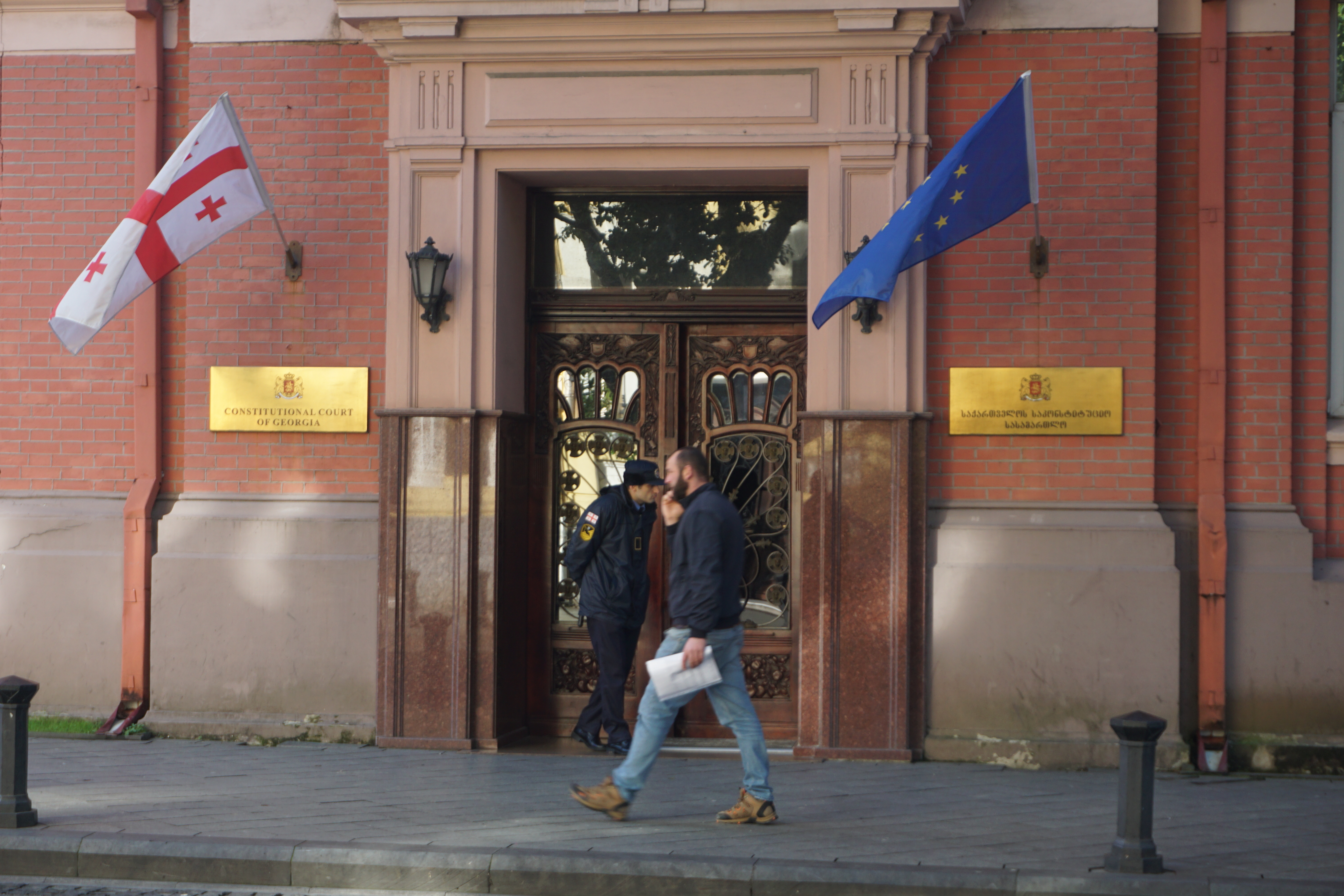
The Constitutional Court sits not in the capital but in Batumi, the Black Sea port city where it has been based since 2007, and the case before it was filed by 88 MPs of the ruling Georgian Dream party, according to Civil Georgia (Civil.ge), which is covering the hearings live. The first hearings are scheduled for October 21, 22 and 23, starting at noon, livestreamed on the court’s YouTube channel, with the Georgian Public Broadcaster the only media outlet authorised to film inside.
Four of the five targeted parties — the United National Movement (UNM), the Coalition for Change, Lelo/Strong Georgia and Gakharia’s For Georgia — sent representatives to plead their cases in the courtroom. The fifth, the Federalists, refused to participate inside, saying they would be “mocking” the proceedings from outside rather than legitimise the process, while staying in Batumi as part of the party’s campaign.
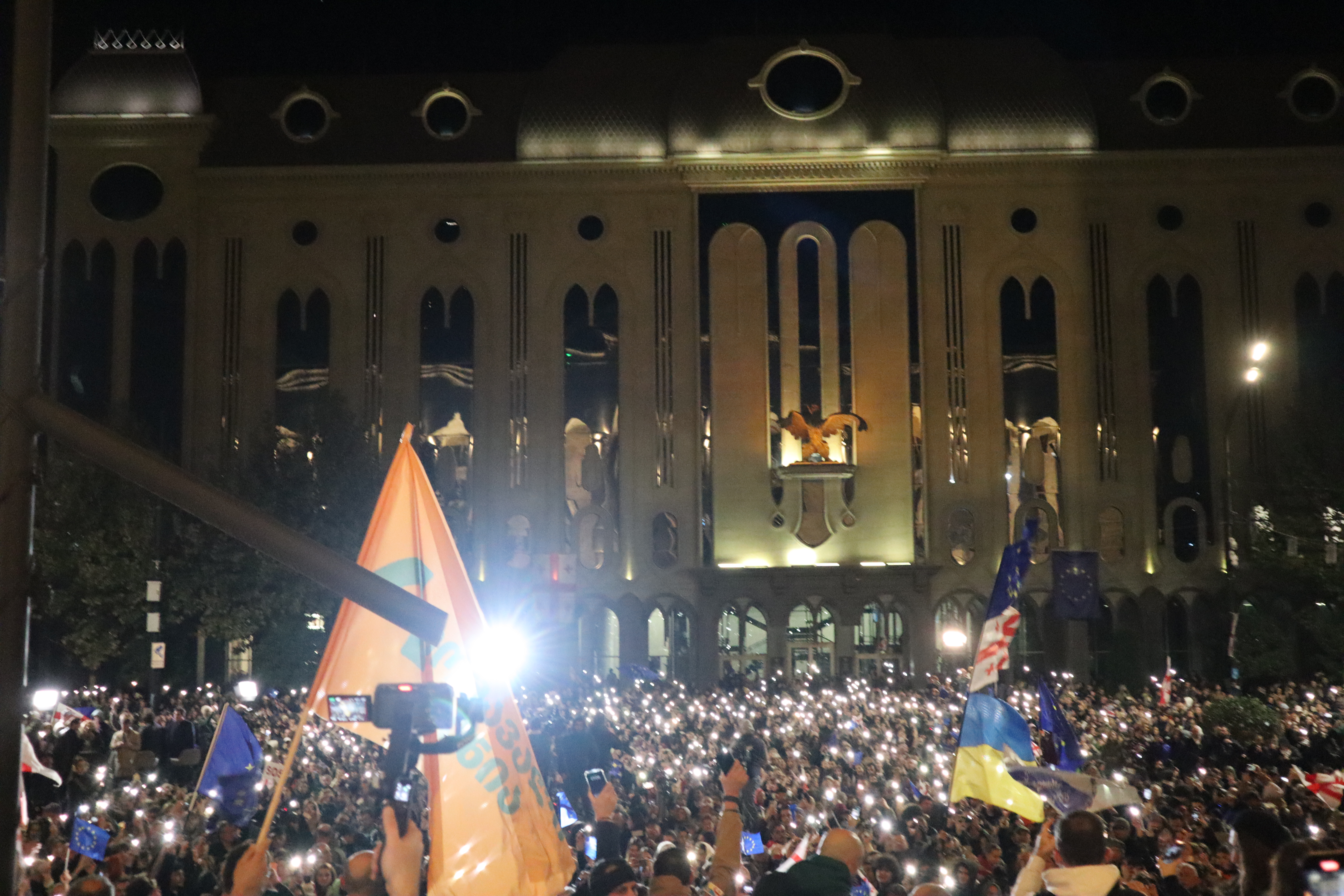
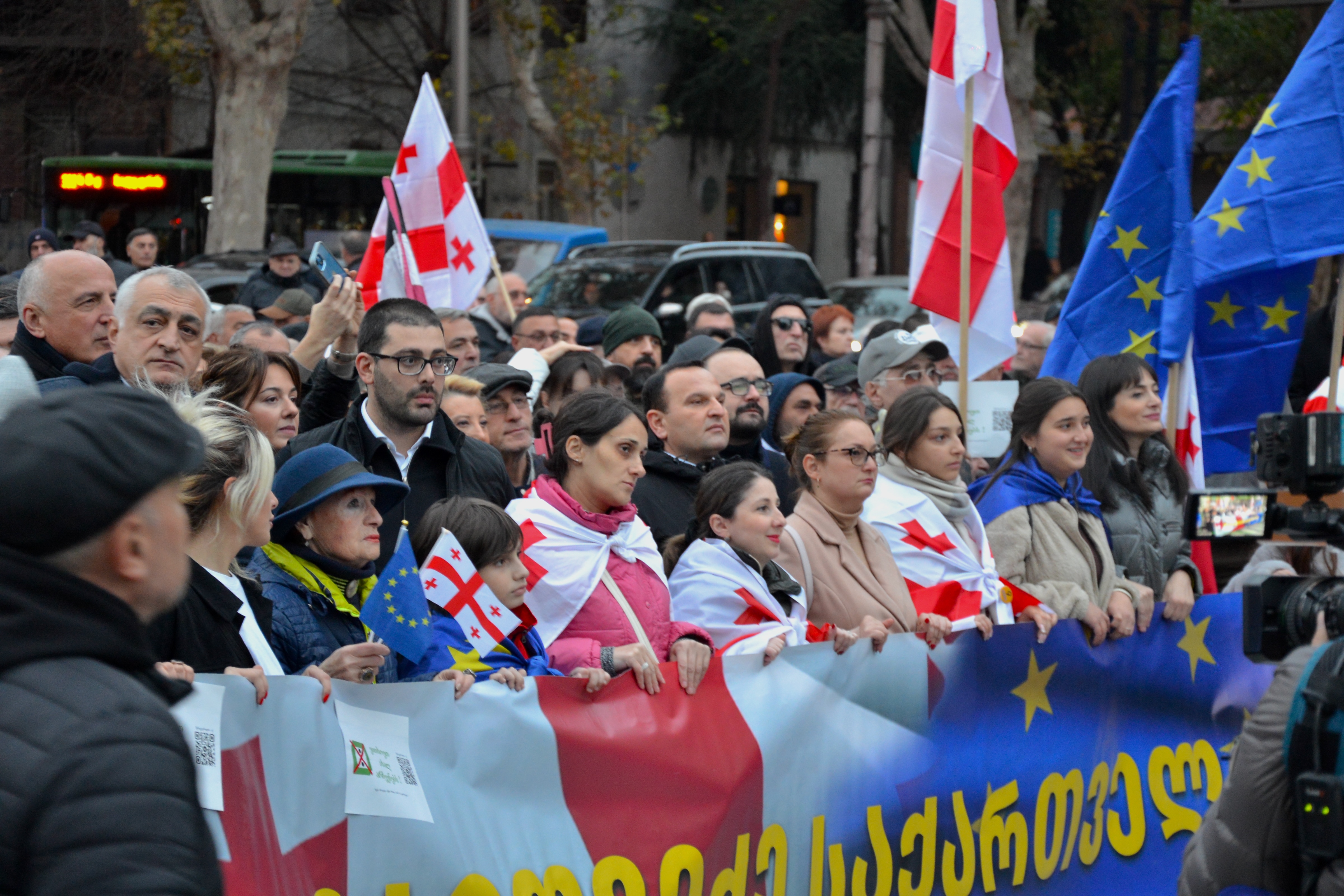
The morning began outside the courtroom. Nineteen Georgian civil society organisations issued a joint statement condemning the lawsuit as “a direct continuation of the ruling party’s undemocratic and repressive policies” and “a new, extremely grave stage of the country’s ongoing autocratization.” The organisations called the cases “completely unfounded” and contrary to Georgia’s Constitution and European legal standards, arguing that the lawsuit misrepresents legitimate democratic activities — government criticism, parliamentary boycotts, peaceful protests and appeals to international partners — as attempts to overthrow the constitutional order. Banning the parties, they warned, would strip hundreds of thousands of voters of political representation and “formally establish a one-party dictatorship.” A rally organised by Freedom Square, a party not itself facing a ban, gathered outside the court. “When injustice occurs, we will fight against it, regardless of whether it directly affects us or not,” its leader Levan Tsutskiridze told journalists.
Inside, the defence opened with recusal motions. The UNM demanded the recusal of the entire plenum, its representative Tsitlidze telling the court it “is neither free nor fair and does not act in accordance with the Constitution of Georgia.” Lelo asked for three judges to step aside, including Vasil Roinishvili, who as a supervising prosecutor had been involved in the case of Sergeant Roin Shavadze, killed after his arrest in Batumi in 2008, in an investigation the European Court of Human Rights later found lacked independence and impartiality; Lelo also questioned the independence of the two most recently appointed judges, Goga Kikilashvili and Sergo Metopishvili. The court retired at 1 p.m. to deliberate — and at 1:50 p.m. Judge Revaz Nadaraia read out the answer: all recusal motions rejected. The court also refused For Georgia’s request, filed the day before, to have the case against it examined separately from the broader lawsuit.
The afternoon brought witness motions, with the same result. The court rejected the UNM’s request to summon former president Mikheil Saakashvili, who is jailed, and imprisoned UNM leader Levan Khabeishvili as witnesses — the UNM had argued the lawsuit largely concerns Saakashvili’s time in power and the events of October 4, in which Khabeishvili figures. It then rejected a request to summon Ivanishvili himself. UNM representative Khatia Dekanoidze, who was later removed from the hearing, had argued Ivanishvili should be questioned because, she said, he is the sole decision-maker in Georgia and responsible for its rapprochement with Russia and distancing from Western partners. Judge Eva Gotsiridze answered for the court: “Within the scope of this constitutional lawsuit, we do not have to decide the question of individual responsibility of specific persons. We need to assess the activity of the political party as a whole.”
The five parties, and the case against them
The lawsuit in its current form targets five parties: the United National Movement, Lelo/Strong Georgia, Ahali/Coalition for Change, the Federalists, and For Georgia. It was not filed in this form. Georgian Dream first submitted the appeal in October 2025 against three parties — the UNM, Lelo/Strong Georgia and Ahali/Coalition for Change, three of the four major forces whose alliances crossed the 5 percent threshold in the disputed 2024 parliamentary vote. It was expanded in April 2026 to add the Federalists, and again in September 2026 to add For Georgia — the party of former Georgian Dream prime minister Giorgi Gakharia, and the only opposition force still represented in the disputed parliament, whose MPs took up their mandates in October 2025 after ending a boycott. Each resubmission reset the court’s nine-month review clock, which is why a case first filed a year ago has a deadline of June 2027.
The legal grounds, as summarised in Civil.ge’s backgrounder on the lawsuit text, are that the five parties have “attempted to overthrow and forcibly change the constitutional order of Georgia” and have a “future aim” to do so. The lawsuit points to what it describes as the systemic infringement of human rights by the opposition parties, their refusal to recognise the legitimacy of institutions and officials elected through general elections, events related to the August 2008 war with Russia, and developments after 2012 as manifestations of infringements of Georgia’s independence and territorial integrity. Against the UNM specifically, it cites independence and territorial integrity as an additional constitutional ground. The analysis site AnewZ, reviewing the September filing, notes the suit invokes Article 23 of the Constitution, covers conduct alleged since 2016, and cites six alleged attempts between 2019 and 2025 to overthrow or violently change the constitutional order, including a June 2019 incident in which the UNM and allied parties are alleged to have stormed the parliament building — an allegation the UNM has denied.
The lawsuit rests heavily on the voluminous report of a parliamentary investigative commission — known as the Tsulukiani Commission after its chair — created to investigate alleged crimes under the UNM government, which ruled Georgia until 2012, and later expanded to cover the period after 2012 as well. That provenance is itself contested: critics note the allegations underpinning the case have not been established by court judgments, a point the opposition returns to repeatedly.
The court that will decide
Georgia’s Constitutional Court has nine seats and ten-year terms, filled three each by the president, by parliament (requiring a three-fifths majority) and by the Supreme Court. Only seven judges are sitting on this case. Judge Manana Kobakhidze resigned on October 13 after the court denied her request to recuse herself — she was a founding member and first chairperson of Georgian Dream, a history she said could raise public doubts about her impartiality, though Prime Minister Irakli Kobakhidze said her past political career was no reason to step aside. Another judge, Irine Imerlishvili, resigned prematurely in October 2025, just as Georgian Dream announced its plan to seek the bans. Three of the seven sitting judges were appointed in the past year, after the ban plan was declared — appointments critics said would leave the body dominated by ruling-party loyalists with, in one September headline’s phrase, “no more dissenting opinions.” The two vacant seats are both parliamentary picks and are unlikely to be filled soon: electing a judge takes 90 votes, and Georgian Dream currently holds 89.
Two features of the process raise the stakes of whatever the seven judges decide. First, a Constitutional Court ruling in Georgia is final and cannot be appealed domestically. Second, the October 2025 amendments adopted by Georgian Dream extend the consequences of a party ban beyond the party itself: restrictions can reach individuals associated with a banned party, including, critics say, multi-year bans on political activity for people who have worked in foreign-funded organisations. The current lawsuit does not target individual members, and Georgian Dream has said it will not target For Georgia’s MP mandates — but the legal machinery to go further exists if the court bans the parties first.
What the ruling party says
Georgian Dream, in power since 2012, presents the lawsuit as democracy defending itself. Its representatives told Reuters the five parties pose “a real threat to the constitutional order.” Ahead of the hearing, Davit Matikashvili, chair of parliament’s Procedural Issues and Rules Committee, told Imedi that Georgians deserve a constructive opposition rather than what he called an “agent network” dominating the opposition landscape. The targeted parties, he said, are in reality the “collective National Movement,” distinguished by attacks on the constitutional order and constant attempts to incite unrest and overthrow the government, receiving instructions and funding from abroad; the lawsuit, he argued, is justified because democracy needs the capacity to defend itself.
Prime Minister Irakli Kobakhidze has made the argument in doctrinal form. Last October he invoked “militant democracy”: targeted forces, he said, “fundamentally oppose the idea of democracy, and therefore such forces should not be allowed to benefit from democracy.” The opposition, he has said, has used elections to “incite radicalism, polarization,” and stripping such parties of the right to run would deprive them of that instrument: “These political parties have no place in elections.” In July he framed the goal in electoral terms — to hold the 2028 parliamentary elections “without agents”: “Agentura cannot be a part of the political system. As long as the agentura is a part of the political system, a healthy democratic system cannot be achieved.” Parliament Speaker Shalva Papuashvili, presenting the first draft last October, argued the targeted parties had denied the legitimacy of the government and the ruling party, and thus, in his framing, one side in the dispute must be declared unconstitutional.
What the opposition and civil society say
The opposition’s answer, in and out of the courtroom, is that the case is about eliminating political choice itself. The lawsuit is about “depriving a large part of Georgian society of genuine political choice and fundamentally changing the nature of the country’s political system,” Giorgi Butikashvili, foreign secretary of the Ahali-Coalition for Change, told Reuters. For Georgia’s representative Berdia Sichinava called the inclusion of his party — the only parliamentary opposition party in the case — “absurd and devoid of any legal basis,” saying it confirmed Georgian Dream’s goal was to declare dissent unconstitutional, create a controlled opposition and stage “the illusion of elections.”
The nine-party Opposition Alliance, in an October 16 statement, framed the move as a power demonstration by Ivanishvili: “He wants them to accept isolation from Europe and the United States and being left alone to face Russia, which would be tantamount to the loss of Georgia’s statehood.” Coalition for Change leader Nika Gvaramia, announcing a protest campaign on October 15, said the initiative was not about politicians’ positions but “about depriving the country of democracy” and of Georgia’s European aspiration. “We will be everywhere: in courtrooms, in Batumi, and, most importantly, on the streets of Tbilisi,” he said. The Alliance has called supporters to gather in Tbilisi on October 25 under the slogan “Georgia without Ivanishvili,” opening a campaign meant to culminate on November 28, the second anniversary of the non-stop protests that began when Georgian Dream halted EU integration talks. The court case also lands inside a wider pattern the opposition cites as context: criminal proceedings against opposition leaders, funding restrictions on media and civil society, and new laws restricting political activity — a pattern this site has covered in its reporting on Georgia’s press-freedom cases, and that mirrors courtroom battles over democratic rules elsewhere, from election-map litigation in the United States (Justice Kagan’s warning on gerrymandering and democracy) to enlargement politics inside the European Union (the EU’s accession-cluster fight).
Why this matters
Party bans are the heaviest weapon a democracy keeps in its own armoury, which is why European law surrounds them with the highest bar in constitutional practice. Council of Europe Secretary General Alain Berset, in a statement issued the day before the hearings, put the standard plainly: European Court of Human Rights case law “requires particularly compelling justification for dissolving a political party, subject to strict requirements of necessity and proportionality.” Berset called on the governing majority “to uphold political pluralism and preserve the space for political opposition,” adding that a governing party “that seeks to remove democratic checks on its power weakens the very country it seeks to serve.” The European Parliament went further on October 8, adopting a resolution calling for the claim’s “immediate withdrawal” and describing the proceedings as “eliminating legitimate political opposition.” The OSCE Parliamentary Assembly’s Hague Declaration in July and a March report under the OSCE Moscow Mechanism reached similar conclusions. After a May visit to Tbilisi, a U.S. State Department delegation listed “a stable domestic political climate that facilitates opposition engagement” among the conditions for a sustainable strategic partnership.
The deeper question the Batumi hearings pose is not only whether these five parties survive, but what kind of competition remains if they do not. Georgian Dream’s theory — militant democracy — has a real pedigree: democracies that lived through collapse in the twentieth century wrote party bans into their constitutions precisely so that anti-democratic movements could not use elections to end elections. The counter-argument is about who judges. A ban decided by a court whose composition the governing party has recently reshaped, on evidence compiled by a commission the governing party created, against parties whose offence includes refusing to recognise that same governing party’s election victory, tests the theory at its weakest point: the referee is not neutral ground, and both sides know it. Day one illustrated the problem in miniature. Every procedural question the defence asked — who sits, who testifies, whether one party’s case is even like the others — was answered by the institution whose impartiality is the dispute.
There is also a geopolitical ledger. Georgia is a Council of Europe member bound by the European Convention on Human Rights, a country whose constitution commits it to European integration, and whose government simultaneously says it wants to “reset” relations with the United States. A ruling that abolishes the entire threshold-crossing opposition would be read in Brussels and Washington as a structural fact, not a legal technicality — the kind of fact that freezes accession files and partnership language for years. A ruling that rejects the bans, conversely, would be the strongest signal in years that Georgia’s institutions can still check the party that appoints to them. Either way, the judgment will outlast the government that filed the case: parties can be re-registered, but a precedent that boycotts, protests and non-recognition amount to attempted overthrow would govern Georgian politics long after 2028.
What the numbers say
Start with representation. Four of the five targeted parties crossed the 5 percent threshold in the 2024 parliamentary elections, and AnewZ’s count of the official results puts their combined vote at 784,820 ballots — 37.79 percent of the national vote. A ban would therefore not remove fringe groups from the ballot; it would remove the organised choice of more than a third of the electorate, in a parliament where the opposition already holds only 12 of 150 seats (For Georgia’s bloc), with 49 seats vacant since the other parties’ boycott. The plaintiffs are 88 MPs; the court deciding is seven judges of a nine-seat bench, two seats empty because the governing majority, at 89 MPs, is one vote short of the 90 needed to fill them. The timeline is equally stark: first filed in October 2025, expanded twice, heard in October 2026, with a ruling deadline of June 2027 — roughly twenty months of litigation hanging over parties that must meanwhile decide whether to organise, fundraise and campaign for elections in 2028 under a legal cloud. Nineteen civil society organisations signed day one’s condemnation. None of these numbers decides the legal question. Together they explain why almost nobody involved is treating this as a technical case.
What happens next
The hearings continue on Thursday and Friday, October 22 and 23, with substantive argument expected after Wednesday’s procedural rulings. Three things are worth watching. First, evidence: the court has signalled it will assess each party “as a whole,” so how much of the Tsulukiani Commission’s report it admits, and whether the defence can contest specific episodes — the 2008 war, the June 2019 parliament incident, the October 4 events — will shape the judgment’s foundations. Second, the streets: the Opposition Alliance’s October 25 Tbilisi gathering and the November 28 anniversary rally will test whether the court case mobilises the protest movement or exhausts it. Third, the response abroad: the Council of Europe says it will “closely follow developments,” and any interim reaction from the EU or the United States during the hearing days will signal how much diplomatic cost each side expects a ban to carry. The judgment itself is due by June 2027 — but the political meaning of this week is already fixed: Georgia’s governing party has asked its constitutional court, in open session and on the record, to abolish the opposition. What the court answers will define the country’s next decade.
Sources
- Reuters, October 21, 2026 — “Georgian court begins hearing lawsuit seeking ban on major opposition parties” (hearings opened in Batumi; three days of hearings; ruling final, due by June 2027; Georgian Dream in power since 2012 seeking bans on grounds the parties pose “a real threat to the constitutional order”; Butikashvili quote; rights groups and EU condemnation): reuters.com
- Civil Georgia (Civil.ge), October 21, 2026 — “Live Updates: Constitutional Court Hears Opposition Ban Case” (88 GD MPs as plaintiffs; hearing schedule and livestream; party representatives; 19 CSOs’ joint statement; Freedom Square rally; recusal, separate-examination and witness motions rejected, with Judge Gotsiridze’s reasoning; Dekanoidze removed): civil.ge
- Civil Georgia (Civil.ge), October 15, 2026, updated October 21 — “Backgrounder: Constitutional Court Starts Hearing Opposition Party Ban Case” (filing and expansion history October 2025 / April 2026 / September 2026; Tsulukiani Commission; grounds; seven-judge plenum and appointments; June 2027 deadline; ruling-party and opposition arguments; EU Parliament, OSCE and U.S. State Department reactions): civil.ge
- Civil Georgia (Civil.ge), October 20, 2026 — “CoE Secretary General Calls to ‘Uphold Political Pluralism’ in Georgia Ahead of Opposition Ban Hearings” (Alain Berset statement of October 20: pluralism call, ECHR party-dissolution standard, governing-party responsibility): civil.ge
- AnewZ, October 21, 2026 — “Why is Georgian Dream trying to ban the opposition?” (four targeted parties’ combined 784,820 votes, 37.79 percent, in 2024; Article 23 grounds; six alleged attempts 2019–2025; June 2019 allegation and UNM denial): anewz.tv
- Civil Georgia (Civil.ge), October 20, 2026 — “Gakharia’s For Georgia Seeks Separate Examination in GD’s Opposition Party Ban Case” (Sichinava: inclusion “absurd and devoid of any legal basis”; separate-examination request the court rejected on October 21): civil.ge
- Imedi, October 2026 — Davit Matikashvili ahead of the hearing (“constructive opposition, not an agent network”; “collective National Movement”; lawsuit justified as democracy defending itself), via Civil.ge search coverage: imedi.ge