France schools crisis explained
Teacher shortages, deteriorating buildings and crowded classes collide with a state trying to contain its deficit — leaving students and ministers to interpret the same school system in radically different ways.
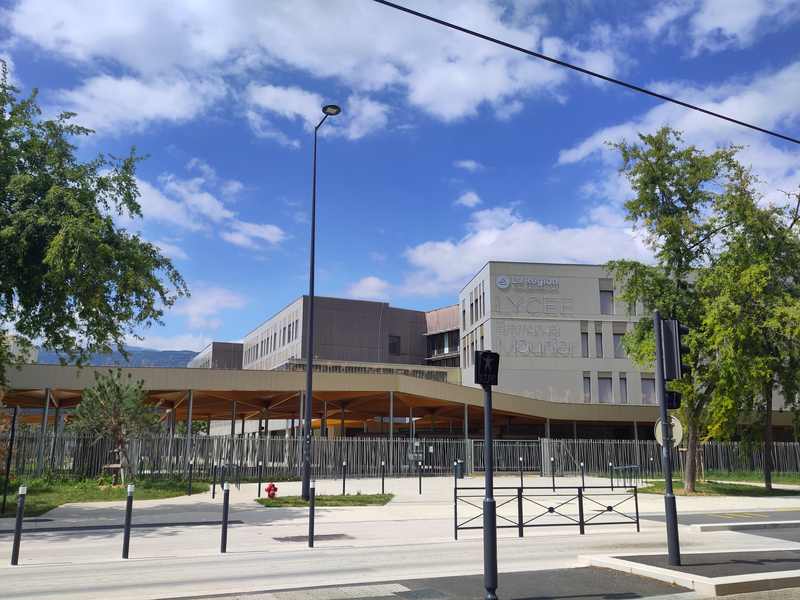
The France schools crisis explained starts with a simple claim from the street: schools that are too cold in winter, too hot in summer, too crowded all year, and too often without teachers. The government's answer is equally simple: 3,000 substitute teachers. Between those two sentences sits the largest student movement France has seen in decades. This explainer lays out what is actually broken, what the numbers really say, and why the two sides read the same facts so differently.
The classroom reality: what the grievances actually describe
Buildings carrying a long repair list
Students and staff describe leaking roofs, broken windows, failing heating, unusable toilets and too little furniture. France's regions, rather than the national education ministry, manage lycée buildings, which complicates both accountability and the pace of renovation. Roughly 10% of the high-school estate has been judged too old, a broad measure that helps explain why the same complaints recur from one region to another.
Temperature has become a political issue as well as a comfort issue. Bac examinations in June 2026 were held in many rooms without air conditioning. On September 7, classes at two lycées in Hérault were interrupted because of excessive heat. The contradiction is hard to miss: some schools struggle to heat rooms in winter, while others cannot cool them when late-summer temperatures become unsafe.
Overcrowding and pressure beyond the classroom
A Marseille teacher cited a class of 37 pupils, a figure that turns every shortage of desks, staff time or specialist support into a daily obstacle. Students also point to overloaded timetables and the stress of Parcoursup, the centralized higher-education admissions system that can make the final lycée years feel like a continuous ranking exercise.
These are pre-existing, documented conditions, not sudden failures created in September. That history explains the competing narratives. The movement frames the crisis as the result of years of underinvestment. The government frames the same problems as a difficult inheritance it is now addressing within real budget limits.
The missing teachers: two surveys, two stories
What the union survey found
On September 9, the SNES union published a survey covering 1,033 establishments. It found at least one teacher missing in 53% of public collèges and lycées. The reported rates were higher in several academies: 70% in Versailles, 66.7% in Toulouse, 61.7% in Nantes and 61.1% in Créteil. When all pedagogical-team roles were counted, 69% of establishments were missing at least one member.
What the ministry counts instead
The Education Ministry answered with national vacancy figures: 98.5% of primary posts and 96.1% of secondary posts were filled. It said 25,043 posts had been offered for 2026, up 40.2% from 2025. Yet another official measure showed that 10% of teaching hours in lycées were not assured during the 2024–25 school year. France spent €8,550 per lycée student in 2023, but a national average does not show when a physics teacher is absent in Créteil or a nurse is missing in Marseille.
Both statistics can be true. A system can be close to fully staffed nationally and still produce acute local shortages, especially when absences are not replaced quickly. That replacement gap is precisely what Education Minister Édouard Geffray's promised 3,000 substitutes target, with deployment focused on the 114 worst-affected schools among roughly 3,700 lycées. The dispute is therefore less about whether most posts exist than about whether a student gets an actual teacher in the room on a given morning. The government's plan and the students' refusal to ease pressure were outlined in reporting on the substitute pledge.
The money trap: debt versus demands
An expensive list meets an anxious bond market
Students want more resources and recruitment, renovated buildings, timetable changes, air conditioning, greater social justice and the abolition of Parcoursup. None of those demands is cost-free. At the same time, the government is trying to pass a deficit-narrowing 2027 budget. France's 10-year bond yield briefly topped 5% on October 5, its highest level since 2002, with Reuters reporting that the protests were compounding investor concern.
Parcoursup supplies one of the movement's sharpest numbers. In July 2026, 163,372 candidates — 18% — received none of their wishes. That compared with 103,000, or 11.9%, in 2025 and 85,000, or 10%, in 2024. Separately, PISA results published September 8 showed French student performance declining alongside results in 90 other countries and regions. The international comparison matters: it warns against attributing every decline to one French policy, while still leaving the government responsible for France's response.
Why neither side can simply concede
The fiscal trap is the structural reason concessions remain small. A government promising quick action faces bond markets already questioning the public finances, while students demand expensive repairs to problems they say were deferred for years. Each position is rational within its own constraint: ministers must fund what they promise; students see another delay as proof that ordinary channels have failed.
The policing question
Injuries, arrests and disputed responsibility
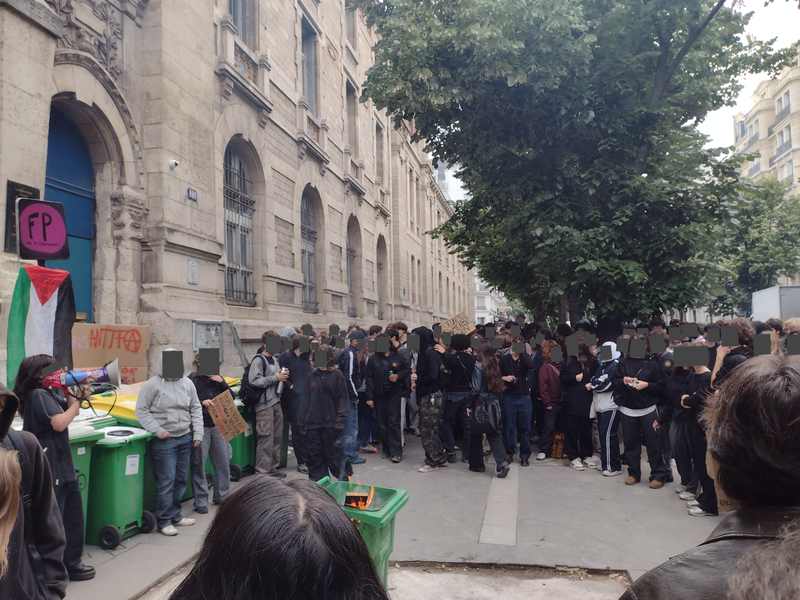
By October 6, the Interior Ministry counted 6,547 arrests across the unrest, well above the 5,000 mark. Hundreds of people were injured. Geffray said 78 education staff had been hurt, while 83 police officers and gendarmes were reported injured on September 30. Students were also among the injured, including a 15-year-old in Lens who lost a hand. Stun grenades were suspended on October 7 pending investigation, and the IGPN police inspectorate opened inquiries.
Teachers' representatives and English teacher Charlotte Beaubeau described the response as heavy-handed. Justice Minister Gérald Darmanin said authorities faced an “active and violent minority” and that events were “no longer simply a protest issue.” Intelligence services claimed the movement had been initiated by politicians from the hard-left France Unbowed party, or LFI. LFI coordinator Manuel Bompard called that claim conspiracism and said the movement was spontaneous.
Paris police chief Laurent Nuñez Faure issued an open letter urging students to abandon blockades, while President Emmanuel Macron held meetings at the Élysée. Le Parisien reported that a minister close to Macron considered the police response “too harsh, without empathy.” The verified picture contains injuries on both sides and sharply disputed claims about who initiated violence. It supports neither the claim that all police action was gratuitous nor the claim that peaceful students as a whole were responsible for attacks.
Why the street, why now
A local victory became a national lesson
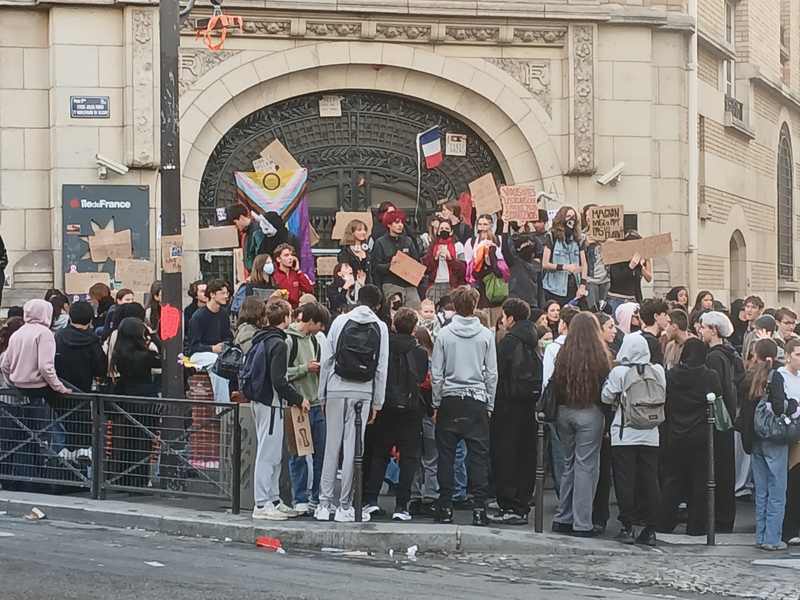
The immediate origin was a September 17 teacher strike at lycée Saint-Exupéry in Créteil, Val-de-Marne, over unfilled posts. Students joined and mounted the first blockade. LFI deputies visited on September 21. A Booska-P interview then reached 1.5 million views on TikTok, turning a school dispute into a national youth story.
More important than the attention was the result: students won a deputy head and a nurse from the rectorat. That visible early victory taught participants that disruption could produce something a petition had not. The movement spread beyond Île-de-France from September 28, and roughly 30 university campuses joined on October 1. The full student-protest timeline shows how rapidly a staffing dispute widened into a national test.
A generation shaped by earlier defeats
Many of the students watched the government prevail over the 2023 pension protests despite enormous marches. That experience fostered distrust of petitions and faith in the street as the only lever that creates immediate political cost. The movement crossed borders too: actions appeared in Wallonia and Brussels from October 1 and in Rome from October 7. A fuller account of why French movements repeatedly adopt occupations and mass marches appears in our history of French protest from the Bastille to 2026.
The October 8 Bastille rally turned that historical symbolism into a current political argument. The parallel report on nearly 900 school closures and the Lens injury details the scale and human cost at the movement's peak. Dates and cross-checks were also reviewed against the French-language overview of the 2026 movement.
Will 3,000 substitutes end it?
The government's internal-democracy pause
Prime Minister Sébastien Lecornu announced a “temps de démocratie interne”: classes would be suspended at the end of the week in all lycées, with a half-day cleared for discussion and an online consultation running until October 23. School-head unions were unimpressed. SNPDEN-Unsa called the rollout cacophony; ID-FO described it as “hors sol” — detached from conditions on the ground.
Three tests for the next phase
In the first scenario, substitutes arrive quickly, teacher absences fall and fewer schools close. That would strengthen the government's argument that targeted staffing can reduce disruption without a vast new spending package. In the second, deployment lags and the October 13 action sustains turnout. The movement would retain leverage because the government's most concrete promise would not yet be visible in classrooms.
The third scenario is more complicated: the union day of action on October 17 broadens the coalition and expands its demands. Greater numbers could increase pressure on the government, but the original school grievances could be diluted inside a wider anti-government campaign — a risk for organizers seeking specific education concessions and for ministers trying to negotiate with a defined counterpart.
The neutral answer is that 3,000 substitutes address the absence-replacement complaint, especially in the 114 schools selected for priority treatment. The number does not repair buildings, rewrite timetables or settle the anger around Parcoursup. Whether it ends the movement depends not just on how many substitutes are announced, but on how many students see one walk into class.
Reporting basis: Reuters, Al Jazeera, The Guardian and Le Monde reports reviewed October 8, 2026; French education ministry figures and union surveys; the French Wikipedia overview of the movement for dates and cross-checks. Government figures are attributed; organizers' claims are identified as such.