why France protests history
France's streets have ended monarchies, accelerated labor settlements and forced policy retreats. They have also produced violence, disruption and electoral backlashes. The pattern explains why both demonstrators and governments treat public protest as a test of democratic authority.
why France protests history is not answered by a national stereotype about temperament. It is answered by institutions and memory. From 1789 through the October 8, 2026 Bastille student rally, French citizens have repeatedly seen organized pressure outside parliament alter the terms of political negotiation. Governments, meanwhile, have learned that yielding too early can weaken an elected mandate, while waiting too long can turn a policy dispute into a crisis of legitimacy.
That history supports an analytical description often heard in France: the street can function like an unofficial branch of government. It is not a constitutional power, and the phrase is not an endorsement of disruption or force. It describes a recurring political mechanism in which elections authorize governments, parliament passes laws, courts review them — and mass mobilization tests whether a decision remains governable. The demonstrator claims democratic voice between elections; the state claims democratic authority from elections. French politics repeatedly stages the collision.
The founding myth: Bastille 1789 and the street becomes sovereign
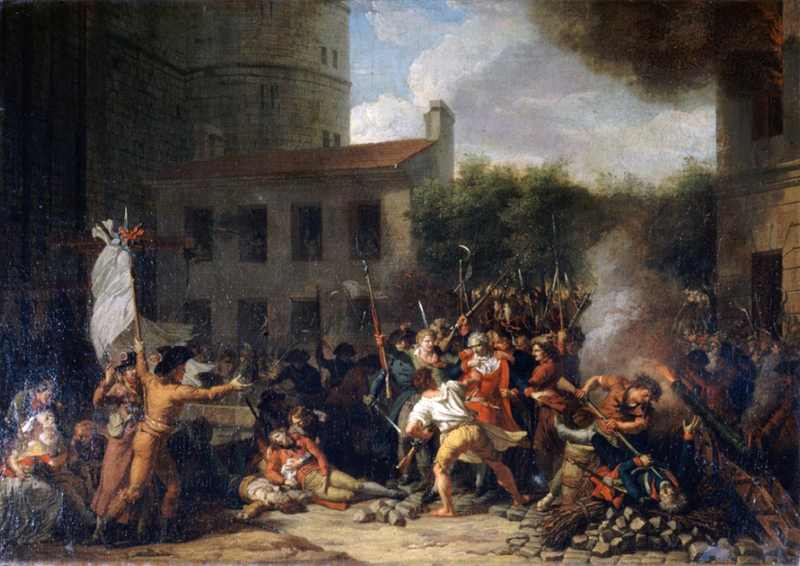
On July 14, 1789, Parisians stormed the Bastille, a royal fortress-prison with few inmates but immense symbolic weight. The crowd sought weapons and gunpowder amid fear that royal troops would suppress the National Assembly and the capital. The fall of the fortress did not by itself create the Republic, but it announced that organized citizens could break the crown's monopoly on coercion and force the political center to react.
For revolutionaries, the Bastille represented arbitrary royal power and the defense of a new national sovereignty. For the monarchy and officials responsible for order, the attack was an armed assault that killed defenders and exposed the state’s inability to protect institutions. Both realities belong in the record. The event widened political participation and unleashed violence; it undermined absolutism and demonstrated the danger of authority losing consent and control at the same time.
France later made July 14 its national day, binding the founding memory of the modern state to a popular uprising. That choice matters. In many countries, the national story begins with a constitution, a declaration or a military victory. France celebrates a day when the governed physically confronted a state stronghold. The French protest tradition therefore draws on a civic myth in which the street is not merely petitioning power; at decisive moments, it can claim to embody the nation.
The 19th-century habit: three regimes broken or remade
The July Revolution of 1830, known as the Trois Glorieuses, turned three days of barricades into the overthrow of King Charles X. The immediate conflict concerned press restrictions and royal ordinances that dissolved the newly elected Chamber. Opponents argued that the crown had violated the constitutional compact. Royalists argued that the king was acting within emergency authority to preserve stability. The uprising resolved the contest in the street, replacing Charles with Louis-Philippe under a more limited monarchy.
That settlement lasted until February 1848. Economic distress, political exclusion and a ban on reform banquets pushed opponents into demonstrations; clashes and defections then made continued rule impossible. Louis-Philippe abdicated, and the Second Republic followed. Yet 1848 also shows why governments fear revolutionary momentum: competing republican, socialist and conservative visions soon collided, and the June Days uprising was crushed with heavy loss of life. Popular sovereignty did not erase disputes over order, property or representation.
The Paris Commune, from March 18 to May 28, 1871, took the pattern to its most tragic extreme. After defeat in the Franco-Prussian War, radical and working-class Parisians rejected the national government's attempt to remove National Guard cannon and established a municipal revolutionary government. Communards saw local democracy, social reform and defense of the Republic. The government in Versailles saw an armed insurrection threatening national unity after military defeat. The Commune ended in the Semaine sanglante, the Bloody Week, when government troops retook Paris and killed thousands.
These episodes taught opposing lessons that still shape policy. Protest movements remember moments when formal institutions were closed and collective action reopened them. The state remembers that a vacuum of authority can escalate from demonstration to armed confrontation. Modern officials therefore defend the right to march while drawing a hard line around weapons, arson and attacks on public infrastructure; protesters often suspect that appeals to order can become a way to avoid addressing the underlying grievance.
The strike as negotiation: 1936, May 1968, 1995 and 2006
By the 20th century, the decisive arena was often the workplace rather than the barricade. After the Popular Front's 1936 election victory, a wave of factory occupations gave labor leverage but also confronted the new government with production stoppages and capital flight. The Matignon Accords, signed June 7, 1936, recognized collective bargaining, raised wages and helped deliver a 40-hour week and two weeks of paid vacation. Workers won durable gains; employers and officials accepted compromise partly to restore economic activity and keep the conflict within a negotiated framework.
That combination — disruption severe enough to force talks, followed by a settlement that lets institutions resume — became central to France strike culture. Unions argue that concentrated economic power rarely yields without collective pressure. Governments and businesses counter that prolonged transport and public-service shutdowns impose costs on people who did not choose the dispute, weaken competitiveness and can transfer bargaining power from voters to organized minorities. French governments negotiate under both pressures.
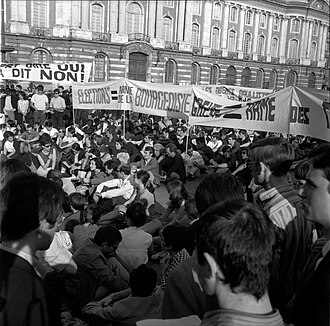
May 1968 explained: revolt, strike and electoral response
May 1968 began with student revolt over university rules, policing and a wider rejection of hierarchy. It expanded into a strike by roughly 10 million workers, the largest general strike in French history. To supporters, it was a democratic rebellion against rigid institutions and unequal authority. To the government, it became a threat to public order, economic continuity and the constitutional state.
The Grenelle negotiations of May 25–26 produced terms concluded on May 27: a 35% increase in the minimum wage, about 10% average wage increases and stronger union rights. Many workers initially rejected the package, showing that leaders could not simply switch the movement off. President Charles de Gaulle then disappeared briefly to consult General Jacques Massu in Baden-Baden on May 29, returned on May 30, dissolved the National Assembly and called elections. The June 1968 vote delivered a large parliamentary majority to the Gaullists.
The result resists a one-sided reading. Street pressure extracted substantial social concessions and transformed culture, education and workplace relations. The ballot then reasserted support for order and the government's constitutional mandate. May 1968 explained in full is neither a simple revolutionary victory nor a simple state victory. It is the classic French sequence: mobilization changes policy; institutions determine who governs.
In November and December 1995, strikes against Prime Minister Alain Juppé's plan to reform pensions and social security shut much of the transport network. The government argued that rising costs and deficits required structural change. Unions and public-sector workers argued that the plan broke social commitments and shifted adjustment onto employees. Juppé withdrew the pension provisions affecting public-sector workers, reinforcing the belief that sustained disruption could stop reform.
The 2006 protests against the First Employment Contract, or CPE, added another generation to the pattern. The government said easier dismissal rules during a two-year trial period would encourage employers to hire people under 26 in a high-unemployment economy. Students and unions said the measure institutionalized precarity and gave young workers fewer rights. Parliament passed the law, but after weeks of university occupations and large marches, President Jacques Chirac promulgated it while ordering that it not be applied; the measure was then replaced. Supporters of the retreat saw democratic responsiveness. Critics saw elected policy overturned by pressure outside the ballot box.
The Yellow Vests rupture: outside parties and unions
The Yellow Vests movement of 2018–2019 began with anger over a planned fuel-tax increase, especially among commuters and rural or peri-urban households who felt climate policy ignored the cost of daily travel. Its fluorescent vest symbol came from an object every driver had to carry. The movement's leaderless Saturday demonstrations bypassed traditional parties and unions, mixing demands for purchasing power, lower taxes, citizen referendums and President Emmanuel Macron's resignation.
The government's case was that carbon pricing served a legitimate climate goal and that a modern state still had to finance services while reducing emissions. Officials also faced riots, vandalism and injuries in Paris, giving police a public-order duty beyond the policy argument. Critics of the police response pointed to serious injuries from crowd-control weapons and said the state too readily treated social anger as a security problem. The movement itself struggled to separate peaceful participants from violent actors it did not centrally command.
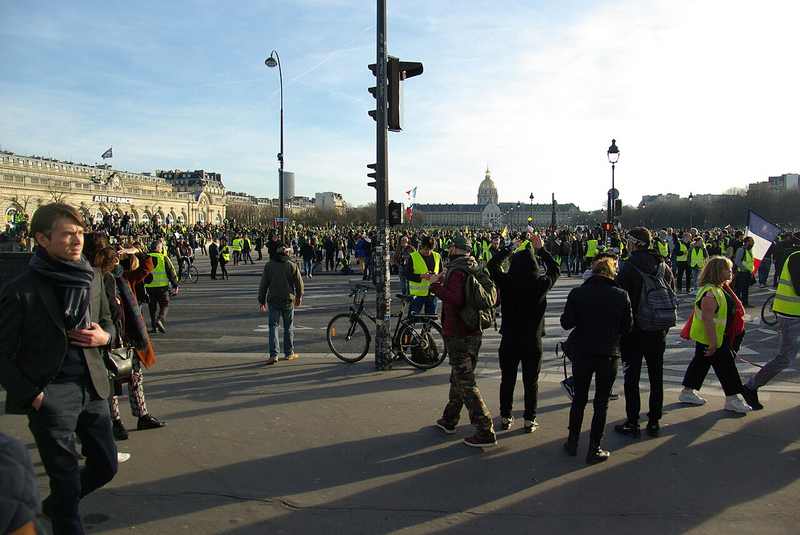
On December 10, 2018, Macron announced concessions: the fuel-tax rise was cancelled, a €100-a-month boost for minimum-wage earners was promised through existing benefits, overtime became tax-free and a planned pension-tax increase for many retirees was rescinded. The package was widely costed at about €10 billion. In Yellow Vests history, that moment is evidence that decentralized protest can force rapid relief. From the government's perspective, it was also an expensive response made under intense pressure, raising questions about budget discipline and whether the loudest mobilization receives priority over less visible citizens.
2023's unfinished business: pensions and Article 49.3
The 2023 pension conflict exposed the limits of street power. Macron's government raised the statutory retirement age from 62 to 64, arguing that longer lives and an aging population made the system financially unsustainable without more years of contributions. Opponents disputed the urgency and fairness of the projections, saying the burden would fall most heavily on people who began work young, held physically demanding jobs or had interrupted careers.
France held 14 national mobilization days, with millions participating across the cycle. On March 16, 2023, the government invoked Article 49.3 of the Constitution to pass the bill without a final vote in the National Assembly, subjecting itself to no-confidence motions instead. Supporters said the mechanism was constitutional and the executive had a democratic mandate to reform. Opponents said using it on a measure rejected by majorities in opinion polls deepened a crisis of representation. The law was signed April 14 after Constitutional Council review.
The reform survived, but the political trauma did too. Protesters learned that even sustained, union-led mobilization might not reverse a central presidential commitment. The state demonstrated that it could withstand the street when constitutional tools, security capacity and political resolve aligned. Both sides paid a price: unions could not stop the age increase, while institutions absorbed lasting distrust that now colors disputes far beyond pensions.
Why 2026 rhymes without repeating the past
The current student movement began with school blockades on September 17 and developed through successive national action days. As the related report on France shutting nearly 900 schools documented, the dispute combines staffing, class size, funding, safety and the use of police crowd-control tactics. Students and teachers say disruption reflects years of unmet warnings and deteriorating conditions. The government says it must protect access to education, keep roads and schools functioning and allocate scarce public money across competing services.
On October 8, organizers called “Act IV,” bringing 71,500 people into nationwide demonstrations and 24,500 to Place de la Bastille. The location deliberately connected the movement to the country's revolutionary memory. Yet numbers alone do not settle legitimacy. Supporters see expanding participation and a moral claim rooted in public education. Officials and critics ask how representative the crowds are, whether blockades infringe the rights of non-participants, and how quickly promised staffing can be financed and implemented.
The analogy to 1789 or 1968 has limits. France in 2026 is a consolidated electoral democracy with courts, unions, opposition parties, local government and a professional civil service. A school protest is not an attempt to overthrow a monarchy. What rhymes is the political grammar: occupations and marches create urgency; the government combines concessions with enforcement; each side watches turnout, public sympathy and the endurance of the other.
What 237 years suggest about Tuesday, October 13
The next planned national action is Tuesday, October 13. History predicts neither victory for the movement nor collapse of the government. It suggests three variables to watch. First is breadth: French protest has changed policy most reliably when students, unions, workers and a wider public converge. Second is governability: authorities become more likely to compromise when disruption remains sustained but public support does not collapse. Third is an exit ramp: concessions matter only if negotiators can present them to their constituencies as meaningful rather than cosmetic.
The government will weigh fiscal room, staffing capacity, public order and its obligation to carry out an elected program. Protesters will weigh whether the offered measures answer class size, replacement coverage and safety concerns, and whether continued disruption strengthens or weakens their claim. Police conduct and protester discipline will also matter; violence can rapidly shift attention from the dispute to security and narrow space for negotiation.
Compared with many Anglo-Saxon political systems, where protest often signals opinion but rarely interrupts the policy process, France gives collective action a more direct bargaining role. That difference is partly historical and partly institutional: centralized national decisions invite centralized national resistance, while strong unions and a memory of successful mobilization make strikes a familiar political instrument. But the street does not automatically outrank the ballot. France's recurring settlement is more complicated: elections establish authority, protest tests consent, and negotiation decides whether either side can convert power into a durable outcome.
That is the balanced meaning of the street as an unofficial branch of government. It has toppled kings and forced prime ministers to retreat; it has also been defeated, divided or answered by voters who preferred order. On October 13, the question will not be whether history repeats. It will be whether students and the state can use a 237-year repertoire of pressure and response without allowing the argument over policy to become a contest over who alone represents France.