Fito wife daughter arrested Colombia
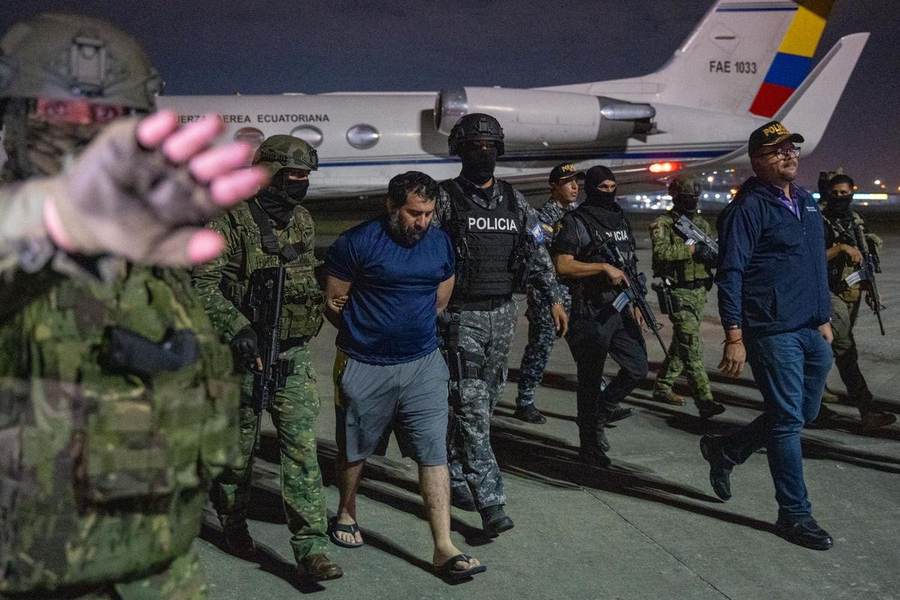
BOGOTÁ — Colombian authorities arrested the wife and daughter of José Adolfo Macías Villamar, the Ecuadorian gang leader known as “Fito,” on Sunday, September 27, in Sabana de Torres, Santander. The cross-border operation, code-named Gran Fénix 059, brought together Colombian police, armed forces and prosecutors with Ecuadorian police and intelligence officers and support from the FBI.
The detainees were identified as Fito's wife, Inda Mariela Peñarrieta Tuárez, and his daughter, Michelle Jamileth Macías Peñarrieta. Ecuadorian authorities describe both women as high-value targets wanted in the “Blanqueo Fito” money-laundering case. Investigators allege they helped operate shell companies used to move and disguise Los Choneros funds. Those are allegations to be tested in court; the arrests do not establish guilt.
Gran Fénix 059 and the Sabana de Torres arrests
The choice of Sabana de Torres, a municipality in northeastern Colombia, underscored the regional reach of the search. This was not a routine local arrest. It required investigators in two countries to align intelligence, locate the suspects and coordinate the legal authority needed to take them into custody. The FBI's support added a third jurisdiction already pursuing Fito through a federal prosecution in New York.
That cooperation matters because transnational criminal groups use borders as friction. A person, company or payment channel can be moved into a neighboring jurisdiction faster than a national investigation can follow. Gran Fénix 059 attempted to reverse that advantage by combining Colombian enforcement power with Ecuadorian case files and U.S. investigative support.
Officials have said the women will be placed at the disposal of Ecuadorian justice. The precise transfer process, timing and detention conditions remain legal questions rather than completed facts. Ecuador's interior minister has identified the maximum-security La Roca prison as a possible destination, but any confinement must follow the applicable judicial process.
Why this is a follow-the-money attack on Los Choneros
Capturing a gang leader removes a visible command figure. Disrupting the financial apparatus tests whether the organization can still pay, procure and protect itself. Money turns trafficking revenue into weapons, transport, safe houses, corrupt access and salaries. The case against Peñarrieta and Macías therefore goes to the infrastructure that can keep a criminal network operating after its boss is behind bars.
According to the official investigation, shell companies were used to launder Los Choneros money. A shell company is not unlawful by itself; it becomes relevant when prosecutors can show that its legal form concealed criminal proceeds, ownership or transactions. The evidentiary burden will be to connect specific entities, transfers and decision-makers to illicit funds, rather than treating family association as proof.
This distinction is both legal and strategic. If investigators document a functioning financial network, they can pursue records, intermediaries and assets that may reveal more of the organization than a single arrest. If the case rests mainly on proximity to Fito, it risks weakening in court and undermining public trust. A durable follow-the-money strategy depends on auditable evidence.
From Fito's prison escape to extradition
Fito escaped from a prison in Guayaquil in January 2024 while serving a 34-year sentence for organized crime, drug trafficking and murder. His disappearance became a symbol of the state's loss of control and was followed by a broader escalation in gang violence. Ecuador recaptured him in 2025 and extradited him to the United States, moving the most prominent prosecution out of the system from which he had escaped.
In New York, Fito faces seven federal charges, including drug and arms trafficking allegations. The potential penalties range from 20 years to life in prison. Those figures describe exposure under the charged offenses, not a sentence already imposed; he is entitled to the presumption of innocence in the U.S. case unless convicted.
The United States also designated Los Choneros as a terrorist organization in 2025. That label expands the legal and financial pressure available to U.S. authorities and raises the cost of dealing with the group, but it does not replace the need to prove individual criminal responsibility. The designation can isolate a network; it can also widen the consequences for people and businesses operating near suspected members, making careful targeting essential.
The scale of Ecuador's security crisis
Ecuador's homicide rate rose roughly fivefold as rival gangs fought over cocaine routes, ports and prisons, reaching about 50 killings per 100,000 people. That transformation — from one of the region's safer countries to one of its most violent — explains the political urgency behind operations such as Gran Fénix 059.
The number also places limits on what any one capture can achieve. A homicide rate of 50 per 100,000 reflects a system: multiple armed groups, contested markets, weak institutions and cycles of retaliation. Removing a leader or suspected financial operator may disrupt one part of that system without reducing violence if competitors absorb territory and recruits.
Signal Post News has examined the wider regional shift toward military pressure on trafficking networks in its analysis of the Shield of the Americas anti-cartel strategy. Colombia's own institutional resilience is also shaped by shocks beyond organized crime, including the costly recovery described in our report on World Bank support after Colombia's earthquake.
Winners, losers and the risks of a kingpin strategy
The immediate winner is cross-border law enforcement. The arrests show that a fugitive network cannot assume a neighboring country is a permanent sanctuary. They may also give prosecutors access to records and devices that could clarify how Los Choneros managed money after Fito's capture.
Ecuador's government gains a visible result. After the embarrassment of Fito's prison escape, the state can point to his recapture, extradition and now the detention of two relatives accused in the financial case. The political value, however, will fade if the prosecutions do not produce transparent evidence and lawful convictions.
Los Choneros may lose financial continuity. Even if the alleged shell-company network had replacements, arrests can force sudden changes in signatories, payment routes and trusted intermediaries. That increases cost and exposure. It may also create internal suspicion about what information investigators obtained.
Communities can lose if disruption becomes fragmentation. Kingpin strategies sometimes weaken a dominant group only to produce smaller, more volatile factions. Rivals may fight over routes and neighborhoods left unsettled by an arrest. The public-interest test is not the number of high-profile detainees but whether extortion, killings and recruitment decline.
Families and defendants face a rights test. Prosecutors are entitled to investigate relatives who allegedly hold operational roles, but kinship is not criminal conduct. The women must have access to counsel, notice of the allegations, a meaningful opportunity to challenge transfer and detention decisions, and protection from coercion or mistreatment. High-security incarceration should be justified by individualized risk, not used automatically because of a relative's notoriety.
Human-rights groups have long warned that emergency security measures can generate arbitrary detention, abusive prison conditions and weak accountability. Those concerns do not erase the harm caused by Los Choneros or the state's duty to protect the public. They set the standard for a response that is effective without reproducing unlawful violence.
What the numbers mean
Seven charges: The U.S. case against Fito is broad enough to keep pressure on him even after extradition, but each count still requires proof. The case is separate from the Ecuadorian proceedings against his relatives.
20 years to life: That is the reported sentencing exposure on the U.S. charges. It creates a powerful incentive for prosecutors to seek cooperation, but no inference should be drawn about plea discussions or testimony unless authorities disclose them.
A 34-year sentence: Fito's earlier Ecuadorian term makes the 2024 escape especially consequential. The episode was not a suspect slipping away before trial; it was a convicted gang leader leaving a prison that was supposed to contain him.
A fivefold rise to about 50 homicides per 100,000: This is the larger measure of state performance. Arrests can be counted immediately. A sustained fall in killings, extortion and forced recruitment would be harder — and more meaningful — evidence that the strategy works.
What happens next
Transfer to Ecuador: Colombian authorities must complete the legal steps required to hand the women over. Any challenge to the transfer, the basis of the notices or detention arrangements could affect timing.
The Blanqueo Fito case: Ecuadorian prosecutors will need to present the company records, transaction trails and witness evidence behind the allegation that the women managed a laundering network. The strongest case would show conduct, control and intent independently for each defendant.
Possible detention at La Roca: Officials have publicly pointed to the maximum-security prison, but placement should remain subject to judicial review, security assessment and human-rights safeguards. Detention conditions will be watched because the legitimacy of the prosecution depends on more than obtaining custody.
Three succession scenarios: Los Choneros could centralize around a replacement able to preserve existing financial channels; fragment into competing factions; or outsource more transactions to outside facilitators. Centralization may make the next target easier to identify. Fragmentation could increase local violence. Outsourcing could make the money trail more international and harder to map.
The decisive evidence will come after the headlines: whether shell companies are frozen, whether additional financial facilitators are charged, whether the Blanqueo Fito trial survives judicial scrutiny, and whether Ecuador's homicide rate falls without a new cycle of factional conflict. Gran Fénix 059 is a significant arrest operation. Its strategic value will be measured in courtrooms, bank records and safer streets.
Sources and reporting notes
- AFP via Berliner Tageblatt: Colombian police capture wife and daughter of Ecuador drug lord
- Demócrata: Gran Fénix 059, the Blanqueo Fito case and transfer statements
- Organized Crime and Corruption Reporting Project: joint operation and U.S. case background
- InterNewscast: AFP report and Colombian Presidency images
Reporting basis: The identities, arrest operation and official allegations are drawn from the cited reporting and statements. Signal Post News describes unproven accusations as allegations and distinguishes Fito's prior Ecuadorian conviction from the pending U.S. charges and the separate Blanqueo Fito proceeding.