World Bank Colombia earthquake recovery
WASHINGTON — World Bank Colombia earthquake recovery funding doubled on Thursday when the lender approved another $200 million for reconstruction and disaster-risk management after the August 10 disaster. Added to $200 million already disbursed, the decision takes the Bank's support to $400 million, Reuters reported.
The approval is significant, but its scale needs discipline. The United Nations Development Programme estimated damage from the magnitude-7.4 earthquake at about $14 billion. Colombia's authorities say 331 people were killed and more than 4,500 injured. Against that bill, the World Bank's total commitment covers less than 3 percent. It can accelerate projects and reassure other lenders; it cannot finance the recovery by itself.
Colombia's finance minister described the decision as evidence of the Bank's confidence in the country and its government. That political signal matters because it arrives as Colombia is trying to reconcile reconstruction with an austerity drive and a sovereign rating that S&P Global Ratings cut this year to BB-, the country's lowest level on record.
Why this matters
The headline amount is only half the story. A World Bank approval tells other creditors that a multilateral institution has judged Colombia's recovery program financeable despite the strain on public accounts. That does not erase the downgrade or guarantee that projects will be delivered. It does give the government a counterpoint to the bleakest market narrative: the country retains access to long-horizon development finance at the moment it needs to rebuild homes, schools, roads and public services.
There is no contradiction in a ratings agency downgrading Colombia while the World Bank keeps lending. Ratings agencies estimate the probability and consequences of repayment stress for investors. Multilateral development banks have a different mandate: they lend through crises, attach technical work to financing and accept long implementation horizons when reconstruction can strengthen future resilience. Their willingness to lend can therefore persist even when market-based measures of credit risk worsen.
That distinction should not be turned into complacency. The Bank's money is not a vote that Colombia's fiscal problems have disappeared. It is a judgment that supporting recovery is preferable to allowing disaster damage to deepen them. If reconstruction is slow, poorly targeted or financed almost entirely with debt, today's confidence signal can become tomorrow's repayment pressure.
How we got here
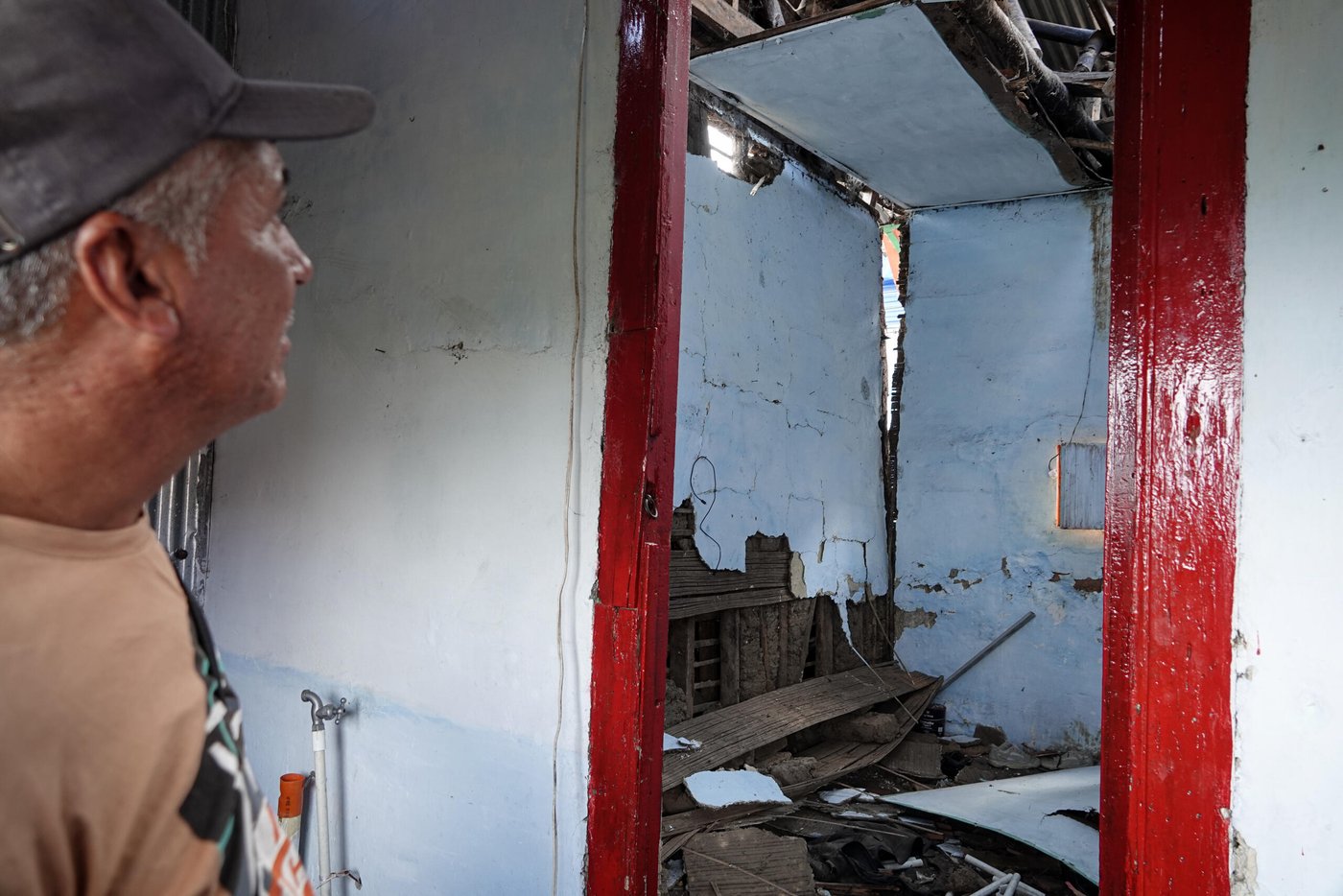
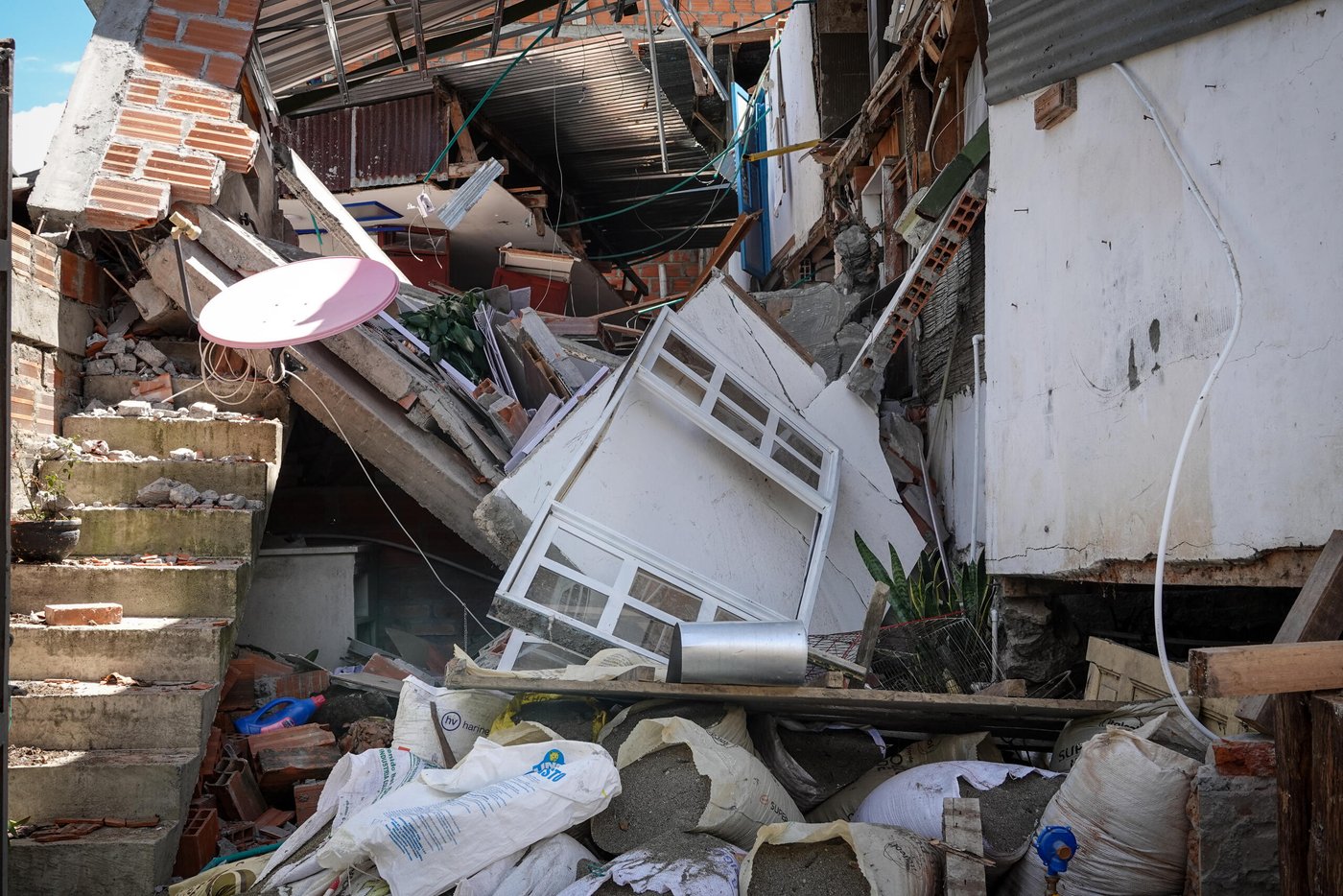
The August 10 earthquake tore across western Colombia with a magnitude of 7.4. Early assessments documented at least 172 collapsed buildings and more than 10,000 homes made uninhabitable. The human toll later rose to 331 dead and more than 4,500 injured. The government declared an economic emergency, opening a three-month period in which it could issue economic decrees without the ordinary legislative timetable.
The social damage extends far beyond the death count. More than 3,000 schools were damaged, disrupting education for roughly 500,000 children. The Norwegian Refugee Council said full recovery could take three to four years. Colombia also hosts one of the world's largest Venezuelan migrant populations, including many people in quake-hit areas who were already navigating fragile housing, informal work and limited access to public support.
Colombia has a warning from its own history. The 1999 Armenia earthquake cost roughly 2.2 percent of gross domestic product and was financed largely through the public budget. The new disaster arrives with weaker fiscal room. The comparison does not provide a precise forecast—the affected geography, economy and damage estimates differ—but it shows how quickly an earthquake can migrate from a humanitarian emergency into a multi-year budget problem.
The sharper warning is more recent. Colombia once had a $400 million World Bank catastrophe bond that transferred part of its earthquake risk to capital markets. The coverage lapsed in February 2021 and was not renewed. The expired bond's face value is the same as the Bank's entire current commitment. Had equivalent coverage remained in force and its trigger conditions been met, part of today's financing might have come through risk transfer rather than new borrowing.
The money, in context
The arithmetic is stark. Four hundred million dollars divided by a $14 billion damage estimate equals about 2.9 percent. Put another way, roughly $34 of estimated damage remains for every $1 in current World Bank support. Even if the Inter-American Development Bank's $300 million contingent facility is fully drawn, the combined $700 million would represent only 5 percent of the UNDP estimate.
Those ratios do not make the facilities unimportant. Reconstruction does not require every dollar on the first day, and a relatively small early tranche can unlock engineering work, temporary shelter, school repairs and the procurement needed for larger projects. It can also preserve liquidity while national budgets are redirected. But the numbers do reject any suggestion that multilateral lending has solved the financing problem.
The form of the money matters as much as the amount. The World Bank's cited $450 million facility is lending, not a grant, and the initial $200 million disbursement must be repaid with interest. The new approval expands available credit for reconstruction and Colombia disaster risk management funding; it does not transfer the loss away from the state. Much of the burden ultimately remains with taxpayers and future budgets.

The government's working assumption that public resources will cover roughly two-thirds of reconstruction costs makes the central conflict unavoidable. Every peso spent rebuilding is defensible, yet it lands inside a fiscal program designed to restrain spending and debt. The economic emergency gives the executive speed; it does not create free money. The quality of the decrees, procurement rules and published project accounts will determine whether speed becomes capacity or merely weaker scrutiny.
This is where the broader market backdrop matters. Reconstruction costs are exposed to interest rates, fuel, imported equipment and investor confidence. Our explainer on the latest Federal Reserve rate increase shows why global borrowing conditions can reach households and governments far beyond the United States, while the market reaction to tighter policy illustrates how quickly risk appetite can shift.
Who gains, who pays
Quake-hit communities gain the possibility of faster work. Funding earmarked for reconstruction and disaster-risk management can move planning and procurement from emergency improvisation toward a program. For families outside safe housing and children outside functioning classrooms, the relevant measure will be time: when a roof, school, clinic or road actually reopens.
The government gains fiscal breathing room and a confidence narrative. The approval helps Bogotá argue that credible multilateral partners remain engaged despite the BB- rating. It also spreads expenditure over time rather than forcing the entire first phase through an already strained budget.
Taxpayers still carry the liability. Calling credit “aid” can blur the distinction between support and transfer. Loans can be essential and fairly priced while still increasing obligations. If growth weakens, revenues disappoint or reconstruction overruns multiply, debt service will compete with other public needs long after the rubble is cleared.
Displaced families and migrants carry the risk of an unequal recovery. Large infrastructure can absorb money faster than scattered rural housing, informal neighborhoods or services for people without secure documentation. The Bank and government will need to show not only how much is disbursed, but where it lands and who can use it.
Critics are right to say that $400 million is a fraction of the need and that borrowing is not a substitute for insurance. But refusing credit would not restore the lapsed catastrophe bond or close the funding gap. The practical argument is about the mix: immediate lending, transparent domestic spending, insurance and capital-market risk transfer for the next disaster, and grants targeted to people least able to absorb more debt.
What happens next
The first test is disbursement speed. An approval is not a repaired school or a habitable home. Colombia and the World Bank will need to publish milestones showing when the additional $200 million becomes available, which agencies control it and what procurement and audit safeguards follow the money.
The second test is whether Colombia draws the Inter-American Development Bank's $300 million contingent facility and on what terms. A draw would increase immediate capacity, but it would also deepen the debt-financed share of recovery. Investors will watch how that choice fits the government's wider deficit and debt plans.
The third test is prevention. The coincidence between the expired $400 million catastrophe bond and the Bank's present $400 million commitment should force a policy review. Renewed catastrophe-bond coverage would not rebuild the country now, but it could keep the next shock from landing so directly on the budget. The decision should be judged on trigger design, cost and coverage—not on the symbolic appeal of a large face value.
Finally, watch the collision between austerity and reconstruction. Fiscal updates, central-bank signals and the emergency decrees will show whether the government can protect essential rebuilding without losing control of the medium-term accounts. The NRC's three-to-four-year horizon is a reminder that this is not one budget cycle. Thursday's approval buys room to begin. Colombia's harder task is proving that the money reaches the people living through the aftermath—and that the financial architecture is stronger before the next quake.
Sources
- Reuters: “World Bank approves further $200 million to help Colombia recover from earthquake,” Andrea Shalal, September 24, 2026
- Atlantic Council: “How the US can support Colombia's post-earthquake recovery—for the long term”
- Bloomberg via BusinessMirror: “$10B earthquake bill imperils Colombia austerity drive,” Oscar Medina and Mie Dahl
- Norwegian Refugee Council: “Inside the aftermath of Colombia's earthquake”
Reporting basis: Fixed September 24, 2026 snapshot. The new approval, total World Bank support, damage estimate and casualty figures are attributed to Reuters; financing structure and risk-transfer context are attributed to the Atlantic Council; fiscal and early-damage context is attributed to Bloomberg; humanitarian impacts and recovery timing are attributed to the Norwegian Refugee Council. Signal Post News analysis is identified as interpretation.