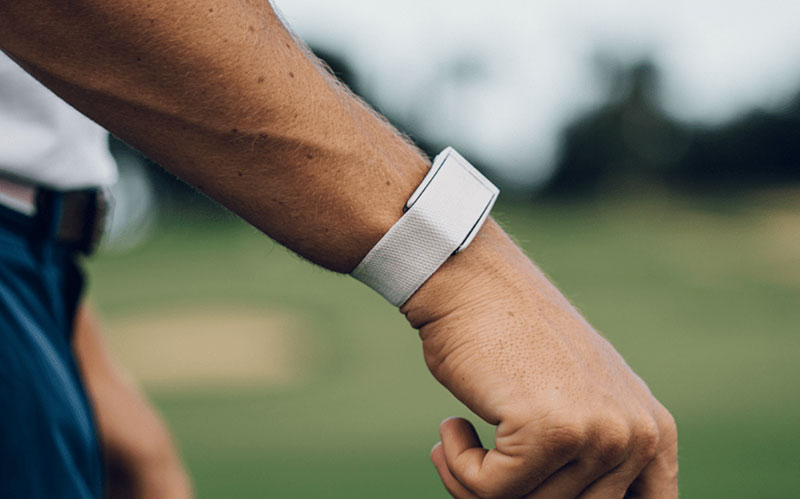

Apple is developing prototypes of a wrist-worn health device with no screen, no stream of notifications and no ambition to become another tiny iPhone. The reported design is a thin fabric strap joined to a sensor-equipped computing module that rests against the wrist. It would collect health information continuously, leaving interpretation to an iPhone, a Health app or a service rather than demanding attention from the wearer.
That description comes from a September 22 report by Bloomberg’s Mark Gurman, whose findings were independently summarized by TechCrunch, 9to5Mac, MacDailyNews, iPhone in Canada, Inc. and gagadget. Across that coverage, the important qualifier is consistent: Apple is in an early internal phase called a “technology investigation.” There is no final product approval. If the idea survives, the earliest reported launch is 2028.
That uncertainty should not be treated as legal fine print beneath an inevitable launch. Apple prototypes many things. A prototype can be a product candidate, a way to test sensors, an instrument for learning what users tolerate, or leverage in an internal argument about where the company should invest. The honest headline is not that Apple has announced a Whoop rival. It is that Apple’s leadership now considers the screenless-health category important enough to build hardware around the question.
Why this matters: Apple is questioning the everything-device
The Apple Watch was built on addition. Over successive generations it added communications, apps, payments, music, safety tools, workout modes and increasingly sophisticated health features. Its display is essential to that proposition: the Watch can show a message, map, alarm, heart rhythm or boarding pass immediately. Apple trained the market to see the wrist as another useful screen.
A screenless band begins with subtraction. It says the best health device may be the one that disappears into a routine, gathers cleaner longitudinal data and interrupts only when the insight deserves attention. That is not a cheaper Watch in the usual sense. It is a different philosophy: less interface on the body, more computation and interpretation elsewhere.
The shift matters because continuous health measurement competes with the practical limits of a smartwatch. People remove watches to charge them. Some do not want a bright display in bed. Others already own a mechanical watch, dislike notifications, or find a feature-rich smartwatch too cognitively present. A lighter band that can stay on through sleep, exercise and ordinary work could close gaps in the data record. In health analytics, completeness often matters as much as any single sensor.
A screenless wearable tracker is really a health-data strategy
The obvious product comparison is Whoop, but Apple’s deeper advantage would be the data flywheel. A band could feed the same health repository as Apple Watch, iPhone motion data, medications, sleep schedules and data voluntarily shared through Apple’s Research app. Better continuity produces better personal baselines; better baselines make readiness, recovery and anomaly detection more useful; more useful guidance makes the hardware harder to abandon.
That is the health-data moat. It is not merely that Apple might measure heart rate. Rivals already do. The strategic value lies in integrating years of measurements with an operating system, a phone, clinical-data partnerships, research infrastructure and a large installed base. If the band is easier to wear around the clock, it could increase the density of that dataset while broadening Apple health tracking beyond people who want a smartwatch.
There is also an attention argument. Technology companies have spent years putting more screens into more moments. A screenless band would concede that another display is not always a feature. For people trying to reduce interruptions, a device that collects evidence without turning every fluctuation into a prompt may feel more modern than a wrist computer with a larger app grid.
What Apple is reportedly testing — and what remains unknown
The reported prototypes combine fabric fitness band sensors with a small computing module. They have no display and are designed around continuous measurement. Beyond that, basic commercial questions remain unresolved: which sensors survive the investigation, how often the band must be charged, whether it works alone or requires an iPhone, how it handles workouts without on-device controls, how data is shown, what it costs and whether software insights sit behind a subscription.
Those unknowns are decisive. Screenless hardware looks simple because the interface is invisible, but invisibility transfers complexity to sensing accuracy, battery management and software interpretation. If the app cannot explain why a score changed, the user gets a mysterious number rather than useful guidance. If the band needs frequent charging, its supposed continuity advantage weakens. If Apple prices it too close to an Apple Watch, consumers may reasonably choose the screen and broader feature set.
The Apple fitness band 2028 window is a warning, not a date
The earliest reported 2028 timing leaves at least two product cycles for the concept to change. Apple could switch the enclosure, alter the sensor package, make the band a companion to Apple Watch, fold the work into AirPods or another wearable, or cancel it entirely. A technology investigation is designed to answer whether the hardware, software and business case converge—not to prepare a launch campaign.
The long horizon also overlaps with a major Apple Watch redesign reportedly expected as early as late 2027. That creates a portfolio decision. Apple can give the Watch a clearer high-end identity while positioning a band as the quiet, long-duration health sensor. Or it can discover that two wrist products create confusing overlap and use the band research to improve the Watch instead.
How Apple’s health strategy reached this point
Apple has spent years moving from activity logging toward interpretation. The Research app gave Apple a path to large-scale opt-in studies. Apple’s recent heart study used Whoop 5 as a comparison point, according to iPhone in Canada’s account. That matters because benchmarking against a screenless rival is both scientific and strategic: it helps Apple understand whether its own sensors and models produce comparable signals across real-world behavior.
The Apple Watch Series 12 and Ultra 4 launched with a Readiness app that turns several inputs into a daily score from 0 to 10. Series 12 also measures heart-rate variability every five minutes. Those choices move Apple closer to Whoop and Oura’s central promise: users do not just want a record of yesterday’s workout; they want a judgment about what their body is prepared to do today.
Readiness is where the product category becomes more than hardware. A sensor can gather heart-rate variability, sleep and activity, but the useful output is a model that distinguishes a hard training week from illness, poor sleep or a shifted baseline. Apple must be careful not to turn probabilistic wellness signals into implied diagnosis. Yet the company’s direction is clear: sensors are becoming inputs to coaching and interpretation.
The Eddy Cue Apple health division changes the internal argument
Services chief Eddy Cue took over Apple’s health efforts after longtime operations chief Jeff Williams retired in late 2025. Gurman’s reporting says Cue and executive chairman Tim Cook are interested in the screenless concept. That leadership pairing is revealing. Cook has long presented health as a defining Apple legacy, while Cue runs businesses built around recurring services and deep engagement.
A hardware-only reading would therefore be incomplete. A simple band may be the acquisition point for a broader health relationship. It can lower friction, collect more continuous information and direct users toward analysis in the Health app. Whether Apple ultimately charges for a premium tier is unknown, but the organizational logic makes a Health+ style service scenario impossible to dismiss.
Members of Apple’s Vision hardware team are reportedly involved in early engineering. That does not mean a wristband will inherit Vision Pro hardware. It suggests Apple is borrowing expertise from a group accustomed to sensor fusion, compact wearable systems and algorithms that convert noisy physical inputs into stable interpretations. The important product may not be the strap; it may be the model that decides what the stream of signals means.
The market numbers explain Apple’s interest
Whoop’s $10 billion valuation validates a narrow product
Whoop’s valuation recently moved above $10 billion, according to TechCrunch. The significance is not the valuation alone. It is that investors assigned that value to a business centered on an intentionally limited device and recurring interpretation. Whoop proved that removing a display does not necessarily make a wearable feel lesser if coaching, recovery and community make the data actionable.
For Apple, that is evidence of an addressable market the Watch does not fully capture. A successful Apple Whoop competitor could attract serious athletes, screen-fatigued users and people who prefer traditional watches. It could also keep those users inside Apple Health rather than letting a rival own their most consistent biometric relationship.
The Oura IPO’s $15.6 billion target makes screenless wearables a public-market test
Oura sold 3.6 million rings in the 12 months ending June 30. Revenue for the nine months ending June 30 rose about 74% from a year earlier to $1.21 billion, and its planned offering targets a fully diluted valuation of up to $15.62 billion. Those figures come from Oura’s prospectus as reported by Reuters.
Three implications follow. First, screenless health hardware has escaped the niche-gadget phase. Second, the market rewards recurring relationships, not just unit shipments. Third, Oura’s growth demonstrates that consumers will accept a device with almost no on-body interface when the form factor is comfortable and the software tells a coherent story.
Google’s launch of the screenless Fitbit Air in May and Polar’s Loop launch in September 2025 reinforce the point: this is becoming a category, not a single-company curiosity. Garmin shares falling as much as 2.5% after Gurman’s report, as MacDailyNews reported, shows how quickly investors translated an uncertain Apple prototype into competitive risk. The move was modest, but the reflex matters. Markets assume Apple’s distribution and ecosystem can reset expectations even before a product exists.
Who benefits, who loses and where the criticism will land
Consumers tired of screens are the clearest potential winners. A comfortable, long-lasting device with strong sensors and understandable guidance could serve people who want health insight without another inbox on their wrist. Existing Apple customers could benefit from a single health record across band, Watch and phone. Researchers could gain denser opt-in datasets, provided consent and governance are clear.
Apple benefits if the band expands rather than divides its wearable audience. More continuous data can improve personal baselines, increase Health app engagement and deepen switching costs. A lower-priced band could create an entry point below the Watch. A premium companion could instead serve athletes who keep wearing Apple Watch for communication but want a second device for sleep or demanding training.
Whoop faces the most direct branding challenge because Apple would enter with a familiar design proposition and enormous retail reach. Garmin and Fitbit would face stronger competition for users who value fitness-first tracking. Oura could be less exposed at the form-factor level—the ring remains distinct—but more exposed at the software level if Apple makes readiness and recovery analysis native to the iPhone.
Cannibalization is not a side issue
Apple must decide what a band is allowed to be good at. If it is cheap, comfortable and collects most of the health information consumers want, some buyers may skip the Watch. If it is too limited, it becomes an accessory without a compelling audience. If Apple sells it mainly as a Watch companion, the requirement to wear two devices risks feeling excessive.
The strongest portfolio answer is segmentation by behavior rather than specification. The Watch can remain the visible computer for communication, safety, navigation and apps. The band can become the invisible sensor for sleep, recovery and continuous measurement. That distinction is easy to explain, but hard to price without making one product undermine the other.
Privacy and the subscription-model war
A device worn around the clock creates an intimate record: sleep timing, activity, stress proxies, recovery patterns and potentially signals the user did not consciously choose to create. Apple’s privacy brand is an advantage, but it is not a substitute for precise controls. Users need to know what is measured, where it is processed, which inferences are made, how long data is retained and what can be shared with researchers, insurers, employers or family members.
The subscription question will be equally contentious. Whoop’s business depends heavily on recurring membership. Oura combines hardware with paid software features. Apple could include core analysis to make the band an ecosystem benefit, sell premium coaching through a service, or bundle it with existing subscriptions. Each choice changes the competitive battlefield. A low-cost band with useful free analysis pressures rivals’ margins; a premium Health+ tier confirms that interpretation, not sensors, is the product.
Three scenarios for 2027–2029
Scenario one: it ships as a Watch companion
In the most plausible commercial scenario, Apple unveils a redesigned Watch in late 2027 and introduces the band in 2028 as a distinct companion. The Watch handles visible interactions and safety; the band emphasizes battery life, sleep, training and passive measurement. Apple could let users wear either device alone while merging data when both are present. This protects the Watch’s premium identity and gives Apple an answer to Whoop.
The execution risk is complexity. Apple would need transparent rules for reconciling simultaneous readings and clear reasons to own both. It would also need charging and fit advantages large enough to justify a second object on the body.
Scenario two: the investigation is killed
Apple may conclude that a band is too close to the Watch, too dependent on a subscription or too difficult to differentiate. In that case, the project can still influence products that ship. Battery work may improve Watch endurance. Fabric-band research may create better accessories. Sensor algorithms may migrate into the Watch, AirPods or Health app. Cancellation would not mean the investigation failed; it would mean Apple learned that the product boundary was wrong.
This outcome is more credible than rumor culture usually allows. Apple’s disciplined advantage is not only launching products—it is refusing to launch some of them. The “may never ship” clause is therefore central to the story, not a hedge to be forgotten after the headline.
Scenario three: it becomes the front door to Health+
The most consequential scenario is a band designed around a service rather than a device category. Apple could sell simple hardware at an accessible price, then use continuous data to power premium recovery, coaching and health-navigation features. The band would be the sensor endpoint; the recurring relationship would live in software.
That model fits Cue’s services background and the economics demonstrated by Whoop and Oura. It also raises the hardest questions: whether meaningful health guidance becomes a monthly expense, whether algorithmic scores create anxiety, and whether Apple can explain limitations without weakening the appeal. Health data is valuable precisely because it is personal. Monetizing interpretation must not become monetizing vulnerability.
What to watch before believing in the product
The next reliable signal is not another rendering. It is evidence of product commitment: supply-chain orders, regulatory filings, developer frameworks, clinical validation, executive language or a public integration in Apple Health that clearly anticipates new hardware. Until then, feature lists and pricing are speculation.
Watch battery claims, too. A screenless tracker earns its place by being easier to wear continuously than Apple Watch. If Apple cannot deliver materially longer endurance, unobtrusive charging or comfortable sleep wear, removing the screen solves less than it appears. Accuracy across different skin tones, motion conditions and wrist fits will matter more than a dramatic launch demo.
Finally, watch how Apple describes readiness. A daily score can be a helpful summary, but it can also flatten uncertainty into false precision. The best implementation would show contributing factors, confidence and trend context rather than instructing users to trust a single number. Good health software should help people interpret their bodies, not outsource judgment to an opaque score.
The real product is permission to disappear
Apple does not need to prove it can build a fabric band with sensors. The company needs to prove that subtraction can be a premium experience: fewer interruptions, longer wear, cleaner data and guidance that earns trust. That is a harder design challenge than putting another screen on the wrist because the value must emerge over days and months rather than in a store demonstration.
If the investigation ships, it could mark a philosophical turn from the Watch as an everything-device toward a portfolio in which different wearables do less, but do it continuously. If it dies, the work still confirms that Apple sees screenless health tracking as a serious threat and opportunity. Either way, the strategic message has already escaped the lab: the next battle in wearables may be won by the device people notice least.
Reporting basis: Fixed September 23, 2026 snapshot. Prototype details, leadership involvement and the 2028-or-later window originate with Bloomberg’s Mark Gurman and are cited here through corroborating coverage from TechCrunch, 9to5Mac, MacDailyNews, iPhone in Canada, Inc. and gagadget. Oura figures are from its IPO prospectus as reported by Reuters. Apple has not announced this product, and all strategy scenarios are Signal Post News analysis.