Uttar Pradesh floods death toll
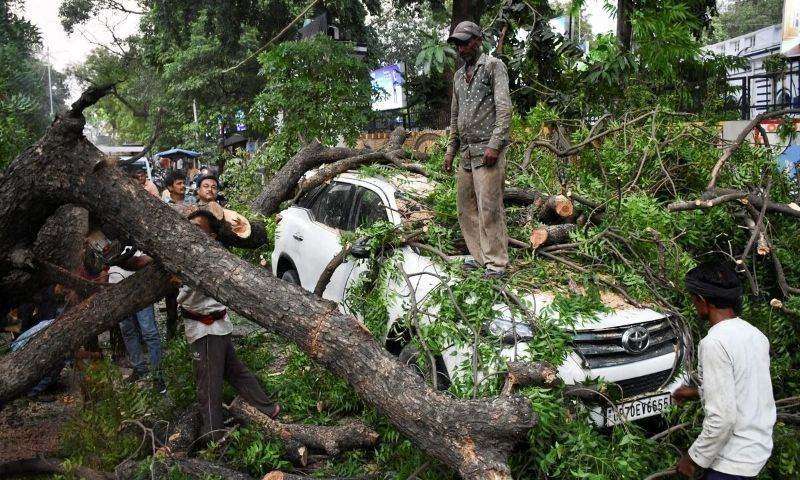
At least 62 people have died after days of heavy rain and flooding in northern India's Uttar Pradesh state, officials said Monday, capping a 72-hour deluge that dumped up to nine times the normal rainfall across one of the most densely populated regions on earth. The state government said 46 people were injured and more than 1,000 houses were damaged after three days of intense rainfall caused flooding in several districts. Some local media reports put the Uttar Pradesh floods death toll as high as 81, with officials cautioning that the figure is still being verified district by district.
The spell of rain began on September 25 and hammered the state through the weekend. Uttar Pradesh Relief Commissioner Hrishikesh Bhaskar Yashod said the state recorded 66.5 millimeters (2.6 inches) of rain between Friday and Sunday morning, compared with a normal 7.6 mm for the period. The India Meteorological Department's data was even more dramatic: 45.1 mm of rainfall in the 24 hours ending Sunday, against a normal of just 1.8 mm — 25 times the average. The Times of India reported a 775 percent surge in rainfall over 48 hours, while Reuters noted the state recorded 19 times its normal rainfall in the 24 hours to Saturday. In Gorakhpur, 150 mm of rain fell in just two hours.
The heaviest toll fell on the Awadh region, which recorded 28 deaths. The worst-affected districts were Sitapur, Lakhimpur Kheri, Bahraich, Balrampur, Ayodhya and Gorakhpur. In Hardoi alone, officials reported eight rain-related deaths and damage to about 330 houses — six of the deaths came from wall or house collapses, and two people died from snake bites during the heavy rain, a grim reminder that flood casualties in India are as often about infrastructure as about water.
Schools were closed Monday across several districts, including the state capital Lucknow, Amroha, Shravasti, Pilibhit and Bijnor, as rescue teams moved residents from flooded areas to safer locations. In Lucknow, a portion of the road near Ekana Stadium caved in, several intersections were waterlogged, and agricultural fields in the Bakshi Ka Talab area were submerged with crops flattened by rain and 30–40 kmph winds. Heavy rain lashed Kanpur, Varanasi, Prayagraj and Bareilly, and a 200-meter stretch of the Kanpur–Etawah highway was damaged. Residents were advised to avoid unnecessary travel through waterlogged areas and stay away from fast-flowing rivers, streams and drains.
Why this matters: the monsoon that won't leave quietly
September is supposed to be the monsoon's exit month in northern India — the withdrawal phase, when the southwest monsoon retreats and rainfall tapers off. What hit Uttar Pradesh this weekend was the opposite: an off-season convergence of two powerful weather systems that turned the season's final act into one of its deadliest episodes. That is the deeper significance of this disaster. It is not a freak cloudburst over one valley; it is a statewide, multi-day extreme rainfall event driven by a rare interaction between a Bay of Bengal depression and a Western Disturbance, arriving exactly when the atmosphere was shifting gears.
The IMD blamed the deluge on the "high possibility of interaction" between a deep depression that traveled inland from the Bay of Bengal — making landfall over the North Andhra Pradesh–South Odisha coast before being absorbed by land and drifting over northeast Madhya Pradesh and southeastern Uttar Pradesh — and a Western Disturbance sitting as an upper-air trough over northwest India. The depression supplied vast moisture from the Bay; the disturbance altered the upper-air flow over northern India; together they increased atmospheric instability and upward motion. The retreating monsoon complicated matters further, because the wind and moisture regime during withdrawal is primed for heavy localized rainfall when a fresh system barges in. Senior IMD scientist Atul Kumar Singh in Lucknow said the system weakened into a well-marked low-pressure area early Sunday, and that rainfall should ease from Monday as the Bay of Bengal system dissipates — with light rain possibly continuing in eastern and western UP through Tuesday.
The scale matters because of who lives there. Uttar Pradesh is India's most populous state, with more than 240 million people — a population larger than all but a handful of countries. When 56 of its 75 districts register excess rainfall and rivers across the northern plains cross danger marks simultaneously, the human exposure is enormous. The Ganga at Ayodhya stood at 92.39 meters against a warning level of 91.73 meters and was forecast to rise further. The Ghagra flowed at 106.14 meters at Elginbridge in Barabanki, above its danger level of 106.07 meters, and was forecast to climb to 106.55 meters. The Rapti stood at 104 meters at Balrampur against a warning level of 103.62 meters. The Mandakini crossed the danger mark in Chitrakoot. India's Central Water Commission said 30 river-monitoring stations across seven states were in a "severe situation," with the Ganga, Gandak, Kosi, Bagmati and Narmada all above danger levels at some stations.
A region drowning together: Odisha, Nepal and the Himalayan avalanche
Uttar Pradesh did not suffer alone. The same weather system flooded the eastern state of Odisha, where more than 75,000 people were evacuated from low-lying areas after rivers rose, bridges and culverts were damaged, and officials shut down the Devkund tourist spot. In neighboring Nepal, 21 people died in weather-related incidents between Thursday and Sunday, according to the country's disaster management agency, with five people still missing, five injured, and 194 houses damaged by floods and landslides. A landslide in Baglung district's Nishi Khola village buried a house while a family slept, killing four people including three children and a woman; in Palpa district, a 75-year-old man was killed and his two teenage daughters went missing when rain debris buried their home.
And high in the Himalayas, the same monsoon fury turned deadly in a different way: ten Nepali workers were missing after an avalanche buried the base camp of the 7,126-meter Himlung Himal in the Manang district, where they had been setting up tents for foreign climbers. Nepali authorities warned of possible flash floods in 49 of the country's 77 districts, with more than half facing high flood or flash-flood risks as major rivers continued to rise.
The regional picture is inseparable from the season's trauma. Nepal is still recovering from devastating August floods that killed more than 1,400 people and left nearly 6,000 missing. Bangkok spent the weekend with 50 districts swamped after the capital was declared a disaster zone. The 2026 monsoon has been exceptionally violent across South and Southeast Asia — and the Uttar Pradesh episode shows that even the season's retreat can be lethal.
What the numbers actually say
The casualty figures deserve scrutiny, because they reveal how disasters get counted. The UP relief commissioner's office first reported 56 deaths for September 25–27 with 46 injured and 1,000+ houses damaged. The Associated Press, citing state officials on Monday, reported 62 dead. Times of India reporting cited by Xinhua pushed the toll to 81. The numbers will likely keep moving as district administrations compile and verify reports — saptashwatv and other outlets noted that later Monday reports indicated the toll was still rising as officials gathered data from additional districts. When reporting a disaster, the honest figure is a range, and the range here is 62 to 81 dead — with the direction of revision pointing upward.
The rainfall statistics are more stable and more damning. Uttar Pradesh received nine times its normal rainfall for the September 25–27 window, and up to 25 times normal in the worst 24-hour stretch. To put that in context: the "normal" monsoon is a finely balanced system that Indian agriculture, drainage and housing are all calibrated around. A 775 percent departure over 48 hours is not a stress test any calibrated system passes. The death profile confirms it: wall and house collapses, electrocutions, snake bites, drownings in drains and pits — these are the signatures of sudden, overwhelming water in a built environment that assumed a gentle September, not of rivers slowly overtopping embankments. In Hardoi, six of eight deaths were collapsing structures. That is an infrastructure story as much as a weather story.
There is also a telling political datum embedded in the coverage. Samajwadi Party chief Akhilesh Yadav shared a video of the newly inaugurated 594-kilometer Ganga Expressway underwater at Unnao — where locals had brought fishing nets to the flooded stretch — and suggested it be renamed the "Ganga Express Waterway." The expressway, built at a cost of ₹36,200 crores, is the flagship infrastructure of the Yogi Adityanath government. Whether or not the jibe is fair, it captures the season's political undercurrent: every new flood exposes the gap between ribbon-cutting and resilience.
Who bears the cost — and who is scrambling to respond
Farmers face the quietest catastrophe. The rains flattened standing paddy, maize, sugarcane and vegetable crops in several districts. September is harvest season in the Gangetic plain; a crop destroyed days before harvest is a full season's income gone, with no time to replant. A morning-stiffness aggregator of Indian media reported that crop-loss review was already underway in Sitapur, Lakhimpur Kheri and Bahraich, the hardest-hit districts. More than 2,000 hectares of farmland were flooded, and more than a hundred cattle died, according to local officials cited by democrata.es. Rural distress from this episode will outlast the floodwaters by months.
Urban administrations are in reactive mode. Lucknow's caved-in road near Ekana Stadium, submerged intersections, flooded homes in Kanpur and Prayagraj, cancelled flights between Bareilly and Delhi, a damaged Kanpur–Etawah highway — the pattern is drainage systems designed for a monsoon that no longer exists. The state's relief department ran rescue operations in waterlogged areas, deployed hundreds of boats and local divers to flood-prone districts, and positioned National Disaster Response Force and State Disaster Response Force teams in vulnerable areas — a posture hardened by the season's earlier episodes, when 173 villages across 13 districts were flooded in August. All India Radio said officials had been instructed to conduct relief operations in affected areas, and a school-and-college holiday was declared in several districts.
The forecasters got the mechanism right — the question is whether warnings reached the ground. The IMD's analysis of the Bay-of-Bengal-depression-meets-Western-Disturbance interaction is a genuinely sophisticated piece of synoptic meteorology, and district-level alerts did go out. But as the iasexam analysis of the event notes, the episode underlines the need for high-resolution, district-level forecasting tied directly to local disaster-response systems, and for weather advisories fast enough to safeguard farmers' standing crops and livestock. Sixty-two-plus deaths in three days suggests the last mile of early warning still fails.
What happens next
The immediate forecast offers relief: the system weakened into a low-pressure area over Uttar Pradesh early Sunday and should dissipate, with rainfall expected to decrease from Monday. But flood risk lags rainfall. Rivers like the Ghagra, Rapti and Ganga were still rising at several gauges on Sunday, and waterlogging in low-lying urban areas can persist for days after the rain stops. Authorities will now move from rescue to damage assessment — counting destroyed homes, washed-out roads and ruined crops — and to compensation, which the state government has promised to affected families.
The longer horizon is the one India's weather office keeps flagging: an increase in extreme weather events, including intense thunderstorms and lightning, and a monsoon whose withdrawal phase is becoming as dangerous as its peak. The policy asks are well-rehearsed — better drainage, floodplain planning, climate-resilient infrastructure, real-time river data linked to local response — and the 2026 season, from Nepal's 1,400 dead in August to Bangkok's submerged capital to this weekend in Uttar Pradesh, keeps demonstrating what happens when they are treated as afterthoughts. The next test will come with the next system; the monsoon may be retreating, but the extremes are not.
Related coverage: Bangkok declared a flood disaster zone as 50 districts swamp · India–Nepal monsoon floods: death toll and damage · Himlung Himal avalanche: climbers' base camp buried
Sources
- Associated Press — "Heavy rain and flooding kill at least 62 in northern India" (Sept. 28, 2026)
- Reuters — "Floods, landslides kill 15 in India, four in Nepal as rivers rise" (Sept. 27, 2026)
- Bernama/Xinhua via Malay Mail — "India's Uttar Pradesh reels from heavy rains and floods that leave 81 dead" (Sept. 28, 2026)
- IAS Exam / Indian Express — "Flood-Like Conditions in Uttar Pradesh" (Sept. 28, 2026)
- Demócrata — "Monsoons in Nepal and India leave more than a hundred dead" (Sept. 28, 2026)
- WE News English — "Heavy Rain Kills 56 In India's Uttar Pradesh State: Disaster Agency" (Sept. 27, 2026)
- Saptashwa TV — "UP Rains: At Least 62 Dead In Heavy Rain And Flooding" (Sept. 28, 2026)