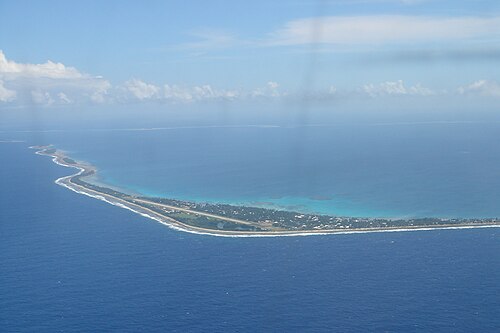
UNITED NATIONS — The UN sea level rise declaration won unanimous approval at the General Assembly on Thursday, September 24, establishing the clearest collective political commitment yet that a nation does not cease to exist when the ocean takes its habitable land. The declaration supports a presumption of continued statehood, continued U.N. membership and the stability of maritime zones already established under the U.N. Convention on the Law of the Sea.
The United States did not block consensus, allowing the text to pass without a vote. That matters diplomatically because the declaration addresses sovereignty, migration, finance and maritime rights at once. It also has an important limit: it is a political declaration, not a legally binding treaty. It strengthens the evidence of international agreement and can influence future state practice, negotiations and legal arguments, but it does not by itself rewrite UNCLOS or compel governments to provide money.
For low-lying states, the distinction between political force and legal enforceability is not academic. If coastlines retreat, a rule that moved exclusive economic zones with them could strip countries of fishing grounds and seabed rights at the same time that homes, roads and freshwater supplies are lost. The declaration says the international community should resist that compounding loss.
Why this matters
The central breakthrough concerns sea level rise statehood international law. Traditional ideas of statehood assume a defined territory and a permanent population. Climate change raises a question those rules were never designed to answer: what happens if a recognized state retains a people and government but can no longer support life on its land?
The declaration answers politically that continuity should be presumed. An island government should not have to re-prove its existence because its citizens relocate, and displaced citizens should not become stateless merely because physical territory is submerged or rendered uninhabitable. The same logic applies to representation: continued U.N. membership preserves a country's voice even if its government and population must operate from elsewhere.
That is why the Alliance of Small Island States sovereignty campaign has focused on legal continuity as well as emissions. For members such as Tuvalu and the Marshall Islands, climate risk is not only damage to infrastructure; it is a threat to the political identity, rights and jurisdiction that allow a country to negotiate, regulate resources and protect its people.
Tuvalu is already building a practical hedge through the Tuvalu digital nation project: digitizing government functions, cultural records and services so the state can continue to operate if relocation becomes unavoidable. The declaration gives that effort a wider diplomatic foundation. A digital state cannot replace a homeland, but it can help preserve institutions, citizenship and collective memory.
How we got here
The September 24 text followed the General Assembly's 2024 high-level meeting on sea level rise and two years of negotiations. Australia and Cabo Verde served as co-facilitators, a pairing that joined a large Pacific neighbor with a small Atlantic island state. Negotiators finalized the text in August 2026 before bringing it to the UNGA81 high-level plenary sea level session.
The declaration gathers several previously separate debates into one framework: protecting statehood, keeping maritime boundaries stable, planning for human mobility, financing adaptation, protecting cultural heritage and improving access to climate information. That combination reflects the reality that coastal loss does not arrive in policy silos. A flooded hospital is a health problem, a budget problem and a displacement problem at the same time.
It also builds on legal work by small island states and international bodies arguing that maritime entitlements should not shrink as a consequence of human-caused sea level rise. Under the declaration's approach to UNCLOS maritime zones fixed baselines, lawfully established baselines and the zones measured from them should remain stable despite later physical change. The practical prize is continuity in exclusive economic zones, fisheries management and seabed jurisdiction.
The politics were visible in the final consensus. Washington's decision not to block the declaration avoided a public split at the General Assembly, but non-opposition is not the same as accepting new binding obligations. Future disputes will still turn on national practice, treaty interpretation and possibly international courts or tribunals.
Who wins, who loses, what the skeptics say
The clearest winners are island states whose legal identity and economic zones could otherwise be questioned as coastlines change. Their citizens gain a stronger international promise that relocation will not erase nationality or political representation. Fishing communities and public treasuries also benefit from the principle that maritime rights should not move landward with the sea.
Coastal states beyond the small-island bloc gain language for adaptation, planned relocation and protection of affected communities. The declaration's call for more island nations climate adaptation funding also strengthens their case in climate-finance negotiations, where grant access, debt burdens and slow disbursement often determine whether protective work begins before or after disaster.
The potential losers are actors hoping to challenge maritime zones after coastlines retreat, or to treat displaced island populations as a problem without a sovereign state behind them. Governments that resist new financial expectations may also face greater political pressure, even though the declaration itself cannot order appropriations.
Skeptics have two serious arguments. First, political declarations can produce eloquent commitments without implementation. Recognition of continued statehood will not keep saltwater out of wells, raise a road or finance a seawall. Second, freezing maritime zones while coastlines move creates questions about evidence, mapping and the relationship between a political commitment and treaty law. Those are not reasons to dismiss the declaration; they are reasons to judge it by subsequent state practice, financing and dispute resolution.
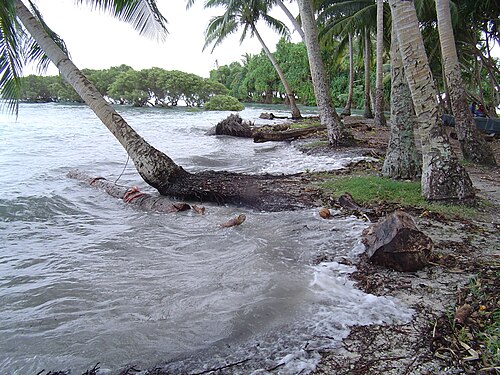
Physical change is also complex. The Marshall Islands inundation climate risk includes erosion, groundwater salinization, storm surge and repeated flooding, not only permanent submersion. Some coral islands can change shape or gain land under certain conditions. That variability does not remove the long-term danger, but it cautions against describing every local shoreline change as proof of one mechanism.
What the numbers mean
U.N. reporting tied to the declaration says about 770 million coastal areas sea level rise exposure is already a global-scale issue: roughly 770 million people live in coastal areas affected by rising seas. The figure is not a forecast that all 770 million will be displaced. It describes the population living where higher baseline water levels can intensify flooding, erosion, salinization and storm-surge damage.
The second headline estimate is equally easy to misuse. A half metre sea level rise displacement 2100 scenario could force 150 million to 300 million people from their homes by the end of the century. The range reflects uncertainty about emissions, ice-sheet response, local geography, population change, protective infrastructure and how migration decisions unfold. It is a risk envelope, not a single scheduled outcome.
For the Bahamas, Prime Minister Philip Davis translated the global projections into present tense: “Our landmass is less than three meters above sea level, we are already seeing our land being swallowed by water.” The statement captures why adaptation finance cannot be treated as a distant contingency. Small differences in elevation and storm surge can decide whether a road remains usable, a freshwater lens stays potable or a family can insure a home.
These figures should also be read alongside other climate hazards. Signal Post News has examined the unequal mortality risk from the 2026 super El Niño, the flood threat from Hurricane Polo and California's emergency preparations for a powerful El Niño. Sea level rise raises the floor beneath many of those events, allowing a similar storm or tide to reach farther inland.
What happens next
The immediate test is whether governments convert consensus into national policy. Coastal states can deposit and publicize fixed maritime coordinates, update laws and maps, and recognize the continuity of other states' zones. Diplomatic recognition and consistent practice can harden a political principle over time, even without a new treaty.
The second test is money. Adaptation funding must reach projects that protect freshwater, ports, hospitals, housing and communications, while also supporting voluntary mobility and cultural preservation where protection is no longer viable. The declaration raises the political expectation; budgets, development banks and climate funds determine whether that expectation becomes concrete.
The third test is human rights. Planned relocation must preserve citizenship, community decision-making, language, land ties and political participation. Treating migration as the only answer would turn a climate injustice into a loss of agency. The declaration's value lies in insisting that movement, when necessary, does not cancel statehood or sovereignty.
Finally, legal institutions will watch what states do next. Courts and tribunals may eventually be asked how continued statehood and stable maritime zones interact with existing law. The declaration will not decide those cases on its own, but unanimous approval gives judges, diplomats and governments a strong statement of collective intent.
The bottom line is both consequential and limited. The General Assembly has drawn a political line against allowing physical disappearance to trigger legal disappearance. Whether that line holds will depend on recognition, implementation and finance long after the applause in New York.
Sources
- United Nations News: General Assembly adopts first declaration on sea level rise
- Grist: What the declaration means for island nations facing territorial loss
- Columbia Law School Climate Law Blog: Statehood of island states after sea level rise
- IISD SDG Knowledge Hub: U.N. finalizes the declaration ahead of the high-level meeting
Reporting basis: Fixed September 24, 2026 snapshot. The vote, declaration language, population estimates and attributed remarks are drawn from the sources above. The legal and policy implications are Signal Post News analysis. The declaration is political and is not a legally binding treaty.