War · Ukraine · Russia
The Ukraine strikes Luhansk bridge aircraft story is really three stories bound into one Ukrainian General Staff statement: a front-line supply crossing hit in occupied Luhansk, a repair base hit in Russia’s Kursk region, and a damage tally — three transport aircraft, one of them an Il-76 hit particularly hard — for a strike 640 kilometres inside Russia eight days earlier. Every damage claim in it is Kyiv’s claim. None has been confirmed by Russia, and the Kyiv Independent said it could not independently verify the strikes or the extent of the damage. Both halves of that sentence matter.
KYIV, November 18, 2026 — Ukraine’s General Staff said on Wednesday that Ukrainian forces had struck a road bridge over the Siverskyi Donets River near Stanytsia Luhanska in Russian-occupied Luhansk Oblast, and a repair facility belonging to a Russian military unit near Khomutovka in Russia’s Kursk Oblast, in strikes carried out on November 17 and overnight into November 18. In the same statement, the General Staff confirmed — in Kyiv’s own assessment — the results of an earlier strike on the 123rd Aircraft Repair Plant at Staraya Russa in Novgorod Oblast: three Russian military transport aircraft damaged, including an Ilyushin Il-76 that sustained particularly severe damage. The wording throughout this article follows the General Staff’s wording as reported by the Kyiv Independent and Mezha: the aircraft were damaged, not destroyed, and the claims are Ukrainian claims, presented as such.
Track it live: Ukraine War Map — live tracker · Wars tracker
What Kyiv says happened
Start with the geography, because the geography is the argument. The three targets in Wednesday’s statement sit at three different depths of the same war. The bridge at Stanytsia Luhanska is a front-line logistics target, in occupied territory a short distance behind the line of contact. The Khomutovka repair facility is a near-rear target, just across the border in Kursk Oblast. The Staraya Russa plant is a deep-rear target, roughly 640 kilometres from the Ukrainian border in Novgorod Oblast — the kind of facility Russia built its war plans on the assumption Ukraine could not reach. A single General Staff statement claiming all three is Kyiv’s way of saying the campaign is no longer about any one depth. It is about the whole chain that moves Russian equipment to the front, repairs it when it breaks, and flies it where it needs to go.
The Stanytsia Luhanska bridge strike: cutting an ammunition, fuel and equipment route
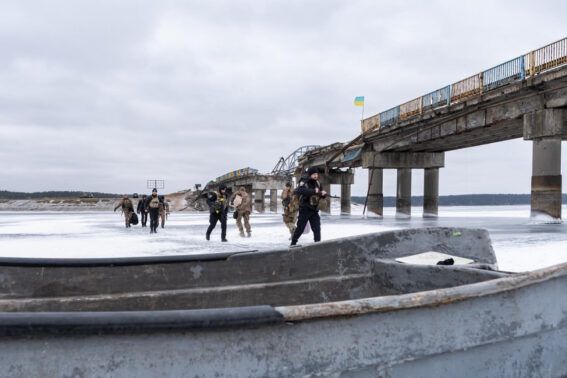
The General Staff said Russian forces used the road bridge over the Siverskyi Donets near Stanytsia Luhanska to transport ammunition, fuel and equipment to the front, and that Ukrainian forces struck it on November 17 and overnight into November 18. Explosions and a fire were reported in occupied Luhansk overnight following the strike, according to the General Staff report. A Siverskyi Donets bridge attack is, in logistics terms, an attack on time: a river crossing on a supply route cannot simply be driven around without cost, and every detour lengthens the road journey between depot and gun line. What Wednesday’s reporting does not establish is the bridge’s current state — whether it is impassable, damaged but usable, or already under repair. The General Staff claimed a strike on the crossing; the extent of the interruption to traffic over it remains, on the public evidence, unquantified. That distinction — struck versus closed — is one readers should hold onto, because it is the difference between a harassment effect and a severed supply line.
The Khomutovka repair base Kursk strike: hitting equipment before it returns
The second claim is quieter and, to logistics officers, just as pointed. The General Staff said Ukrainian forces struck a repair facility belonging to a Russian military unit near Khomutovka in Kursk Oblast, where damaged Russian military equipment was reportedly held before a planned return to the front. Repair bases are the war’s revolving door: vehicles and systems that are damaged but salvageable pass through them and come back. A strike there does not need to destroy the equipment outright to impose cost — it needs to interrupt the queue, damage the tooling and shelter the work depends on, and force the unit to move its broken fleet somewhere else. As with the bridge, the public reporting establishes the claim, not the measured effect: neither the Kyiv Independent nor Mezha could put a verified damage figure on the Khomutovka facility, and none is offered here.
Staraya Russa: three aircraft damaged at the 123rd Aircraft Repair Plant
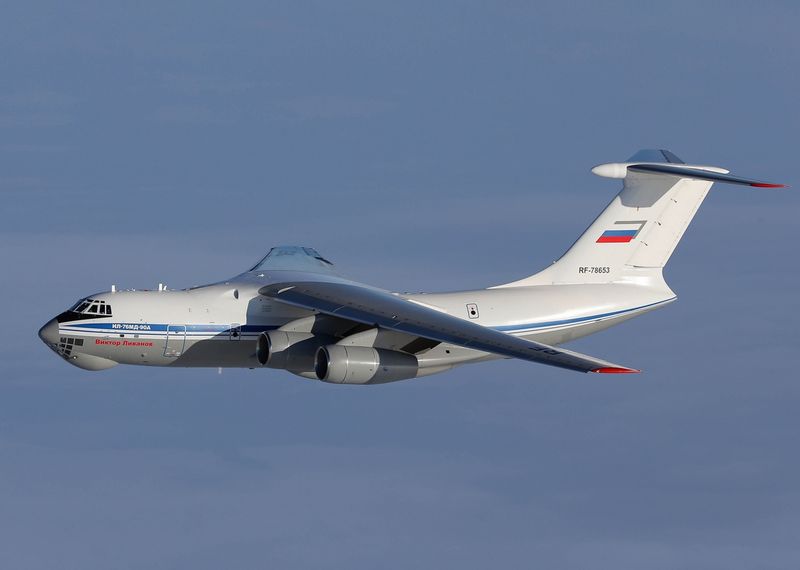
The third element of the statement was not a new strike but a confirmation — Kyiv’s first claimed damage tally for the strike of the night of November 9–10 on the 123rd Aircraft Repair Plant in Staraya Russa. The General Staff said three Russian military transport aircraft were damaged, including an Il-76 that sustained particularly severe — in one summary’s phrasing, very significant — damage; a General Staff account carried by Security Signal said all three were rendered inoperable. The plant repairs, modernises and maintains Russian military transport aircraft — Il-76 heavy transports and Il-78 tankers, L-410 light transports — and, per the General Staff, A-50 airborne early-warning aircraft; it has its own runway capable of handling heavy aircraft. Aircraft are present at such a plant precisely because they are already out of service for maintenance, which cuts both ways analytically: they were not flyable losses from the active fleet on the night of the strike, but damage inflicted inside the repair system extends their absence and consumes the very capacity needed to fix them.
There is limited corroboration, and it should be described exactly as limited. Satellite imagery published on November 16 by the Ukrainian OSINT channel AviVector suggested an Il-76 was likely hit at the Staraya Russa site — suggestive, not conclusive. The Kyiv Independent explicitly said it could not independently verify the reported strikes or the extent of the damage, and Russia has not confirmed the aircraft damage in these reports. The honest summary is: a Ukrainian claim, partially consistent with commercial satellite imagery as interpreted by a Ukrainian OSINT channel, awaiting the kind of independent imagery analysis that usually settles such questions days later.
Why this matters
Kyiv’s long-range strike campaign has visibly changed its centre of gravity. The best-known phase targeted oil — refineries, depots and export infrastructure — on the theory that fuel and revenue are a war economy’s bloodstream; Signal Post News has covered that campaign in depth, including how Ukrainian drones have nearly halved Russia’s oil refining and the November strikes on the Afipsky and Ilsky refineries in Krasnodar. Wednesday’s statement describes the complementary half of the strategy: the logistics-and-repair backbone. A supply bridge, a forward repair base and a deep-rear aircraft plant are not targets of spectacle. They are targets of throughput — the unglamorous capacity that decides how much equipment Russia can keep at the front, and for how long.
Repair capacity deserves particular attention because it compounds. A damaged tank or transport aircraft is not a total loss if a functioning plant can return it; the loss is measured in weeks. But repair plants are few, specialised and hard to disperse — an aircraft repair plant with a heavy runway cannot be moved into a forest — and every additional damaged airframe queues behind the same small number of facilities. The Staraya Russa plant had already been struck once this year, in March 2026, when the General Staff said an A-50 undergoing maintenance was damaged. The A-50 context explains Kyiv’s persistence: Russia operates only a handful of the airborne early-warning aircraft, each valued in earlier reporting at around $350 million, and the fleet cannot be quickly replaced. A plant that services both the transport fleet and the A-50 fleet is, from a targeting perspective, two bottlenecks in one perimeter fence.
The timing adds a political layer that should be noted without being over-read. The confirmation was published on November 18, the eve of the November 19 Trump–Putin–Xi trilateral in Shenzhen, at a moment when Ukraine’s partners and adversaries alike are calibrating what Kyiv can still do militarily. An unusually itemised General Staff confirmation — naming aircraft types, a plant number and a damage tally — reads as a deliberate evidentiary posture: Kyiv showing its work, or at least its claims, at the moment the diplomatic argument about the war’s trajectory is loudest. That is an interpretation of the statement’s presentation, not a fact about its motive, and it is labelled as such.
Context: one wave, several campaigns
Wednesday’s statement did not arrive alone. The November 17–18 strike wave also included the attack on the Kerch Strait bridge — covered by Signal Post News as the Crimean Bridge’s second strike, with traffic suspended — and followed within days the refinery strikes in Krasnodar and Belgorod. Read together, the wave spans the full target set of Kyiv’s campaign in a single 48-hour window: a strategic bridge to Crimea, refining capacity, a tactical bridge in Luhansk, a repair base in Kursk, and a damage confirmation for an aircraft plant in Novgorod. Whether that breadth reflects a coordinated design or simply the rhythm of available weapons and weather is not something the public record settles; what it does show is that none of these target classes is a one-off experiment any longer.
The Staraya Russa thread also has its own history. When Ukrainian forces struck the plant on the night of November 9–10, the Institute for the Study of War’s Russian Offensive Campaign Assessment of November 10 reported a fire at the site and assessed Kyiv’s strike campaign as degrading Russia’s airborne early-warning support infrastructure; the damage extent was unconfirmed at the time. The November 18 statement is Kyiv converting that unconfirmed strike into a claimed result — three aircraft damaged — eight days later. That lag is normal in this war’s information practice on both sides: strike first, assess through imagery, announce when the assessment hardens. It is also exactly why independent verification matters, since the announcing party is grading its own work.
Multiple angles: the claim, the silence and the verification gap
From Kyiv’s side, the statement is a model of the genre: specific targets, specific functions, a specific tally, and a through-line — Ukraine strikes Russian logistics at every depth — that reinforces the case for continued long-range strike capacity. From Moscow’s side, there has been no confirmation of the aircraft damage in these reports. Russian silence on such claims is routine and proves nothing in either direction: Russia has at times acknowledged strikes only after imagery forced the issue, and at other times Ukrainian claims have been revised downward once independent imagery appeared. Analysts who watch the repair-node campaign make a third point, and it is the most durable one: even if the Staraya Russa tally is eventually confirmed at a lower figure, the strategic fact — that a plant 640 kilometres from the border, struck once already this year, can be struck again — is itself the datum. Air defences cannot be everywhere, and repair infrastructure cannot move. No side is taken in this article between the claim and the silence; the record as it stands is a Ukrainian claim, limited satellite suggestion, and an open verification gap, and it is reported as exactly that.
The numbers: what they do and do not prove
Three aircraft. One bridge. One repair base. Six hundred and forty kilometres. Those are the statement’s numbers, and they reward careful reading. Three damaged transports — if confirmed — would be a real cost: Il-76-class airlift is the backbone of Russian military transport aviation, the fleet is not in serial mass production at anything like replacement speed, and a severely damaged airframe inside a damaged repair queue could be out of service for a very long time. But three damaged aircraft do not, by themselves, prove a crippled airlift capacity: Russia’s transport fleet numbers in the dozens of airframes, damaged is not destroyed, and repair timelines are unknown. The bridge and the repair base follow the same logic — a struck crossing proves reach and intent; only observed traffic patterns over the following days will prove effect. The numbers establish that Kyiv’s campaign now routinely spans from the front line to Novgorod Oblast. They do not yet establish how much Russian capacity it has removed. Both halves of that sentence are the analysis.
What happens next
Three things to watch. First, imagery: commercial satellite passes over Staraya Russa and the Stanytsia Luhanska crossing will either harden Kyiv’s tally into a broadly accepted assessment or revise it, and the AviVector precedent suggests Ukrainian OSINT channels will publish their readings before official confirmations arrive. Second, the repair clock: if the three aircraft were indeed rendered inoperable inside the plant that would fix them, watch for airframes being moved, cannibalised or written off — each outcome carries a different cost, and each will leak into the open-source record at a different speed. Third, the bridge: whether traffic over the Siverskyi Donets crossing near Stanytsia Luhanska resumes quickly, limps along under repair, or diverts to longer routes will tell the truest story of the November 17 strike — in logistics, the enemy’s detour is the damage report. Kyiv, for its part, has set the pattern to expect: more itemised confirmations, published days after the strikes they describe, each one another entry in the argument that the repair-and-logistics backbone — not just the front line — is now a battlefield.
Related coverage
Crimean Bridge Second Strike: Traffic Suspended
Ukraine Drones Hit Afipsky and Ilsky Refineries in Krasnodar and Belgorod
Ukraine Drones Nearly Halve Russia’s Oil Refining
Sources
- Kyiv Independent via EuropeSays, November 18, 2026 — report of the Ukrainian General Staff statement (europesays.com): the November 17 and overnight November 18 strikes on the Siverskyi Donets bridge near Stanytsia Luhanska and the repair facility near Khomutovka, Kursk Oblast; confirmation that the November 10 Staraya Russa strike damaged three transport aircraft including an Il-76. The Kyiv Independent said it could not independently verify the reported strikes or the extent of the damage.
- Mezha / Obronka, November 18, 2026 — “Confirmed damage to three Russian aircraft” (oboronka.mezha.ua): the General Staff’s confirmation of three damaged transport aircraft at the 123rd Aircraft Repair Plant, Staraya Russa, and the plant’s role maintaining Il-76, Il-78, L-410 and A-50 aircraft.
- Security Signal, November 18, 2026 — summary of the General Staff report (securitysignal.ie): explosions and a fire reported in occupied Luhansk overnight; the three aircraft described as rendered inoperable.
- Institute for the Study of War / Critical Threats, Russian Offensive Campaign Assessment, November 10, 2026 (criticalthreats.org): the night of November 9–10 strike on the Staraya Russa plant, the reported fire, the assessment that Kyiv’s campaign degrades Russia’s AEW&C support infrastructure, and the plant’s March 2026 strike, when the General Staff said an A-50 undergoing maintenance was damaged.
- SOFX, November 11, 2026 — “Ukraine strikes Russian repair plant for A-50 radar and Il-76 jets, second time in 2026” (sofx.com): background on the 123rd Aircraft Repair Plant, its aircraft types and its own heavy runway.
- Kyiv Post via AERONAUT / UNITED24 Media, November 16, 2026 (aeronaut.media): AviVector satellite imagery suggesting an Il-76 was likely hit at the Staraya Russa site — suggestive only, as reported in this article.
- Photos: Ilyushin Il-76MD-90A in flight — Wikimedia Commons file photo. Siverskyi Donets bridge — war.ukraine.ua file photo. Both credited in place. All damage claims in this article are Ukrainian General Staff claims; Russia has not confirmed them.