War · Ukraine · Energy
Ukraine drone strike Tatarstan: oil storage facilities came under Ukrainian drone attack on Thursday, Interfax reported, citing local authorities, with several civilian facilities damaged and no dead or injured. Separately, a Ukrainian monitoring channel reported that the Kaleykino oil pumping station near Almetyevsk — a hub on the Druzhba pipeline system — had been set ablaze. The two accounts describe the same night from different vantage points, and they are not the same claim.
The Ukraine drone strike Tatarstan officials described on Thursday, November 19, carried Kyiv’s long-range campaign against Russian oil infrastructure into one of the deepest and most symbolically loaded corners of the country’s energy map. Tatarstan lies east of Moscow, well over 1,000 kilometres from the Ukrainian border, and its oil cities sit astride the trunk pipelines that gather crude from the Volga and Siberian fields and move it west. Interfax reported that oil storage facilities in the region came under Ukrainian drone attack on Thursday and that several civilian facilities also suffered damage, citing local authorities, in a report carried by Reuters; no dead or injured were reported. In parallel, the Kyiv Independent reported that Ukrainian drones struck an oil pumping station in Tatarstan overnight, and that eyewitnesses said the Kaleykino Oil Pumping Station near Almetyevsk was set ablaze, according to the Ukrainian monitoring channel Exilenova Plus. Those are two attributed accounts of one night’s attack. This article keeps them separate throughout, because what each source actually says — and does not say — is the story.
Track it live: Ukraine war map tracker
What happened: two accounts of one night, kept separate
The first account is the official Russian one, as relayed by wire reporting. Reuters reported on Thursday, November 19, that Interfax had said oil storage facilities in Tatarstan came under Ukrainian drone attack, and that several civilian facilities also suffered damage, citing local authorities. The same report carried the detail that matters most for the human ledger: there were no dead or injured. That is the whole of the confirmed official picture as of Thursday morning — storage facilities attacked, some civilian damage, no casualties. Interfax’s report, as carried by Reuters, did not name the storage sites, did not describe a fire at a pumping station, and did not quantify the damage beyond the civilian facilities mentioned.
The second account comes from the Ukrainian side’s open-source ecosystem. The Kyiv Independent reported that Ukrainian drones struck an oil pumping station in Russia’s Tatarstan region overnight on November 19, and that eyewitnesses said the Kaleykino Oil Pumping Station near Almetyevsk was set ablaze, according to Exilenova Plus, a Ukrainian monitoring channel that tracks strikes inside Russia. That is a specific and consequential claim — Kaleykino is not a depot on the margins of the system but one of the best-known nodes in it — and it rests, in the reporting available on Thursday, on a monitoring channel’s account of eyewitness reports. Signal Post News attributes it to that channel throughout this article. It is not stated here as settled fact, and readers should hold it at the same distance: reported, plausible within the pattern of the campaign, and unconfirmed by any official damage assessment published so far.
What is not yet known is a longer list than what is. Neither account, as published on Thursday morning, establishes the scale of any fire, the duration of any outage, or whether crude flows through Tatarstan were interrupted at all. Transneft, the state pipeline operator whose network includes Kaleykino, had issued no intake or scheduling announcement in the reporting cited here — and as the February precedent discussed below shows, that kind of announcement is precisely how the operational consequences of a strike on this system usually become measurable. Ukraine’s military, for its part, had not published a detailed claim for the Tatarstan strike in the reports available on Thursday morning. The verified core of the story is therefore narrow: drones attacked oil facilities in Tatarstan overnight; Russian local authorities, via Interfax, report storage facilities hit, civilian damage and no casualties; a Ukrainian monitoring channel, via the Kyiv Independent, reports the Kaleykino pumping station ablaze.
What Kaleykino is — and why February is background, not this strike’s result
Kaleykino, near the oil city of Almetyevsk in southeastern Tatarstan, is one of the principal pumping stations in Transneft’s network and a gathering point for crude moving into the Druzhba pipeline system. Druzhba — Russian for “friendship” — is one of the world’s largest oil pipeline networks, built in the Soviet era to carry crude westward from the Volga and Siberia to refineries in central and eastern Europe. A pumping station is the system’s heartbeat at that point on the line: it keeps crude moving at pressure through hundreds of kilometres of pipe, and it concentrates pumps, power supplies, metering and storage in one fenced site. That concentration is what makes such stations efficient, and what makes them targets.
Kaleykino has been struck before, and the earlier strike is the source of the figures most likely to be attached to this one by mistake. In February 2026, the station was hit in an earlier Ukrainian attack, and Reuters reported on February 24 that Transneft cut its crude intake by roughly 250,000 barrels per day in the aftermath. That intake cut is a fact about February. It is background here for one reason only: it demonstrates what a successful strike on Kaleykino can do to flows, and it establishes the form — a Transneft intake announcement, reported by Reuters — in which a comparable consequence would most likely surface this time. No intake cut has been reported for the November 19 strike. Nothing in Thursday’s reporting supports carrying February’s 250,000-barrel figure forward into November, and this article does not.
Why this matters
The geography is the first reason. Ukraine’s campaign against Russian oil began with refineries, most of them in Russia’s west and south, and has steadily reached deeper: Tatarstan’s oil region lies east of Moscow, at a distance from the Ukrainian border that only a handful of strike locations have matched. A drone that can reach Almetyevsk can reach the gathering infrastructure of the Volga oil province itself — the fields, stations and storage that feed the trunk lines — rather than only the plants at the system’s western edge. The target category is the second reason. Storage and pumping are the connective tissue of an oil system: refineries can only process the crude that pipelines deliver, and export terminals can only load what arrives. A campaign that moves between refineries, storage and pumping stations is not repeating itself; it is working through the system’s dependencies in sequence.
The third reason is timing. The Tatarstan attack came two days after Ukrainian strikes set fires at two refineries in Krasnodar region, one day after Reuters published industry sources’ assessment that the campaign has cut Russia’s current refining rate by some 45% since late October, and on the morning of a day of high diplomacy over the war’s future. Each strike in this sequence lands on a system already absorbing the previous ones: repair crews, spare parts and air-defence coverage are finite, and they are now being demanded at refineries in the south, at storage in the Volga region and along the pipeline network at once. Whether Thursday’s strike proves operationally large or small, its place in that sequence is what gives it significance.
Context: an autumn campaign moving through the oil system
On November 17, Ukrainian drones hit the Ilsky and Afipsky refineries in Russia’s Krasnodar region, setting fires at both plants, as Signal Post News reported in its coverage of the strikes on the Afipsky and Ilsky refineries. On November 18, Reuters published the first system-wide pricing of the campaign: two industry sources estimated that Ukrainian attacks had cut Russian refineries’ combined crude processing by 45% since late October, to about 400,000 metric tons a day, with operations disrupted or halted at 15 of Russia’s 35 major refineries — the assessment Signal Post News covered as Ukrainian drones nearly halving Russia’s oil refining. The same week brought the infrastructure war’s other front back into view, as the Crimean Bridge was hit for a third time, halting traffic again. Tatarstan is the next entry in that ledger: refining in the south, a strategic bridge in the strait, and now storage and pumping in the Volga interior, inside four days.
The data in context
The numbers that frame this strike belong to the refining system, and they should not be silently transferred to pipelines. Reuters’ November 18 figures — a current processing rate of about 400,000 metric tons a day, down 45% from more than 700,000 tons a day at the end of October, with 15 of 35 major refineries disrupted — measure what refineries are doing now. The same report’s caveat matters just as much: because the decline was gradual, November’s average processing remains only about 5–10% below September and October levels. A strike on storage and pumping works on a different variable. Crude that cannot be pumped can sometimes be rerouted, held in storage or slowed at the field; the effect appears not in a same-day throughput estimate but in operator announcements about intake and scheduling — the form in which February’s roughly 250,000-barrel-per-day intake cut at this same station was reported by Reuters. Until Transneft speaks, or satellite and trade reporting fills the gap, the honest data statement for November 19 is the narrow one: an attack happened, damage to civilian facilities and storage is officially reported by the Russian side with no casualties, a pumping-station fire is reported by a Ukrainian monitoring channel, and no flow figure of any kind has been published for this strike.
Multiple angles
Kyiv: reach as the message
From Kyiv’s side, a strike on Tatarstan demonstrates range as much as damage. Ukraine’s long-range drone campaign has been built, strike by strike, into an argument that no part of Russia’s oil system is beyond reach — an argument with obvious value as diplomacy over the war intensifies, since a capability that can be paused or intensified is a negotiable asset. Ukrainian officials have consistently framed the oil campaign as a response to Russian strikes on Ukraine’s own energy infrastructure. The Kaleykino report, if borne out, would add the pipeline system’s gathering nodes to the list of target classes struck in a single week; even at the level of the officially reported storage damage, Thursday’s attack extends the campaign’s map east of Moscow.
Moscow: no casualties, and a familiar defensive problem
From Moscow’s side, the official account as relayed by Interfax emphasises two things: that civilian facilities were damaged, and that nobody was killed or injured. Both can be true alongside the military significance of the target set, and the emphasis itself is a choice about which facts lead. The underlying defensive problem is the one this campaign has posed all autumn: Russia’s oil infrastructure is vast, fixed and spread across a territory that air defence cannot cover uniformly, and each new target class — refinery, depot, pumping station — widens the area that must be defended to protect the whole. Russian officials had not, in Thursday’s reporting, published a damage assessment for Kaleykino or commented on the monitoring channel’s fire report; that silence is noted here as a gap in the record, not as evidence either way.
Markets and Druzhba’s customers: flows, not fires, are the metric
For oil markets and for the European refineries that still receive crude through Druzhba’s branches, the operative question is not the fire but the flow. A pumping-station outage matters in proportion to its duration and to the availability of rerouting and storage around it; a station repaired in days is an incident, while an intake cut of the kind Transneft announced in February is a supply event. Nothing reported on Thursday morning establishes either. Traders and refiners will therefore watch the same evidence as everyone else: Transneft’s scheduling statements, nominations on the Druzhba system, and whether the refining-rate deterioration Reuters documented on November 18 deepens as the strike tempo continues. A one-night attack on storage is a headline; a sustained interruption at a Druzhba gathering hub would be a pricing story, and the distance between those two outcomes is exactly what the next several days of operator statements will measure.
What happens next
The evidence to watch is specific. First, Transneft: any announcement on intake, scheduling or repairs at Kaleykino would convert Thursday’s attributed reports into an operational fact, as its February announcement did. Second, Tatarstan’s authorities and Russian state media, whose damage updates will either confirm, narrow or leave standing the monitoring channel’s account of a fire at the station. Third, the independent record — satellite fire detections and imagery of the Almetyevsk district, and any Ukrainian official claim that fills in the strike’s intended targets. Fourth, the campaign itself: whether the sequence that ran from Krasnodar’s refineries on Monday to Tatarstan’s storage and pumping on Thursday continues into the weekend, and whether the diplomatic track changes the tempo, as the fate of October’s announced energy ceasefire suggests it might not. What is established on November 19 is narrower than the week’s headlines and still substantial: the campaign has reached Tatarstan’s oil heartland, the Russian official account reports storage hit and no casualties, and the war over Russia’s oil system is now being fought at every layer of that system at once.
Reporting based on Reuters (Nov. 19, 2026, reporting Interfax and local authorities) and the Kyiv Independent (Nov. 19, 2026, reporting the monitoring channel Exilenova Plus). The February 2026 Kaleykino strike and Transneft intake cut are Reuters reporting from February 24, 2026, cited as background only. The refining figures are Reuters’ November 18, 2026 industry-source estimates. Claims are attributed to their sources throughout; the Kaleykino fire report had not been confirmed by an official damage assessment in the reporting available on Thursday morning.
Sources
- Reuters, November 19, 2026 — Interfax reported that oil storage facilities in Tatarstan came under Ukrainian drone attack on Thursday and that several civilian facilities also suffered damage, citing local authorities; no dead or injured were reported. (Reuters report syndicated via Devdiscourse, November 19, 2026.)
- Kyiv Independent, November 19, 2026 — Ukrainian drones struck an oil pumping station in Tatarstan overnight; eyewitnesses said the Kaleykino Oil Pumping Station near Almetyevsk was set ablaze, according to the Ukrainian monitoring channel Exilenova Plus.
- Reuters, February 24, 2026 (background only) — Transneft cut crude intake by roughly 250,000 barrels per day after the February 2026 strike on the Kaleykino station. No intake cut has been reported for the November 19, 2026 strike.
- Reuters, November 18, 2026 — two industry sources estimated Ukrainian drone attacks had cut Russian refineries’ current crude processing rate by 45% since late October, to about 400,000 metric tons a day, disrupting or halting operations at 15 of 35 major refineries, with November’s average decline at 5–10%.
- Signal Post News, related coverage: Ukrainian Drones Have Nearly Halved Russia’s Oil Refining, Sources Say; Ukrainian Drones Set Fires at Two Krasnodar Refineries as Belgorod Reports Three Killed; Crimean Bridge Hit for a Third Time This Week as Traffic Halts Again.
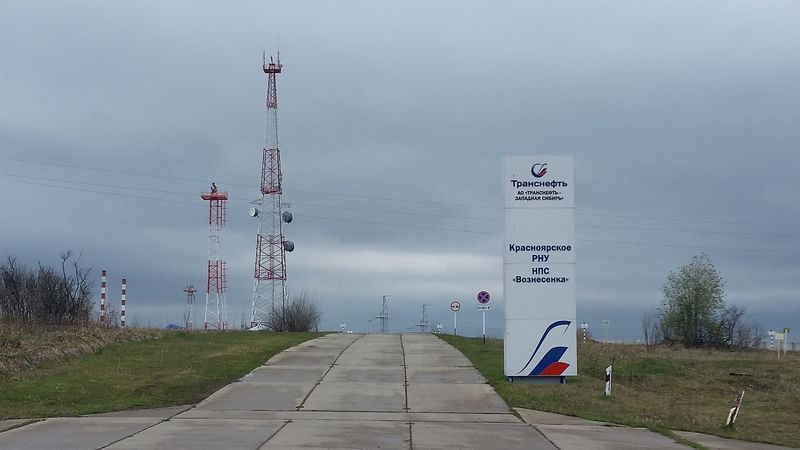
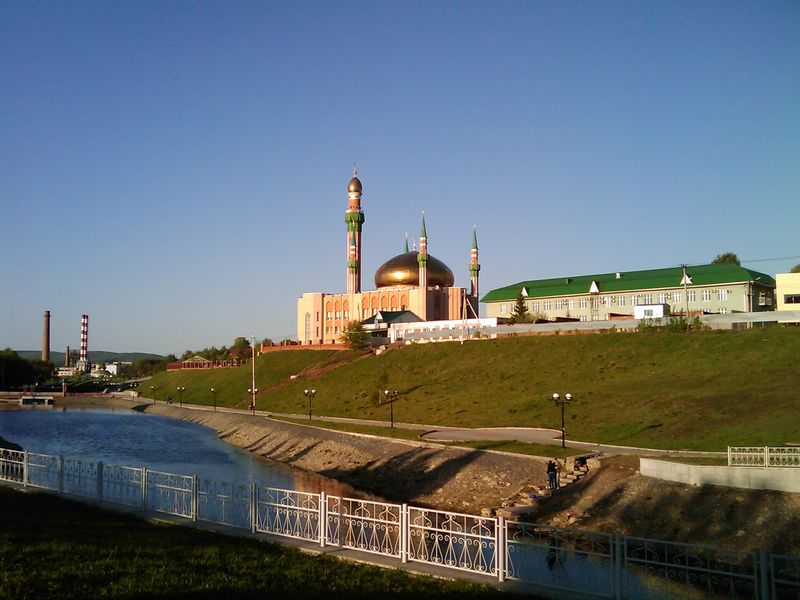
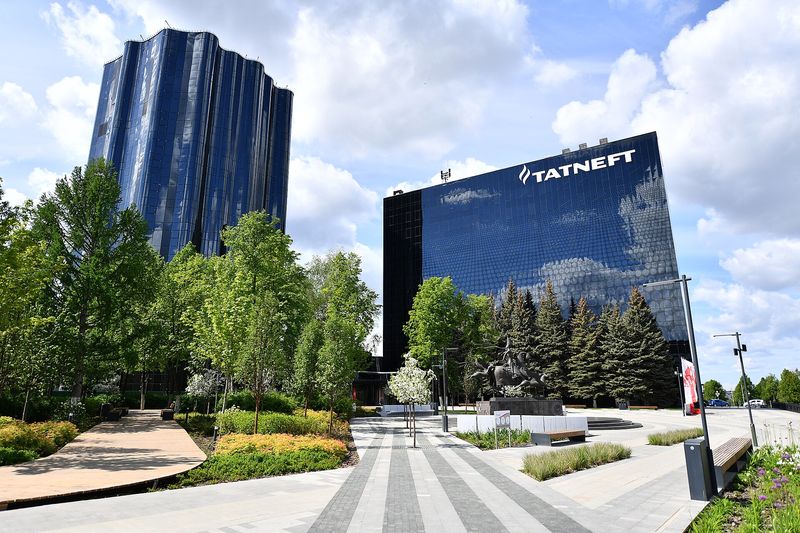
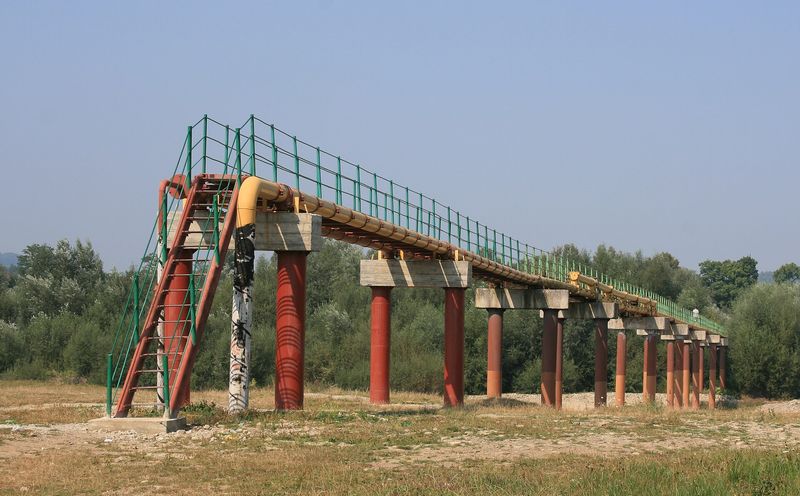
- Photos: entrance to Transneft’s Voznesenka oil pumping station, Krasnoyarsk Krai, Melnikov (CC BY-SA 4.0) via Wikimedia Commons; Almetyevsk, Tatarstan, Aleksandr Yukhimenko (CC BY 3.0) via Wikimedia Commons; the Druzhba pipeline crossing the Stryi river, Lviv region, Vodnik (CC BY-SA 3.0) via Wikimedia Commons; Tatneft headquarters, Almetyevsk, MiklMS (CC BY-SA 4.0) via Wikimedia Commons. All are file photographs.