War · Russia · Ukraine · Libya
Libya’s eastern-based government says a preliminary investigation points to a suspected drone attack on the Russian corvette Merkury in Benghazi. Satellite imagery shows most of the vessel capsized and sunk — but the cause, the weapon and who was responsible have not been established.
Track it live: Ukraine war map · War tracker
BENGHAZI, November 22, 2026 — On Sunday, 22 November 2026, an explosion and fire struck the Russian corvette Merkury Benghazi naval base in eastern Libya. Libya’s eastern-based government said a preliminary investigation indicated a suspected drone attack. Satellite imagery provider Vantor told Reuters the imagery showed most of the vessel had capsized and sunk, with only its bow visible above water. Reuters medical sources said 10 people — Russians and Libyans — were slightly injured and treated in Benghazi, with no deaths reported. The eastern government said the ship had stopped in Benghazi to refuel and resupply on its way back to Russia under maritime cooperation agreements, and that a joint investigation with Russia had been launched. Everything beyond those points — what weapon was used, where it came from and who sent it — remains unproven, and this article keeps that line visible throughout.
What happened in Benghazi
The established sequence, drawn from Reuters’ reporting and the eastern-based government’s own statements, is narrow. An explosion struck the Merkury at the Benghazi naval base on Sunday and a fire broke out aboard; the fire was later extinguished. The eastern-based government said a preliminary investigation indicated a suspected drone attack — wording that matters, because a preliminary indication is not a finding of cause, and neither the government nor Reuters has established what weapon, if any, was used or who was responsible.
The clearest picture of the damage comes from above. Satellite imagery provider Vantor told Reuters that its imagery showed most of the vessel had capsized and sunk, with only its bow visible above water. The Associated Press, in its own account, described the warship as severely damaged. Those two descriptions are the responsible outer bounds of what is known about the ship’s condition: a vessel largely submerged at its berth, described by one imagery provider as mostly capsized and sunk and by AP as severely damaged. Whether the Merkury is a permanent loss has not been conclusively established, and no official salvage or repair assessment has been published.
The human cost, on the reporting available, was limited. Medical sources told Reuters that 10 people — Russians and Libyans — were slightly injured and treated in Benghazi. No deaths were reported. The eastern government said the corvette had stopped in Benghazi to refuel and resupply on its way back to Russia, under maritime cooperation agreements between the two sides, and that a joint investigation with Russia into the explosion had been launched. That investigation, when it reports, will be the first authoritative test of the preliminary suspected-drone finding.
What is claimed — and what is not proven
Separate from the eastern government’s preliminary finding is a more specific claim, and it rests on a narrow base. Two anonymous officials affiliated with the Libyan National Army, speaking to the Associated Press, said several Ukrainian sea drones were launched from a base in western Libya, that at least four of the drones were intercepted or destroyed, and that two hit the warship. That account — the Ukrainian origin, the western Libya launch point, the numbers intercepted and the two hits — comes only from those two anonymous officials affiliated with the Libyan National Army speaking to AP. It has not been independently confirmed, and it is reported here strictly as their claim.
Ukraine has not publicly claimed responsibility in either the Reuters or the AP accounts. No Ukrainian official statement taking credit for a strike in Benghazi appears in those reports, and readers should treat any suggestion of Ukrainian responsibility as unproven unless and until evidence or an official claim establishes it. A European official who spoke to AP offered a middle position that underlines the uncertainty: the official said reports of the incident appeared credible, but offered no assessment of what caused the explosion. Credibility about the event is not attribution of the act.
Independent imagery work points in the same limited direction. BBC Verify’s satellite reporting described a vessel burning and later partially submerged at the base — consistent with the explosion, fire and capsizing described by Vantor to Reuters, but again evidence about the ship’s condition, not about a perpetrator. Put together, the verified record supports three conclusions and no more: there was an explosion and fire; the ship capsized and is mostly submerged; and 10 people were slightly injured. The suspected drone finding is preliminary, and the Ukrainian sea-drone account rests solely on the two anonymous officials affiliated with the Libyan National Army who spoke to AP.
A second vessel reported hit off Benghazi
Later on Sunday, a second and separate incident was reported off Benghazi. Two Libyan military sources told Reuters that a Maltese-flagged commercial vessel was hit by a drone boat off Benghazi. That report is attributed here exactly as Reuters carried it: to two Libyan military sources, speaking about a commercial ship, in a separate incident from the explosion aboard the Merkury in port.
The distinction matters. The Merkury explosion is the subject of a preliminary official finding of a suspected drone attack and a joint investigation. The Maltese-flagged vessel report, by contrast, rests on the accounts of two Libyan military sources via Reuters, with no official finding attached to it in the reporting. Whether the two incidents are connected — in timing, in method or in authorship — has not been established, and this article does not connect them. What can fairly be said is that, on a single Sunday, Benghazi’s waters produced two reported drone-related vessel incidents, one against a Russian warship in port and one, as reported, against a commercial vessel offshore.
Why this matters
If the claim were confirmed, the map of the naval war changes
Ukraine’s maritime campaign since 2022 has been fought overwhelmingly in the Black Sea, where uncrewed surface vessels and missiles have damaged or sunk Russian warships and pushed the Black Sea Fleet away from its historic anchorage at Sevastopol. If a Ukrainian-linked strike in Libya were ever confirmed — and it has not been — it would extend that campaign’s geography from the Black Sea to the Mediterranean and North Africa, a distance and a theatre change of a different order. It would suggest that Russian naval movements far from home waters, including routine refuelling stops, sit inside the same risk envelope as movements off Crimea. That is an analytical consequence of a claim, not a description of an established fact: the claim itself comes only from two anonymous officials affiliated with the Libyan National Army speaking to AP, and Ukraine has not publicly claimed responsibility.
The Libya dimension
Libya remains divided between eastern authorities aligned with the Libyan National Army and governments in the west, and Benghazi is the east’s principal port. A launch from western Libya, as the two anonymous officials affiliated with the Libyan National Army claimed to AP, would risk dragging Libya’s divided authorities into the Russia-Ukraine war: the east hosts and cooperates with Russia, while an attack staged from the west would hand the east a grievance with a foreign war attached to it. For Moscow, Benghazi is not a courtesy stop. It is a working node in the logistics that sustain Russia’s presence in Libya, the wider Mediterranean and Africa. A warship capsized at that node — whatever the cause proves to be — strains the assumption that the route is safe, and every future Russian transit will now be planned against Sunday’s precedent. The diplomatic temperature around the Black Sea has already been rising, as our coverage of how Putin ruled out energy and Black Sea ceasefires after the Crimean Bridge strikes sets out.
The Russia dimension
For Russia, the arithmetic is unforgiving even before attribution is settled. The Merkury is a Black Sea Fleet hull, and the fleet has been attrited since 2022 with no practical way to reinforce it: under the Montreux Convention, the Turkish straits are closed to warships of the belligerents while the war continues, a closure whose effects on Black Sea shipping diplomacy we examined when Erdogan condemned Black Sea attacks after talks with Zelenskyy in Istanbul. A modern corvette damaged or lost thousands of kilometres from its home waters cannot simply be replaced by sailing another hull south, and repair options for a capsized warship in a foreign port are limited, slow and politically exposed. Whether the ship is ultimately salvaged or written off, the fleet is down one of its newest escorts for the foreseeable future.
Russia in Libya: how we got here
Russia’s position in eastern Libya was built over years of support for the eastern forces led by the Libyan National Army, through the civil war and into the uneasy division that followed it. Benghazi, the east’s main city and port, became a natural point of contact: a harbour where Russian vessels could refuel and resupply under maritime cooperation agreements of the kind the eastern government cited on Sunday, and a shore link in a longer chain connecting Russia to its interests in the Mediterranean and across Africa.
That wider logistics picture is the context that makes a single port call strategically legible. Since its Mediterranean squadron lost the certainty of its Syrian basing arrangements, Russia has valued every friendly harbour on the sea’s southern shore more highly, and Benghazi’s role as a refuel and resupply stop fits a pattern of distributed, partner-hosted access rather than formal bases. Sunday’s explosion landed directly on that pattern.
The Black Sea Fleet context is the other half of the background. Since 2022 the fleet has lost or seen damaged a succession of major units — from the cruiser Moskva in the war’s first months to landing ships, a submarine and patrol vessels struck in port and at sea — largely to Ukrainian missiles and uncrewed surface vessels, and it has dispersed from Sevastopol under that pressure. The Merkury, a Black Sea Fleet corvette on a voyage back toward Russia, belongs to that same strained fleet picture even though Sunday’s incident happened an entire sea away. As historical comparison, the pattern is consistent: the fleet’s hulls have been most vulnerable in port, alongside, at predictable moments — which is precisely the posture the Merkury was in at Benghazi.
The numbers in context
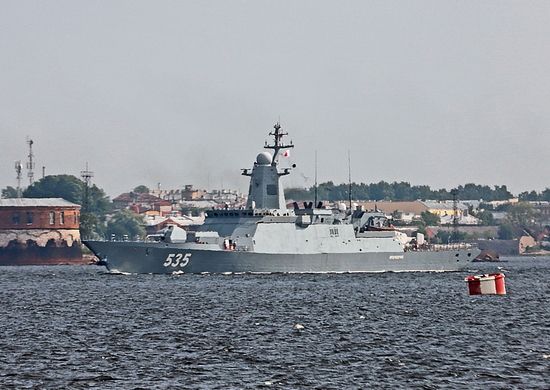
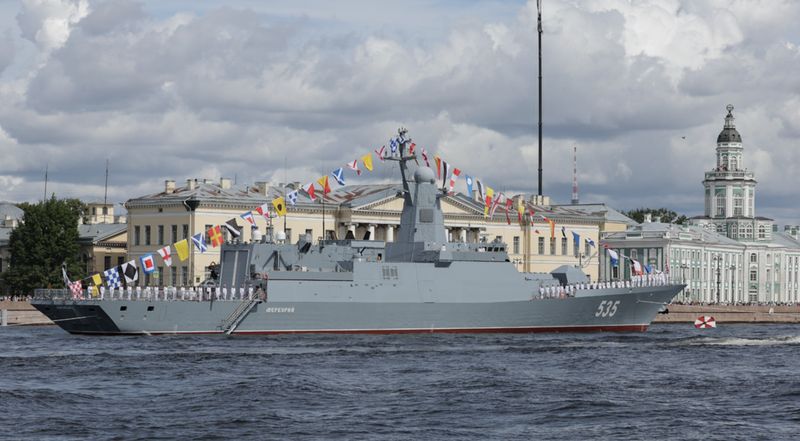
The ship itself frames the loss. The Merkury is a Project 20380 Steregushchiy-class corvette, about 104.5 metres long — roughly 344 feet — commissioned in May 2023 and assigned to Russia’s Black Sea Fleet. Commissioned barely three and a half years ago, it is among the fleet’s newest corvettes: a modern, multi-role escort designed for exactly the sea-control and protection duties a dispersed fleet can least afford to lose. A navy can absorb damage to an ageing hull as a maintenance problem; damage to a 2023 corvette is a capability problem.
The reported attack numbers require their attribution to travel with them. The figures in circulation — several drones launched, at least four intercepted or destroyed and two hits on the warship — come only from the two anonymous officials affiliated with the Libyan National Army speaking to the Associated Press. They are claims, not counts, and no independent tally exists. Even taken purely as claims, though, they describe the familiar economics of the drone war: a salvo in which most of the attackers are stopped and a small number get through can still mission-kill a warship worth orders of magnitude more than the weapons used against it.
The replacement maths completes the picture. With the Turkish straits closed to belligerent warships under Montreux, a Black Sea Fleet corvette lost or disabled abroad cannot be backfilled from Russia’s other fleets, and a new-build replacement is measured in years, not months. Ten people slightly injured and no deaths reported is, in human terms, a mercifully small figure for an explosion that left a warship on its side. In fleet terms, the number that matters is one: one modern hull, out of a fleet that cannot readily replace it, in a port that was supposed to be a safe stop.
What happens next
Three broad paths follow from Sunday, and none can be assigned a confident probability today. The first is attribution and response: the joint investigation by Russia and the eastern Libyan authorities attributes the attack, and Moscow responds — diplomatically, with protests, expulsions or demands on whichever capital it blames, or militarily, in a theatre of its choosing. An official attribution would convert a preliminary suspected-drone finding into a political fact with consequences, which is precisely why its evidence will need to withstand scrutiny the anonymous claims so far have not faced.
The second path is permanent ambiguity. Attribution is never publicly proven, no government claims the strike, and the Benghazi explosion settles into the growing category of deniable maritime attacks: everyone with an interest holds a private assessment, no one produces public proof, and the incident’s deterrent and signalling effects operate anyway. This path requires nothing further to happen, which historically has made it a common destination for attacks on ships in politically complicated waters.
The third path is contagion. Sunday already contained a second report — the Maltese-flagged commercial vessel said by two Libyan military sources via Reuters to have been hit by a drone boat off Benghazi — and if Russian-linked or Russia-adjacent shipping in the Mediterranean comes to be seen as a standing target set, insurers, charterers and navies will reprice the whole basin’s risk. Copycat risk runs in both directions: a successful unattributed strike teaches every actor watching that port calls are exposed. What would discriminate among these paths is evidence — the joint investigation’s findings, any official claim of responsibility, and whether further vessels are hit. Until then, uncertainty is not a gap in this story; it is the story’s central fact.
Related coverage: Putin rules out energy and Black Sea ceasefires after Crimean Bridge strikes · Erdogan condemns Black Sea attacks on civilian ships after Zelenskyy talks in Istanbul
Sources
Sources: Reuters, 22 November 2026 — reporting that Libya’s eastern-based government said a preliminary investigation indicated a suspected drone attack caused the explosion aboard the Russian ship in Benghazi, that satellite imagery provider Vantor said most of the vessel had capsized and sunk with only its bow visible, that medical sources said 10 people were slightly injured with no deaths reported, that the ship had stopped to refuel and resupply under maritime cooperation agreements and that a joint investigation with Russia had been launched; and reporting, attributed to two Libyan military sources, that a Maltese-flagged commercial vessel was hit by a drone boat off Benghazi later on Sunday — reuters.com. Associated Press via Military.com, 22 November 2026 — AP report on the suspected strike at the Benghazi naval base, including the account of two anonymous officials affiliated with the Libyan National Army who said several Ukrainian sea drones were launched from a base in western Libya, at least four were intercepted or destroyed and two hit the warship, the description of the warship as severely damaged, and a European official who said reports appeared credible but offered no assessment of cause. BBC Verify satellite reporting describing a vessel burning and later partially submerged is also reflected in the text. Analysis in this article is Signal Post News’s own and is distinguished from the reported facts above; the cause of the explosion, the weapon type and the perpetrator are not established, Ukraine has not publicly claimed responsibility in the Reuters or AP accounts, and the sea-drone account rests solely on the two anonymous officials affiliated with the Libyan National Army who spoke to AP.