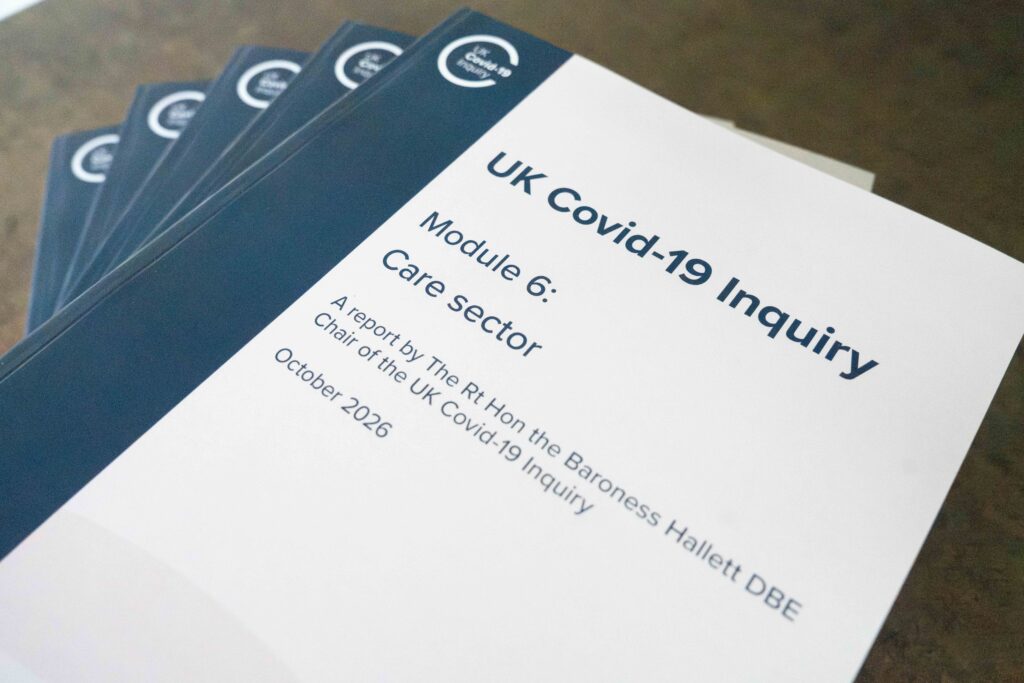
Covid inquiry care homes: the UK Covid-19 Inquiry’s care sector report found Covid inquiry care homes policy treated adult social care as “something of an afterthought” while more than 43,000 residents died.
Health / UK — Baroness Hallett’s sixth report rules the “protective ring” claim unfounded, finds untested hospital discharges and a “wholly unacceptable” PPE failure, and sets eight tests for the next pandemic
Track it live: follow current disease-outbreak data on Signal Post News’s live outbreak tracker — signalpostnews.com/tracker/outbreak.
What the report actually found
Module 6 is the sixth of the Inquiry’s ten investigations, and it examined the publicly and privately funded adult social care sector across all four nations of the United Kingdom — England, Scotland, Wales and Northern Ireland — including infection prevention, visiting restrictions, the experiences of the care workforce and the decisions to discharge patients from hospitals into care homes. Fifty-seven witnesses gave oral evidence at public hearings held between June 30 and July 31, 2025: residents and their families, unpaid carers, care workers, sector representatives, healthcare professionals, regulators and senior politicians and civil servants among them.
The conclusions are cumulative, and each one lands on the same foundation: the sector entered the pandemic unplanned-for. The UK government and the devolved administrations knew before Covid-19 arrived that care home residents were extremely vulnerable to respiratory viruses. They had been told so in writing for a decade. The 2011 UK Influenza Pandemic Preparedness Strategy flagged the “particular challenges” social care would face; Exercise Cygnus, the 2016 pandemic rehearsal, recommended developing ways to assess social care and surge capacity. That work, Hallett found, had not been completed by the time the pandemic struck. Ministers were therefore left making the most consequential decisions of the crisis “without the information they needed” about the very sector where the virus would kill most efficiently.
What followed in March and early April 2020 is the report’s darkest passage. The overriding focus of government, Hallett wrote, was protecting hospitals. To free up beds, the discharge of patients from hospitals into care homes was accelerated — a decision the Inquiry accepts was necessary — but it was taken at a moment when there was not enough testing capacity to know those patients’ Covid-19 status. About 25,000 hospital patients were moved into care homes across England in March and April 2020 before mandatory testing was introduced on April 15. And isolating discharged patients inside care settings, one of the few effective protections actually available, was not initially advised in England, Wales or Northern Ireland — “a significant omission”, in the report’s words. The High Court had already ruled in 2022 that the discharge policies were unlawful; the government said in May 2022 it would not appeal. Hallett’s report now supplies the institutional explanation for how it happened: the failures, she concluded, “created environments in care settings in which the virus could spread like wildfire”. In evidence to the Inquiry last year, a civil servant described the toll as a “generational slaughter within care homes”.
The protective ring, examined
No finding will travel further than the one about the ring. The words belong to Matt Hancock, the health secretary at the time, who told a Downing Street press briefing on May 15, 2020: “Right from the start, it’s been clear that this horrible virus affects older people most. So right from the start, we’ve tried to throw a protective ring around our care homes.” Giving evidence to the Inquiry, Hancock took responsibility for the discharge decision and called it “the least worst decision to a terrible problem”. But Hallett’s verdict on the slogan itself was unsparing: the choice of words did not reflect what was happening. Bereaved families had called the phrase a “sickening lie” long before the report; on Tuesday the state’s own inquiry agreed with the substance of their complaint. Hancock declined to comment on the findings when approached by the PA news agency.
The PPE chapter reads almost as bleakly. Severe shortages left some care workers wearing waterproof ponchos from festivals, painters’ overalls, or home-made protection fashioned from fabric, bin bags and bed linen; others used laminated plastic to make face masks and elastic cut from leggings to tie them on. The report calls this “wholly unacceptable” and concludes care workers were left “without the protection they needed”. While PPE shortages were a global problem, better planning could have ensured a much better supply from the outset. This was a workforce of at least 1.5 million people, including domiciliary carers who go from home to home. Many suffered burnout; some left the profession entirely. Changes to sick pay that would let staff afford to self-isolate arrived in England, Scotland and Northern Ireland between March and May 2020 — but not in Wales until November 2020. And the Inquiry notes that at least 1.5 million care workers put their lives at risk while no central record of deaths among them was kept, hindering even an understanding of what the virus was doing to the workforce. Behind them stood 5.8 million unpaid carers, relied upon for longer hours of more complex care with little or no respite; support for them, too, came too late.

The harm that left no infection statistics
Some of the report’s most painful evidence concerns not the virus but the response to it. Visiting restrictions did not begin to ease until the summer of 2020. Residents were cut off from loved ones for months; some were not allowed to be with dying friends or relatives in their final moments. Families who would normally help with eating, drinking and washing were kept out, and the report describes homes “becoming prisons” for some residents, and a decline in residents’ health and wellbeing that was especially severe for people with dementia and other complex cognitive conditions. Guidance did allow exceptions for end-of-life visiting, but many families were never permitted in. “Many remain wracked by a guilt that they do not deserve to carry,” Hallett wrote. One recommendation answers this directly: people who rely on care should have a right to in-person visitors, with any future limits governed by published guidance — and core participants such as Care Rights UK argue an amendment already passing through Parliament, introducing a “Health and Care Partner” right across health and care settings, could implement that recommendation immediately.
The report also revisits Do Not Attempt Cardiopulmonary Resuscitation (DNACPR) decisions. Bereaved families told the Inquiry some decisions were made inappropriately, or without proper consultation, based on a person’s age, health condition or learning disability. Hallett found no evidence of a national policy encouraging blanket use of DNACPRs — an important limit on the worst allegation — but concluded some decisions were indeed made inappropriately or without proper consultation, and that health and social care workers often lacked the skills to hold these conversations “thoughtfully and compassionately”. Her remedy is mandatory end-of-life care training for relevant staff.
Why this matters
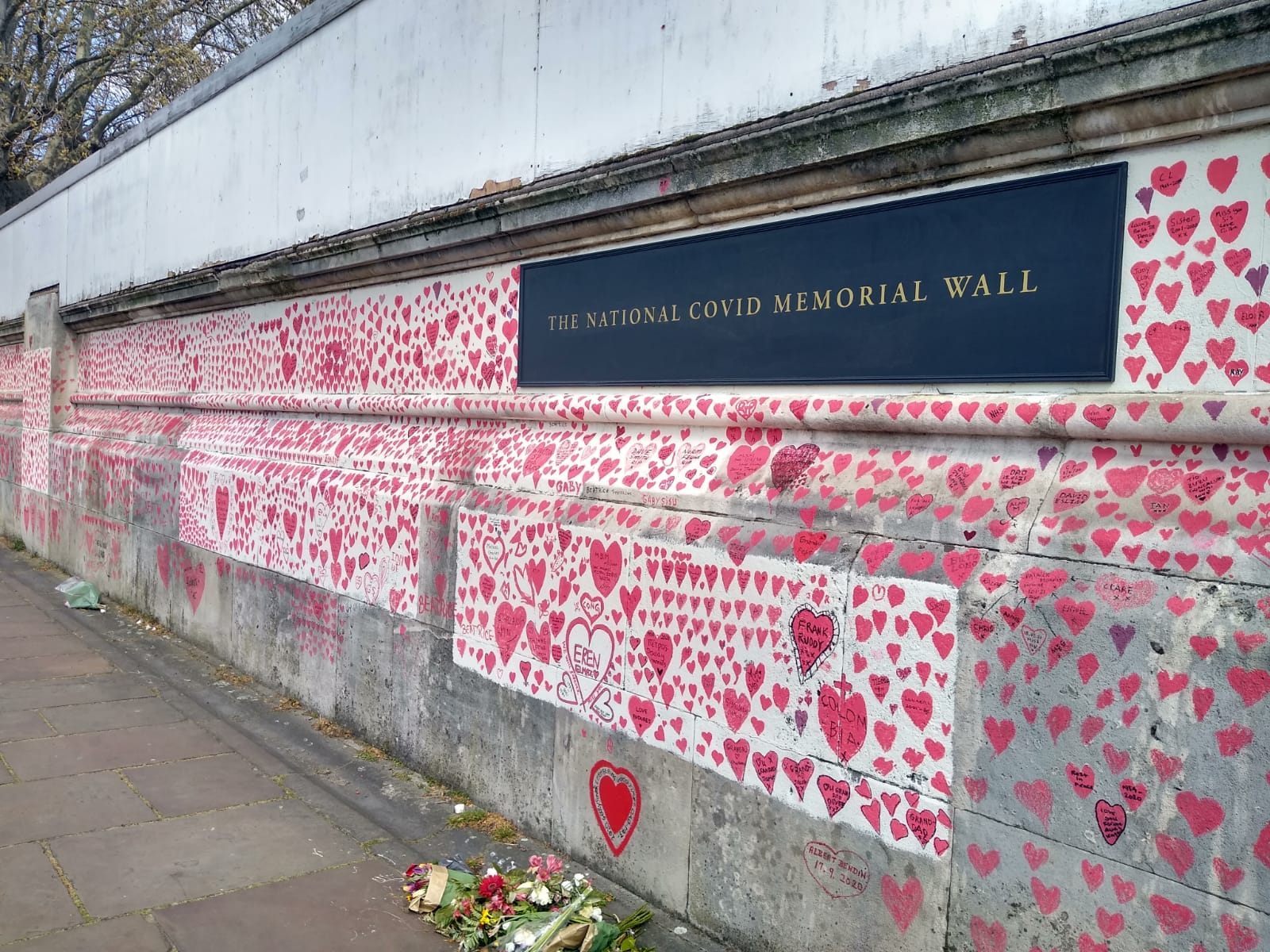
It would be easy to file this report as history: a verdict on decisions taken six years ago by a government long gone. That reading misses what Hallett is actually doing. Module 6 is not primarily an argument about 2020; it is an argument about the structure of the British state, which organises a crisis around the institution it can see — the NHS, with its beds, its dashboards and its nightly numbers — and discovers the institution it cannot see only when the bodies are counted. Social care in Britain is delivered by thousands of mostly private providers, a workforce larger than the NHS’s, with no single command structure, patchy data and, in England, not even a register of its own workers. In a pandemic, invisibility is not a neutral condition. It is the mechanism by which 25,000 untested patients can be moved into the highest-risk buildings in the country while the slogan claims a ring was thrown around them.
The numbers make the asymmetry concrete. More than 43,000 recorded deaths involving Covid-19 in care homes, out of roughly 500,000 people living in care at the time — close to one in every eleven residents. Covid-19 was the second leading cause of death in care homes across the period. Set that against the apparatus now judging it: an inquiry that has cost more than £200 million, the most expensive in British history, with the government spending a further £122 million-plus responding to it, and 55 recommendations already issued across its first reports before Module 6 added eight more. The bereaved families’ response to Tuesday’s report captures the tension: some of their representatives called it a “superficial damp squib” that holds no individual accountable, and said they would draw up their own demands to strengthen the recommendations. Hallett’s institutional answer is that accountability here is systemic — the absence of planning, over a decade, across governments of different parties in four nations. Both things can be true at once: a system failed, and no one person will carry the failure.
There is also a lesson in the report for any country reading it, and it is not really about Britain. Every advanced health system faces the same structural temptation in a fast-moving epidemic: empty the hospitals, because hospital collapse is televised and immediate, and let the consequences land somewhere quieter. Care homes are where that temptation ends. The Inquiry’s careful concession — that rapid discharge was necessary — is what makes its condemnation credible: the sin was not the discharge itself but discharging blind, without tests, without isolation advice, without spare capacity to separate the infected, and without having done any of the decade of preparation that would have made a safer version possible. Preparedness, in this report, is not a stockpile or a plan on a shelf. It is whether the least visible part of the system has been thought about before the week it starts dying.
The eight recommendations — and what happens next
Hallett’s eight recommendations are deliberately unglamorous, because the failures were unglamorous: (1) improve pandemic planning so structures, roles and responsibilities are clear before a crisis; (2) plan properly for the safe isolation of care home residents, including those discharged from hospital; (3) have financial support schemes ready to switch on so care staff can afford to self-isolate or limit movement between settings; (4) publish guidance on how visiting restrictions will be decided in a future pandemic; (5) keep inspection and oversight running, with protocols that allow on-site inspections to continue; (6) improve data collection on deaths across the adult social care sector; (7) make end-of-life care training mandatory for relevant health and social care workers; and (8) introduce a voluntary register for the social care workforce in England — Scotland, Wales and Northern Ireland already have registers — recognising and supporting the workforce. “My recommendations in this report must be acted upon now before the next pandemic strikes,” Hallett said.
The baton now passes to four governments. Hallett noted the action taken so far on earlier modules and said she expects all recommendations from all published reports to be implemented promptly and in full; progress is tracked on the Inquiry’s public monitoring page. The next report — Module 7, on Test, Trace and Isolate — is due on Thursday, November 19, 2026, with the final three modules (children and young people, the economic response, and the impact on society) following in the first half of 2027. Families’ groups, meanwhile, are preparing their own list of demands, arguing the recommendations need to be hardened into rules that force decisions before, not after, an outbreak reaches a care home.
For readers following the wider UK picture this autumn, the report lands in a season when the state’s numbers are again under strain — see our coverage of UK inflation at 3.5 percent and borrowing of £24.5 billion and of the decision to approve the Jackdaw gas field in the North Sea. But Module 6 is measuring something those stories cannot: whether a state that has now spent more than £200 million establishing exactly how it failed its most vulnerable residents intends to be ready next time. The 43,000 cannot benefit from the answer. The roughly half a million people living in care today are the ones waiting for it.
Sources
- UK Covid-19 Inquiry, Oct. 20, 2026: “Care sector ‘something of an afterthought’ with no so-called ‘protective ring’, Inquiry finds” (official statement of the Module 6 findings, recommendations, witness count and publication schedule) — https://covid19.public-inquiry.uk/news/care-sector-something-of-an-afterthought-with-no-so-called-protective-ring-inquiry-finds/
- The Guardian, via The Brief, Oct. 20, 2026: “UK Covid Inquiry says failures let virus spread ‘like wildfire’ in care homes” (25,000 discharges, April 15 testing date, High Court ruling, Hancock evidence, eight recommendations, inquiry cost) — https://www.thebrief.news/en/standard/article/34255/uk-covid-inquiry-says-failures-let-virus-spread-like-wildfire-in-care-homes
- PA Media, via Radio News Hub, Oct. 20, 2026: “Matt Hancock’s care home protective ring claim ‘unfounded’, Covid report finds” (Hancock’s May 15, 2020 words, “generational slaughter” evidence, Hancock declined to comment) — https://www.radionewshub.com/articles/news-updates/Matt-Hancocks-care-home-protective-ring-claim-unfounded-Covid-report-finds
- BBC News reporting summarised by BritBrief, Oct. 20, 2026: “Covid inquiry: care homes ‘afterthought’ as 43,000 died” and “Covid inquiry: essential carers should have entered care homes earlier” (DNACPR findings, Exercise Cygnus and the 2011 strategy, essential-carer recommendation) — https://britbrief.co.uk/health/public/covid-inquiry-care-homes-afterthought-as-43000-died.html
- Inside Housing, Oct. 21, 2026: “43,000 care home residents died as result of pandemic as claims of ‘protective ring’ were ‘unfounded’, inquiry finds” (approximately 500,000 people living in care; isolation-capacity failure) — https://www.insidehousing.co.uk/news/43000-care-home-residents-died-as-result-of-pandemic-as-claims-of-protective-ring-were-unfounded-inquiry-finds-99218
- Care Rights UK, Oct. 20, 2026: response of a Module 6 core participant (right to in-person visitors; Health and Care Partner amendment) — https://www.carerightsuk.org/news/covid-inquiry-report-on-care-sector
- Hello Rayo / Hits Radio, Oct. 20, 2026: the eight recommendations in full; Module 7 timing — https://www.hellorayo.co.uk/hits-radio/uk/news/uk-covid-inquiry-pandemic-planning-for-adult-social-care-an-afterthought