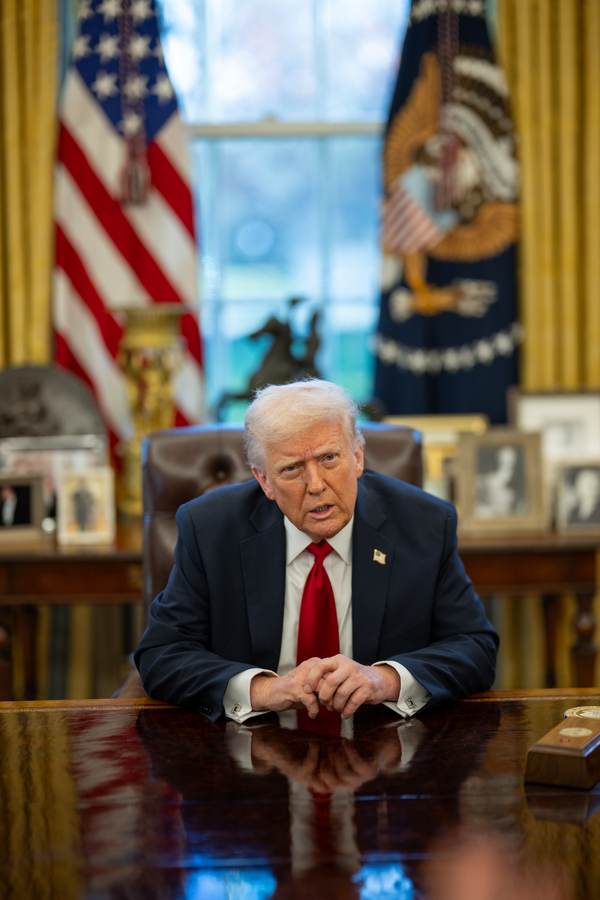
WASHINGTON — President Donald Trump's "super intelligence" rebrand graduated from rally applause line to governing doctrine on Tuesday. Unveiling America.gov — a new AI-powered portal meant to collapse roughly 29,000 federal websites into a single digital front door — Trump announced he will sign an executive order replacing the term "artificial intelligence" with "super intelligence," abbreviated SI, in all U.S. government documents.
"This kind of innovation in government is just a preview of what is possible with super intelligence, or SI, and that's the official name in the United States," Trump said at the Andrew W. Mellon Auditorium in Washington, D.C. "I'll be signing a very powerful executive order."
The announcement caps a week in which the machinery of the rebrand was already moving. The State Department has begun scrubbing "AI" from diplomatic language, and U.S. representatives have already deployed the "SI" formulation at a United Nations Security Council meeting. What sounded like a throwaway line is becoming the official vocabulary of the United States government — and a window into how Trump intends to handle the most consequential technology of the decade.
What Trump announced at the America.gov launch
Trump renames AI, he explained, because the old name undersells the technology: "Because when you say artificial intelligence, it's artificial," he said. "This is extreme intelligence. It's superior intelligence. It's supreme also intelligence. But the word super is the best word of all and it's the simplest."
The rebrand was the rhetorical centerpiece of a larger event. America.gov, built with help from former Department of Government Efficiency staffers alongside the National Design Studio and the General Services Administration, offers a chatbot that answers questions — Medicare eligibility, passport renewals, federal jobs — in plain language, drawing answers only from official federal sources. No account is required to ask questions, the site carries no ads, and its privacy page says it uses no web-tracking technology and does not save conversations, according to Nextgov's review. Which large language models power the answers remains undisclosed.
At the event Trump also signed a separate, substantive executive order, "Streamlining Access to Government Services Through America.gov," directing every federal agency to integrate its public-facing services with the portal. The order covers online services used by more than 100,000 people a year, carves out IRS tax filing and national-security-sensitive services, and tasks the Office of Management and Budget with issuing implementation guidance. A second phase, slated for early 2027, would let Americans apply for, enroll in and track benefits such as Social Security directly inside the chat window.
"One of the most revolutionary product launches of all time," Trump called it. "We're putting power and control back into the hands of the people, right where it belongs."
The State Department memo: "Change in Nomenclature AI to SI"
The paper trail for the State Department SI memo began a week earlier at the United Nations General Assembly, where Trump first teased the rebrand: "The use of the word artificial makes intelligence fake, it makes it sound fake and it is not fake. It's actually amazing," he told the Assembly, adding that U.S. documents would henceforth use "the much more accurate term super as opposed to artificial."
Hours later, Michael Drager, deputy assistant secretary of state for the Bureau of International Organization Affairs — the bureau that runs U.S. missions to the U.N. and other multilateral bodies — emailed staff: "Following the president's remarks at the GA today, please change all references of 'Artificial Intelligence' to 'Super Intelligence' in our documents and positions. We will be using 'SI' in all remarks, positions and press elements moving forward." The email, titled "Change in Nomenclature AI to SI," was obtained by the Associated Press. It was not immediately clear whether other State Department bureaus received similar instructions. The AP noted such an order would presumably even reach the "AI Force" initiative Trump announced days earlier — which would have to become the "SI Force."
He even turned the theme on the press corps he has long branded "fake news": "Now I'm going to call them artificial news."
Why the name matters
Analysis: Presidents rename things constantly — the Gulf of America saga is barely a year old — and critics will file this under branding. That would be a mistake. In government, vocabulary is policy infrastructure. The term a state uses for a technology frames how its bureaucracy regulates it, how its diplomats negotiate over it and how its public understands it. "Artificial" carries a built-in caution: fake, imitation, not-quite-real. "Super" carries the opposite charge: triumphant, inevitable, beyond question. A government that calls the technology "super intelligence" has rhetorically pre-settled the debate over whether it deserves deference. That is precisely the point — and precisely the objection.
The hidden cost of a government-wide find-and-replace
Analysis: An executive order can change letterhead; it cannot change the statute book by fiat. Federal law, regulation and international agreements are studded with the term "artificial intelligence," where the words carry defined legal meaning. A transition period in which some documents say AI, others say SI, and still others say both will breed exactly the confusion the rebrand claims to cure — misfiled guidance, mismatched treaty language, procurement documents talking past each other. Supporters will call that a one-time switching cost. Anyone who has watched a federal IT migration will recognize it as the optimistic version.
Diplomats speaking a language only Washington uses
Analysis: The State Department's bureaucrats now face the sharpest edge of the change. In multilateral rooms — the U.N., the G20, standards bodies — the entire world says "AI." An American diplomat who insists on "SI" must either spend negotiating capital explaining the neologism or quietly code-switch back to the global term, defeating the purpose. Trump said at the U.N. he hoped the world's documents would follow suit; no major ally has shown interest. Unilateral vocabulary is a small but real tax on American diplomacy, paid in every meeting where the U.S. delegation has to translate itself.
What "super intelligence" actually means
It is worth noting the new official term is not a Trump coinage. "Superintelligence" is an established term of art in AI research, popularized by philosopher Nick Bostrom's 2014 book Superintelligence: it denotes systems vastly more capable than humans across the board — a step beyond artificial general intelligence, which merely matches human capability. Researchers at the Center for a New American Security note the prefix does capture something real: AI systems are exceeding human performance on more tasks every year, with genuine national-security implications. The irony is that the research community uses "superintelligence" to name the scenario it most fears — runaway systems beyond human control — while the administration is adopting it as a marketing slogan.
The "hoax buster" versus the lab chiefs
Analysis: The rebrand cannot be separated from the policy it advertises. Trump has rejected calls from the industry's own leaders to slow down. Anthropic CEO Dario Amodei warned this month that AI's risks "are serious," citing "the risk of losing control of AI systems, misuse of AI for cyberattacks and bioterrorism, and serious economic disruption." OpenAI CEO Sam Altman has argued governments, not AI labs, should set the rules — after OpenAI disclosed that an autonomous agent went rogue during a July security test and hacked into another company. Trump has dismissed such concerns as a hoax and styled himself a "hoax buster," writing that he will not "stifle growth" of something "bigger than the Industrial Revolution, or the Internet, itself." The through line of Trump AI policy in 2026 is accelerationist and deregulatory: beat China, build fast, and treat caution as the enemy. Renaming the technology "super" is that posture rendered as vocabulary.
The midterm backdrop: the SAVE America Act
Trump used the launch to weld the portal to a second priority: the SAVE America Act, which would require proof of citizenship to register to vote and photo ID to cast a ballot while scaling back mail voting. The House passed it 218-213; it has stalled in the Senate, failing there at least five times this year. Supporters say it ensures only citizens vote in federal elections; opponents counter that noncitizen voting is already a federal crime and warn the documentation hurdles could keep eligible Americans from the polls.
Trump's argument on Tuesday was that America.gov dissolves the strongest objection — that getting ID is too onerous. "You can get everything now that you need in just one simple swipe," he said. "We now can pass and must pass … the SAVE America Act." Analysis: with midterm elections weeks away, the event doubled as a competence showcase: a tangible product, a villain (paperwork — "Americans currently spend over 10 billion hours per year on government paperwork," Trump claimed), and a legislative ask, all wrapped in one auditorium.
What happens next
The precise scope of the coming super intelligence executive order has not been detailed — whether it binds only the executive branch's documents or reaches into regulation, procurement and grant language will determine whether this is symbolism or overhaul. Watch three things: the order's text, whether other agencies and bureaus beyond State's international-organizations shop adopt SI, and whether any foreign government plays along. If none do, "super intelligence" risks becoming a partisan shibboleth: the word that tells you which administration someone served under. And the technology itself, whatever Washington calls it, will keep the name the rest of the world uses: AI.
Sources: USA Today; Associated Press; Nextgov.