Trump super intelligence accord typo
WASHINGTON — The Trump super intelligence accord typo turned one of the White House’s signature technology rollouts into a national punchline on Wednesday. The White House posted the signed “White House Accord on Super Intelligence: Joint Commitment on Frontier Responsibilities” to its social media accounts on September 30 — and directly beneath President Donald Trump’s signature, the document identifies him as “President of the Unites States,” misspelling “United” as “Unites.” Trump also shared the document on Truth Social, captioned: “Important conversation and we signed today the White House Accord on Super Intelligence.”
The names and companies of the other six signatories are spelled correctly. The error was first flagged publicly by Gizmodo reporter Matt Novak, and it traveled fast: within hours, the misspelling was the most-viewed part of a document meant to project American leadership over artificial intelligence. California Governor Gavin Newsom mocked the mistake on social media, users piled on — “We got a real problem when The White House can’t even spell ‘United States,’” one widely shared post read — and by Wednesday afternoon the typo had eclipsed the policy. The White House did not immediately respond to requests for comment, a silence noted in the reporting by USA Today, TechCrunch and People.
Why this matters
Start with the surface irony, because it is real: a document about intelligence misspells the name of the country it claims to lead. Presidential documents are supposed to be among the most proofread pages on earth, and a signature page carrying the nation’s name in error raises a plain process question — who looked at this before it went public, and why did no one catch it between the September 29 signing and the September 30 posting?
The deeper stakes are what the mockery buried. The accord is the administration’s answer to one of the most consequential governance questions of the decade: who polices the most powerful AI systems, and with what authority? A viral typo is comedy; the substance underneath is a voluntary framework with no enforcement. When the laugh fades, that question is still on the table, and it deserves a harder look than the internet gave it on Wednesday.
How the typo was found — and why it spread
Novak spotted the misspelling in the version the White House posted to X, and the discovery did what typo stories do on social media: it spread faster than the document itself. The image is instantly legible — a single wrong letter, circled in red by thousands of quote-posters — and it arrived pre-loaded with a storyline about competence at the top.
Newsom’s mockery amplified it into partisan theater, and the pile-on followed the familiar physics of internet ridicule. It is worth keeping a sense of proportion: White House documents have carried embarrassing errors under presidents of both parties, and a misspelling is not a policy. But proportion cuts both ways. The administration chose to make this document a set piece of its AI leadership push, posting it across official accounts; the unforced error was its own, and the criticism it drew was correspondingly loud.
Background: the September 29 luncheon that produced the accord
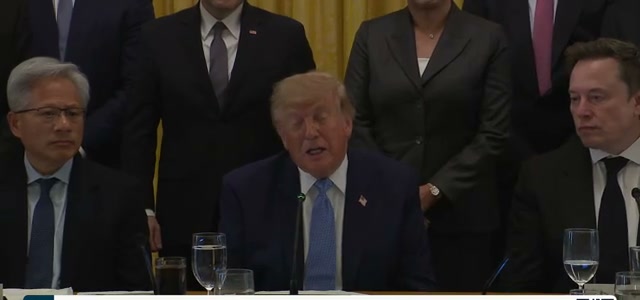
The document was signed Tuesday at the White House’s “Super Intelligence Luncheon” in the East Room. Seven names appear on it: Trump, Google CEO Sundar Pichai, Anthropic CEO Dario Amodei, Meta CEO Mark Zuckerberg, OpenAI President Greg Brockman, Nvidia CEO Jensen Huang and Elon Musk of SpaceX. OpenAI CEO Sam Altman was notably absent, attending his company’s San Francisco conference instead.
The signing capped a long-running argument inside the industry about how fast frontier AI should move. Altman, Amodei and Musk have each, at different moments, called for slowing down or pausing the most aggressive development — warnings about systems outpacing our ability to control them. Trump and Huang have rejected that framing, arguing that America must win the AI race against China and that deceleration would hand the advantage to Beijing. The luncheon compressed both positions into one room: the people warning about the technology’s dangers sat beside the people racing to build it, and the compromise was the accord itself. Our analysis of the White House AI luncheon examined who was at the table and what the seating chart revealed about the balance of power.
What the accord actually contains
The full title is the “White House Accord on Super Intelligence: Joint Commitment on Frontier Responsibilities.” Trump has described it as “morally binding,” with a “tremendous self-policing aspect,” and compared it to “almost like a constitution.” In substance, it lays out four layers of AI safety oversight: internal monitoring by the companies themselves, dedicated internal safety teams, review by independent auditors, and oversight at the board level.
What it does not lay out is consequences. TechCrunch notes there are no legal or regulatory ramifications for a signatory that breaks the pledge — compliance is voluntary, and enforcement is reputational at best. That is the core of the criticism: a self-policing promise written and monitored by the companies it is meant to constrain. Bill Gates told NBC News, “No one thinks self-regulation is enough,” a line that has become the skeptics’ shorthand for the whole exercise. The industry’s counterargument is that speed matters — that binding rules would slow American development while rivals keep building — but even on its own terms, the accord asks the public to trust the signatories to grade their own homework.
The rebrand, the executive order and America.gov
The typo story landed on a day the White House was already making AI news on two other fronts. Trump signed a separate executive order directing all federal agencies to refer to “artificial intelligence” and “AI” as “super intelligence” and “SI” in public communications, websites, reports and materials — saying the new term “more appropriately captures the promise, potential, and rapidly advancing capabilities of these technologies.” He also launched America.gov, an AI-powered federal services website intended as a single front door for dealing with Washington.
The rebrand is pure Trump: change the vocabulary, change the debate. Whether “super intelligence” survives contact with researchers, companies and international bodies — none of whom answer to the executive order — is an open question. Our coverage of the ‘super intelligence’ order breaks down what the renaming requires of agencies and where it is likely to stop.
Who wins, who loses
The six CEOs win first. A voluntary framework is the lightest possible governance: no binding rules, no penalties, no outside authority with real power over their roadmaps. They get the legitimacy of a White House signing ceremony and the substance of the status quo. For companies racing each other on capabilities, that is the ideal outcome.
The White House wins the headline and loses the day. The administration wanted September 30 to be about AI leadership — the accord, the executive order, America.gov. Instead the day’s defining image is a misspelled word. The policy substance survived the mockery intact, but the communications shop that let a typo through on a signature document now owns the story.
Critics of self-regulation get an assist they didn’t need. The typo is irrelevant to whether four layers of oversight can work, but symbolism matters in politics. A document that cannot spell the country’s name invites the question of what else it got wrong — and Gates’s “no one thinks self-regulation is enough” line now travels with a punchline attached.
Newsom gets his theater. Mocking the typo costs the California governor nothing and buys him a news cycle as the administration’s chief heckler — a role he has clearly decided to keep.
The public loses the debate it deserved. The serious questions — who audits the auditors, what happens when a company ships despite a failed safety test, whether a voluntary pledge survives its first real conflict — got less attention on Wednesday than a single letter. The typo will be forgotten; the answers to those questions will shape the next decade.
What the numbers mean — and what happens next
Seven signatures, four oversight layers, one misspelling, zero enforcement mechanisms. Those four figures are the whole story in miniature: a serious-looking governance framework, built on trust, announced with a typo.
A corrected version is the first test. The White House has not said whether it will reissue the accord with “United States” spelled correctly. Issuing one is trivial; the interesting question is whether the administration treats the error as worth fixing on a document it calls almost a constitution. USA Today notes it is unclear whether the accord will appear in the Federal Register the same way as the executive order — and if it does, which version counts.
The rebrand’s follow-through is the second test. Agencies answer to the executive branch, so “super intelligence” will likely appear in federal materials quickly. Researchers, companies and foreign governments have no obligation to follow. If the phrase remains government branding while the technical world keeps saying “AI,” official documents could end up speaking a different language than the field they describe.
The next safety incident is the decisive audit. A voluntary accord gains legitimacy if signatories disclose failures quickly, contain the damage and submit to credible outside review. If they delay, minimize or dispute what the pledge requires, the document will look less like a constitution than a press release — typo and all.
Sources and reporting notes
- USA Today: White House accord on super intelligence misspells “United States”
- TechCrunch: Pledge signed by President Trump and top AI leaders misspells the United States
- People: Trump signs new super intelligence agreement with major typo below signature
Reporting basis: The typo, the signatories and the White House’s lack of immediate comment are reported by the cited outlets. Descriptions of the accord’s voluntary character and the four oversight layers come from the White House’s public statements and the cited reporting; enforcement details had not been disclosed at publication.