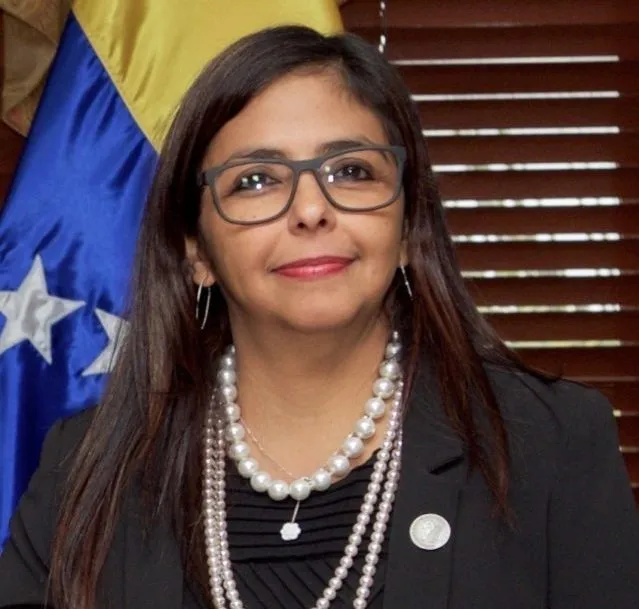
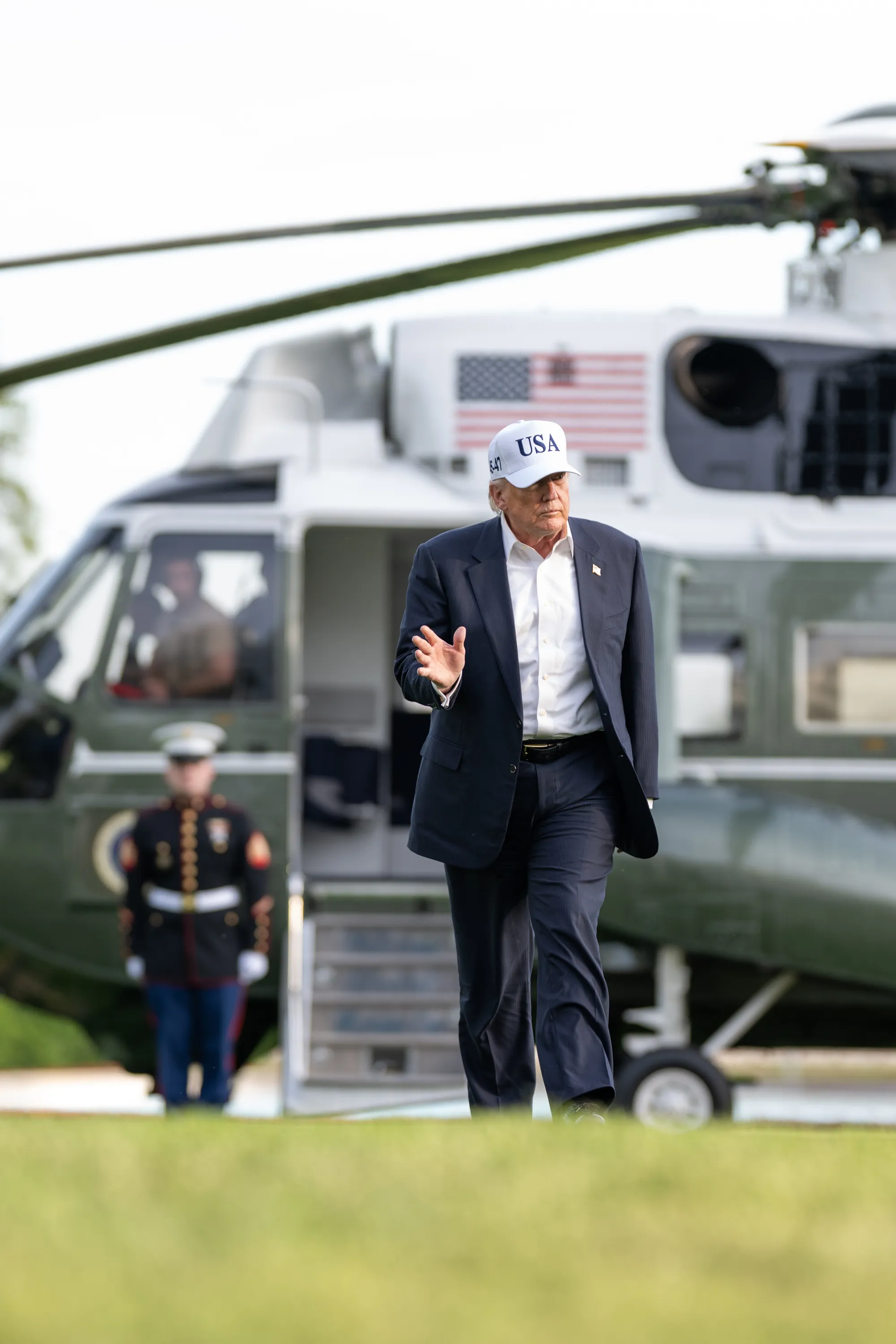
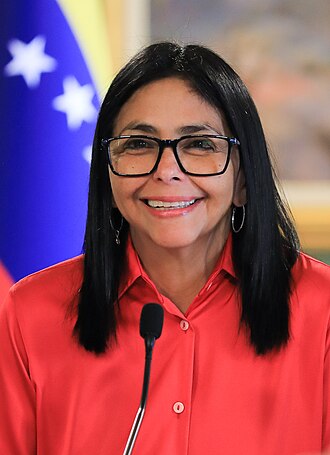
Trump meets Delcy Rodriguez is now more than a search phrase for an unlikely diplomatic encounter. It marks a strategic turn in U.S.–Venezuela relations: President Donald Trump and Venezuela’s interim president held their first face-to-face meeting Tuesday evening on the sidelines of the United Nations General Assembly, less than nine months after U.S. forces captured and deposed Nicolás Maduro in a January raid.
The pull-aside occurred at a Trump-hosted reception at New York’s Lotte Palace Hotel. Rodríguez described it afterward as a “historic meeting” focused on energy, mining, security and other areas of common interest. Trump had used his General Assembly speech hours earlier to praise an oil agreement signed with Caracas last month, declare that “to the victor belong the spoils” and say he wanted $100 billion of investment to flow into Venezuela’s oil industry.
Confirmed: the two leaders met; both governments sent senior economic and security officials; and the publicly stated agenda centered on bilateral cooperation. Not yet confirmed: a project list, binding investment commitments, election timetable, sanctions schedule or public text spelling out who controls which oil assets. The distance between a political target and signed, financeable projects is the central uncertainty.
Why this matters
The meeting matters because it shows what Washington has chosen to prioritize after the Maduro raid. The administration could have made electoral transition the organizing principle of the relationship. Instead, the announced agenda puts oil, investment, mining and security first. That choice may stabilize a country with enormous resources and degraded infrastructure, but it risks converting a military victory into a bargain with much of the old governing apparatus still intact.
Rodríguez was Maduro’s vice president and spent more than two decades inside the Chavista system. Her new role gives the United States a partner who understands the state, the oil sector and the coalition that survived Maduro’s removal. That continuity can make agreements executable. It also means a change at the presidency has not automatically produced a democratic transfer of power.
The opposition sees the trade-off clearly. Critics say Washington has sidelined the movement led by María Corina Machado and softened its insistence on free elections in favor of economic agreements with the interim government. More than 50 protesters gathered outside the U.N. Tuesday with signs including “No Vote No Oil” and “New Face, Same Regime.” Their argument is not that Venezuela needs no investment. It is that access to oil money can strengthen an interim administration before voters have settled who should govern.
Signal Post News analysis: Trump’s approach is best understood as transactional state-building. It seeks quick, measurable cooperation from officials able to command ministries and PDVSA, while postponing the harder question of political legitimacy. The potential gain is administrative speed. The risk is that economic normalization becomes the substitute for a transition rather than leverage to secure one.
What happened Tuesday
Reuters reported that the meeting had been scheduled for 7:40 p.m. local time at the president’s reception during the General Assembly. It was Rodríguez’s first trip to the United States since taking office. Her delegation included Venezuela’s vice president of economy, oil minister and officials from state oil company PDVSA. Two people close to the delegation told Reuters that the group was focused on presenting Venezuela as “investable.”
The White House side included Secretary of State Marco Rubio, Treasury Secretary Scott Bessent, chief of staff Susie Wiles and deputy chief of staff Stephen Miller, according to the administration’s account reported by the New York Post. That roster suggests the conversation was not ceremonial. Rubio brings the regional and diplomatic portfolio; Bessent sits at the intersection of sanctions and capital; Wiles and Miller represent presidential decision-making and domestic political priorities.
Rodríguez wrote on X that the two governments discussed strengthening bilateral ties and advancing cooperation in “strategic areas such as energy, mining, and security.” She also thanked the Trump administration for support after Venezuela’s June 24 earthquake and for backing what she called the country’s reintegration into multilateral institutions. Her Telegram and X posts are primary-source descriptions of Venezuela’s position, not an independent record of every exchange inside the room.
No detailed joint communiqué was available in the source material reviewed for this article. Neither side publicly announced a new election commitment, an enforceable investment schedule or the allocation of oil revenue. A photograph and positive statements establish political intent; they do not by themselves establish the terms or durability of an economic settlement.
The encounter unfolded during a U.N. week already dominated by Trump’s interventionist foreign-policy message. His broader address included an explicit threat against Iran; our analysis of Trump’s UNGA speech and Iran warning examines how coercion and deal-making appeared together in the same doctrine. The Venezuela meeting supplied its Western Hemisphere example.
Background: from the January raid to the oil deal
U.S. forces captured then-president Nicolás Maduro in a January operation that ended his rule and placed him in federal custody in Brooklyn pending trial on drug-trafficking charges. The raid created a vacuum but did not erase Venezuela’s institutions, security networks or economic emergency. Rodríguez, previously vice president, became the figure with whom Washington built a working relationship.
Trump used his Tuesday U.N. speech to describe Maduro as an “outlaw dictator” and the raid as evidence that the United States would use its military power to defend its interests in the hemisphere. He also said hundreds of political prisoners had been released since the capture. That prisoner figure was a presidential claim in the reviewed reporting; a complete public list and independent case-by-case verification were not provided there.
The relationship then moved from coercion to commerce. Trump said the United States and Caracas signed an oil agreement last month and called it “perhaps the biggest deal ever made.” The phrase “US Venezuela oil deal 100 billion” captures the scale of his ambition, but it should not be mistaken for cash already invested. Reuters reported that Trump wants $100 billion in investment to flow into the industry. The New York Post described the agreement as giving the United States control connected to more than 65 billion barrels of proven reserves, yet the available accounts do not publish the operative contract language needed to test the legal breadth of that claim.
Rodríguez’s delegation arrived in New York Monday and held talks on energy, mining and debt with U.S. officials, companies and multilateral lenders, according to people familiar with the discussions cited by Reuters. The Inter-American Development Bank’s president was working to secure approval for a $2.5 billion Venezuelan loan, but some board members were resisting. That financing fight is an early test of whether diplomatic momentum can be converted into institutional consent.
The background therefore runs on two tracks. One is the extraordinary use of force that removed Maduro. The other is a rapid effort to reconnect Venezuelan resources to capital and U.S. policy. The administration presents those tracks as a sequence: pressure produced concessions, and concessions opened space for investment. Critics see a different sequence: military power displaced one leader, then commercial priorities displaced the opposition.
Who wins and who loses
Trump and U.S. energy interests could gain leverage. A functioning partnership with Caracas could give Washington more influence over a vast petroleum base, create openings for oilfield service companies and offer another source of supply in a market shaped by conflict and sanctions. Trump also gets a concrete story for the doctrine summarized in his “to the victor belong the spoils” line: military pressure followed by an economic agreement favorable to U.S. interests.
Rodríguez gains recognition and room to govern. A photograph beside a U.S. president at UNGA is political capital. It allows her to present herself as the official able to deliver sanctions relief, financing, reconstruction and international reintegration. If investment begins before an election timetable is fixed, her administration may also gain resources and institutional durability that its rivals lack.
Venezuela’s economy could benefit—but distribution is decisive. Oil production requires capital, equipment, power, skilled labor and predictable rules. Investment could lift output, restore wages and create fiscal capacity for services. Those gains are not automatic. If contracts are opaque, revenue is diverted, or environmental and labor safeguards are weak, the headline figure could enrich political and commercial insiders without repairing daily life.
Machado and the democratic opposition face the clearest political loss. Her team said she made three unsuccessful sea and air attempts to return to Venezuela in recent hours, part of seven reported failures since she left clandestinely nine months ago. Reuters said the State Department had privately urged her to postpone a return after June earthquakes and opposed those efforts. ABC, the Spanish newspaper that first reported details, did not explain who blocked the attempts.
Those facts do not prove a formal U.S. decision to abandon Machado. They do show a stark asymmetry: Rodríguez can travel to New York, meet Trump and market Venezuela to investors, while the Nobel Peace Prize laureate who became the opposition’s central figure remains in exile. Until Washington ties economic benefits to a transparent political process, the interim government has more immediate bargaining power than its democratic rival.
Maduro’s old coalition is divided between survival and exposure. Officials who cooperate may preserve influence under a new arrangement. Others could face prosecution, sanctions or exclusion. Maduro himself remains detained and awaiting trial. The governing system he led, however, cannot be reduced to one person, which is why Rodríguez’s institutional continuity is both useful to Washington and alarming to opponents.
What the numbers actually mean
$100 billion is a target, not a transfer. Trump has said he wants that amount invested in Venezuela’s oil sector. It could combine private capital, reinvested revenue, lending, equipment and commitments spread over years. Without a published schedule, named investors or final contracts, it cannot responsibly be reported as money secured or spent.
More than 65 billion barrels is a resource claim, not a production forecast. Proven reserves describe oil judged recoverable under specified economic and technical conditions. They do not say how quickly barrels can be produced, at what cost, with what quality discount or under whose operational control. Venezuela’s heavy crude, aging infrastructure and long period of underinvestment turn reserve size into an opportunity only after financing and execution.
$2.5 billion is the more immediate institutional test. The proposed Inter-American Development Bank loan is much smaller than the oil-investment aspiration, but it requires approval from a multilateral body whose members may demand governance conditions. Board resistance would show that a Trump–Rodríguez understanding does not automatically bind lenders or allies.
Three recent failed return attempts—and seven overall—measure political exclusion rather than economics. Machado’s inability to re-enter Venezuela is not a footnote to the investment story. It is an indicator of whether the post-raid order is opening or closing political competition. Because the reporting does not identify who stopped each attempt, responsibility should not be assigned beyond the available evidence.
More than 50 protesters is a small crowd, not an opinion poll. The New York demonstration made a clear argument linking votes to oil, but it cannot quantify Venezuelan public opinion at home or abroad. Its significance is qualitative: the electoral question followed Rodríguez to the place where she was seeking international legitimacy.
The numbers reveal a hierarchy. The largest figure—$100 billion—is the least concrete. The smaller loan is closer to a formal decision. The return-attempt count documents a recurring political obstacle. Good analysis keeps those categories separate rather than adding them into a single story of inevitable normalization.
What happens next
Rodríguez is expected to address the U.N. General Assembly Wednesday afternoon. Her speech will be watched for three things: whether she supplies details on the oil framework, whether she offers a timetable for elections and whether she defines security cooperation in ways that preserve civil liberties. The phrase Delcy Rodriguez UN General Assembly address will matter only if the speech moves beyond diplomatic language into commitments that can be measured.
Washington’s next moves are financial and legal as much as diplomatic. Treasury can shape sanctions relief and licensing. Companies must decide whether contracts are bankable. Lenders must assess debt sustainability and governance. Congress may press the administration on the legal basis and strategic purpose of the oil arrangement. None of those actors is bound simply because the presidents met.
The administration’s simultaneous handling of Iran shows why energy policy cannot be separated from security strategy. Our report on Iran’s disputed Hormuz reopening offer tracks another negotiation in which oil flows, military pressure and ambiguous terms move together. The wider Trump UNGA diplomacy briefing places the Venezuela meeting alongside the week’s other high-stakes bilateral talks.
For the opposition, the practical test is whether Machado can return safely and participate in an open political process. For Rodríguez, it is whether “investable” becomes more than a slogan—whether PDVSA governance, debt terms, contract enforcement and infrastructure improve. For Trump, it is whether a resource-centered bargain can deliver stability without making the United States responsible for an opaque settlement or a stalled transition.
Confirmed direction: the two governments are pursuing cooperation and the interim leadership is actively courting investment. Unresolved outcome: who controls the projects, how benefits reach Venezuelans, whether elections advance and how durable the arrangement would be under political or legal challenge. The meeting changed the relationship’s optics immediately. Its substance will be judged by published terms, barrels produced, money actually committed and political rights restored.
Sources and reporting basis: Reuters, September 22; Reuters, September 23; New York Post, September 23, including its reproduction of Rodríguez’s X statement and White House participant list; and TBS News/AFP for the Telegram statement. Rodríguez’s public X and Telegram posts from September 22–23 were treated as attributed primary-source claims. Signal Post News did not independently attend the private meeting; analysis is labeled and uncertainty is stated where the reviewed sources do not provide documents or independent verification.