Trump Columbus Day
Trump Declares 'Days of Plunder Are Over' in Columbus Day Push: Statues 'Back, More Magnificent Than Ever'
The post arrived on Sunday, the day before the holiday, and it was not a pro-forma greeting. "HAPPY COLUMBUS DAY TO ALL, in particular our great Italian American Community which was forced to suffer as the Radical Left Dumocrats, Socialists, and Communists rampaged through our cities and towns ripping down almost all of the beautiful statues of Christopher Columbus," Trump wrote on Truth Social. "Well, those days of plunder are over, and the statues are back, more magnificent than ever. This is a big day for our great Italian American Community, and the Country of Italy itself, maybe the biggest. Congratulations!"
On Monday he followed it with the formal machinery of the presidency: a Columbus Day proclamation declaring Oct. 12 as Columbus Day — pointedly not Indigenous Peoples' Day — and recognizing Columbus as one of history's greatest heroes. Columbus Day, observed on the second Monday of October, has been a federal holiday since 1937 and was moved to its Monday slot in 1971. The fight over what the day means is older than the holiday's current form, and this year the president did not merely referee it. He took a side, loudly, and pointed to physical evidence: statues that are, in fact, going back up on federal ground.
What 'the statues are back' actually refers to
The claim was not only rhetorical. In the days before the holiday, the White House held a Columbus Day celebration at which a marble statue of Columbus took its place on the White House grounds, by the Rose Garden — a replica reported to have been fashioned from fragments of the Columbus statue that protesters pulled down in Baltimore on July 4, 2020, and threw into the harbor. "I resurrected Christopher Columbus," Trump said of the installation. "He's been rehabbed 100 percent." A presidential proclamation issued this month celebrated Columbus's courage, pledged to safeguard his story, and vowed never to allow his legacy to be erased.
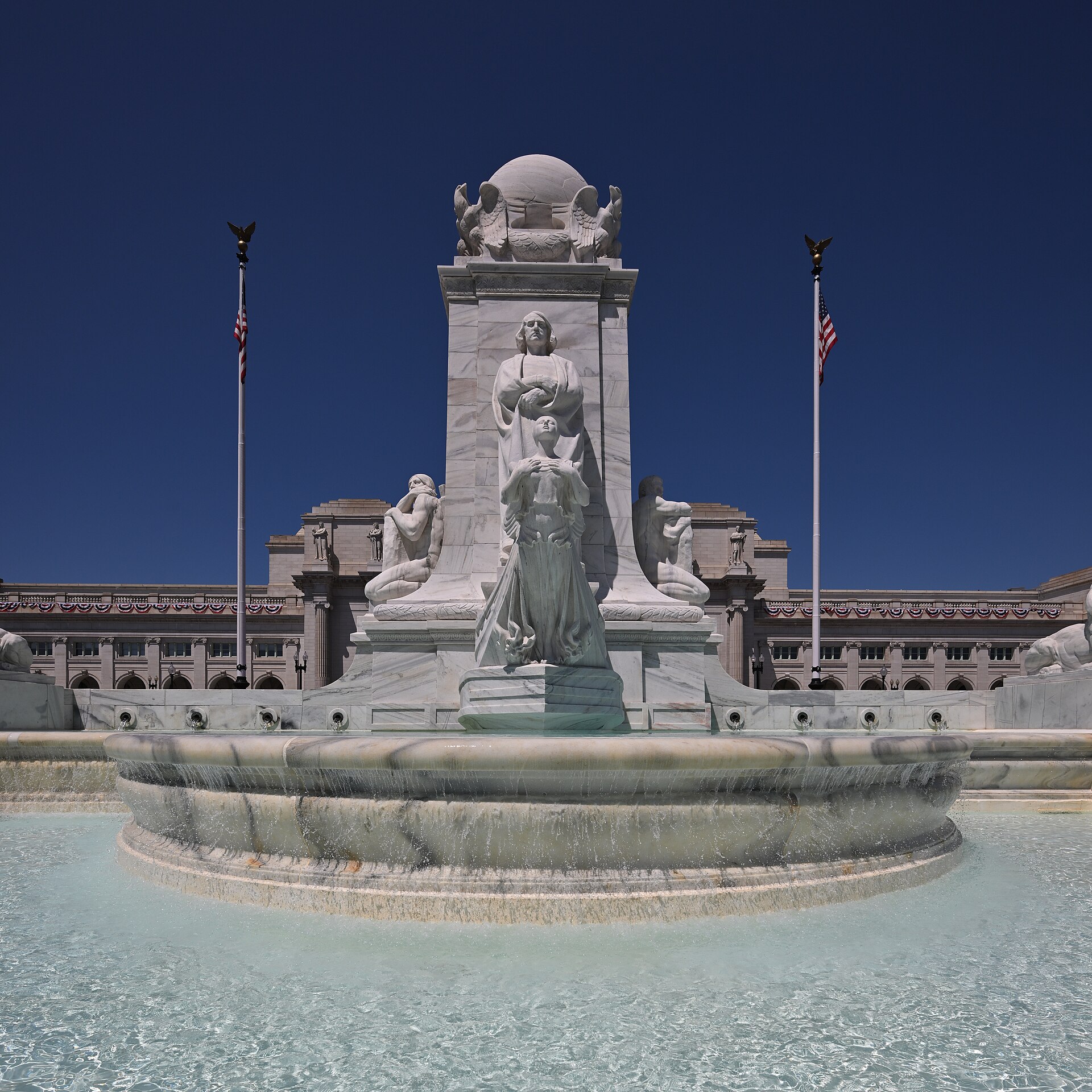
The centerpiece of the restoration effort predates the holiday. The Christopher Columbus Memorial Fountain, the marble monument that has stood in front of Union Station in Washington since 1912, had been broken since 2007 — dry for 19 years. The administration repaired it, and the fountain was reopened in May, running again a short walk from the Capitol. For a presidency that trades in symbols, the fountain was the perfect one: a Columbus monument the federal government itself had let decay, restored by the federal government itself, on the record, in the capital.
How the statues came down
The removals Trump described were real, if not quite as total as "almost all." During the protest wave of 2020, Columbus statues became a focal target: demonstrators toppled them, cities removed them by council vote, and others were hauled into storage. The Baltimore statue went into the harbor on Independence Day 2020. A Washington Post and MIT analysis counted at least 40 Columbus monuments removed since 2018, most of them in 2020 and 2021; other tallies of the 2020 wave count more than 30 statues toppled, vandalized or removed in a single season. In many cities the removals were fiercely contested by Italian-American organizations, for whom the statues were not abstract history but monuments their own communities had raised — in Baltimore's case, dedicated in 1984 with a president in attendance.
That conflict — between the communities that built the monuments and the movements that pulled them down — is the terrain Trump has been working since his first term, when he signed an executive order on protecting American monuments and promised prison terms for vandals. His Columbus push this year is the affirmative version of the same argument: not only punish the toppling, but reverse it.
The other side of the holiday
The counterargument has its own federal history. In 2021, President Joe Biden issued the first presidential proclamation of Indigenous Peoples' Day, observed on the same second Monday of October, and repeated it through his presidency. A number of states and many cities now mark Indigenous Peoples' Day instead of, or alongside, Columbus Day — the arrangement Trump has pushed to refocus since returning to office.
Advocates of the change argue that honoring Columbus glorifies what followed his 1492 landfall: colonization, enslavement and catastrophic violence and disease visited on the Native peoples of the Americas. From that view, the statues are not neutral heritage but public honors for the man whose voyages opened that era, and a holiday in his name asks Native Americans to celebrate the beginning of their dispossession. Critics of the Columbus story also note that he was not the first European to reach the Americas — the Norse explorer Leif Erikson made the crossing centuries earlier — and that Columbus never set foot on the mainland of what became the United States. For Indigenous Peoples' Day supporters, the second Monday in October should recognize the peoples who were here first and who survived.
Why Columbus became an Italian-American symbol
Understanding why the fight is so durable requires the older history. Columbus Day's roots in American life run through one of the ugliest episodes in Italian-American history: in 1891, eleven Italian immigrants were lynched in New Orleans after a trial that became a national scandal. The following year, President Benjamin Harrison proclaimed a one-time national Columbus celebration for the 400th anniversary of the voyage — a gesture made in part to ease the diplomatic and communal wound. Italian-American communities, then facing open discrimination, embraced Columbus as an American hero who was also theirs: a founder figure who proved they belonged. Franklin D. Roosevelt made Columbus Day a national holiday in 1937.
That is the constituency Trump's message addressed by name — "our great Italian American Community" — and it is why statue removals landed, for many Italian Americans, not as historical correction but as a community's hard-won place in the American story being renegotiated without them. Both readings of the same statues — heritage and harm — are sincerely held, which is why every October now produces the same argument in city councils, statehouses and, this year, from the president himself.
What happens next
Presidential proclamations are annual, and nothing about Monday's settles the underlying map. States and cities will keep choosing their own observances — Columbus Day, Indigenous Peoples' Day, both, or neither — because the federal holiday binds federal offices, not local calendars. Statues on federal ground, like the Rose Garden figure and the Union Station fountain, are within a president's power to restore; statues in city squares belong to the cities, and most of the monuments removed in 2020 remain in storage, in museums or in litigation rather than back on their pedestals. Trump's claim that "the statues are back" is, for now, most literally true within sight of the White House.
But the direction of the federal government is the story of this Columbus Day. A president who declares the "days of plunder" over, installs the explorer by the Rose Garden, repairs his fountain and signs his proclamation has made the federal position unmistakable — and guaranteed that next October's argument starts from a new fact on the ground: some of the statues really did come back.
Sources: USA Today (Oct. 12, 2026); New York Post (Oct. 11–12, 2026); White House Columbus Day proclamation and celebration (October 2026); Washington Post / MIT monument-removal analysis. Photograph: G. Edward Johnson / Wikimedia Commons (CC BY 4.0).