Trump doubles down San Antonio
Politics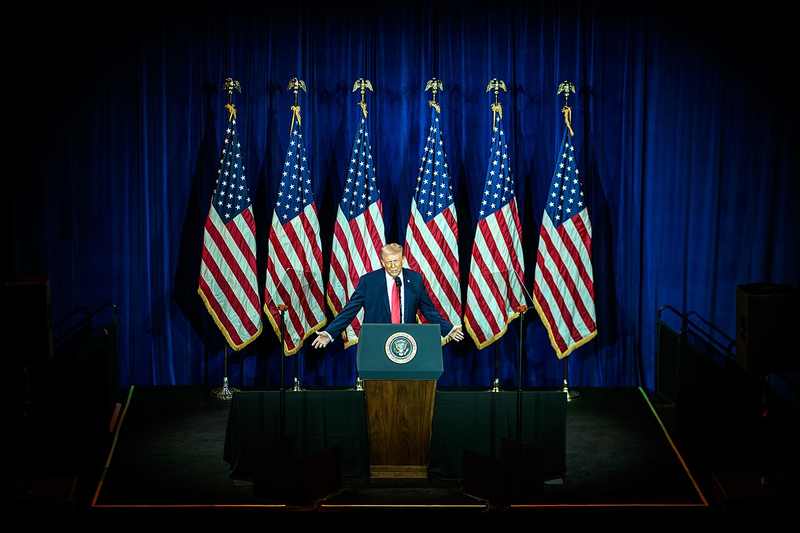
SAN ANTONIO — President Donald Trump stood before a midterm rally crowd at Freeman Coliseum on Wednesday night, October 7, and did something presidents almost never do: he repeated the line. "I said it the other day," Trump told the audience, "let them hit a missile into San Diego or Los Angeles on the way. Let them hit." It was the second time in three days that the president of the United States had mused aloud about an Iranian attack on two American cities — and by Thursday morning, the mayor of one of those cities was calling on Congress to investigate him.
In the shorthand the internet will surely adopt, this was the "Trump doubles down San Antonio" rally. The remark landed differently than it had on Monday in Grand Island, Nebraska, where Trump had first said Iran could "take out" Los Angeles and San Diego at "a very small price to pay." In San Antonio the line came back with new flourishes — a "horror show," a country in "free fall" — and it drew a same-week rebuttal from Los Angeles Mayor Karen Bass, who said she had already called lawmakers in Washington to push for a congressional investigation into the president's conduct.
Strip away the spin and the facts of the night are straightforward. Trump revisited his Monday remarks, expanded them, kept his caveat — "We protect our cities, we protect our country... We're not letting that happen" — and folded the whole episode into a midterm rally for Texas Senate candidate Ken Paxton, less than four weeks before the November 3 elections. The White House and his supporters will call it vivid deterrence rhetoric aimed at Tehran. The mayor of Los Angeles calls it a danger to her city. The distance between those two readings — and what it reveals about this presidency, this war, and this campaign — is the real story.
Why this matters: the second time changes everything
In politics, the first instance of a startling line can be filed under ad-lib — the improvisational excess of a president who has always governed partly by riff. The second instance, delivered from a rally stage two nights and a thousand miles later, is a choice. That is the first reason Wednesday night matters: repetition converts a remark into a position. Whatever Trump meant on Monday in Nebraska, by Wednesday in San Antonio he had decided the line was worth keeping.
The second reason is institutional. It is one thing for a governor or a cable-news panel to denounce a president's rhetoric. It is another for the sitting mayor of America's second-largest city to respond by demanding that Congress investigate the president's conduct. Congressional investigations of presidential speech are vanishingly rare in American history, and whether Bass's demand goes anywhere, its existence marks an escalation: a municipal leader treating a president's rally remarks not as politics to be answered with politics, but as conduct to be examined by the legislature.
The third reason is strategic, and it is the one national-security professionals keep returning to. The president's words do not stay inside Freeman Coliseum. They are translated, clipped, and studied in Tehran, where analysts parse them for intent. When the commander-in-chief of the United States says, twice in three days, that an adversary might be permitted to strike American cities, foreign capitals have to decide what he means — and as Governor Gavin Newsom warned this week, they may not decide the way Washington intends.
The fourth reason is the calendar. Twenty-seven days from Wednesday night, voters decide the midterms. Trump was in Texas to campaign for Ken Paxton in a tight Senate race against James Talarico, and every line he delivers between now and November 3 will be weighed by both parties for what it costs or gains. A sitting president inviting, even rhetorically, an attack on two cities in the country's largest state is now part of that calculus.
The "Trump let them hit Los Angeles" line, twice in three days
Put the two moments side by side and the pattern is unmistakable. Monday in Nebraska: Iran could "take out" Los Angeles and San Diego, at "a very small price to pay" for keeping the country and the world safe. Wednesday in San Antonio: "let them hit a missile into San Diego or Los Angeles on the way. Let them hit." The verbs changed — from the passive "take out" to the permissive "let them hit" — and the second version is the more startling of the two, because permission implies a decider. In the first telling, Iran acts and America absorbs. In the second, the president of the United States is narrating the permission himself.
What he actually said at the Trump San Antonio rally October 2026
For the record, here is the passage as delivered on Wednesday night, in the president's own words:
"I said it the other day, let them hit a missile into San Diego or Los Angeles on the way. Let them hit... You want a horror show? You want to see problems? Let them hit San Diego. Let them hit Los Angeles, and you want to see some bad things happen. You want to see a country that would be in free fall."
And the caveat, delivered in the same remarks:
"We protect our cities, we protect our country... We're not letting that happen."
Any honest account of the night has to hold both passages together. The first is the line that detonated across cable news and social media. The second is the line his defenders will cite, correctly, as proof that the president was describing a scenario he says he would prevent, not one he desires. The tension between those two passages — between the vivid permission and the flat denial — is where the entire debate lives.
The "Trump horror show free fall quote," line by line
It is worth slowing down on the rhetoric itself, because Trump chose his images carefully. "You want a horror show?" Horror is the language of spectacle — it frames the hypothetical attack not as a policy outcome but as a viewing experience, something the audience is invited to picture. "You want to see a country that would be in free fall?" Free fall is the language of markets and empires — uncontrolled, accelerating descent. Together the two phrases do specific work: they convert an abstraction (Iranian retaliation, American vulnerability) into a feeling (dread), and then they convert the feeling into an argument (this is why the stakes of the Iran war are absolute).
His supporters will read this as the point. A president trying to convey what a nuclear-armed Iran could mean, they argue, cannot do it in the bloodless language of white papers; he has to make the cost vivid or the public will not grasp it. His critics will read the same lines as the problem: a president should not need to narrate an attack on Los Angeles to make a point about Iran, and doing so normalizes the idea that American cities are pieces on a board. Both readings are coherent. Neither can be dismissed without engaging it.
How we got here: Nebraska, the Iran war, and a midterm campaign
The San Antonio remarks did not emerge from nowhere. On Monday, October 5, in Grand Island, Nebraska, Trump first floated the formulation that Iran could "take out" Los Angeles and San Diego — and that such a loss would be "a very small price to pay" for keeping the world and the country safe. Our full account of the Nebraska remarks is here. The reaction was swift: by Tuesday, Governor Newsom had called the president "mentally ill" and urged officials to invoke the 25th Amendment, and the story was dominating political coverage nationwide.
The backdrop is the ongoing war with Iran, which Trump has said will end "very soon." That framing sits in visible tension with this week's rhetoric: a war described as nearly over is being discussed in terms of catastrophic strikes on the American homeland. Analysts on both sides have noticed the contradiction. Supporters reconcile it by arguing that maximalist language is itself the instrument bringing the war to its end — that Tehran, hearing what its adversary is prepared to absorb, calculates accordingly. Critics reconcile it the other way: they argue the "very soon" promise and the "let them hit" imagery cannot both be true, and that the gap between them reveals a policy being improvised in public.
Trump midterm rally Texas: the Paxton–Talarico stakes
The setting matters. Trump was not in San Antonio to deliver a foreign-policy address; he was there to campaign for Ken Paxton in a tight Texas Senate race against James Talarico, with the November 3 midterms 27 days away. Our account of the rally's campaign dimension is here. Midterm rallies are where presidents road-test the lines they will carry into the final stretch, and the choice to re-air the "let them hit" formulation before a Texas audience suggests the White House political operation does not view it as a liability — or has decided the vividness is worth the controversy. Democrats, for their part, have already begun clipping the footage for the opposite purpose.

Two readings of the same sentence
What follows is not a verdict but a map. The country is about to argue about what the president meant, and the argument will be sharper if both sides' cases are stated at full strength. The facts are not in dispute — the quotes above are the quotes. What is disputed is what they signify.
The White House framing: deterrence and the price of a nuclear Iran
The most generous reading of Trump's remarks — the one his supporters offer — runs like this. The president was illustrating, in his characteristically maximalist register, the stakes of allowing Iran to obtain or keep nuclear weapons: that the alternative to decisive action is a world in which American cities are vulnerable, and that preventing that world justifies extraordinary measures. On this reading, "let them hit" is not permission but provocation-by-illustration — a rhetorical device meant to shock the audience into grasping what is at stake, immediately qualified by "we protect our cities... we're not letting that happen." The intended audience, in this account, is not San Diego at all but Tehran: a signal that Washington's resolve is total and its imagination of the costs unflinching. Presidents have used vivid, even lurid, hypotheticals to sell hard policies before; Trump's defenders note that his entire negotiating style, from real estate to diplomacy, runs on calculated overstatement, and they argue his base understands the register perfectly.
What "Trump Iran San Diego attack comments" signal to adversaries
The critics' case starts from a different premise: that the presidency is not a rally stage, and that the words of a commander-in-chief are received abroad as data, not theater. National-security professionals across administrations have long warned that adversaries parse presidential rhetoric for shifts in intent, and that loose talk about absorbing attacks can be misread — or deliberately misrepresented — as invitation. This is the substance of Governor Newsom's warning: he said Tuesday that he had directed the state to monitor the situation specifically in case foreign actors interpret the remarks as an invitation to target California. On this reading, the "we protect our cities" caveat does not neutralize the earlier permission, because the permission is the part that travels. A missile does not check the transcript for the caveat. The critics' question is blunt: what does it profit the United States for its president to narrate, twice in one week, the circumstances under which Los Angeles and San Diego might burn?
The Karen Bass congressional investigation Trump demand
Then there is the response from the woman who actually governs one of the named cities. Appearing on FOX 11's LA Live News Tonight after the rally, Mayor Karen Bass said: "I do not understand why the President of the United States, whose number one job is to protect and defend the American people, would make a statement anywhere near what he has made." She said she had called lawmakers in Washington to push for a congressional investigation. On Thursday, she put it in writing on X: "This is now the second time President Trump called for an attack against Los Angeles and San Diego. Let there be no ambiguity: these outrageous comments put our city in danger and I am calling for an immediate Congressional investigation into his conduct."
Note the precision of Bass's framing. She does not call the remarks a gaffe or a metaphor; she calls them a call "for an attack against Los Angeles and San Diego," and she ties them explicitly to the city's safety — "these outrageous comments put our city in danger." Whether Congress acts on her demand is an open question, but the demand itself reframes the story: it moves the remarks out of the category of campaign rhetoric and into the category of presidential conduct subject to legislative scrutiny. That is a Rubicon most mayors never approach. Bass crossed it on live television.
The Gavin Newsom 25th Amendment Trump call — and the Democrats pile on
Bass was not the first California Democrat to escalate. On Tuesday, responding to the Monday Nebraska remarks, Governor Gavin Newsom called Trump "mentally ill," urged officials to invoke the 25th Amendment, and said he had directed the state to monitor the situation in case foreign actors interpret the remarks as an invitation to target California. The 25th Amendment language — the Constitution's mechanism for presidential incapacity — is among the most severe charges one elected official can level at another, and Newsom's use of it signals how seriously Sacramento is taking the episode.
The national Democratic Party followed. The Democrats' official X account posted: "Trump just said it again: Let Iran hit Los Angeles or San Diego. Disgusting and dangerous." And in a detail that gave the story concrete military texture, Amy McGrath noted that the USS Lincoln is returning to San Diego after a deployment of more than ten months — a reminder that San Diego is not an abstraction but a Navy town, full of the service members and families whose lives are organized around the fleet.
The numbers behind the names: Trump Iran war California cities
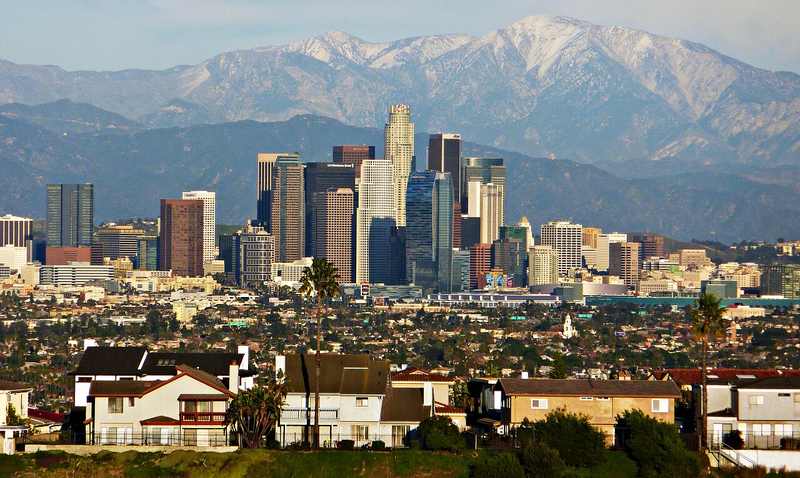
It is easy, in the churn of quotes and counter-quotes, to let "Los Angeles" and "San Diego" remain proper nouns — dots on a map the president pointed at. They are not dots. The Los Angeles metropolitan area holds more than 12 million people, one of the largest urban economies on earth. The city of San Diego holds roughly 1.4 million residents; San Diego County holds about 3.3 million. Between them sits Camp Pendleton, one of the Marine Corps' principal West Coast installations. To put the scale in the starkest honest terms: the two metropolitan regions the president named contain, combined, more Americans than most states.
That is the arithmetic his critics want the country to sit with. When Trump said on Monday that losing those cities would be "a very small price to pay," he was pricing, however rhetorically, the lives and livelihoods of well over fifteen million people — plus the military infrastructure concentrated around San Diego Bay, where carriers like the returning USS Lincoln are home-ported. His supporters will answer, fairly, that pricing was never the point — that "we're not letting that happen" is the sentence that governs, and the rest is illustration. But illustration has weight when it comes from the presidency, and the numbers are the reason the illustration landed like a detonation. There is no modern precedent for an American president publicly naming American cities as acceptable losses in a war he says is nearly over — which is either evidence of his singular rhetorical method or evidence of its singular danger, depending on which of the two readings above you hold.
What happens next: Congress, the midterms, and Tehran
Three questions now hang over the story, and each resolves on a different clock.
First, will Congress act? Bass says she has called Washington lawmakers, and her demand for an investigation is now a matter of public record. But a congressional investigation into a sitting president's rally remarks would be extraordinary — a collision between legislative oversight and the presidency's broad latitude over political speech. The smart money in Washington will likely bet on hearings-that-never-happen: stern letters, cable segments, and a file that stays open. Yet the smart money has been wrong about this presidency before, and Bass's demand gives every Democrat on the ballot a ready-made question for their Republican opponent: do you defend the remarks?
Second, what does it cost in the midterms? Twenty-seven days is an eternity and no time at all. In Texas, where Trump was campaigning for Paxton against Talarico, the remarks may barely register — or they may become the clip Democrats play on a loop in the state's diversifying suburbs. In California, where Republicans are defending competitive House seats, the footage of a president musing about attacks on Los Angeles and San Diego is manna for Democratic challengers. The national parties have both already begun treating Wednesday night as a campaign event rather than a news event, which tells you how they expect it to function.
Third — and most consequentially — how does Tehran read it? Here the two interpretations of Trump's intent genuinely matter, because deterrence only works if the signal is received as intended. If Tehran hears "Washington will absorb anything to finish this war," the remarks may harden its negotiating posture rather than soften it. If it hears "the American president is unbound and unpredictable," the remarks may accelerate whatever endgame Trump says is coming "very soon." Either way, the Islamic Republic's analysts are studying the Freeman Coliseum transcript this week with more care than most American voters will. That asymmetry — the world listening more carefully than the home audience — is the oldest hazard of the bully pulpit, and it is fully in force.
There is a final irony worth noting, and it is one the president's own ambitions supply. Trump has spent recent weeks openly campaigning for the Nobel Peace Prize — our coverage of that push is here — the peacemaker's laurel, the prize for the man who ends wars. This week he narrated, twice, the incineration of two American cities as the price of waging one. His supporters will say the two postures are one posture: peace through the vivid demonstration of resolve. His critics will say they are opposite postures, and that the gap between them is the story of the week. The country will decide which reading it believes — at the ballot box in 27 days, and in the history written after.