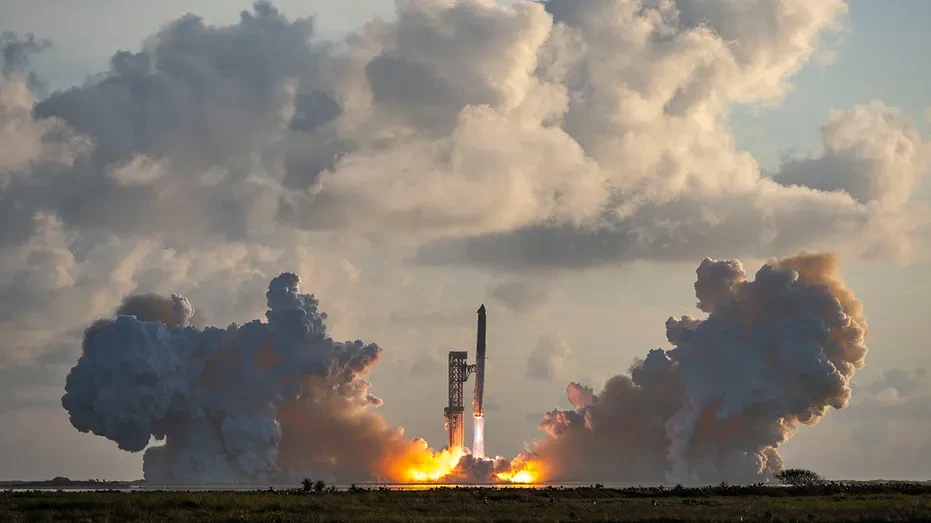
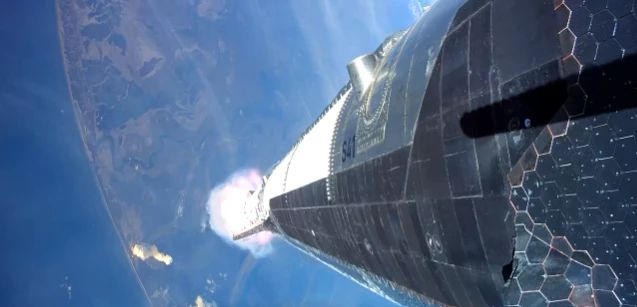
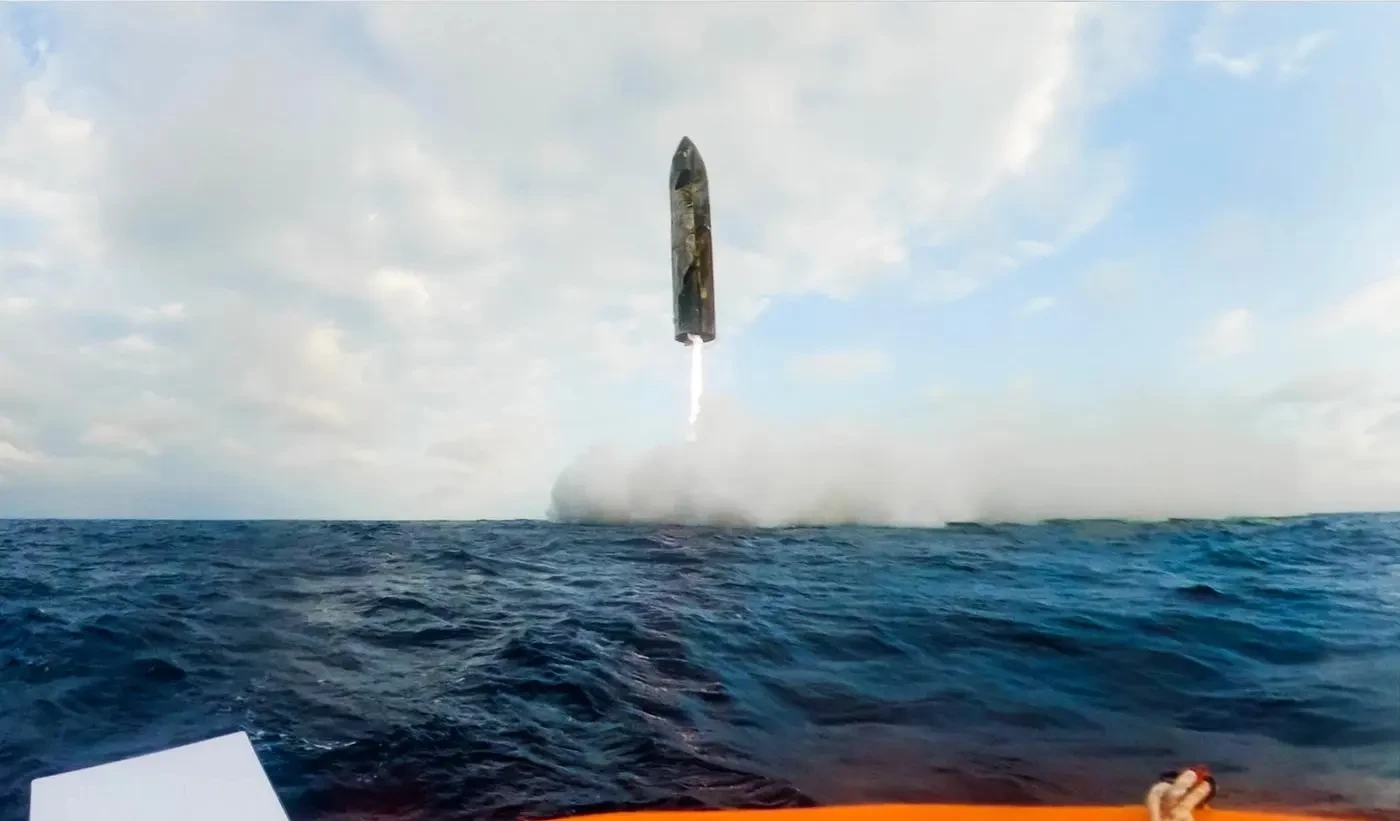
The SpaceX Starship first orbital flight lifted off from Starbase, Texas, at 8:48 a.m. EDT (7:48 a.m. CT) on Monday, September 28. About 27 minutes later, after an ascent anomaly and an unusually consequential real-time risk review, the vehicle became the first Starship in 14 integrated tests since April 2023 to enter low-Earth orbit.
Starship Flight 14 survives an engine-out decision
One of Starship’s six Raptor 3 engines shut down unexpectedly during ascent. The first response from mission control was caution: without confidence that the ship could later leave orbit safely, SpaceX would keep it on a suborbital trajectory. For roughly 22 minutes, engineers reviewed telemetry before determining that the three central Raptors needed for orbital insertion and the deorbit burn were healthy. The launch team polled “go for orbit.”
A single Raptor then circularized the ship at roughly 170 miles (275 kilometres), where orbital speed was about 17,500 mph. The call “Starship is orbital” came at approximately 9:15 a.m. ET. The Starship Raptor engine failure therefore did not erase the objective; it showed that the mission’s fault logic, propulsion redundancy and human decision-making could preserve it without sacrificing a controlled return.
Starlink V3 satellites deployed: payload changes the category
Over the next half-hour, 26 Starlink V3 satellites deployed from the ship. SpaceX later said the Starlink team had contacted all 26. They were the largest Starlink satellites yet flown and Starship’s first operational payload—not mass simulators or inert demonstrations. Three carried cameras positioned to observe the ship’s heat shield after deployment.
That distinction matters commercially. Flight 14 did not merely prove that Starship reaches orbit; it proved the vehicle could do useful work there. The heavier V3 design is meant to deliver substantially more network capacity than the V2 Mini satellites launched by Falcon 9, giving Starlink a direct interest in Starship cadence, while customers stand to gain from higher connectivity speeds and reliability if deployment scales as planned.
An early deorbit and controlled Starship splashdown in the Pacific
SpaceX had planned a nearly 10-hour, six-orbit mission. Instead, after assessing the ship’s condition, controllers chose the first safe return opportunity and conducted a deorbit burn after about three hours. Starship reentered at roughly 11:40 a.m. ET and completed a controlled Starship splashdown in the Pacific at about 11:57–11:58 a.m., inside a pre-authorized northern Pacific safe zone. SpaceX posted at 11:58 a.m.: “Splashdown confirmed. Congratulations to the entire SpaceX team on the first orbital flight of Starship!”
Super Heavy did not attempt a tower catch. The booster instead tested software and hardware upgrades during a controlled offshore landing in the Gulf of Mexico. That was the disciplined choice: add orbital complexity on the ship without also demanding a catch from the booster. Tower catches are expected to return on later flights as SpaceX closes the loop on both stages.
Why this SpaceX reusable rocket milestone matters
The Starship orbital test flight of September 2026 marks the transition from suborbital test article to operational spacecraft. All 13 previous integrated flights followed suborbital trajectories by design. They tested staging, ascent, heat shielding and controlled descent without committing the ship to sustained orbit. Flight 14 added the missing combination: orbital insertion, a real payload, hours in space, deorbit and controlled reentry.
Starship also takes the title of most powerful rocket to reach orbit. The 33 Raptor engines on Super Heavy produced nearly 17 million pounds of thrust at liftoff, close to twice the roughly 8.8 million pounds generated by NASA’s Space Launch System on Artemis missions. Power alone does not deliver reliability or reuse, but the comparison explains the potential economics: if that lift capability can be flown, recovered and flown again rapidly, mass-to-orbit costs could fall on a scale that changes satellite networks, exploration architectures and the commercial launch market.
Elon Musk declared the mission a success on X at about 10:23 a.m. ET. NASA Administrator Jared Isaacman was more specific about the public interest, writing: “Gorgeous launch, getting Ship to orbit and managing every step in a safe, responsible, and especially inspirational way. @NASA, along with the rest of the interested public, is excited to help where we can and for Starship missions to become routine!”
Who benefits—and who absorbs the pressure
Starlink is the most immediate winner because its biggest satellites now have a carrier built around their size. NASA benefits because Starship NASA Artemis plans depend on a lunar-lander variant that can reach space reliably. Commercial customers gain leverage if a high-capacity reusable launcher pushes prices down. SpaceX’s success also increases pressure on SLS, Blue Origin and other heavy-lift competitors to justify slower schedules or higher costs with capabilities Starship cannot yet match.
The burdens are not abstract. Communities around Boca Chica and environmental groups will face calls for a more intense launch cadence, more closures and more scrutiny of debris, habitat and cumulative impact. Regulators must reconcile SpaceX’s rapid-iteration model with public-safety and environmental obligations. And the engine-out anomaly is a warning against treating one orbital mission as maturity: a crewed vehicle, a lunar lander and a reusable cargo ship need failure tolerance that is repeatable, not merely dramatic.
How we got here
When Flight 14 slipped from September 22 toward September 28, its six-orbit plan, Starlink payload and final regulatory status were still provisional. That uncertainty was itself part of Starship’s development method: hardware, range, weather and licensing constraints moved in parallel. Years of iteration since the first integrated flight in April 2023 produced a vehicle able not just to survive a planned test sequence, but to respond when the sequence changed.
Flight 14 also corrected a common misconception about the earlier missions. Their failure to complete a full orbit did not mean each was trying and missing; the previous 13 were suborbital by design. The new achievement is that SpaceX deliberately crossed the threshold and retained control of the ship afterward.
What happens after Starship’s first orbit
SpaceX calls this the start of the next phase toward full and rapid reusability. Facilities for future Starship Kennedy Space Center launches are already under construction at Launch Complex 39-A, while work is also advancing for Starship at Cape Canaveral’s Launch Complex 37. Florida operations would widen cadence and give NASA closer integration with Artemis infrastructure.
The harder work now shifts from reaching orbit once to making orbital flight routine. SpaceX still must demonstrate reliable heat-shield performance, repeatable ship recovery, tower catches of both stages, rapid refurbishment and in-space cryogenic propellant transfer. Orbital refueling is the bridge between this low-Earth-orbit success and lunar or Mars missions: NASA’s contracted Starship lunar lander cannot reach the Moon with crew without a chain of tanker launches and successful fuel transfers. Flight 14 opened that test programme; it did not complete it.
Sources: SpaceX on X; Florida Today live coverage; NPR / WAMC; Gizmodo; The Times; Associated Press coverage. Facts and figures are a fixed September 28, 2026 reporting snapshot and do not update live.