Indus Waters Treaty act of war
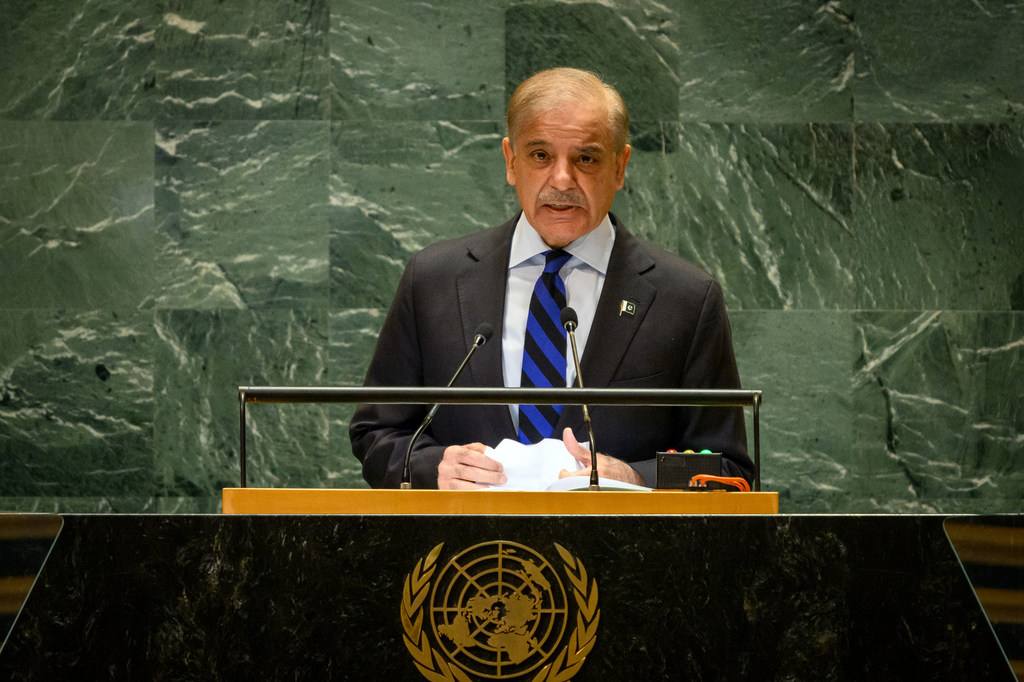
Indus Waters Treaty act of war warning: Pakistan's Prime Minister Shehbaz Sharif told the United Nations General Assembly on Friday, September 25, that any attempt by India to stop, impede or divert Pakistan's share of the Indus river system would be treated as an “act of war.” He paired that warning with a renewed demand for a UN-backed plebiscite in Kashmir and a favorable account of Pakistan's performance in the May 2025 clash with India. New Delhi answered in its Right of Reply by rejecting his narrative, accusing Pakistan of cross-border terrorism and describing the address as a performance rather than a peace initiative.
The exchange was familiar in form: two nuclear-armed neighbors used the annual General Debate to restate incompatible histories. Its substance was less routine. Water was no longer presented mainly as a technical treaty dispute. Sharif placed it in the vocabulary of armed conflict. When an essential resource is described as a trigger for war, engineering choices, reservoir operations and legal disagreements acquire strategic meanings they may not have been designed to carry.
What Sharif said — and what India rejected
Sharif challenged India's April 2025 decision to place the Indus Waters Treaty “in abeyance,” saying an agreement brokered by the World Bank in 1960 could not be suspended by one party. He argued that Pakistan's treaty share of the rivers was a legal entitlement and warned against interference. The speech did not identify a newly completed Indian diversion project or document a present interruption of flows; it established a red line for future action.
On Kashmir, Sharif called again for what he described as a free and impartial plebiscite under United Nations auspices. He accused Indian authorities of repression and demographic engineering in Jammu and Kashmir. Those are Pakistan's allegations. India rejects them, says the region is an integral part of the country, and treats changes made after the revocation of Jammu and Kashmir's special constitutional status in August 2019 as internal matters.
India's First Secretary Petal Gahlot used the Right of Reply to counter that Pakistan “preach[es] peace by day” while carrying out terrorism at night. She rejected Sharif's version of the 2025 confrontation and argued that Islamabad was again using the General Assembly to internationalize a bilateral dispute. The competing statements offered accusation and denial, not independently testable evidence about every military claim repeated from the rostrum.
Sharif also credited U.S. President Donald Trump with helping prevent “an all-out war” between nuclear-armed neighbors during the May fighting. That serves Trump's preferred mediator narrative and Pakistan's interest in keeping outside powers engaged. India has consistently said the halt followed direct military communication and rejects third-party mediation over Kashmir. The disagreement is not ceremonial: it determines whether Washington is treated as a broker, a supporter or merely an influential observer in the next crisis.
The 2025 chain: Pahalgam, Operation Sindoor and treaty abeyance
The immediate background began on April 22, 2025, when gunmen killed 26 people in Pahalgam in Indian-administered Kashmir. India blamed Pakistan-linked militants; Pakistan denied involvement and called for an impartial investigation. New Delhi then announced punitive measures, including putting the Indus Waters Treaty in abeyance. On May 7, India launched Operation Sindoor, striking sites it described as terrorist infrastructure in Pakistan and Pakistan-administered Kashmir. Pakistan disputed that characterization and responded militarily. Four days of missile, drone and artillery exchanges followed before the firing stopped.
That sequence matters because it fused two formerly separate tracks. Counterterrorism and military deterrence had long shaped India-Pakistan crises. The treaty, by contrast, had survived the 1965 and 1971 wars and the 1999 Kargil conflict. Its durability made water cooperation one of the few institutional restraints that endured when diplomatic relations collapsed. The April 2025 move broke that psychological firewall even before it produced a proven physical change in river flows.
Sharif's speech also widened Pakistan's own security narrative. He said the country had lost roughly 100,000 lives and more than $150 billion to terrorism, and accused the Tehrik-i-Taliban Pakistan and the Baloch Liberation Army of operating from sanctuaries in Afghanistan. Kabul has denied harboring militants. Recent frontier claims have been sharply contested, as our report on the Pakistan-Afghanistan Gulistan border clash shows. By combining India, Kashmir and Afghanistan-based threats in one address, Sharif presented Pakistan as a state under pressure on multiple fronts.
How the Indus bargain was built
The Indus Waters Treaty divides the system by river rather than by an annual volumetric quota. India received control over the eastern rivers — the Ravi, Beas and Sutlej — while the western rivers — the Indus, Jhelum and Chenab — were allocated principally to Pakistan, subject to specified Indian uses including domestic consumption, irrigation within limits and certain run-of-river hydropower projects.
The design was intentionally technical. Questions can move from bilateral commissioners to a neutral expert or a court of arbitration, depending on the nature of the dispute. That three-tier structure does not eliminate conflict; it creates procedures that slow a disagreement before it becomes a national-security emergency. India has argued that circumstances and treaty interpretation require revision. Pakistan argues that abeyance has no basis in the text and that dispute mechanisms must continue to operate.
The scale explains the alarm. Research cited by the German Institute of Development and Sustainability says the Indus basin sustains more than 200 million people in Pakistan and about 100 million in northwestern India. In Pakistan, the river network underpins irrigated agriculture, urban supply and hydropower. In India, western-river projects carry their own energy, storage and development stakes. Neither side is discussing an abstract diplomatic asset. They are arguing over the timing and reliability of water that supports farms, cities and electricity systems.
Why water securitisation is an escalation vector
First, river operations are difficult to read in real time. A change in flow can reflect rainfall, snowmelt, sediment, maintenance, reservoir management or deliberate policy. In a crisis, intelligence agencies and political leaders may choose the hostile explanation before hydrological data are reconciled. Ambiguity compresses decision time.
Second, seasonal timing magnifies even short disruptions. A delay during a critical planting window can matter more than the same volume arriving later. Hydropower systems also depend on predictable flows. When water is framed as a weapon, routine operational changes can be interpreted as coercion.
Third, the military geography overlaps the river geography. Dams, barrages, tunnels and power stations are fixed infrastructure. They can become objects of surveillance, cyber operations or target planning even when neither government initially intends a physical attack. Public rhetoric raises pressure on leaders to answer a perceived water move with a visible security response.
Fourth, nuclear deterrence does not make lower-level escalation safe. It may discourage deliberate total war while encouraging both sides to believe limited pressure can remain below the nuclear threshold. The May 2025 exchange demonstrated how rapidly strikes and counterstrikes can accumulate. Adding water infrastructure to the bargaining space creates more pathways for miscalculation, not fewer.
Kashmir and Resolution 47: the missing sequence
Sharif's plebiscite demand rests on a real but frequently simplified UN history. Security Council Resolution 47, adopted on April 21, 1948, recommended a process intended to lead to a free and impartial plebiscite on Jammu and Kashmir's accession. It did not order an immediate vote without conditions. The plan first called for Pakistan to secure the withdrawal of tribesmen and Pakistani nationals who had entered to fight. India was then to reduce its forces to the minimum needed for law and order, after which a UN-nominated administrator would organize the plebiscite.
That demilitarisation sequence was never completed. India and Pakistan disputed the order, scale and verification of withdrawals, along with the political conditions for a vote. Later wars, the division of the territory by the Line of Control and sharply divergent legal positions moved the dispute far from the resolution's envisaged pathway. Pakistan continues to cite the plebiscite commitment. India emphasizes later bilateral agreements and its sovereignty claim. A serious account has to hold both facts: Resolution 47 proposed a vote, and the prerequisite process on which that vote depended did not occur.
The same problem of sequence now haunts the water dispute. Pakistan wants treaty performance restored before broader normalization. India has linked cooperation to its security concerns after Pahalgam. Each side therefore asks the other to move first, and each treats the other's condition as proof of bad faith.
The wider UN message: Gaza, militancy and Security Council power
Sharif's address was not only about India. He called for the war in Gaza to end and reiterated support for an independent Palestinian state on pre-1967 lines with East Jerusalem as its capital. That position places Pakistan within a broad bloc of states pressing the General Assembly to act where the Security Council has repeatedly deadlocked. Other UN speeches this week also used the chamber to challenge the limits of major-power diplomacy; our analysis of the U.S. president's Iran warning at the UN shows how the same forum can function as both negotiating stage and deterrence theater.
On Security Council reform, Sharif argued against creating additional permanent seats and favored more elected representation. Pakistan has long opposed India's campaign for permanent membership. The institutional argument is therefore inseparable from regional rivalry: New Delhi seeks recognition as a major power, while Islamabad warns that adding permanent privileges would freeze new inequalities into the Council.
The political theater extended outside UN Headquarters. Protesters denounced Sharif and Pakistan's rights record, creating a visible counter-message to the prime minister's presentation of Pakistan as a defender of self-determination. Their presence did not settle any allegation made inside the hall, but it underlined a recurring weakness in UN diplomacy: governments invoke universal principles abroad while critics test those claims against conditions at home.
Who benefits from the speech
Sharif gains domestic and international leverage. At home, the “act of war” language signals that the government will not appear passive on a resource Pakistan considers existential. Abroad, combining water law with nuclear risk invites third parties to press India for restraint. The cost is reduced room for quiet compromise: after announcing a red line at the UN, any technical concession can be attacked as weakness.
Trump gains a mediator's narrative. Sharif's praise reinforces the president's claim that U.S. intervention helped stop the May 2025 fighting. That can support Washington's diplomatic brand, but only Pakistan publicly endorses that account. India's rejection limits what the United States can credibly claim as a jointly accepted role.
India reinforces its deterrence posture. The Right of Reply keeps Pahalgam and cross-border militancy at the center of New Delhi's case and rejects a return to externally mediated Kashmir diplomacy. India's approach benefits from strategic clarity: attacks attributed to Pakistan-based groups will carry state-level consequences. Its risk is that security conditionality applied to a water treaty can alarm civilians, investors and neighboring states far beyond the original counterterrorism dispute.
Who loses — and what critics argue
Farmers and power consumers carry the most immediate downside because they depend on predictable flows but control none of the diplomacy. Even without a long-term diversion, uncertainty can change planting choices, credit decisions, insurance costs and energy planning. Officials on both sides may gain bargaining power from ambiguity; households and businesses pay for it.
Critics of Sharif's formulation argue that labeling any impediment an act of war is dangerously broad and could turn a technical dispute into a military ultimatum. They also say Pakistan's UN strategy internationalizes Kashmir without confronting the unresolved demilitarisation conditions in Resolution 47. Critics of India's approach argue that placing a water treaty in abeyance after a terrorist attack weakens a durable rule-based mechanism and makes civilians dependent on political escalation they did not cause.
There is also an institutional loser: treaty law itself. If an agreement that survived wars can be suspended whenever security conditions worsen, future water treaties elsewhere become harder to negotiate. If a treaty cannot adapt to new engineering, climate pressure or security concerns, it risks becoming brittle. The choice is not between preserving every procedure unchanged and abandoning the bargain. It is whether revision happens through agreed mechanisms or coercive uncertainty.
What happens next: four pathways
- Managed legal confrontation. India continues projects it says the treaty permits, Pakistan challenges them through neutral-expert or arbitration channels, and both avoid physical interference with established flows. The rhetoric stays severe, but institutions absorb the dispute.
- Hydrological signaling. One side changes the timing of releases, accelerates construction or withholds operational data to create pressure without a declared treaty breach. This is the most dangerous gray zone because weather and policy become difficult to distinguish.
- A renewed security crisis. Another mass-casualty attack attributed to a Pakistan-based group could trigger Indian strikes and fresh treaty measures; Pakistan could answer militarily under the red line Sharif announced. Escalation would then run simultaneously through air, missile and water domains.
- A diplomatic off-ramp. The two governments restore technical data exchange, authorize commissioners to meet without prejudice to their legal positions and accept a third-party technical facilitator rather than a political mediator. A narrow agreement on flood warnings, project notification and uninterrupted civilian supply could rebuild a firewall around water even while Kashmir remains unresolved.
Conclusion: restore the firewall before the next crisis
Sharif's speech succeeded as signaling. It told India, Pakistan's public and the wider UN membership that Islamabad views river interference as a national-security threshold, not an ordinary treaty complaint. India's reply was equally clear: it will not separate water diplomacy from the militancy and deterrence questions raised after Pahalgam.
That clarity is not the same as safety. The Indus system worked for decades because technical rules survived political hostility. Rebuilding that separation does not require either side to abandon its claims on Kashmir, concede the argument over the 2025 fighting or accept an unwanted mediator. It requires both to make river data less ambiguous than their rhetoric. Between nuclear-armed states, the most useful diplomatic victory may be the least theatrical one: keeping a reservoir decision from being mistaken for an opening move in war.
Sources and reporting notes
- UN News — Pakistan's September 25, 2026 General Assembly address
- UN Web TV — Pakistan's address to the 81st session General Debate
- Daily Jagran — India's Right of Reply and Petal Gahlot's response
- German Institute of Development and Sustainability — Indus basin, treaty structure and population stakes
- The News International — speech themes, Gaza, terrorism and Security Council reform
- Particle News — Kashmir plebiscite and Indus warning summary
- Resolution 47 overview — April 21, 1948 demilitarisation and plebiscite sequence
- UN Geneva — source page for the September 2024 file photograph
Reporting cutoff: September 26, 2026. Allegations by Pakistan and India are attributed; Signal Post News has not independently verified battlefield or terrorism claims repeated in the speeches. The photograph is a clearly labeled 2024 file image and does not depict the 2026 address.