World · War · Russia
A Russian military plane crash in Siberia has killed all 19 people on board an Antonov An-12 transport aircraft, Russia’s defence ministry said on Tuesday — a scheduled flight that came down near the village of Yagunovo in the Kemerovo region, in an unpopulated area, far from any front line. The ministry gave the preliminary cause as a technical malfunction; a commission from the Russian Aerospace Forces is at the site, and the Investigative Committee has opened an inquiry into possible violations of flight safety rules. This report follows the verified record as it developed through the day — including the fact that early Russian-media reports put the number aboard at 17 before the ministry’s later confirmation revised it to 19 — and it states plainly what is not known: the cause is preliminary, the dead have not been publicly identified in the reporting available, and no party has claimed or suggested any hostile involvement. Nineteen people are dead. The facts, attributed, are what follow.
Track it live: https://signalpostnews.com/tracker/wars · Ukraine war map: https://signalpostnews.com/tracker/ukraine-war-map
KEMEROVO, November 17, 2026 — A Russian military Antonov An-12 transport aircraft crashed on Tuesday in the Kemerovo region of southwestern Siberia, killing all 19 people on board, Russia’s defence ministry said in a statement carried by the RIA Novosti and TASS news agencies and reported by CNN and AFP. The aircraft, which the ministry said was on a scheduled flight, came down near the village of Yagunovo, south of the regional capital, Kemerovo — roughly 3,000 kilometres east of Moscow — in what the ministry described as an uninhabited area. “There were 19 people on board, including the crew. All of them lost their lives,” the ministry said. It gave the preliminary cause of the crash as a technical malfunction, and said a commission from the Russian Aerospace Forces was working at the site to establish all the circumstances.
The number requires the care this article will give it throughout, because it changed during the day. Early Russian-media reports — Izvestia’s account, carried internationally — put the toll at 17, and several international headlines initially used that figure. The defence ministry’s later confirmation revised the number to 19 people on board, all killed, superseding the earlier media reports. The figure of 19 in this article is therefore the ministry’s figure, attributed to the ministry; it has not been independently verified by this newsroom, and no list of the dead accompanied it in the reporting available on Tuesday. Kemerovo’s governor, Ilya Seredyuk, confirmed from the scene that an aviation incident had occurred in the Yagunovo district, that emergency crews had extinguished a fire at the site and that police had sealed off the area; in the early reporting, the governor did not himself identify the aircraft type or confirm the toll — the identification and the toll are the defence ministry’s.
What happened: the verified sequence
Reconstructed strictly from attributed statements, Tuesday’s sequence is short and, beyond its outline, thin — which is normal in the first hours of a military aviation accident in Russia, and is a reason for precision rather than for filling gaps. A Russian military An-12 transport was on a scheduled flight through the Kemerovo region. It crashed near Yagunovo, in an unpopulated area. Emergency services attended; a fire at the site was extinguished; police sealed the area. The defence ministry confirmed the aircraft type, the toll of 19 including the crew, and a preliminary technical malfunction as the cause. The Aerospace Forces commission began its work at the site, and the Investigative Committee opened its inquiry into possible violations of flight safety rules — the standard legal track after a fatal Russian aviation accident, which examines whether rules were broken without presuming that they were.
What is not in the verified record should be listed with the same plainness. No official statement available on Tuesday identified the dead, described the aircraft’s unit or mission beyond “scheduled flight,” specified what the aircraft was carrying, or offered any detail of the malfunction beyond the word “technical.” Reports circulating on social media and in unsourced channels added particulars of exactly those kinds; they rest on single, unverifiable channels, officials have not confirmed them, and this article omits them rather than laundering them into print with a “reports say.” When the commission or the Investigative Committee puts findings on the record, they will be reported then, attributed to them.
The aircraft: an An-12, in service since the late 1950s
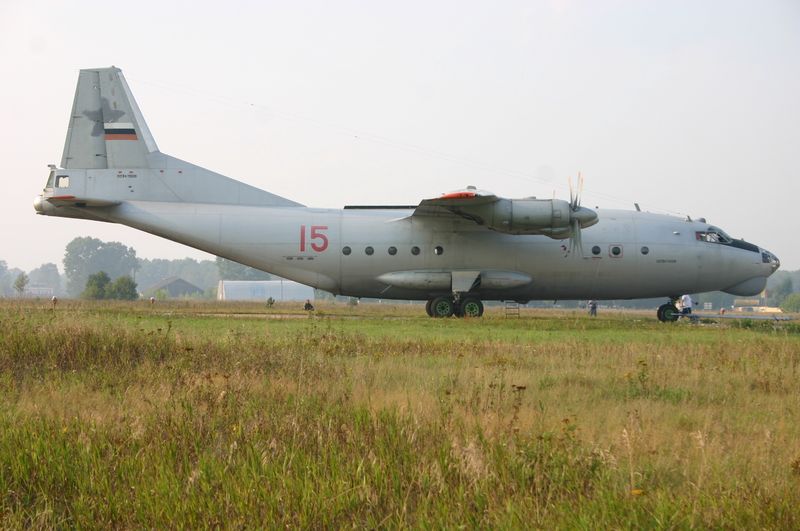
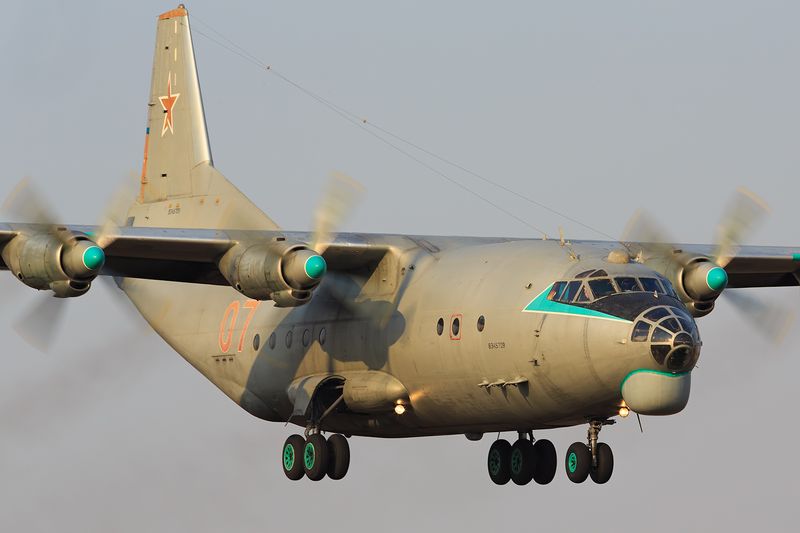
The Antonov An-12 is a Soviet-built, four-engine turboprop military transport that first entered service in the late 1950s — a contemporary of the earliest jets, designed in the same Antonov bureau tradition that produced the workhorse transports of the Warsaw Pact. It has been the backbone of Soviet and then Russian tactical airlift for more than six decades: a high-wing freighter with a rear loading ramp, built to move troops, vehicles and cargo into rough fields, and kept in service long past the retirement of most of its contemporaries because the fleet, the crews, the maintenance chain and the mission all still exist. Russia continues to operate the type alongside newer and larger transports, and An-12s remain a routine sight at Russian military airfields — the aircraft in the file photographs accompanying this article are of the same type and service, and are not the aircraft that crashed.
One arithmetic fact in the ministry’s statement deserves to be drawn out, because it frames the human scale of the loss. An An-12 typically operates with a crew of about six. Nineteen people were aboard. The aircraft was therefore carrying roughly a dozen people beyond its crew — additional personnel of some kind, as transports on scheduled flights routinely do. The ministry’s phrase “including the crew” is all that has been said about who they were; this article does not invent a breakdown of passengers, ranks or roles that no source has provided. Nineteen families will receive notifications through Russian military channels; the public identification of military dead in Russia is controlled and often delayed, and nothing in Tuesday’s reporting changes that expectation.
Why this matters
Why this matters, beyond the loss of life itself, is what a fatal accident of this kind reveals about the strain on Russian military aviation nearly five years into the war against Ukraine. Russia’s transport fleet flies intensified wartime schedules — moving personnel, equipment and supplies across the largest country on earth, between rear bases, training grounds and the logistics hubs that feed the front. That tempo is flown substantially by aircraft designed in the Soviet period, of which the An-12, in service since the late 1950s, is among the oldest types still in regular use. Age alone does not cause accidents, and this article does not claim it caused this one — the ministry’s preliminary finding is a technical malfunction, unspecified, and the commission’s work has barely begun. But every fatal hull loss in a fleet of finite, ageing airframes subtracts lift capacity that cannot quickly be replaced, and every accident inquiry grounds, inspects and slows the aircraft that remain. Attrition in war is usually counted at the front; it also accumulates, quietly, on scheduled flights in Siberia.
It matters, too, as a test of information discipline in wartime. A military aircraft crashed 3,000 kilometres from the fighting, on the same day that Ukraine struck the Crimean Bridge and Russia struck bridges in Kyiv — events this newsroom covered separately, the Crimean Bridge attack and the strikes on Kyiv’s bridges among them. The coincidence of timing invites connection, and the record does not support one: no Ukrainian, Russian or any other party has claimed or suggested Ukrainian involvement in the Kemerovo crash, the crash site is deep inside Russia far beyond the geography of the day’s strikes, and the Russian defence ministry’s own preliminary account is a technical malfunction. Context is not cause. This article places the crash in its day because the day is real; it declines to place the day inside the crash, because no evidence does.
The response: governor, commission and investigators
Governor Ilya Seredyuk’s role in Tuesday’s reporting is a small study in the division of Russian official communication. The governor, posting from the scene, confirmed the incident itself — an aviation accident in the Yagunovo district — and the civilian response: emergency crews at the site, the fire extinguished, the area sealed by police, the aircraft having been transiting the region. He did not, in the early reporting, name the aircraft or give a toll. Those facts came from the defence ministry in Moscow. The pattern is standard — the region speaks for the ground it administers, the ministry speaks for the aircraft and the dead — but it explains the shape of the day’s information, in which the most local official source confirmed the least, and the toll reached the public through the military’s own channels, revised once along the way from the early media figure of 17 to the ministry’s 19.
Two formal processes now run in parallel, and their outputs are the milestones to watch. The Aerospace Forces commission at the site conducts the technical investigation: wreckage, recorders if fitted and recovered, maintenance and flight documentation, and the reconstruction of the aircraft’s final minutes. The Investigative Committee’s inquiry runs the legal track, examining possible violations of flight safety rules — a formulation that is standard after fatal crashes and that does not, in itself, accuse any individual. Russian military accident investigations rarely publish interim findings quickly, and final reports, when they come, are often summary. What can responsibly be said on Tuesday is what has been said: a preliminary technical malfunction, per the ministry; two inquiries open; no further official detail available.
Context and background: Russian military aviation under wartime load
The An-12 crash joins a ledger of Russian military aviation accidents accumulated during the war years — training and transport flights, far from combat, that have killed crews and passengers in ones and twos and, on days like Tuesday, in larger numbers. The pattern has structural drivers that analysts across the spectrum identify, even where they dispute particulars: airframes of great age kept in service by necessity; maintenance and spare-parts chains under sanctions pressure; aircrew experience diluted by wartime demand; and flight tempos that compress the margins in which small technical faults are caught on the ground rather than discovered in the air. Each of those is a context, offered here as context — none is a finding about this aircraft, this crew or this flight, and the commission exists precisely to establish what general context cannot.
The An-12’s longevity is itself part of the background. A type that entered service when jet airliners were new has outlived the state that built it by more than three decades, sustained by the same logic that keeps elderly transports flying worldwide: the mission is unglamorous, the replacement is expensive, and the aircraft, maintained within its limits, does the job. The limits, though, are enforced by inspection regimes and component lives that wartime tempo strains. Whether any of that bears on Yagunovo is the commission’s question, not this article’s. What can be said is that Russia cannot quickly replace either the airframe or the nineteen people lost with it, and that a fleet asked to do more, with older tools, under greater pressure, will keep producing days like this one at some rate — which is an argument for reading each inquiry’s findings, when they come, with attention.
Multiple angles: what each account can and cannot carry
The ministry’s account is the spine of the record and also its boundary: it establishes the aircraft, the place, the toll and a preliminary cause, and it is the account of the institution that operated the aircraft and will participate in investigating its loss. That dual role is normal in military aviation worldwide and is why the Investigative Committee’s separate legal track exists. The governor’s account corroborates the incident and the response but deliberately — or by remit — adds nothing about the aircraft or the dead. Early media reporting supplied the first toll, 17, and was wrong, or at least superseded; the correction is carried in this article not as a footnote but as part of the story, because in fast-moving fatal news the first number is the one that lodges, and the honest record is the one that shows its own revisions.
The angle that requires the most discipline is the war itself. Critics of Russia’s war effort will read the crash as a symptom of systemic decay; Russian official voices will read it as an accident of the kind all large air forces suffer. Both readings are arguments, and neither is evidence about November 17 in Kemerovo. The evidence, as it stands on Tuesday evening, is: a scheduled flight, an unpopulated crash site, a preliminary technical malfunction, nineteen dead, two inquiries open, and no claim of hostile involvement from any party. Analysis that stays inside those lines can still say a great deal — about fleet age, tempo and attrition, as the sections above do — without crossing into speculation about sabotage, shoot-downs or causes that no source has advanced. The dead are owed that discipline as much as the readers are.
What happens next
The coming days will bring, in whatever order the Russian authorities choose: the identification of the dead, through family notification first and public naming only as the ministry permits; any statement from the Aerospace Forces commission on what the site and the aircraft’s records show; and the Investigative Committee’s progress on the flight-safety inquiry, including whether it becomes a criminal case against individuals or closes as a technical finding. A fleet-wide response is the operational question to watch — whether An-12 operations pause for inspections, formally or in practice, is the kind of fact that often emerges from flight activity rather than announcement. Burials and any official commemoration in the Kemerovo region will be the governor’s to announce.
This newsroom will update its reporting as the commission and the Committee put findings on the record, and will correct the toll or any other figure if an official revision supersedes Tuesday’s — as Tuesday’s ministry figure itself superseded the early reports of 17. For now, the record closes where the day left it: an ageing transport on a scheduled flight, down in an empty field in Siberia, nineteen people dead, a fire put out, a perimeter sealed, and two inquiries beginning their work in the cold. That is a smaller story than the day’s battles, and a complete one. It is also, for nineteen families, the whole of the news.
Sources
CNN, November 17, 2026, “Russian military transport aircraft crashes in Siberia, killing 19, defense ministry says”: the Antonov An-12 crashed in the Kemerovo region of southwestern Siberia near the village of Yagunovo, about 3,000 km east of Moscow; the defence ministry, via RIA Novosti/TASS, said the aircraft was on a scheduled flight, came down in an unpopulated area, and that “There were 19 people on board, including the crew. All of them lost their lives”; preliminary cause a technical malfunction; an Aerospace Forces commission at the site. AFP (syndicated via Business Recorder and other outlets), November 17, 2026: the ministry statement via TASS/RIA; the Investigative Committee’s inquiry into possible violations of flight safety rules; An-12 background — Soviet-built four-engine turboprop, in service since the late 1950s, typical crew about six. The Independent, Ukraine war live blog, November 17, 2026 (21:00 entry): ministry confirmation via state media; Governor Ilya Seredyuk confirmed the incident near Yagunovo, the fire extinguished and the area sealed; in early reporting the governor did not himself identify the aircraft type or the toll. Toll evolution: early Russian-media reports (Izvestia, via Anadolu) put the figure at 17; the defence ministry’s later confirmation revised it to 19 on board, all killed, and the ministry figure is the one used in this article, attributed throughout. PRECISION: the cause is the ministry’s preliminary finding only; no final cause has been established. Unverified single-channel social-media details circulating about the flight are omitted from this report. No party has claimed Ukrainian involvement in the crash, and none is suggested here; same-day war events are referenced as context only. Photographs are file photos of the An-12 type via Wikimedia Commons, captioned as file photos; neither depicts the aircraft that crashed, and no crash-site imagery is published.