War · Ukraine
A Kharkiv drone strike in the middle of the day has killed a 60-year-old man in the city’s Osnovianskyi district — the same district a jet-powered Russian drone set ablaze the night before, in a 24-hour double hit that left 14 people injured across the wider region.
Track it live: Ukraine war map · Live war tracker
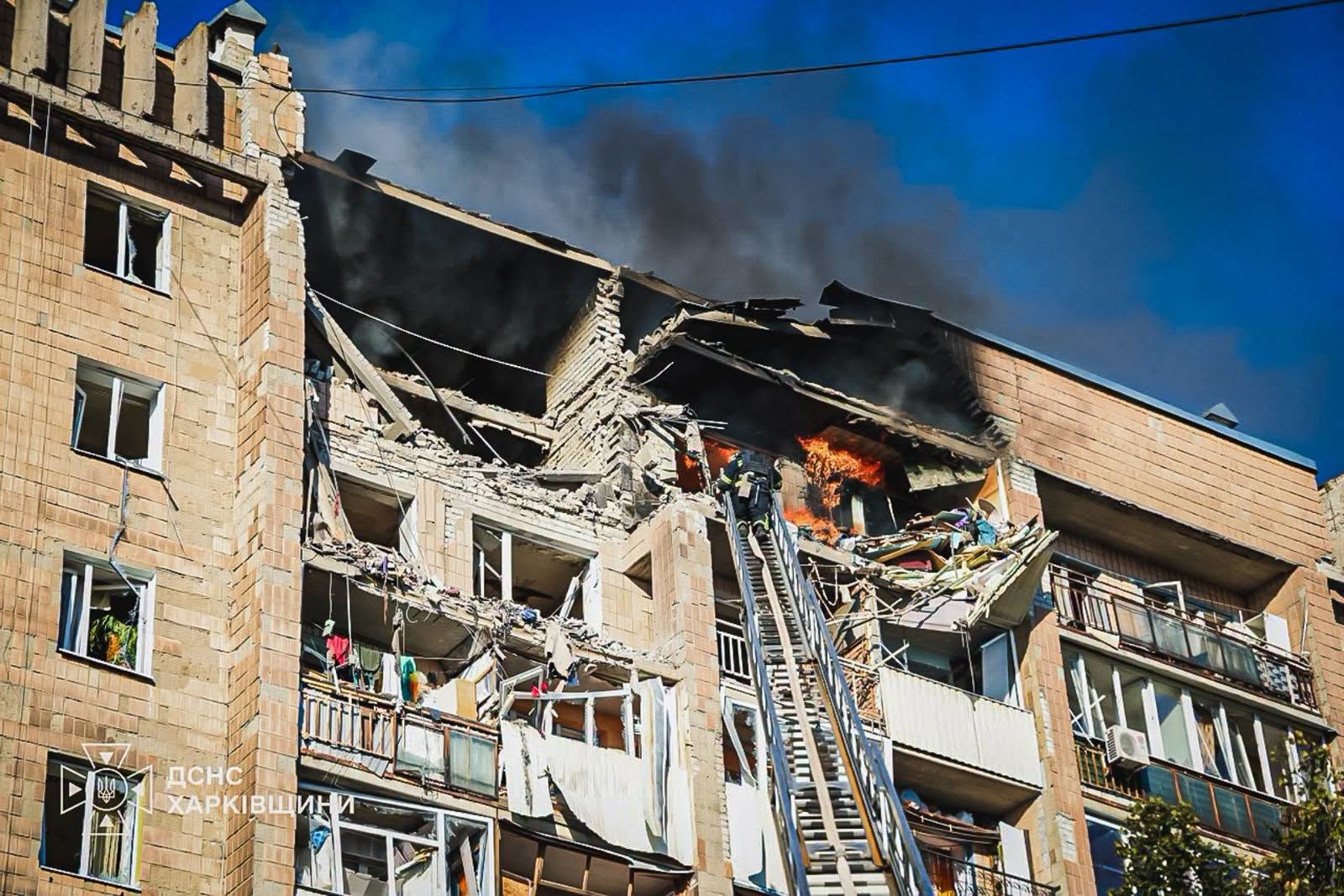
KHARKIV — A Russian combat drone struck Kharkiv’s Osnovianskyi district in the middle of the day on Wednesday, October 28, killing a 60-year-old man and injuring three other men, in the second Kharkiv drone strike to hit the same district in less than 24 hours. The drone came down at about 12:50 p.m. local time — some official updates timed the impact at 12:57 — while residents and emergency crews were still clearing the wreckage of a jet-powered drone that had set part of the district ablaze the night before, according to Ukrinform, reporting statements by Kharkiv Mayor Ihor Terekhov and Kharkiv Oblast head Oleh Syniehubov.
The three injured men, aged 41, 46 and 56, were all taken to hospital, Ukrainian officials said. The toll was revised during the afternoon: an earlier live update had put the strike at one person killed and two injured, before officials confirmed a third injured man had been admitted. A fire broke out at the impact site, and the strike disrupted power in the area and forced changes to trolleybus routes, Terekhov reported, according to Ukrainska Pravda.
The second strike in less than a day
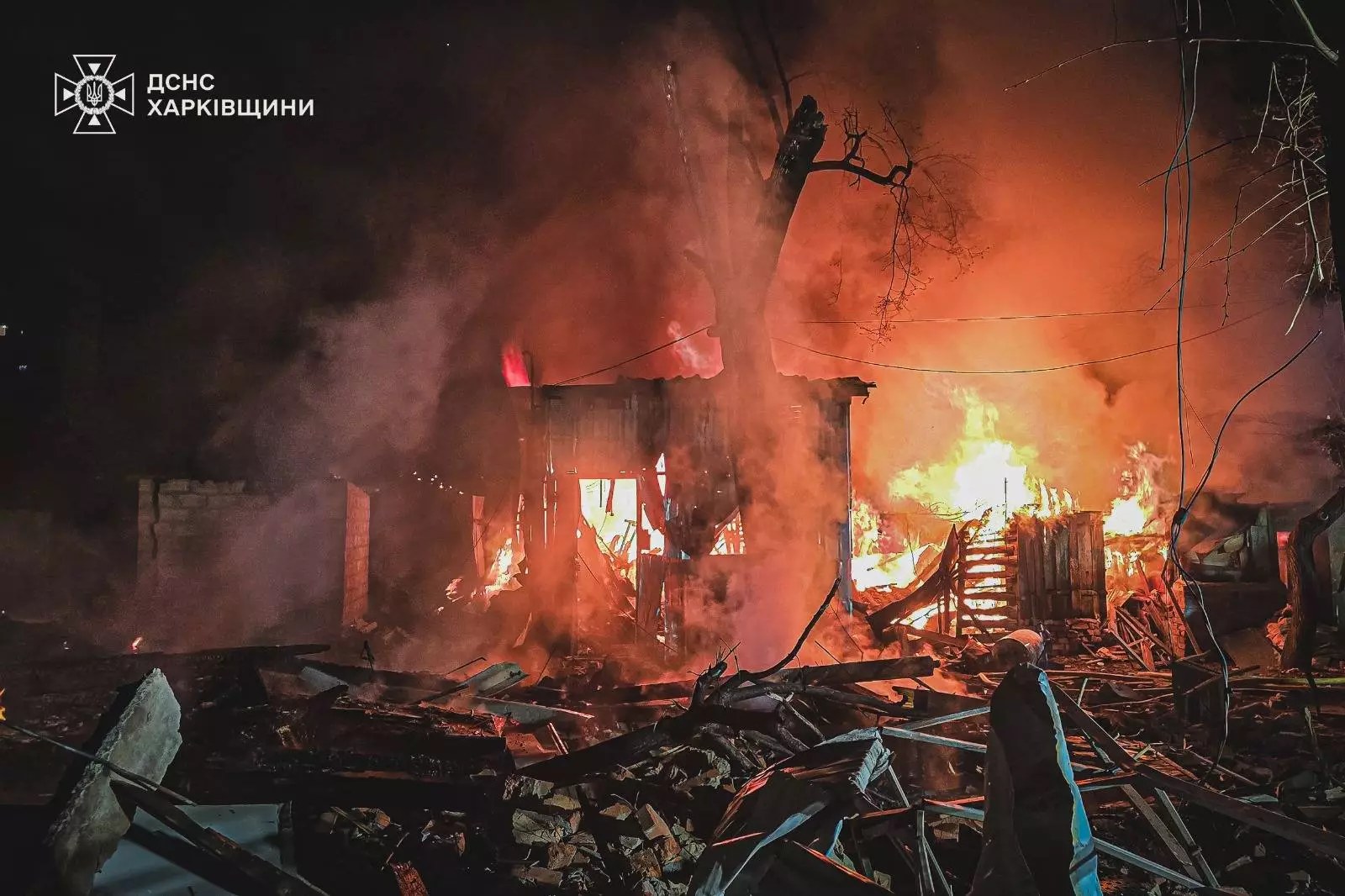
What makes Wednesday’s strike distinct is not only its timing — broad daylight, at lunchtime, in a residential district of Ukraine’s second-largest city — but its address. The drone fell in the Osnovianskyi district, in the south of Kharkiv, less than a day after a Russian jet-powered drone hit the same district on the evening of Tuesday, October 27, starting fires that burned across roughly 2,500 square metres and kept fire crews working through the night.
By Wednesday lunchtime, that work was still not finished. Clearing, damage assessment and repair were under way in the district when the second drone arrived, which meant the second strike landed in streets where emergency workers, utility crews and residents returning to inspect their homes were already gathered. Ukrainian officials have not said the timing was deliberate, and Signal Post News is not aware of any claim by Kyiv that the second strike was aimed at responders; Russia’s Defence Ministry had issued no specific comment on this strike in the sources checked by publication time. What is documented is the sequence itself: two strikes, one district, under 24 hours apart.
The first hit: the night of October 27
The first strike, on Tuesday evening, was already a serious incident in its own right. A jet-powered Russian drone hit the Osnovianskyi district and ignited fires across about 2,500 square metres, according to Ukraine’s State Emergency Service (SES), as reported by Reuters. A two-storey residential building, a private house, outbuildings and three industrial premises were damaged. Five people were injured, among them a four-year-old boy; three of the injured were hospitalised, and a 65-year-old woman was treated for acute stress.
Signal Post News covered that first hit last night, in context, inside our report on the same night’s exchange in the other direction — Ukraine’s strikes on the Novolipetsk steel plant and the Azot chemical plant, where the Osnovianskyi attack appeared as the Kharkiv leg of a two-way night of raids. Wednesday’s daylight strike is a separate and new event: it is the second blow to the same streets, and it is the one that killed.
Fourteen injured across the region in 24 hours
The Osnovianskyi strikes were part of a heavier 24 hours for the whole region. Syniehubov, the oblast head, said 14 people had been injured across Kharkiv region in the preceding 24 hours — a figure that spans the Tuesday-evening drone hit, Wednesday’s fatal strike and the region’s other attacks in the same window. Kharkiv region borders Russia along its northern edge, and its towns and villages sit within range not only of drones and missiles but of glide bombs and artillery, which is why its daily toll so often runs ahead of regions further from the front.
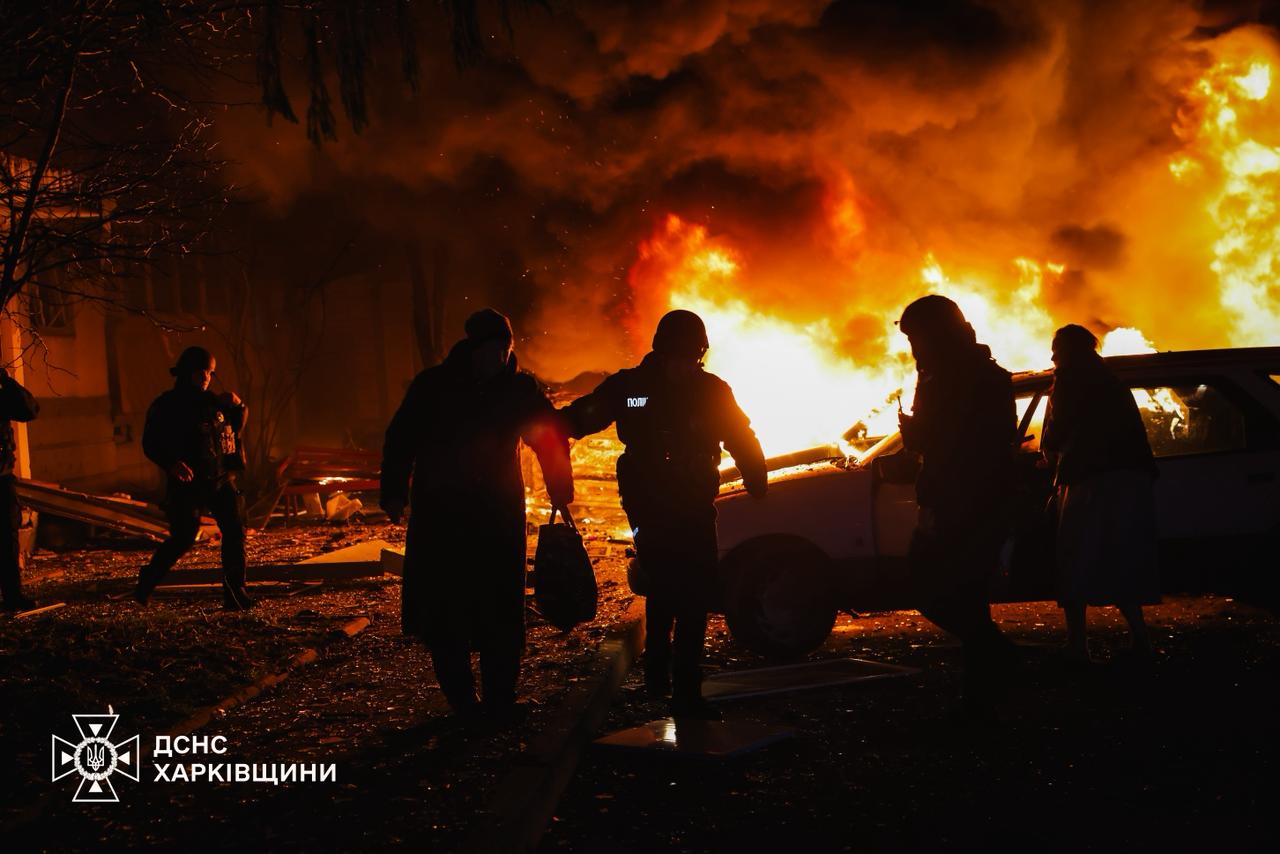
Inside the city, the practical consequences of Wednesday’s strike were immediate and mundane in the way wartime consequences usually are: power disrupted in the impact area, trolleybus routes changed, a fire to be put out and a new crater of damage in a district that had not finished clearing the previous night’s. Each of those tasks falls to the same small cast of people — SES fire and rescue crews, medics, police, utility repair teams — who had already worked the same streets the night before.
The overnight barrage, in numbers
The Kharkiv strikes sat inside a much larger overnight attack across Ukraine on October 27–28. Ukraine’s Air Force said Russia launched 88 attack drones — 38 of them jet-powered — together with one Iskander-M/S-400 ballistic missile. Air defences neutralised 71 of the drones, 31 of them jet-powered, the Air Force said. Even so, strikes were recorded at eight locations and falling debris at two more — the arithmetic gap between what was stopped and what got through is where the night’s casualties, in Kharkiv and elsewhere, came from.
What 71 out of 88 actually means
A neutralisation rate of roughly four in five sounds like a defensive success, and by the standards of this war it is a substantial one — each drone stopped is a warhead that does not land on a building. But the figure cuts both ways. Seventeen drones were not neutralised, on the Air Force’s own count, alongside a ballistic missile of a type that only high-end interceptors can engage. Against targets spread across a country the size of Ukraine, that residue is enough to produce hits at eight locations in a single night. And the composition matters as much as the count: 38 of the 88 drones were jet-powered variants, which fly faster than the propeller-driven Shahed-type drones that mobile fire groups with machine guns have learned to hunt, compressing the time defenders have to detect, track and engage them.
Why this matters
A daylight repeat strike on the same streets
Repeat strikes on a single location are a recognised feature of this war, and analysts who track Russian strike patterns describe several logics that can sit behind them: returning to a target that was damaged but not destroyed, exploiting the fact that a district’s defences and services are already committed, or simply the geometry of a border city that the same launch areas can reach again and again. Wednesday’s sequence fits the pattern in form, whatever the intent: a night strike that starts fires and draws in every available crew, followed within a day by a second strike on the same district in full daylight, when those crews and the residents they are helping are out in the open. Ukrainian officials have frequently accused Russia of deliberately timing second strikes to hit responders — the pattern known as a “double tap” — while Moscow has consistently denied targeting civilians. In this specific case, Kyiv’s officials reported the sequence without, in the sources checked, attaching that accusation to it, and Russia offered no specific comment on the strike at all.
The strain on the people who respond
The less visible casualty of a 24-hour double hit is capacity. Kharkiv’s rescuers do not rotate in from a quiet rear area; they are the same crews, working the same city, night after night. A district struck twice in a day consumes them twice: twice the firefighting, twice the rubble work, twice the door-to-door checking of damaged buildings, on top of the ordinary call-outs of a city of more than a million people. The 65-year-old woman treated for acute stress after Tuesday’s strike is a reminder that the responder burden includes the psychological first aid handed out at the scene, long after the fires are out. Fatigue, in this trade, is not an abstraction — it is how mistakes happen around unstable buildings and unexploded ordnance.
Kharkiv’s geography is its vulnerability
Kharkiv sits roughly 30 kilometres from the Russian border — close enough that warning times for some weapons are measured in minutes or less, and close enough that it has been within reach of Russian strike systems since the first day of the full-scale invasion. It is Ukraine’s second-largest city, a major industrial and university centre, and it has been struck so repeatedly that its residents measure the war in damaged districts the way other cities measure weather. The Osnovianskyi district, in the city’s south, is a largely residential area of apartment blocks, private houses and small industrial premises — the mix of buildings damaged on Tuesday night is a fair description of the district itself. Nothing about it is a front-line position. It is a place where people live, which is precisely why a four-year-old boy was among Tuesday’s injured and a 60-year-old man is dead after Wednesday’s strike.
The jet-powered shift
Tuesday night’s first strike and 38 of the 88 drones launched overnight share a detail that Ukrainian air defenders have been flagging all year: jet propulsion. The jet-powered Geran variants Russia now fields in growing numbers are faster and fly different profiles than the original propeller-driven design, and Ukrainian officials and analysts say they are harder to intercept with the cheap tools — mobile fire groups, machine guns, light cannon — that Ukraine built to avoid spending scarce missiles on slow drones. Thirty-one of the 38 jet-powered drones launched overnight were neutralised, on the Air Force’s figures, which suggests the adaptation is being met; but each jet-powered drone that requires a missile interceptor rather than a gun team worsens the exchange economics that run through this entire war.
The winter energy campaign ahead
Wednesday’s strike also landed in a city bracing for winter. Russia’s autumn campaigns have repeatedly turned toward Ukraine’s energy system as temperatures fall, and Kharkiv — whose power infrastructure has been hit again and again — is among the most exposed large cities in the country. The power disruption reported after Wednesday’s strike was local, not systemic, but it is the kind of damage that accumulates: substations, lines and repair crews all degrade a little with each hit, and the margin for a cold winter narrows accordingly. It is against that backdrop that Britain used this week’s Budget to pledge a further £500 million for Ukrainian air defences this winter, part of the £10 billion support package we reported in Britain’s new support pledge for Ukraine.
The war’s other track: talks
The strikes landed on a day when the diplomatic track was, at least on paper, moving. President Volodymyr Zelenskyy has been pressing for a new round of talks in Abu Dhabi as early as this Sunday, even as he warns that Ukraine’s interceptor shortage — the same shortage written through Wednesday’s numbers from Kharkiv — is the war’s central military fact; we set out his position in Zelenskyy’s push for Abu Dhabi peace talks this Sunday. Nothing about Wednesday in Kharkiv changes the formal positions of either side. What it does is fix the context in which any talks would open: a war in which a major city can be struck twice in 24 hours, in daylight, while its president is asking for a meeting.
What happens next
In Kharkiv, the immediate sequence is procedural: SES crews will finish clearing both strike sites, investigators will document the two impacts as part of Ukraine’s standing war-crimes documentation effort, and officials will update the casualty count if any of the hospitalised men’s conditions change — the pattern of Wednesday afternoon, when the injured toll rose from two to three, is a reminder that first counts in this war are floors, not finals. Across the region, Syniehubov’s office will publish its next 24-hour tally on Thursday, and the Air Force will publish its next overnight count; the questions those releases will answer are whether the jet-powered share of Russia’s drone launches keeps climbing toward half, and whether Kharkiv’s districts get a quieter night. For the diplomatic track, attention turns to whether the Abu Dhabi meeting Zelenskyy wants is confirmed for Sunday — and whether, by then, Osnovianskyi has been struck a third time. Russia’s Defence Ministry had not commented specifically on the October 28 Kharkiv strike in the sources checked at publication; if it does, this article will be updated.
Sources: Ukrinform reporting via EuropeSays, carrying statements by Kharkiv Mayor Ihor Terekhov and Kharkiv Oblast head Oleh Syniehubov on the October 28 Osnovianskyi strike, the death of the 60-year-old man, the three injured men aged 41, 46 and 56, and the 14 people injured across Kharkiv region in 24 hours; EuropeSays live coverage, including the Ukraine Air Force figures for the night of October 27–28 (88 attack drones, 38 jet-powered, one Iskander-M/S-400; 71 neutralised) and the earlier one-killed, two-injured update for the October 28 strike; Reuters via Devdiscourse (October 28, 2026), on the October 27 evening strike on the Osnovianskyi district, the five injured including a four-year-old boy, and the State Emergency Service response; Daily Guardian Europe, publishing SES video of the fires across some 2,500 square metres after the October 27 strike. Ukrainska Pravda reporting of Mayor Terekhov’s account of the strike time, power disruption and trolleybus changes is cited in the text. Russia’s Defence Ministry had issued no specific comment on the October 28 strike in sources checked at publication.