Russell wins Azerbaijan Grand Prix
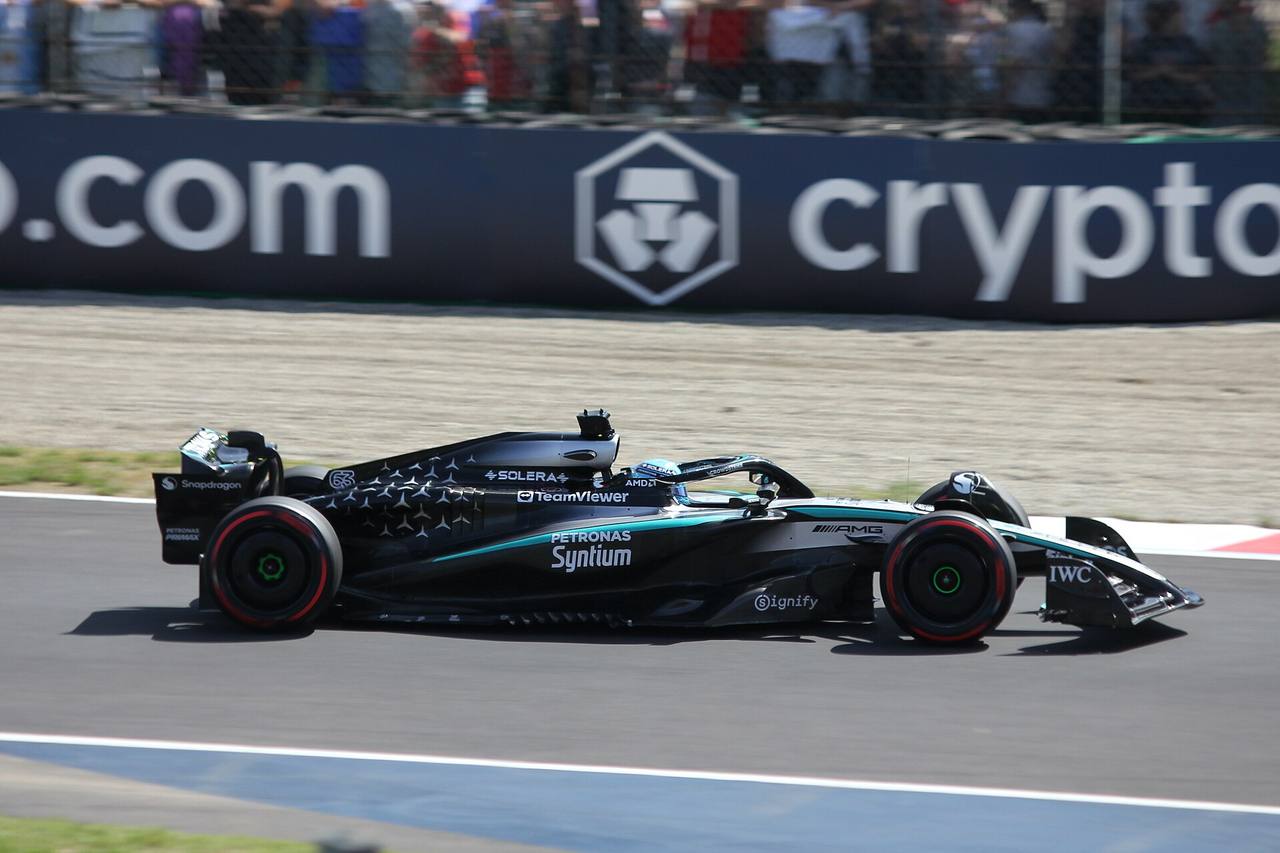
Russell wins Azerbaijan Grand Prix by 0.196 seconds. That slender advantage over Max Verstappen decided a race that had repeatedly seemed under George Russell's control, until two safety cars compressed the field and a last-lap accident left his Mercedes short of power. Russell still reached the line first at the Baku City Circuit on Saturday, September 26, completing 51 laps in 1:38:02.143 for his third victory of the 2026 Formula 1 season.
The result was much larger than its margin. Russell converted pole into his first win since June's Austrian Grand Prix, having also taken the season opener in Australia. He cut Mercedes teammate Kimi Antonelli's championship advantage from 81 points to 66, turning a commanding lead into a contest with pressure attached. Verstappen, starting eighth after a difficult qualifying session, climbed to second but remains without a victory in 2026 — his first winless season to this point since his 2015 rookie campaign.
Isack Hadjar finished third, 10.704 seconds behind, to give Red Bull both cars on the podium. Charles Leclerc was fourth for Ferrari at 14.136 seconds, Antonelli recovered from 16th on the grid to finish fifth at 14.512, and Lewis Hamilton completed the top six for Ferrari at 22.382. The bare finishing order says Russell controlled the afternoon. The final straight showed just how close he came to losing it.
Why this matters
Russell's win makes the championship run-in a live contest rather than a procession. A 66-point deficit remains substantial, and Antonelli's fifth place after hitting the wall at Turn One in Friday qualifying was an important act of damage limitation. But the direction of travel changed in Baku. Fifteen points disappeared from the lead in one race, while Russell delivered what amounted to a perfect weekend: a dominant pole, command of the race and composure when the field was twice reset behind the safety car.
The most significant pressure is now inside Mercedes. Antonelli, 20, has been the season's benchmark and, as Russell put it, “pretty flawless throughout.” Yet Russell's warning was clear: “Now we're getting to crunch time.” A title fight between teammates forces a team to manage strategy, upgrades and risk with exceptional care. Every pit call becomes a competitive decision as well as a sporting one; every mechanical issue can alter the balance between two drivers using essentially the same equipment.
Red Bull also left Baku with a complicated result. Verstappen's eighth-to-second charge and Hadjar's podium made it a double top-three finish, evidence that the car had serious race pace even after Verstappen's qualifying problems. But the four-time champion's winless season continues. He has not gone through a campaign without winning since 2015, the year he entered Formula 1. Baku therefore offered both encouragement and a sharper measure of what remains missing.
Then there is the margin itself. VAVEL reported that 0.196 seconds was the closest Formula 1 finish since the 2002 United States Grand Prix at Indianapolis, when Rubens Barrichello beat Michael Schumacher by 0.011 seconds. That comparison is not an official Formula 1 statistic, but it places the finish in useful historical context. After 306.049 kilometres of racing, the difference was less than the time needed to blink.
The Azerbaijan Grand Prix 2026 results also supplied a vivid example of how the current regulations can multiply uncertainty. Russell's early advantage was repeatedly erased, Verstappen could turn an eighth-place start into a final-lap attack, and six cars failed to finish. Baku's walls and long straights have always punished mistakes, but this race combined that familiar volatility with cars close enough in performance for one interruption to reorder the strategic picture.
How Baku unfolded
Russell began the weekend by establishing the reference point. His pole lap of 1:42.526 put him 0.837 seconds clear of Leclerc, a gap described in qualifying coverage as the largest of Russell's career. On a circuit where confidence under braking is decisive, that margin suggested the Mercedes driver had pace in reserve. He carried it into Saturday, made a clean start and led the race from the opening lap.
The first phase rewarded control rather than spectacle. Russell built a comfortable advantage while the field sorted itself behind him. Verstappen, only eighth after a difficult Q3, began the long recovery through traffic. Antonelli was conducting a different rescue. His Friday crash at Turn One had left him 16th on the grid, so every place gained reduced the championship damage caused by Russell running at the front.
The race changed on lap 29 when Alex Albon crashed heavily, prompting the first safety car. Russell's accumulated cushion vanished, and the restart placed rivals close enough to attack without having had to match his pace over the preceding stint. He managed that reset, but the field did not stay green for long.
A second safety car followed after Franco Colapinto locked up at Turn One and collided with Alpine teammate Pierre Gasly and McLaren's Lando Norris. All three retired, turning one braking error into a three-car elimination and wrecking Norris's afternoon. The incident also compounded a disastrous result for Alpine: both cars were removed in the same corner. Formula1.com counted six retirements overall; Fernando Alonso had gone out on lap 22 and Lance Stroll on lap nine, while the final retirement came later.
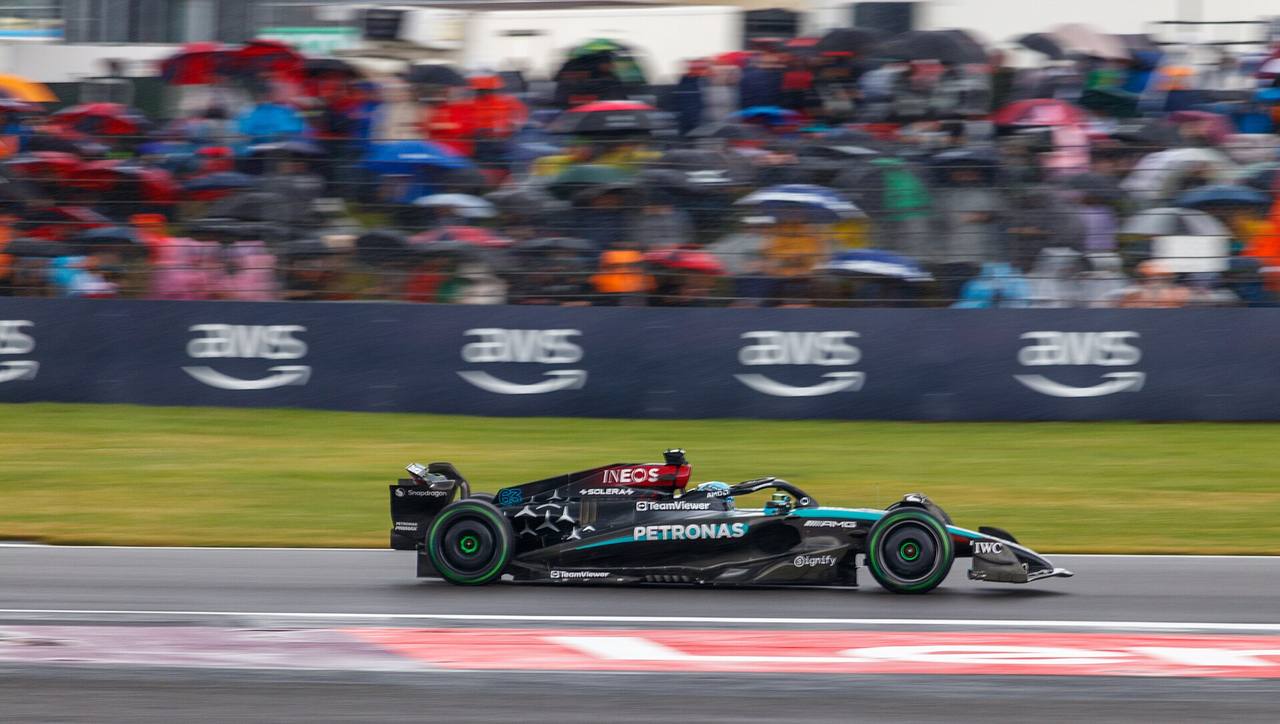
Each neutralisation helped Verstappen. With the gaps compressed, he moved into second and arrived within striking distance for the closing laps. Yet Russell kept enough control to prevent a clean passing attempt until the last complication: Cadillac's Valtteri Bottas crashed on the final lap, slowing the leaders and disrupting the run to the finish.
Russell then lost boost and power as Verstappen accelerated toward him on the straight. “I lost the boost, I had no power. Thought he was going to get us,” Russell said afterward. The Mercedes reached the line 0.196 seconds ahead. What had started as a demonstration of qualifying and race pace ended as a drag race in which almost none of the original advantage remained.
The Saturday schedule was itself unusual. Baku held practice on Thursday and qualifying on Friday because Sunday, September 27, is Azerbaijan's national memorial day. The change concentrated the event into a different rhythm for drivers and teams, but the 6.003-kilometre circuit and its 51-lap distance were unchanged. Russell handled both the altered timetable and the race's multiple interruptions without surrendering the lead.
The numbers that tell the story
0.196 seconds: Russell's winning margin over Verstappen after 51 laps. It was close enough that a slightly earlier loss of boost, a cleaner exit for the Red Bull or a few metres more straight might have changed the winner.
0.837 seconds: Russell's advantage over Leclerc in qualifying. That was the foundation of the victory. Pole kept him clear of the first-lap traffic and allowed him to dictate the opening stint instead of spending it attacking or defending.
1:38:02.143: Russell's official race time across 306.049 kilometres. The tiny final margin represented roughly two-thousandths of one percent of that total duration — a reminder that a race can be controlled for more than 98 minutes and still be decided in its final fraction.
66 points, down from 81: Antonelli's championship lead over Russell. The gap is still the equivalent of more than two race victories under the standard points system, but Baku demonstrated how quickly it can contract when one Mercedes wins and the other has to recover from the back half of the grid.
Eight to second; 16th to fifth: Verstappen and Antonelli each gained six and 11 positions respectively. Those recovery drives kept them among the day's winners even without the trophy. In a championship, limiting the loss from poor qualifying can matter almost as much as converting pole.
Six retirements and two safety cars: the measure of Baku's attrition. It also explains why the final classification cannot be read as a simple pace ranking. Surviving restarts, debris and compressed gaps was part of the competitive task.
Winners and losers
Winner: George Russell
Russell delivered at every stage: the biggest qualifying margin of his career, a clean start, control through two restarts and enough composure to survive a power problem at the finish. The win does more than add a trophy. It supplies proof that he can turn peak speed into points while a title is still mathematically and psychologically in play.
Winner, with unfinished business: Max Verstappen
Moving from eighth to second on a street circuit was a statement drive, and the double Red Bull podium suggests the team's race package had strength that qualifying concealed. Yet Verstappen left only 0.196 seconds from ending a drought that now defines his season. A near-win can point toward recovery, but it does not erase the first winless campaign since his rookie year.
Winner: Isack Hadjar and Red Bull
Hadjar's third place at 10.704 seconds gave Red Bull a balanced result rather than a one-car rescue. For a team assessing whether Baku marked a genuine upswing, getting both drivers onto the podium is stronger evidence than Verstappen's late charge alone.
Winner: Kimi Antonelli's damage limitation
Antonelli's weekend began with the Turn One wall and a 16th-place start. Fifth was not enough to prevent his lead shrinking, but recovering 11 places kept a difficult weekend from becoming a collapse. Championship leaders do not need to win every disrupted race; they need to keep scoring when the weekend turns against them.
Loser: Lando Norris
Norris became collateral damage in the second safety-car incident. Colapinto's lock-up gathered Gasly and the McLaren into a crash none could reverse. On a day when opportunities appeared through attrition and restarts, Norris instead left with his race ended at Turn One.
Loser: Alpine
Losing both cars in one corner was the sharpest team-level setback of the race. Whatever pace or strategy Alpine had built disappeared in a single incident between its own drivers that also eliminated a rival. It is the kind of result that demands more than a routine review because the sporting loss was multiplied by avoidable intra-team contact.
What comes next
The F1 championship standings for 2026 now frame the closing rounds around a 66-point gap. Russell cannot close it through isolated brilliance; he needs a sequence of weekends in which qualifying control becomes victories while Antonelli gives away points. Baku showed that possibility without making it probable. The decisive question is whether Russell can reproduce this “crunch time” form before the calendar runs out.
Mercedes must also keep its intra-team contest from becoming self-defeating. When both drivers are title contenders, aggressive strategy can create the points swing one driver needs but expose the other to rivals. Antonelli's season has earned him the lead; Russell's Baku weekend earned him the right to apply pressure. The team's challenge is to let both compete without allowing a private contest to weaken Mercedes against Red Bull and Ferrari.
For Red Bull, the next race will test whether Baku was a revival or a circuit-specific result. Verstappen's recovery and Hadjar's podium say the car could race. Russell's 0.837-second qualifying margin says it was still badly beaten over one lap. Closing that Saturday deficit would give Verstappen a realistic route to ending the winless run instead of relying on safety cars and late-race disruption.
The unusual Saturday race will also be remembered as more than a scheduling footnote. Formula 1 adapted its timetable around Azerbaijan's September 27 memorial day without diminishing the event. That does not mean Saturday grands prix will become routine, but Baku showed the championship can alter its weekly cadence while preserving the competitive and public weight of race day.
Most of all, the run-in has a new image: Russell powerless on the final straight, Verstappen closing, and the timing line arriving 0.196 seconds before the order could reverse. Antonelli still owns the advantage. Russell now owns the momentum. Baku made both facts matter at once.
- Reuters: Russell wins in Baku and cuts Antonelli's title lead
- AP via Sportsnet: Russell holds off Verstappen in Azerbaijan
- Formula1.com: race report and full finishing order
- Athlon Sports: full results and Baku takeaways
- race-trace: 51-lap race chronology and 0.196-second finish
- Vivasport: Russell's dominant qualifying performance
- VAVEL: closest-finish comparison with the 2002 United States Grand Prix