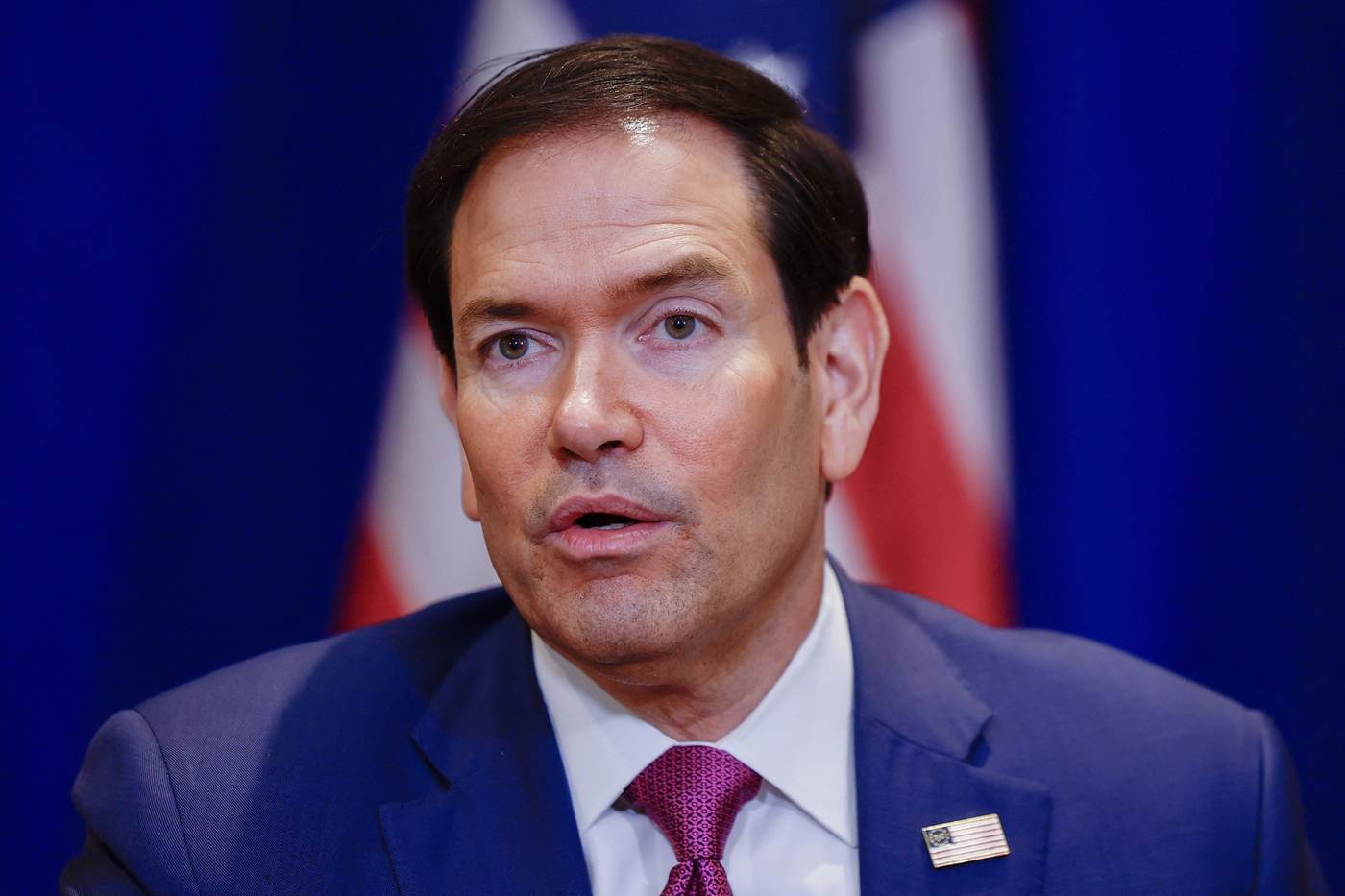
Secretary of State Marco Rubio publicly accused Ukraine on Tuesday of repeatedly striking ships and oil supplies with American connections, creating a new point of friction between Washington and Kyiv as the Trump administration tries to negotiate a pause in attacks on energy infrastructure. Rubio said the strikes were probably unintentional, but his decision to raise them on television hours before President Donald Trump met Ukrainian President Volodymyr Zelenskyy at the United Nations gave the complaint diplomatic weight.
“The one thing we are concerned about, however, is that over the last few months, on a number of occasions, American-linked ships, American oil supplies have been targeted, probably not deliberately, but targeted nonetheless by Ukraine,” Rubio said on Fox & Friends on Tuesday morning. “And so that’s something that needs to be addressed.” He added: “We can’t have that happening.”
The claim is significant because it moves Washington’s concern beyond the indirect effects of Ukrainian attacks on Russian refining. It suggests the administration believes U.S. commercial interests have been touched directly or placed at unacceptable risk. Yet Rubio did not name a ship, date, strike location or company, and he did not define “American-linked.” ABC News reported that Ukrainian officials did not immediately respond to its request for comment.
From refinery pressure to a shipping dispute
The most likely context is the Black Sea port of Novorossiysk and the Caspian Pipeline Consortium, or CPC, which carries crude from Kazakhstan through Russia to export terminals. Chevron and ExxonMobil are shareholders in the network or major Kazakh projects connected to it. Those corporate links could make a vessel “American-linked” even if it were not U.S.-flagged, U.S.-owned or carrying American crude. That is an analytical inference from the infrastructure involved, not a definition supplied by Rubio.
The dispute has been building for months. The Wall Street Journal reported in July that the Trump administration privately warned Ukraine against attacks on non-Russian Black Sea vessels after four tankers were hit near Novorossiysk, including one chartered by Chevron. The Journal said the warning reflected concern over Kazakh exports and a pipeline that carries about 2% of daily global oil supplies. Ukraine and the United States later confirmed the warning, according to subsequent reporting.
In August, the Financial Times reported that Vice President JD Vance personally asked Zelenskyy to stop strikes on tankers using Novorossiysk. Reuters’ account of that report said Kyiv agreed not to target CPC infrastructure or non-Russian ships unless they were sanctioned by Ukraine or carrying Russian oil or other Russian cargo. Reuters could not independently verify the report at the time. It also reported that the July attacks had reduced CPC loadings by as much as one-fifth and that Kazakhstan’s oil production fell 14% from June to July.
That history narrows the possibilities behind Rubio’s remarks, but it does not establish which incidents he meant. A tanker can be linked to the United States through ownership, chartering, cargo, insurance, financing or a shareholder in the terminal serving it. Without names, Washington’s allegation cannot be checked vessel by vessel, and Kyiv cannot publicly answer a defined charge.
Rubio backs a reciprocal energy ceasefire
Rubio paired the criticism with support for a limited ceasefire. He called a halt to attacks on energy infrastructure a “great idea” and an “ideal outcome,” describing an arrangement in which Ukraine’s infrastructure and Russian energy supplies would both be spared. But he also stressed the central obstacle: “it takes two sides to agree to that.”
That qualification matters. A unilateral Ukrainian halt would protect Russian refineries while leaving Ukraine’s power stations, substations and other infrastructure exposed if Moscow did not reciprocate. Zelenskyy said Monday that Russian attacks on Ukraine’s energy sector, critical infrastructure and Black Sea food exports must stop and that this would produce matching Ukrainian de-escalation. Russia had not publicly accepted that reciprocal formula before Tuesday’s meeting.
After a 40-minute meeting with Trump, Reuters reported that Zelenskyy said Kyiv was ready for any format of an energy ceasefire. He also said a unilateral suspension of Ukrainian attacks on Russian refineries was not discussed. Zelenskyy repeated that he was prepared to meet Russian President Vladimir Putin in a trilateral meeting with Trump and hoped Washington could bring Moscow into negotiations.
The diplomatic sequence continues Wednesday, when Rubio is due to meet Russian Foreign Minister Sergei Lavrov in New York. That meeting gives Washington a chance to test whether Moscow will accept the same reciprocal limits it is asking Kyiv to consider. If the terms presented to each side differ, the proposal risks becoming pressure on Ukraine rather than a ceasefire framework.
Why oil and diesel prices are shaping diplomacy
Rubio said most of the recent rise in oil prices came from the Russia–Ukraine war, while Houthi activity in and around the Red Sea also contributed. That is the administration’s attribution, not a settled decomposition of the price move. Oil and refined-fuel prices respond to several overlapping forces, including Middle East supply disruptions, refinery outages, shipping risk, inventories, sanctions and seasonal demand.
The political pressure is measurable. AAA figures reported Monday put the national diesel average at a record $6.51 a gallon, up from $6.23 one week earlier. Regular gasoline averaged $4.48, up from $4.31. In absolute terms, diesel rose 28 cents and gasoline 17 cents in seven days; that is about 4.5% for diesel and 3.9% for gasoline. The larger diesel move matters because diesel prices feed into trucking, agriculture, construction, home heating and delivery costs, spreading beyond motorists who buy the fuel directly.
Ukraine’s campaign has clearly reduced Russian refining capacity. According to International Energy Agency figures cited by The Times, Russian diesel production was down about 30% year over year and petrol output about 20%. A Russian refinery was hit on average once every three days from January through August, and refining fell to its lowest output in more than 20 years. Some facilities closer to Ukraine were attacked more than a dozen times.
Those figures show scale and sustained pressure, but they do not prove that Ukrainian strikes explain most of the increase at U.S. pumps. The IEA data concern Russian production; the U.S. retail price combines global supply conditions with domestic refining, distribution, inventories and taxes. The responsible conclusion is narrower: damage to a major exporting country’s refineries tightened an already stressed product market and likely amplified price pressure.
Why this matters for the alliance
Publicly, Washington still supports negotiations intended to end the war and Kyiv still depends on U.S. diplomatic, military and intelligence backing. Rubio’s words nevertheless expose a difference in priorities. Ukraine views long-range strikes as a way to weaken Russia’s war economy and create leverage it cannot obtain through territorial advances alone. The Trump administration is increasingly focused on the global cost of those strikes, the exposure of U.S.-linked companies and the domestic political consequences of fuel inflation.
That does not make the interests irreconcilable. A verified reciprocal pause could protect Ukraine’s grid before winter while easing pressure on Russian refined-product exports. It could also create a limited test of compliance before negotiations on a broader ceasefire. The problem is sequencing: Kyiv has little incentive to surrender a working pressure tool first, while Moscow may demand protection for refineries without accepting equivalent restrictions on the Ukrainian power system.
Critics of Washington’s approach argue that asking Ukraine to shield Russian refining rewards Moscow and reduces Kyiv’s leverage before Russia has agreed to stop its own attacks. Supporters argue that damage to internationally connected oil flows raises prices for allies, harms American companies and risks turning neutral or partner shipping into collateral. Both arguments depend on details that remain missing: which assets are covered, when a pause begins, how violations are investigated and whether an accidental strike triggers retaliation.
Who gains, who loses
Russia would be the clearest immediate beneficiary of a halt to refinery attacks, gaining time to repair plants and stabilize fuel output. Ukraine could benefit if the same deal protects its electricity system and Black Sea exports, particularly before winter, but it would give up a campaign that has imposed visible costs on Russia. U.S. oil companies and Kazakhstan would gain from safer CPC operations, while consumers and freight-dependent businesses could benefit if the agreement lowered the market’s risk premium.
The political distribution is equally important. Lower fuel prices would help the White House and Republican candidates heading into the November midterms. Continued increases would raise transport and food costs and give opponents a direct household-economy argument. Rubio’s emphasis therefore connects battlefield targeting to an election-year economic concern, even though no single conflict or strike campaign fully determines the pump price.
What happens next
Three scenarios now stand out. In the first, Rubio and Lavrov agree on the outline of a reciprocal energy ceasefire and Washington brings Kyiv and Moscow into a defined mechanism. In the second, Russia rejects equivalent limits, leaving Ukraine unwilling to halt strikes and the conflict’s energy front unchanged. In the third, the parties announce a narrow pause without shared definitions or monitoring, producing repeated disputes over whether ships, terminals, grids and dual-use facilities fall inside it.
The indicators to watch are concrete: whether Washington identifies the “American-linked” ships; whether Kyiv offers a public response; whether Moscow accepts reciprocal protection for Ukrainian energy sites; whether CPC traffic stabilizes; and whether diesel and gasoline prices ease after any agreement. Rubio’s allegation has made the commercial boundary of the war part of the diplomatic agenda. The next test is whether the administration supplies enough evidence and sufficiently even terms to turn that complaint into a workable de-escalation plan rather than a deeper alliance dispute.
Sources and reporting notes
- ABC News, via KVNU, September 22, 2026: Rubio’s remarks, unidentified incidents, U.S.-linked infrastructure context and Ukraine comment request
- Washington Examiner, September 22, 2026: full “We can’t have that happening” remark and July warning context
- The Thinking Conservative, September 22, 2026: Fox interview, reciprocal ceasefire language and Rubio’s oil-price attribution
- The Wall Street Journal, July 2026: U.S. warning over non-Russian vessels, Chevron and CPC exposure
- Reuters, August 12, 2026: Financial Times report on Vance’s request and the pause in tanker strikes
- Reuters, September 22, 2026: Zelenskyy’s reciprocal offer, UN meeting context and Rubio–Lavrov schedule
- Reuters, September 22, 2026: Zelenskyy’s post-meeting account and readiness for an energy-ceasefire format
- The Times, September 22, 2026: IEA refining figures and Trump–Zelenskyy pressure over diesel
- Daily Caller News Foundation, September 21, 2026: AAA national diesel and gasoline averages and freight context
Reporting cutoff: September 22, 2026, after the Trump–Zelenskyy meeting. Rubio did not identify the incidents behind his allegation or define “American-linked.” Price-causation claims are attributed; calculations of weekly percentage increases are Signal Post News analysis based on the cited AAA figures.